|
Selected Correspondence Vineeto Beauty RESPONDENT: It has been a foggy day here in NY/NJ. As I drove through the woody areas, my windshield decorated with random droplets of mist, I was happy to be where I was and doing the driving. Mysterious misty mountains and low, cloudy skies were touching my car. It was very intimate and peaceful. VINEETO: This is a delightful description. Did you happen to notice if there were any feelings or emotions while you were experiencing this intimate and peaceful surrounding, any feelings of beauty, gratefulness, awe or fuzzy feelings of belonging? It would be interesting to examine such experiences carefully to distinguish between a peak experience or PCE and an experience of beauty and ‘good’ feelings – that is, if you want to know the difference for yourself. Here on the East Coast of Australia we are now having delightful autumn days, the rainy
season is finishing, leaving the landscape lush and green with shiny leaves, glittering now in the softer sun of the late evening.
There is a certain time of the day, when one suddenly notices that the light has changed, the shadows deepen, the colours have
more depth as well, the light on the leaves has a golden glow – and the birds start singing again after a few hours of rest
during the day. Then the Eastern horizon turns into that delicious combination of pink and deep blue stripes while on the Western
side the sun sets in peach, light blue, purple and orange. It is a particular delicious spectrum of colours – and all with the
background of twittering, chirping birds, sounds of cars driving along and the clicking of two keyboards...
RESPONDENT: But I believe that the remaining human instincts as basic as the ‘will to live’, or less basic such as to be creative, to make one’s surroundings beautiful continue to operate in the background of one’s psyche even in the state of apperception. The difference lies probably in that the focus of the psyche on ‘how I want it to be’ is relaxed or gone as one is enjoying this moment of the life. VINEETO: Apperception, by definition, is a state when there is no self in operation, which means no social identity and no instinctual passions. From the glossary –
As for ‘to be creative, to make one’s surroundings beautiful’ – The incentive to make my surrounding pleasing to the eye is simply common sense and delight in operation, whereby what is pleasing to the eye is different for everyone. Creativity is simply an expression of being alive as a sensate and reflective human being – it’s a pleasure to play with all that’s available, to arrange things according to my taste and liking, to produce something according to my expertise, be it for money or for mere fun. When I play on our website for hours and hours, it is not because what I am doing has some innate meaning or importance – maybe nobody will ever read it. Arranging and re-arranging, copying and pasting, sorting and collecting, scheming and categorizing is simply my way of appreciating what others and I have written about Actual Freedom to date. And it may be useful to somebody else to make sense of life, the universe and what it is to be a human being. Creativity, as it is usually understood and applied, is inextricably intertwined with the creative person’s identity, an expression of his or her ‘real me’, one’s innermost being or ‘true self’ and, as such, it only reinforces the shackles of one’s identity. Beauty is the feeling perception of what the ‘self’ loves and creativity is the process of expressing that feeling of beauty or whatever other feeling the creative person wants to express. Now, that my ‘self’ has lost the grip over me most of the time, I am simply doing what is happening and enjoy what I am doing. That doing may be working for people, sorting their financial affairs, writing letters, thinking something through, watching TV, redressing web-pages, cooking a meal, washing dishes, having lunch in town or lying on the couch. Having eliminated the basic resentment of ‘having to be here’, I now find that whatever I do is the delightful expression of being alive. Creativity or doing nothing is now all part of the same delight – being the universe’s experience of itself as a sensate and reflective human being. * RESPONDENT: Is it easy for you to differentiate between the feeling of love and dependency and the sensation of fulfillment, freedom and happiness that comes when two people share intimacy? VINEETO: I like your question. For an actualist, to investigate the good emotions of love, beauty and compassion is as essential as examining the bad emotions of anger, fear, resentment and depression. In order to investigate the feeling of love and all its accompanying emotions, I had to sharpen my awareness and become persistently alert to detect when love was kicking in. Love is, after all, the most honoured and appreciated of all human emotions, and one is very easily tempted to brush over the nice sweet feeling when it happens. Investigating and dismantling the good feelings is a real detective adventure game, because, as you mentioned to No 8,
Our identity thrives on feelings, it cannot exist without feelings and emotions – therefore detecting the emotion ‘plastered on any simple sensation’ is to separate out and successively eliminate your very identity – ‘who’ you think and feel yourself to be. In the beginning, my guiding light was the memory of the pure consciousness experience when there was clearly no emotion happening, as well as the first brief moments of actual intimacy with Peter that occasionally occurred. In hindsight I can describe love as a bundle of various emotions that arose –
All in all, love produces almost visible psychic tentacles that engulf the other and make him or her a commodity of one’s own desire. After all, love is the expression of the instinctual passions of nurture and desire, packaged nicely into a possessive and exclusive concern for, and focus on, the other. What is usually considered ‘intimacy’ is most often the first honeymoon stage of love. ‘I’ love the other because he/she makes me happy, because ‘I’ feel less lost, lonely and frightened in his/her presence. ‘I’ care for him/her because he/she is the centre and hero / heroine of my dream and the moment ‘my’ hopes, needs, dreams and expectation are not fulfilled, love turns into disappointment, resentment, retreat or even hate. You see, when one honestly investigates the so-called altruistic feelings of love, there is nothing altruistic about it. Love is utterly selfish and self-centred. Love prevents me from appreciating and meeting the other as a fellow human being because every feeling towards the other, positive or negative, makes me unable to perceive the other as an autonomous human being. Being in love, I create an all-pervasive affective image of the other, consisting of my hopes, needs, fears, dreams and expectations. Only by being an autonomous human being myself can I experience an actual intimacy with my fellow human beings. This is how I described my first experience of actual intimacy –
You might also want to check out
RESPONDENT: It’s starting to dawn on me how radical a proposition AF is making. I’ve been generally trying to view everything that happens in the context of AF, and how it would all change if these principles were commonplace. We would be without wars. We would also be without most competitive sports, ... VINEETO: Yes, I can certainly think of more fun-things to do than training for the Olympics. RESPONDENT: ... most of the great art works, ... VINEETO: Why shouldn’t we have works of art in a world free from instinctual passions? People certainly would have more time at their hand to play when they are not driven by fear, aggression and greed, and one’s favourite pastime could very well be an artistic one. If you take away the social and affective values of beauty and fashion, then playing with the materials of the earth can be very sensuous and pleasing indeed. RESPONDENT: ... maybe most of the buildings. VINEETO: Why should buildings disappear? I certainly prefer to live in a modern comfortable building compared to a cave or straw hut. When the affective faculty disappears, people will be free to build what is sensible, comfortable, practical and sensuously pleasing. But there would certainly be no need for police stations, law courts, jails, army bases, martial art dojos and the like, nor would there be need for churches, cathedrals, temples, monasteries, ashrams or the like. RESPONDENT: I’m being a bit extreme here perhaps, but most of the progress of human civilization (term is used loosely, ok?) has been driven by that amygdalic reaction. This is a big change. VINEETO: No, ‘the progress of human civilization’ has been engineered
by human inventiveness, ingenuity, intelligence and the inbuilt drive for betterment but has been continuously hampered by fear,
righteousness, religious superstition, greed and corruption. It is, in fact, astounding what excellence in technology, safety,
leisure and pleasure has been achieved despite ‘that amygdalic reaction’. * RESPONDENT: Hi Vineeto... back from my vacation in the US Pacific NW (avoiding ‘certain’ parts of Oregon), enjoying myself too thoroughly. Now back to work... VINEETO: Good to hear that you had an enjoyable holiday. Funny that you should say you were ‘avoiding ‘certain’ parts of Oregon’ – these ‘certain’ parts of Oregon are the only landscape of the US I have ever seen in person apart from the bus ride to and from Portland airport. <snip> RESPONDENT: It’s too bad you didn’t experience more of the region... it is truly beautiful geography. Amazing that you were insulated from the majesty of nature en route to such an ‘important’ place. The forests/mountains/water make a far grander ‘church’ than any guru’s ashram. I found I was quite drawn to the environment of the NW, and shortly after I returned I was approached about an interesting job opportunity in the area. Clearly divine forces at work, huh? ;-) So, a move may be in the offing. VINEETO: Oh, on my journeys to the Oregon Ranch – four altogether – I was entirely focussed on seeing Rajneesh and our new commune. In my years of spiritual search I was geared to finding the ‘inner beauty’ that was represented by Rajneesh and ‘his people’, nothing ‘outer’ mattered much to me. My disregard for the magnificence around me is yet another proof of how much spiritual belief and religious devotion were clouding, distorting and restricting my perception and making me oblivious to the splendour of the actual physical universe. Many spiritualists claim to see and experience this magnificence and splendour but what
they feel is beauty, which means they also see and experience ugliness. As such, they can only sustain the feeling of beauty by
denying or turning away from their feeling of ugliness. This is also evident in the religion of animism that underpins much of
Environmental belief – whilst they see beauty and goodness in Mother Nature they also see ugliness and evil in materialism and
technological progress.
RESPONDENT: I’m not having PCEs but I am having direct experiences. I will write when I have more to say. That’s all for now. VINEETO: As I said above, in order to understand what Actual Freedom is about it is essential to remember a pure consciousness experience. It is vital to investigate precisely those ‘direct experiences’, and determine when and where and how the experience is being polluted by the ‘self’, by the feeling and spirit-ual interpretation of the actual sensate, sensuous experience. It is a fascinating adventure to explore one’s sensate experiences with the magnifying glass of attentiveness and heightened awareness and to discover the ingredients that invariably occur to stop or prevent one’s direct experience of the actual world. Particularly in the beginning I would often be thrown into a turmoil of fears and ‘bad’ feelings when trying to remove the ‘good’ feelings of love, beauty, spiritual meaningfulness or virtue from a sensate experience. Suddenly all hell broke lose, the ‘bad’ feelings of loneliness, starkness, dread or vice would come to the surface. Moral and ethical values would appear as noisy and frightening doubts in my head calling me traitor, whore, evil, animal. But remember, those feelings – as scary as they may look at first – are nothing but the flipside of the coin called morality and can confidently be dismissed along with all the good feelings. The ‘good’ and the ‘bad’ feelings are the rose-coloured and grey-coloured glasses one has to remove from one’s eyes in order to experience the actual world as magnificent as it is. What is left is pure delight. * RESPONDENT: My previous teachings to me are about the actual. For example, a key ingredient of my previous teachings is about having a direct experience of the actual which I feel is necessary to having a PCE. VINEETO: I am stunned that you can call Mr. Jiddu Krishnamurti’s teaching being ‘about the actual’. If you had followed a bit of Richard’s extensive correspondence with many, many people on this very same teacher’s mailing list, you would at least have noted that Mr. Jiddu Krishnamurti’s concern is the transcendental and nothing but the transcendental. Vis:
In order to be able to say that Mr. Krishnamurti’s teachings to you are ‘about the actual’ you have to either ignore 90% of Krishnamurti’s teachings or twist the meaning of the word ‘actual’ into meaning spiritual and transcendental. ‘The key ingredient of [your] previous teachings is about having a direct experience’ of the divine, not the actual. Vis:
I have no problem with whatever name you might give to your goal and your experiences but denial and transcendence are sure methods of avoiding a Pure Consciousness Experience. For comparison I copied a description of a direct experiencing of the actual.
And just a little bit further in the correspondence files I found a perfect example to demonstrate actuality:
RESPONDENT: My previous teachings to me are about the actual. For example, a key ingredient of my previous teachings is about having a direct experience of the actual which I feel is necessary to having a PCE. VINEETO: If Krishnamurti’s method and other methods of ‘self-discovery’ or ‘self-knowledge’ were able to produce a PCE, it would have happened by now, don’t you think? I acknowledge that to grasp even a glimpse of the actual world is very difficult because normal reality is all we know and spiritual reality is all we imagine. For that very reason it is so vital to remember or to experience a pure consciousness experience. However, changing a few words, applying your previous spiritual methods and denying even being spiritual at all is a sure recipe of cutting yourself off from ever experiencing anything outside of the Human Condition. RESPONDENT: Direct experience of the actual would be being with this monitor without having other thoughts about the past, etc. I’m not into any new age teachings. I clearly see the difference between sensual feelings and affective feelings. VINEETO: As you might have gleaned from Richard’s description, your ‘direct
experience of the actual’ and Richard’s direct experience of the actual are two different pairs of shoes. The choice is
always yours. * VINEETO: In order to be able to say that Mr. Krishnamurti’s teachings to you are ‘about the actual’ you have to either ignore 90% of Krishnamurti’s teachings or twist the meaning of the word ‘actual’ into meaning spiritual and transcendental. ‘The key ingredient of [your] previous teachings is about having a direct experience’ of the divine, not the actual. Vis:
RESPONDENT: I was talking about the teachings themselves such as being aware of what I am actually doing, thinking and feeling from moment to moment and you have added a quote from his early years and what he may or may not have meant by truth at that period of his life. VINEETO: I find it interesting that you should object to the relevance of the above quote from J. Krishnamurti by saying that it was ‘from his early years’. This is one of the several stock standard responses that were used by several faithful followers of Krishnamurti when Richard introduced quotes on Mailing List B to prove a point he was making. Only in September last year Richard had a lengthy discussion with one correspondent about that very same argument ... ‘from his early years’ . You were also writing on the list at the same time but maybe you missed the exchange. I have copied the relevant correspondence at the end of this letter. I had posted this particular quote because I know from my thorough investigation into my years of spiritual dependency that you cannot separate the teachings from the teacher and just pick out a some advice that seem worth applying in your life and ignore the rest. The above quote shows clearly, as do many others from his later years, that J. Krishnamurti was a through and through spiritual person – ‘God-intoxicated’ – and his declared purpose was to teach people how to achieve this experience for themselves. Vis.:
Therefore, following his method can, at the most, lead you to what he achieved –
becoming yet another spiritual teacher immersed in ‘that which is eternal’ – and not knowing anything about a
‘direct experience with the actual’.
RESPONDENT: Whilst I have no memory of a PCE, I do remember that I used to sit outside my parents’ house and contemplate the beauty around me until I one day came to a point where there was, for a split second, no ‘me’ there. Unfortunately the feeling function kicked in suddenly I felt the ‘tremendous love’ for the universe and ‘God’. This unfortunate incident led me down the path of the spiritual seeker who is trying to attempt to ‘make sense of it all’. VINEETO: I know from my own experience how tempting this grand feeling of ‘tremendous love’ for all is. I am glad that Richard had warned us not to ground on the ‘Rock of Enlightenment’, so I did not have to get lost into that passionate fantasy for too long. But it is good that I had the experience of that tremendous love so clearly because I know now from my own experience, where not to go. It only leads to power, sorrow for all and the whole enlightenment-saga. That ‘split second’ of your experience is, as Alan points out, a fascinating bit, a
split second of a PCE. When such a moment comes around the corner next time, you could stay with the physical – with the actual
– with the senses. Then feelings of love and beauty have less chance to overtake the pure consciousness experience.
RESPONDENT: Vineeto, I would like to know something more about the happiness, benevolence and magnificence of the actual world. I can understand that it would be harmless because without ‘I’ there would be no malice. But wherefrom the happiness comes? Is it just the absence of sorrow? VINEETO: I had some lengthy correspondence on Once you see the actual physical universe without the grey glasses of malice and sorrow and without the rose-coloured glasses of love and compassion, the magnificence becomes apparent. Take a sunset. Someone in love will see the beauty of the particular scene and be full of gratitude, love and awe. Someone who just split up with his girlfriend will see the sorrow, the transitory nature of all things, the ending of a day, a life, a period. Someone about to go to war will see the power and beauty of his God, pray for protection and feel supported in his passionate mission by the display of the glorious colours. An actualist might see this immense fireball of helium in the sky, giving warmth and light and life to its orbiting planet called earth, all seen through the layer of atmosphere, giving it the wonderful display of ever-changing colours, different each day. To lay any feelings or imagination or even a creator-God over this magnificent event is to miss the actual experience of it. To experience the world around me without the distorting filter of self-centred emotions, feelings and instincts enables me to perceive and appreciate this infinite magnificence, this purity and perfection and this magical actuality of each moment in paradise. RESPONDENT: Or is there anything positive about it? VINEETO: ‘Positive’ is too small a word, for it is only invented to counteract the original objection to being here. The Human Condition in each of us inevitably results in not wanting to be here but to be somewhere else, in imaginary heights or in a hope for a better future or life after death. When senses and awareness are freed from the shackles of emotions, feelings, beliefs and instincts one is – as Richard says – ‘the universe experiencing itself as a sensate and reflective human being’, nothing less. Then, one is as benevolent as the rest of the universe. I understand where your question may come from. The absence of sorrow, when one is empty of tears, can be experienced as a starkness, grey, empty and dull reality. Because this seems unbearable, one then cranks up some positive thoughts and feelings to ‘believe’ that life is not so terrible after all. This so-called happiness has nothing to do with the gay and abundant experience when there are no feelings and emotions. The wide and wondrous path to Actual Freedom is to investigate and remove whatever
feeling, emotion, belief or instinct surfaces until slowly, slowly the actual world becomes apparent – and its magnificent and
benevolent nature. And you are then the bit of the universe that says ‘WOW, isn’t the physical universe extraordinary and
amazing, wonder-full and perfect!’ * RESPONDENT: My logical thinking is that if I understood (intellectually) this thing before reading about actualism – it must be because of spiritualism, because that is what I was exposed to till that time. There could be one more reason, however. As Richard suggested, I looked into my Hindu belief of ‘all paths lead to the same goal’. It could be because of this belief, when I read about actualism, subconsciously, I kept on correcting my previous understandings and made myself to believe that, that is what I understood so far also. I am looking into it but some of the events/understandings I can clearly recollect happening much before. VINEETO: There is a much more simple explanation. Since actualism lies 180
degrees in the opposite direction to spiritual beliefs, you probably have not yet discovered what ‘actual’ is – facts
existing independent from one’s ideas, feelings, interpretations and hopes. It is a great moment when one for the first time
discovers a bit of the actual world. I can highly recommend concentrating on investigation of facts. One of the keywords is
‘independent’ from my own interpretation, feeling about it, imagining about it, philosophising about it. Just the simple fact
of a coffee-cup being a coffee-cup, a tree being a tree – not some life-producing oxygen-machine or item of beauty – simply a
tree, trunk and branches, birds and insects, smells and leaves rustling in the wind. It’s good to start with something so simple
as an everyday object and investigate how many ideas and feelings we are weaving around those objects. It’s good fun and it will
give you some experience about plain facts.
RESPONDENT:
VINEETO: There is another topic-page on I myself didn’t have a PCE until four month of intense investigations into actual freedom, but I had enough understanding that the old solutions didn’t work and I had the intent to investigate something new. However, to become actually free it is very helpful, and eventually vital, to remember
a PCE in order for you to have clear experiences of the freedom that you are aiming for. But don’t let the worry of not
remembering one right now spoil your enjoyment of the moment or diminish the intent of your investigation into your emotions and
beliefs. Sooner or later, if you are sincerely, honestly and persistently inquiring, a PCE will sneak up on you, possibly after
you have seen through a particularly ‘dense’ belief. When it happens, it is good to look out for the ‘good’ emotions of
gratefulness, bliss, love and beauty so they do not to take over, thus inviting the ‘self’ back in and destroying the purity
of the peak experience.
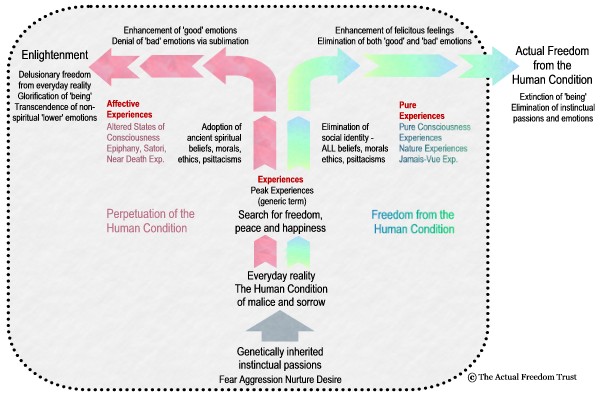
VINEETO to Alan: The green arrows: During Pure Consciousness Experiences one is taking short excursions into the actual world, for minutes or hours, experiencing life as a kind of holiday stripped of the restricting, burdening, agonizing selfish and self-centred worldview of everyday life. In the beginning those PCEs open one’s eyes to a world never experienced before, never considered possible. On the path to freedom those PCEs are vital, absolutely necessary to determine the direction, to kindle one’s naiveté, to tap into pure intent. The actual world is seen for what it is, and everything is self-evidently clear and obvious, and one recognizes that ‘what I am’ has always been here, I just never got a word in edgeways. Nevertheless, once the PCE is over and the ‘self’ takes control again, there is only a faint memory left. The world of ‘grey arrows’ and the world of ‘green arrows’ never meet. Given that during a PCE one is without beliefs, feelings and emotions, there is consequently no emotional memory to draw from when one comes back to the ‘real’ world, and the experience can vanish without a trace unless one is very aware. Likewise, back in the world of beliefs, feelings and emotions, the faint memory of the purity and perfection can only be vaguely remembered but not relived or imagined. That’s where naiveté and pure intent are absolutely essential if one wants to experience an actual freedom state for 24 hours a day. One other important point – spiritually inclined people, and that is almost everyone who is on a search for freedom, peace and happiness, usually confuse the ‘green arrows’ with some sort of spiritual higher ‘self’, Satori, god-experience, beauty, love, bliss or enlightenment. The ‘green arrows’ have clearly nothing to do with any emotion- or feeling-based experience, any Altered State of Consciousness or anything happening in the head or in the heart. ‘Green arrows’ is the sensate-only, sensuous and pure experience of the actual physical universe in its pure, magical, delightful and sparkling perfection. * The grey arrows: Due to the intrinsic quality genetically built into the physical fabric of the universe to be the best it can be, every human being has the potential to evoke naiveté and intent – the innate drive to look for a way out of the grim everyday experience of life. Given that Richard has discovered that one can totally eliminate one’s identity, conditioning and instinctual passions, and has also devised a practical and effective method to do so, it is now possible to use the experience of a PCE to reach to a permanent actual freedom from the Human Condition. Due to the intrinsic quality genetically built into the physical fabric of the universe to be the best it can be, every human being has the potential to evoke naiveté and intent – the innate drive to look for a way out of the grim everyday experience of life. Given that Richard has discovered that one can indeed eliminate one’s identity, conditioning and instinctual passions, and has also devised a method to delete one’s inherited genetic software package, so to speak, it is now possible to use the experience of a PCE to reach to an actual freedom from the Human Condition, permanently. It is no longer necessary to interpret one’s glimpses of the perfection and purity of the actual world as some kind of god-given grace, thus degrading and distorting the experience of pure magnificence into a feeling-based self-centred interpretation of beauty, love or ‘the divine’. Out of those moments of a pure consciousness experience to dare and acknowledge ‘what I am’, a living and apperceptive organism lived by this splendid and perfect universe without separation by any sense of ‘being’ whatsoever, is to take the first step in direction of an actual freedom. In order to get closer to one’s avowed aim, the living of a PCE for 24 hours a day, one then has to get off one’s bum and dismantle the ‘grey arrows’ – who one thinks and feels one is. The change that needs to happen can only happen in the ‘grey arrows’. The only thing ‘I’ can do is actively diminish ‘me’ – examining and investigating my social and spiritual conditioning and my set of survival instincts – all my passionate beliefs and my affective imaginations. So when I get confused, or impatient, or fearful, or greedy for more PCEs or discouraged, or, or, or ... this is where I have to look, this is where I can change something. This is where ‘I’ can speed up ‘my’ demise. When I am emotional, slightly off-track or very disturbed, I am the ‘grey arrows’ – and I can only do something about the ‘grey arrows’. That means, ‘I who I think and feel I am’ is the thing that needs to be taken apart, the thing that needs my full attention, intent and concentration. The ‘grey arrows’ is the only thing I can do something about, because that is ‘me’, obstructing and preventing the perfection that is already here from becoming apparent. In that sense the ‘green arrows’ don’t really get bigger, ‘what I am’ becomes more and more apparent. As I pointed out to No. 4 in a previous post, there is no point in waiting for the
‘Grace of Existence’ to descend and deliver a PCE. When all is said and done, waiting for a PCE derives from a grim-world view
where one doesn’t want to be here but wants to go somewhere else – into a PCE. There is nothing I can do about the ‘green arrows’ – ‘what I am’ is already perfect, it is already as it should be.
But I can actively do something about the obstacles that prevent me from experiencing the actual world; I can remove, slowly and
meticulously, the stuff that the identity consists of. I can investigate into each belief, each hope, faith and ‘truth’,
examine experientially each feeling and emotion that is triggered by people or situations, until I finally uncover the bare animal
instincts. By that time the ‘grey arrows’ have become rather thin and transparent so that the ‘green arrows’ of ‘what I am’ can be more and more clearly
experienced. * VINEETO: Your letter is a perfect launching pad for defining various terms that we actualists frequently use – Altered State of Consciousness, peak experience, Pure Consciousness Experience and the new one, ‘excellence experience’. I have found it immensely useful both for my own investigation and for communicative purposes to be accurate in my use of terms – something that I have learned from Richard and Peter. It is one of the notorious and ‘belief-maintaining’ habits of spiritual practice to be vague, loose, empathetic, accommodating and intuitive when communicating my beliefs and feelings. Interestingly, Peter and I got scolded many times on the Sannyas list for not being flexible enough with our definitions of words. Here we go, starting with Peter’s definition of ‘excellence experience’ and Abraham Maslow’s term of ‘peak experience’ –
ALAN to Peter: Good points, Peter. Your post, my recent experiences and Richard’s reply have led to much reflection on the subject. Here are some initial thoughts. I have started by redefining ‘peak experience’. Peak Experience: A phrase first used, I think, by Mr. Abraham Maslow to describe something experienced by all peoples to a lesser or greater degree. The prevailing characteristics are that one feels good, one’s problems seem trivial and there is a general sense that all is right with the world. Feelings of elation, love and happiness may be experienced. One may see beauty one has ignored before, often resulting in tears of joy. The experience may be brought on, in many cases, by events or circumstances – a mother looking at her new born baby, a magnificent sunset, a promotion and pay rise, doing a job well. At the ‘top end’ of the scale, it may be described as an ‘excellence experience’ – the best one can be while a ‘self’ is still present. One experiences life as perfect and one is virtually happy and harmless, virtually free of sorrow and malice. However, in this condition, ‘I’ am still extant, even though subdued and this is one of the main attributes differentiating the peak experience from the pure consciousness experience. VINEETO: In my university days, Abraham Maslow used to be my favourite psychologist because he was not so much concerned with the misery of human emotions but researched ‘self-actualization’ and outstanding experiences. He was a refreshing alternative to the nihilism and existentialism that were fashionable in Europe in those post-war / cold war years. He has definitely done some good research and drew scientific attention to the fact that there is more to life than simply being a well-adapted member of society. Nevertheless, he had only two alternatives in his interpretation of people’s experiences – psychological and spiritual-religious. The third alternative had not been discovered yet. I went searching on the net for Mr. Maslow’s definition of peak experience and found plenty of references. The quotes below are from his book ‘Religions, Values and Peak Experiences’ and I have copied some relevant text at the end of this letter. Peak Experience is obviously a generic term used for a wide variety of exceptional experiences, which can range from being very happy to feelings of great love or beauty, from pure consciousness experiences to epiphanies, Satoris or full blown Altered States of Consciousness. Mr. Maslow often uses religious and emotional terminology when describing people’s experiences –
As you said, Alan, the thinking and particularly the feeling ‘self’ is extant in most cases of the described peak experiences and this ‘self’ will either during the experience, or later on, define and interpret the event as an emotional (‘good, loving, beautiful’) and/ or a religious experience (‘awe, humility, surrender’). Many people clearly categorize their peak experience as a spiritual or religious experience, which is confirmed by Mr. Maslow’s list of intrinsic values of reality derived from a peak experience. ‘Truth, goodness, beauty’ correlate precisely with ‘Satyam-Shivam-Sunderam’ (the Truth, the Good, the Beautiful) of Eastern Mysticism ascribed to the ultimate god-experience of an Altered State of Consciousness and also correlates with the venerated Christian values of ‘the Good, the True, the Beautiful’ of Mr. Wolfgang Goethe’s philosophical essay. Personally, I stopped using the term ‘peak experience’, because for an actualist it
is absolutely vital to make a clear distinction between a selfless pure consciousness experience and an emotional / spiritual peak
experience, including any Altered States of Consciousness. Both For above reasons, an actualist’s ‘excellence experience’ is not at the top end of what is normally termed ‘peak experience’ but it is a new and therefore unambiguous term for a new experience, being without malice and sorrow and utterly happy to be alive, an experience free of both ‘good’ and ‘bad’ feelings and any spiritual connotations. In an excellence experience, life is simply scrumptious, superb, delightful, delectable, sensate, exciting and effervescent. In an excellence experience one enjoys the felicitous/ innocuous feelings and there is an absence of any feelings of the ‘bad’ and ‘good’ category, which means that one feels neither worry nor love, neither fear nor beauty, neither sorrow nor compassion, neither misery nor grandiosity. When I am excellent, my senses are heightened, no emotions are bothering me, life is delicious as it is and interacting with people is easy and enjoyable. It is a delight to be alive for the very reason that I am alive. However, from the corner of my eye, so to speak, I can see ‘me’ lurking about – the ‘self’ is weakened but clearly discernible. In Virtual Freedom most days are experienced as excellent whereas a pure consciousness experience happens once in a while – enough to remind me that I have not yet arrived at my destiny. (...) * VINEETO: Reference from Abraham Maslow on Peak Experiences – (...) The following may be seen either as a list of the described attributes of reality when perceived in peak-experiences, or as a list of the irreducible, intrinsic values of this reality. Truth, goodness, beauty, wholeness, aliveness, uniqueness, perfection, completion, justice, simplicity, richness, effortlessness, playfulness, self-sufficiency. A. Maslow, Religions, Values and Peak Experiences, Appendix GQuotes from Abraham Maslow, ‘Religions, Values and
Peak Experiences’, Penguin Books 1964, Appendix A, D, G, for complete reference see
http://www.druglibrary.org/schaffer/lsd/maslow.htm
VINEETO: Hi Alan, I have dug out our diagram of ‘180 degrees opposite’ in the library and we have added two columns to it, noting the differing experiences that occur on the path to Enlightenment and on the path to Actual Freedom. Note that Peak Experiences, as the general generic term, can include affective-spiritual experiences as well as ‘self’-less experiences.
Given that everyone who has been searching for freedom up until now has been searching on the traditional paths, everyone has been searching for an Altered State of Consciousness type freedom. Out-of-the-ordinary experiences that occur in the pursuit of a permanent ASC aka Enlightenment are in general of the affective and imaginary kind and include near death experiences, feelings of dread, bliss, universal sorrow and oneness, epiphanies and Satoris as well as transgressing into atavistic psychic realms such as channelling, reading Akashic records, telepathy, etc. All of these experiences are epitomized by feelings, ‘bad’ or ‘good’ feelings. On the Actual Freedom side of the diagram we have listed the pure experiences that one has on the path to Actual Freedom – the Pure Consciousness Experiences. A pure experience can sometimes be known as ‘nature experience’ and as ‘Jamais Vu’ experience, provided that there is no affective component in them whatsoever. As Actual Freedom is totally new to human experience, and nobody has lived in a Pure Consciousness Experience before for 24hrs a day, every day, all expressions describing pure experiences are bound to be tainted, polluted and grabbed by ‘me’ at some time in the course of the experience. One needs to make a clear distinction between a ‘self’-less ‘nature experience’ and an affective experience wherein one merely marvels at nature with one’s heart full of beauty, love and religious awe. Richard provides clarification for this ‘self’-less type of ‘nature experience’ –
These ‘self’-less pure experiences are one’s ultimate authority, one’s guiding
light and touchstone on the path to Actual Freedom.
RESPONDENT: I have begun to apply the method of ‘how am I experiencing being alive now?’ and am getting some results. I’m beginning to see what a pain ‘love’ and ‘beauty’ can be – even though that’s what many of us spend our lives pursuing. I’ve had to confront the fear of being a social outcast and winding up alone – even losing one’s own ‘sanity.’ Anyway, it does seem that when one has gone down the spiritual path for awhile, enough is enough – which can become momentum 180 degrees the opposite direction. VINEETO: To be upfront I have to say that by pursuing actual freedom one does indeed abandon one’s sanity – the sanity that consists of human morals and ethics, the sanity that perceives a universe ruled by an Almighty God or a Higher Intelligence in one form or another and the sanity that maintains that you can’t change human nature and therefore sets in concrete the instinctual animal passions that every human being is endowed with. Questioning each of my worldly and other-worldly beliefs, all of my morals and ethics that I had imbibed since birth often left a bewildering sense of disorientation as I successively left the sanity of the real world and the delusion of the spiritual world behind. However, in the process of becoming more and more free from my beliefs and automatic affective reactions, the emerging sensuousness, intelligence and common sense always confirmed that I am moving towards a salubriousness that far exceeds any real-world sanity or otherworldly bliss. RESPONDENT: On to a couple questions at hand that I’ve been looking into. One of the fears I’ve had to confront is that of losing my lifetime ‘love’ of music. Confronting that fear has shown me how foolish it is to hold something like that so dear to my heart which could be lost with physical disability. I read some of Richard’s comments scattered through the website about music – mostly which seemed to suggest that enjoyment of music is affective – a passion. Then I began to question just what I thought ‘music’ is... There is music designed to pull at the heartstrings – music to rally soldiers to war – music which is intended as sorrowful – music intended to be happy music that is educational and fun – and music which doesn’t seem to have any purpose at all. Not that I can catalogue all the different types, but I soon realized that the word ‘music’ doesn’t really have anything in particular that it describes – rather a loose association of actualities. Now, it seems to me that most any actuality can be ‘experienced’ on 2 levels – what Richard calls ‘sensate,’ then also the ‘mental/emotional.’ So, remembering that the idea behind moving toward virtual or actual freedom is minimizing emotional highs and lows, what would music be like on a purely sensate level? I remember Richard remarking that he is not interested in ‘beautiful music’ or even artistic ‘beauty.’ Does that then eliminate any interest in ‘music’ or ‘art’ all together? It would seem to me that just as there is a level on which we can delight in what is ‘pleasing to the eye’ without involving beauty – that we can also delight in what is ‘pleasing to the ear’ – as in various musical forms – without involving the beautiful and the sorrowful. What can any of you say about this? VINEETO: I found human-made music to be almost always affective. Given that human beings are emotional beings, they play music to express themselves and their feelings – be it rebellion, anger, love, sexuality, bliss, fear, sorrow, worry, beauty, awe or hope. As such, hearing and playing music can be an excellent tool to study and investigate whatever emotions are being triggered in you. As you become more and more aware of your emotional-instinctual reactions and free yourself from the affective impact music usually has, you will experience an increasing clarity, intensity and delight in your sensual perception. (...) * RESPONDENT: Lastly, I’d like to learn more about what is meant by ‘not suppressing or expressing’ strong emotions. Normally, the example given is anger. We commonly make a division between the feeling of anger and taking it out on someone – so that seems an obvious example. But what about emotions like empathy or compassion or feeling beauty? Take playing the guitar for example. The feeling of beautiful music while playing is the very same as it’s expression. I don’t feel the beauty without actually playing the musical instrument. So it’s difficult to divorce feeling and expression in a context like that – so that it seems like not expressing in that context is none other than repression – which would mean NOT to allow oneself to pickup the guitar or be ‘tempted’ by beauty. Or do you mean by ‘expressing emotion’ – ‘to take it out on somebody or something’? Also, with empathy – are we to hold ourselves back from expressing empathy because we don’t yet know the dividing line between ‘feeling empathy’ and ‘being benevolent’? That to me, seems to verge on repression. I suppose I’d like to see a little more carefully detailed explanation of what exactly is meant by ‘not suppressing or expressing’ emotion – since it seems to me that some emotions only arise when expressed – or are in danger of being repressed if not expressed in some way. I look forward to hearing of your explorations and how they might help along the way. Happiness and Harmlessness to all VINEETO: Personally, I found that by continuously running the question of ‘how am I experiencing this moment of being alive?’ with sincere intent I was unable to repress any emotion for long – by focussing my awareness on what went on inside my head and heart, all my beliefs and feelings came to the surface, one after the other. However, I first had to inquire into my spiritual, moral and ethical values that had taught me to consider some emotions as ‘good’ and worth expressing and some emotions as ‘bad’ and requiring repression. Only by examining and becoming free of the social-spiritual straightjacket of automatically classifying feelings as ‘right’ and ‘wrong’, ‘good’ and ‘bad’ was I able to clearly experience and scientifically investigate each emotion as it arose. As I had set my aim to become free from malice and sorrow, the first obvious thing to do was to stop expressing my malice and to stop imposing my sorrow on others. As for expressing the ‘good’ emotions like love, compassion, empathy, hope and trust – in a sincere inquiry you will soon find out that when expressing ‘good’ emotions one is as much driven by one’s instinctual passions as when expressing ‘bad’ emotions. We have been taught that the alternative to expressing emotions is to repress them – however, there is now a third alternative. Whenever an emotion occurred, I usually stopped in my tracks, took notice, labelled the emotion, found out when the emotion started, what triggered it and whether any beliefs, moral and ethical values were the cause of triggering the feeling. In the first year of actualism I spent a lot of time on the couch thinking and contemplating about one or another belief or emotion, I talked with Peter about the issue, wrote about my discoveries and attempted to more and more understand the human condition in action. Often I found ‘good’ emotions like desire, hope, trust, attachment, loyalty, compassion and love also triggered off the ‘bad’ emotions and this discovery of the inter-connectedness and interdependence of good and bad then spurred me on to continue questioning the ‘good’ and ‘right’ values I had unquestioningly swallowed. As for the ‘the dividing line between ‘feeling empathy’ and ‘being benevolent’’ – empathy makes you suffer with the other person, which can clearly be experienced as an emotion. You then either wallow with the other in their suffering or you have an emotional investment in attempting to alleviate the other’s emotional suffering in order to relieve your own co-suffering, i.e. com-passion. Then you subsequently become eager to impose your solution to their problem. The benevolence that an actualist experiences it not a feeling at all but happens on
its own accord when one’s ‘self’-centredness ceases to dominate one’s every thought and feeling. Benevolence arises out of
the experience and understanding that we are all fellow human beings doing this business of being alive on this perfect lush and
verdant planet earth.
VINEETO: I found that my dream of ‘human love’ and my search for ‘divine love’ had the same source – my feelings of separation due to me being an alien entity inside this body and my feelings of desperation for ‘having to be here’. When human love failed I went off to the East to look for the master’s love, which was seen and felt as God’s love in a man’s body. My relationship with my partner turned into a triangle, for the love for my master was always priority. One could compare one’s love for the master to unrequited love because the ideal of one’s feelings is never tested in day-to-day life and can therefore easily be maintained in its idealistic glory. GARY: Yes, I think that when many reach a certain age, usually in their 30s and 40s and they find that their intimate relationships have been shipwrecked, the religious or spiritual quest becomes all the more attractive as a way of reaffirming their identity. I think it was this way for me. The love of the Master (in my case the Christian Jesus) replaced the missing love of the wife who was long gone, the father’s love, the family, etc. It seemed so stimulating to think that I was loved by Jesus and even known by him personally, that I had a direct line to the love of God, to put it plainly. It was so self-evidently self-aggrandizing, I can see that now, but I could not see it then. But yes, there is the underlying feeling of separation that fuels this search for Love. Now, I must say, I do not feel that way. I know there is a wonderful actual world there, and even if I am not intensely experiencing it at the moment, ‘I’ am getting in the way and only need let go of the controls and get out of the way to have the actual world rise to my sight. VINEETO: It is fascinating to read your ‘It was so self-evidently
self-aggrandizing’ – such a simple statement about a simple fact. Everyone else I am corresponding with at present is
frantically defending Love, Beauty, Supreme Intelligence, Compassion, the Unknown, universal Consciousness and whatever other
names they have invented for their God. To acknowledge the fact that god is a mere figment of passionate imagination is more than
most will bear. * VINEETO: It is fascinating to read your ‘It was so self-evidently self-aggrandizing’ – such a simple statement about a simple fact. Everyone else I am corresponding with at present is frantically defending Love, Beauty, Supreme Intelligence, Compassion, the Unknown, universal Consciousness and whatever other names they have invented for their God. To acknowledge the fact that god is a mere figment of passionate imagination is more than most will bear. GARY: No, I am not into defending these ideals and I will not. It was hard for me, looking back at it in retrospect, to admit of my former hero’s (Krishnamurti’s) debauches with his friend’s wife. At the time, I did not see the relevance of inquiring into what he did or didn’t do. But I am looking at that differently now. I think the critical thing is to be harmless. What an enormous hypocrisy to say things out of one side of your mouth while practising something differently in your personal life. I will not be disingenuous. VINEETO: Before I met Peter and later Richard, I had not consciously questioned how and if the spiritual teachings were lived by the gurus themselves. It is one of their useful tricks, that the master is always exempt from his own teaching. He has already ‘got it’ and you, the disciple, have to practice humility, austerity, discipline, meditation, listening, etc. etc. A whole new world opened up when I started questioning what was the practical outcome of the spiritual teachings in the master’s life, for his disciples and for the people who had lived the teachings of his lineage – in my case the Indian people. Had anything improved because of the teachings? Had my own life improved? Had my relationships to others become more loving, peaceful, happy? When enlightened, would I be living like the master? Did I like his lifestyle? How was he with women? How did he use power? Was it possible for everyone of his supposed 10,000 disciples to live like he did, all at the same time? Who would serve whom? Who would earn a living? Who would clean, cook and build the houses? I started to put all the master’s seductive and soothing words to the test of common sense and was astounded that nothing added up. Not only was his teaching full of deliberate contradictions, but also it completely disregarded common sense. When I started to search for facts, there were more gaps than coherence. The teachings and the cult was only held together by the love, devotion and desire for enlightenment of his disciples. The further I investigated, the more I found dis-ingenuity combined with corruption, lies, extreme egotism, power games of the highest order, denial, greed, blaming the disciples and malicious competition with other gurus. Once I questioned and removed the overriding moral rule that you should never ever think for yourself and determine what is fact and what is belief, a whole Pandora box of rotten revelations followed. As an aside – the latest guru gossip has it that John de Ruiter, the new kid on the
block, was told by Truth to invite two female disciples into his household and it was Truth that told him to lie to his wife about
the nature of his relationship to them. The Truth told him to lie, cute eh? Nothing stays hidden in the bright daylight of the
internet.
VINEETO: However, the more I learnt, read and understood about actualism and Actual Freedom, the more I realised how much of my beliefs, feelings and emotions felt as though they were ‘under attack’ by the very understanding that relying on facts made more sense than relying on faith, hope, trust, intuition, feeling and belief. RESPONDENT: To me there is more of an element of uncertainty rather than attack. I am not yet convinced that it is sensible or necessary to exterminate the imagination. I mean just what are facts? It seems to me, that if man depends solely on the senses, the mind would never have imagined the possibility of electricity or flying which are now facts. Many of our finest inventors contemplate graphically before making their inventions actual facts. Were it not for their imaginations we would not be communicating via an Internet. What am I missing that perhaps Richard or yourself can explain. VINEETO: If imagination works for you, if it makes you utterly happy and
harmless then why investigate further? To me, imagination As for imagination being necessary for sensible inventions – this is one of the clichés voiced by those who want to defend their passionate world of fantasy. You said yourself, ‘inventors contemplate graphically ...’ – well, contemplation is not imagination. Flying machines were invented by studying the flight patterns of birds – if you watch the reports on early attempts of humans to fly you can see an amazing similarity between those machines and birds. Even today’s aeroplanes are built and refined according to the aerodynamic principles originating from details studied in many different species of birds. No-one got to fly by imagination – it required an enormous amount of trial and error, often fatal, by many, many people over centuries of time. The discovery of electricity has also nothing to do with imagination but with the meticulous observation and study of physics and experimentation by failure and success. Thomas A. Edison did not imagine a light bulb and then build it according to his imagination. He researched and experimented for years and years to invent something practical, tangible and repeatable, a light-globe that works every time you screw it in and switch it on. The same goes for the invention of the world wide web.
The process of developing the WWW began when Tim Berners-Lee wrote a computer program to network the various computers in the company he worked for in order to access the different softwares on all the computers in the company. His invention was a practical response to the obvious needs of his job and had nothing to do with imagining a world wide web which serendipitously developed later from the original program. The result that we are enjoying today was beyond anybody’s imagination, including that of Tim Berners-Lee. The scientific process of discovering, understanding and applying the laws of nature is not that (one) of passionate imagination, but an inquisitive study of the empirical laws of physics, fuelled by curiosity and the desire for comfort, progress and development, using the method of trial and error, logical conclusions and practical sensibility. It is called intelligence and the application of common sense. Poets, painters and saints use passionate imagination, they describe reality or
Reality, not actuality. They create a world of their own, full of the feelings of sorrow and hope, love and depression, beauty and
prayer. I don’t need imagination to go ‘somewhere else’, away from the tangible, sensately experience-able actual world,
because I have an utter YES to being here in the world of people, things and events.
RESPONDENT:
‘This is a godless universe and it thrills me that I have the chance to ride along with it, even if only for my few decades of awareness. Many people turn to religion saying, ‘But there has to be more to it all than this.’ To them I say, ‘Look around you! What more could you ask for?’ In terms of Truth, Beauty and Wonder, all the world’s religions cannot compete with a clear, cold, moonless night.’ The person that wrote the above believes in black holes and pulsars (as concepts) but it’s clear that he has no spiritual beliefs. Is he an atheist according to you? VINEETO: As I said in my last letter to you, because of the current trend to water-down the meaning of the word atheist, both on this list and elsewhere, it is more accurate to call actualists thorough-going atheists. This expression indicates that they now hold no religious, spiritual, mystical or metaphysical beliefs whatsoever because they have thoroughly investigated and eliminated all of their religious, spiritual, mystical or metaphysical beliefs. As such whether or not someone else calls himself or herself an atheist is a side-issue. For instance the person you quoted has replaced God with ‘Truth, Beauty and Wonder’. Truth with a capital T generally denotes an unquestionable higher value or universal meaning or a non-physical energy, which either permeates or underlies the physical world. Put plainly, he is considering himself to be an atheist because he sees the universe as ‘godless’ and yet he proclaims a spiritual value he calls Truth. In contrast, someone who has examined and abandoned all their spiritual beliefs knows with absolute certainty that neither God, nor Divinity, nor any kind of metaphysical energy exists in this ‘godless universe’ and as such he/she also knows that there is no such thing as ‘Truth’ in ‘a clear, cold, moonless night’ nor are they to be found in any other aspect of the physical universe. The same is the case with beauty – beauty is in the eye of the beholder, i.e. it is a subjective, affective feeling and like all affective feelings it has a diametric opposite, in this case ugliness. When it is written with a capital B, it is often valued as pointing to the Truth. In the Upanishad, the holy scriptures of Eastern mysticism, the ultimate experience of enlightenment is described as Satyam, Shivam, Sunderam – Truth, Goodness and Beauty. Indian mystics described God as being the source of all that is true, good and beautiful. I am not saying this particular self-declared atheist is an adherent to Eastern spirituality but that he, like millions of others, is doing no more than inflating or aggrandizing his affective experience of the magnificence of this paradisiacal planet to be absolute values (‘Truth, Beauty and Wonder’). This habit of aggrandizing one’s own feelings is a universal phenomenon that exists across all cultures, religions and philosophies and its only interest to an actualist is that it is evidence of the universality of affective/ instinctive experiences. The person you quoted also gives his own definition as to what he considers atheism to be on his webpage –
Skimming through his website it appears he is mainly concerned with addressing Christian beliefs and apparently remains unconcerned with the beliefs of the so-called godless religions of the East and the wide range of Eastern mysticism that have permeated all levels of Western society over the last century. Whilst taking this initial step of questioning the monotheistic God or even dismissing the polytheistic Gods is a sensible first step, such a person would still be susceptible to either having an experience of Godliness, such as you had in the ASC you described, or to gullibly follow the teachings of a guru who negates a creator God while simultaneously advocating the search for one’s inner divinity and becoming one with the divinity of the Universe, such as I did. It is relatively easy to reject a belief in a creator god – something I did myself when I was 24 – but this is but the tip of the iceberg if one sincerely aspires to be a harmless and happy thorough-going atheist. A thorough-going-atheist is one who knows by personal experience that the tempting
succour of spiritual and metaphysical beliefs as well as the lure of glorious spiritual and metaphysical experiences are nought
but impassioned beliefs and atavistic fantasies that arise from the instinctual survival passions of his or her own psyche. * VINEETO: For me, I have set my goal to become free from having a psyche – the instinctual ‘being’ arising from the instinctual passions of fear aggression, nurture and desire – and as a part of this process I found I was compelled to investigate and eliminate all of my beliefs, be they related to my gender, nationality, culture, religion, spirituality, metaphysics, materialistic values, societal morals, dietary mythology, health myths or sexual taboos. The very action of daring to examine and expose all of one’s beliefs significantly weakens one’s identity such that one comes to directly experience the raw instinctual passions that lay hidden beneath this outer layer of cultural conditioning that constitutes one’s social identity and thus one is able to get a clearer understanding of what it is that generates one’s ‘being’ or psyche. The next step is to leave instinctually-driven Humanity behind. RESPONDENT: It’s not so easy to deal with the seductive powers of love, wonder and beauty in comparison to the ‘bad’ passions triggered by fear and aggression. VINEETO: To clarify – the ability to wonder is not necessarily one of the ‘seductive’ good emotions because it can also be the felicitous fascinated perception of the fairytale-like marvel of the actual world. Having said that, I can also understand that it does take a good deal of attentiveness in order to separate wonder from emotions such as awe, love and beauty –
RESPONDENT: As an example, my current partner is an open, beautiful, kind and compassionate human being, she’s very much centred on the ‘good’ side. She’s also very practical and intelligent and I’m having a hard time to point out any flaws in her and I wonder whether that’s because I love her. VINEETO: And why would you want to point out any flaws in your companion? When I made the commitment to look at everything that is in the road of my having a happy and harmonious companionship with Peter I only needed to look at my ‘flaws’, my grumpiness, my neediness, my demands, my moods, my resentments, my complaints, etc. and then I set about changing myself in order to become as flawless as one can be whilst still being a ‘being’. RESPONDENT: I should also say that I’m not a romantic, my life-attitudes and interests are better described by the Dune series of Frank Herbert. But when I look into her clear and beautiful green eyes there’s something I would definitely call wonder... It’s like I’m looking into her ‘soul’ and it’s so ...pure. It seems that no ‘evil’ could ever lie dormant there. VINEETO: When one is in love there is no assessment of ‘silly’ and ‘sensible’ – one judges with one’s feelings and the other is either good, beautiful, lovable, adorable and pure or bad, unappealing, repulsive or ‘evil’. In love one is in the grip of intense passion and as such what you ‘definitely call wonder’ seems more likely to be feelings such as love, beauty, awe and adulation. I am reminded of the story of how Richard was able to see the other face of Love –
RESPONDENT: I find the above harder to investigate as it is the ‘good’ and ‘beautiful’ side of Being, that part that is so pleasing and fascinating to be with. It’s also hard not to reciprocate the other’s feelings when the other is standing ‘naked’ in front of you (without the usual barriers, fears or defences), that complete and genuine openness that is possible in the intimacy of a relationship. It invites... love from my part. VINEETO: When I met Peter I soon fell in love with him and then I began to
inquire into the pros and cons of this intense feeling. For me the major set-back to the feeling of love that I encountered was
pining – I soon came to be aware that the feeling of pining I experienced deep in my belly whenever Peter wasn’t around was
deleterious because it meant that I could not be happy whenever I was on my own. I also realized that pining meant I wasn’t able
to be fully here in this place in this moment of time enjoying whatever I was doing because I was busy dreaming about either some
past time when I was with him or anticipating some future time with him. Being a practical person I decided not to let this pining
spoil my life, even if I had to let go of something I thought as being precious to me – and I’ve told the story in Another aspect of love that soon became clear to me was that being in love was inextricably intertwined with me perceiving another person as being an extension of ‘my’ world – he was ‘my man’ and consequently I wanted to mould him according to ‘my’ image, fitting into ‘my world’. Of course this was aggravated by the fact that in past relationships the other, being in love with me, felt exactly the same way – he wanted me to fit into his ‘extended world’. I remembered how this mutual desire for the other to fit one’s inevitable image of ‘the loved one’ had resulted in ongoing disappointment, disagreement and endless power struggles and I was determined to finally put a stop to this whole scenario by stopping playing my part in the game. Yes, I know that at first ‘it’s also hard not to reciprocate the other’s feelings’ but I found it was only hard as long as I myself had not made a sincere inquiry into the nature of my feelings of love and traced them to their core. Once I recognized that my feelings of love were arising from the instinctual passions of nurture and desire, I saw that love is in fact purely ‘self’-serving in that it serves my identity of being a lover and of being loved. I began to see how I squeezed the other into an image of my dreams – in fact I never got to meet the actual person as long as I was intoxicated by my feelings of love. Actual intimacy, the direct experience of the other, only happens when love is out of the way because then and only then I am capable of seeing the other as a fellow human being and only then will I perceive what of my feelings and actions are harmful or beneficial to the other. RESPONDENT: What ‘to do’ when I get in touch with my companion ‘soul’? It’s clear that I cannot make it disappear ... and it’s hungry for affection. VINEETO: When you truly care you will dare to offer her actual care and consideration and an actual intimacy instead of the usual feeling substitutes in the form of love and affection. RESPONDENT: What I want to say is that I sometimes feel imprisoned in our relationship despite the fact that I cannot find any major flaws in my partner’s character. I wonder why I feel so? Is it because this ‘good’ side of Being has its own unwritten conditions, demands and expectations that are projected onto the other and thus ‘trap’ him into a role to play? Or is it because of my own ‘inner’ constraints? VINEETO: It is love itself that is the trap – love inevitably has ‘unwritten
conditions, demands and expectations’ – invisible and unspoken strings that tie you to the one you love and it is these
strings that result in feelings of entrapment or imprisonment. I experienced them as an instinctual bond similar to an umbilical
cord that connected the core of my ‘being’ to the other’s ‘being’ and even with the best of intentions I could not help
but being directly connected to the other’s various feelings and moods, vibes and impulses and directly pass on my own feelings
and moods, vibes and impulses to the other. When I became aware of the extent of the reciprocal strings of love, it was clear that
I could not remain in love and be harmless at the same time.
VINEETO: My experience with becoming gradually free from aspects of my identity is that as those aspects fall away I gradually forget that they ever existed. As such I not only not miss those aspects that I left behind but I often wonder what all the fuss is/was about. RESPONDENT: That’s a touchstone in seeing whether or not a particular feeling, belief or habitual response is deleted/ eliminated or merely transcended/ repressed/ denied/ avoided/ covered up. When at this stage is doesn’t even require a ‘nipping in the bud’ as ‘the problem’ is simply gone, the ‘nipping in the bud’ is a form of attrition ... eventually the beast and its accompanying beauty die out. VINEETO: For me, nipping in the bud comes mainly into play when I have already
understood the core of the problem and need to entirely erase a persistent visceral habit. For instance when I applied myself to
investigating the issue of love, I fairly quickly understood the dream that lays behind the pining feeling of love and awareness
revealed the manipulating possessiveness of the feeling of love. However, it took me much longer to detect these feelings the
moment they arose and to disempower the emotional feel-good hooks and tentacles before they had a chance to really take hold. Such
feelings seem to have a life of their own until ongoing attentiveness and a sustained period of ‘nipping in the bud RESPONDENT: But prior to ‘nipping it in the bud’, I’ve acted in such a way as to inflame the passion and/or stretch the limits of a particular belief, see if it stands the actuality check, then I’ve moved on to curiously look at ‘me’ acting... ‘handcuffed’ (my version of the hands in the pocket), sort of when a Beauty is on the mesmerizing mode or a dragon is showing off its powers to Buggs Bunny while he says ‘hmm ... that’s really interesting doc, where have you learned that?’ VINEETO: I know well the seductive temptation to dramatize ‘me’ under the guise of ‘self’-exploration (and most Western therapy groups thrive on this tool of ‘self’-enhancement) – that’s why the sincere intent to become free from the human condition in toto is essential. After I decided to give actualism a go I recognized that this would involve abandoning all that I had tried in the past – I would describe this turn-around as ‘cutting the crap and getting out of misery as fast as possible’. My experience is that one does not need to exaggerate feelings as attentiveness itself reveals not only the invidious nature of affective feelings but it also reveals the full range of affective feelings whether it be from feeling slightly annoyed to being overcome by blind rage, from feeling a mild ennui to plummeting into gut-wrenching despair, from feeling a little worried to sinking into a full-blown paranoia, from feeling a little detached to plunging into a dissociative state, and so on. No need for exaggeration as every human being has the capacity to feel the feel the full gamut of affective feelings. For me to keep my hands in my pocket while neither repressing, nor expressing nor
acting upon my feelings but allowing myself to feel the feeling in order that I could be attentive to the nature of the particular
feeling whilst it is happening was extremely sensible advice. This allows me to put the feeling in a bind – it is like holding
the feeling under a microscope rather than letting it go unobserved or letting it run rampant as is normally the case.
Vineeto’s Text The Actual Freedom Trust:1997-. All Rights Reserved.
Disclaimer |