|
Peter’s Correspondence on the Actual Freedom List with Correspondent No 3
PETER: Hi, Good to hear from you again. I was sitting back the other day wondering what you were making of LeDoux’
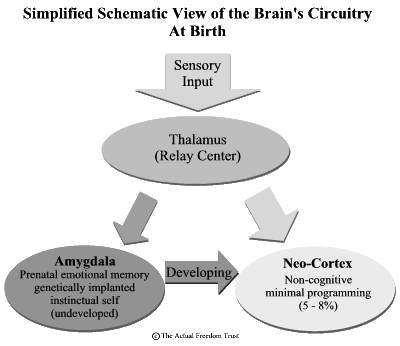
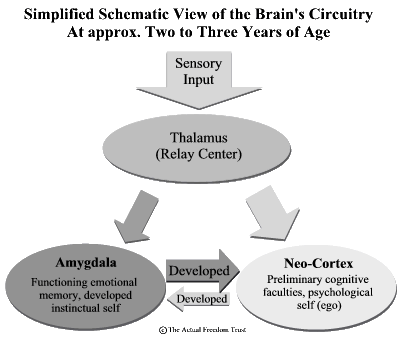
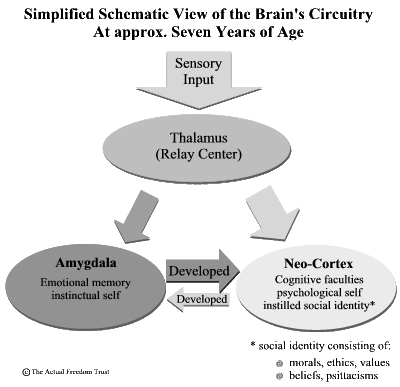
research and The other point is that the findings will not only be ignored and misinterpreted by both lay and professional people, they will be deliberately twisted and perverted in order to maintain the enormous vested interests of the Ancient Wisdom Business. It will be fascinating to watch the twists and turns, the ethical and moral arguments that ensue. Already we have seen the banning of genetic ‘meddling’ which could have eliminated inherited diseases and abnormalities because ‘we can’t play God’. So the suggestion that we deliberately set out to eliminate all feelings, self and our survival instincts is not going to be popular consumption for a goodly while. It is so radical, so confrontational, so 180 degrees in the opposite direction, that it will take intrepid pioneers and adventurers to be the first ones to journey out from the Human Condition. It has only now become possible to become free of the Human Condition because of the extraordinary change that has occurred in the last 40 or so years, as a significant proportion of the population does not now have to fight for survival – be it territory, food, defence, battling rampant diseases or the like. The actual world is a safe and benign world – we have won the fight over marauding wild animals, we have tamed most deadly plagues, we produce enough food, we enjoy good living standards, but still humans suffer from sorrow and inflict malice on others. The only ‘solution to date for temporary relief from instinctual fear and aggression has been to conjure up ‘good’ feelings of compassion – feeling sad for others – and love – desperately trying to feel good about, and be ‘kind’ to, at least one other person on the planet. Isn’t it so bloody good, so liberating, to know the reason for sorrow and malice, to not feel guilty about it, to have a method for eliminating the buggers and to get on with the job? To see clearly that the whole instinctual package was only necessary for the survival of the species and that it is now redundant. Not only redundant but plainly lethal in that most of the 160,000,000 that died in wars this century died not fighting for survival but for passionate feelings such as Honour, Country, God, Justice, etc. And all the murders, rapes, tortures, suicides, sadness and despair occur only because of the ‘animal’ still wired within each of us. What a grand thing to journey out of sadness and fear, spite and envy, deception and confusion – to more and more experience the sensate delights of this very actual world, happening right now. The only way that such a journey is possible is because one is eliminating all that is in the way of experiencing what is actual – the process is one of elimination, not of building a new belief or concept about how to be, how to cope or how to escape from the world as-it-is and people as-they-are. As such, each step on the path is a factual step, a sincere investigation, a fact replacing a belief, with more and more happy and harmless moments replacing fearful, sad or angry ones. One would not proceed ‘where few have gone before’ without a glimpse of the paradise that this actual world is – a Pure Consciousness Experience. It is not enough to rely on others’ stories, for then it is only yet another belief, and with belief comes doubt, hand in hand, and the subsequent need for trust, hope, and faith. Merely adopting another belief will not instil the necessary pure intent to guide one through the maze of one’s own psyche. I think I am on a rave again. So back to the BrainBomb web-site whose address you sent. It would seem that many people will use the research on instincts to justify the ‘bad’ in us and continue to flog the old ‘be good – find God’ methods that have relentlessly failed to end suffering and failed to bring peace, despite the sincere efforts of billions upon billions of people. This ‘wishful thinking’ involves nothing more than accentuating and identifying with the so-called good instincts and sublimating and dis-identifying with the ‘bad’ instincts. If one is successful in the effort one becomes totally identified with the Good and in full-blown delusion one can even become God or Cosmic Consciousness, so self-aggrandizing is the exercise in the end. But given the current research efforts, at very least, the ancient belief in Tabula Rasa will be harder to maintain in the face of scientific fact. A little definition may be appropriate at this point – Encyclopaedia Britannica Vineeto has worked up three more diagrams, based on our initial diagram, showing a schematic representation of the development of the brain’s circuitry and programming at birth, by age 2 to 3 years and at about 7 years. I would emphasize that, while the diagrams are a factual representation of what happens in the initial years of a human’s life, they are purely schematic in neurological terms. They should be treated as guides only, and although we are well aware of the potential for nit-picking abuse and misrepresentation, I personally find them very useful in order to make sense of the functioning of that extraordinary organ, the human brain.
Well, I hope you enjoy the diagrams. You probably have read all this stuff before but I wanted to also take the opportunity to post the schematics on the list with a bit of an explanation. It’s so good to make sense of this business of being a human being, to swap stories, share discoveries, and to get to write a post to someone on the other side of the world – a few mouse clicks and ... And it’s back to the drawing board for me ...
PETER: I’m finally getting around to replying to your post – I’m working to ‘feed’ my computer at the moment as well as myself so I’ve been busy at the drawing board. RESPONDENT: Actually about this amygdala and brain business – I am more interested in a complete overview showing how the amygdala interacts with the discrete components and how the method is changing it. For example, does the neo-cortex weak link back to the amygdala strengthen with successive interactions with strong emotions? How do the components change and what happens to the obsolete ones? PETER: Well, we did have a chat about what was happening but found ourselves involved in speculating and imagining, so we gave up on the exercise. When I get a bit more time we will possibly put out a simple ‘Actual Freedom diagram’, but as to what the neuro-biological changes are and what happens in the brain, I suspect it will be others who discover and map the science of it. It also could be that we never know, as it may be in the same league as asking why the neo-cortex developed in the first place? The physical universe, as one of its more intriguing qualities, has the propensity to develop towards increasing refinement, utility and intelligence, and the individual human’s ability to free the neo-cortex from the animal instinctual survival mode is at the current cutting edge of this ever on-going development. And it’s bloody good to be on the bus to freedom. RESPONDENT: If there is a working model and an understanding of the main function of each component then I think it would be possible to extrapolate to create a rough picture of what happens. PETER: The ‘working model’ we have for the process, at this stage, is Richard, and given his little ‘detour’ of finding himself in an Altered State of Consciousness as opposed to a pure consciousness state for some 11 years, his ‘picture of what happens’ is a bit distorted. There is, however, no doubt that Richard can report reliably on the end result of the process – the complete and utter extinction of both the psychological and psychic self – and that this extinction results in the complete elimination of the instinctual passions. Those currently following in his footsteps and utilizing his method are avoiding the delusion of an Altered State of Consciousness and, as such, their discoveries, experiences and writings give an accurate picture of the process in operation. I also must admit to a lack of curiosity as to ‘how’ it all happens – I am more interested in the fact that it is now possible for it to happen. Of even more vital interest is that it is happening to me – that I can be free of the instinctual animal passions of malice and sorrow that accompany the self – the alien entity within this flesh and blood body. I watched a television interview with Douglas Adams – the author of the ‘Hitchhikers Guide to the Galaxy’. I pricked up my ears when he said that the major issue that human beings are presently facing was the ‘battle between instincts and intelligence’. But within a few sentences he was proclaiming the popularist belief that ‘our survival is threatened by our instinctual behaviour in that we are wiping out endangered species and that only intelligent action will save us’. Not a word about our instinctual behaviour towards each other, such as war, rape, torture, genocide, murder ... let alone despair, depression, loneliness, suicide ...
It is only those who acknowledge that they feel malicious, murderous, revengeful, resentful, sad, depressed, lonely, despairing, etc., – and want to do something about it – who will be interested in Actual Freedom. Now that the neuro-biological scientific evidence is becoming available, it will be up to each of us what we do with it – whether we continue to ignore or escape from it, or get up off our bums and do something. The main interest for me in LeDoux’s findings was that instinctual fear was sourced in the primitive brain and that the primitive brain was the quickest to react. The ‘quick and dirty’ instinctual response then overwhelms the modern brain – a ‘hose pipe’ connection from the amygdala to the neo-cortex compared to a ‘drinking straw’ the other way. This explained my feelings of being overwhelmed by rage, anger, sadness, despair or loneliness in my lifetime and it explains the more subtle feelings that constantly served to ruin my happiness. It makes it glaringly obvious that, no matter how ‘good’ or well intentioned ‘I’ am, it is factually impossible to be free of malice and sorrow unless I am free of the instinctual animal programming in its entirety. So, I see that LeDoux is very good news for we actualists.
At the end of one of PETER: Just a P.S. from me that might be useful. I found writing is an excellent way of holding on to or not losing those ‘flashes’. The action of writing, labelling, a bit of subsequent contemplation and exploring, can build on and deepen those important flashes, very often into life-altering realizations. I ran a personal jotting notebook which I found most useful and I would have it by my side when contemplating. It is also an invaluable companion while you are having a PCE as you can glean much information which may fade with memory of the PCE afterwards. This way, afterwards you can read back and see what it was that you realized while free of it all. I also found reading Richard’s journal to be excellent – just a passage or two and then a stretch back for a bit of a muse about what was written, a jot in the note book and who knows what might happen? What I am suggesting is a little game plan – maybe settle for one particular issue that you want to crack through – and you’ll probably know which one – and then establish a method that suits you and that enables you to comfortably abandon caution and slip a little deeper. Supplement your investigations with writing, observing, reading other viewpoints, etc – do anything necessary to focus your attention on the issue at hand. What I found was once I had success with one issue the next one would come swanning along by itself. The other comment I would make is about working. During most of the time when I was investigating and digging deep into emotions I was working supervising a building site. I found it a rich field in which to observe and label feelings and emotions as they arose and I focussed on several consecutive major issues that arose at work and found that I was able to eliminate them to the point that both my enjoyment level and efficiency level increased. There is a lot to be said for testing oneself out in the market place for the immediate aim is to be happy and harmless in the world as it is with people as they are. Good to hear from you. You seem to be having great fun.
RESPONDENT: I have only a general game plan so far and it goes like this.
The following is New for me:
PETER: Good to hear from you. You seem to be having great fun. RESPONDENT: Indeed, at first when I heard that investigation into ‘me’ would be a wonderful adventure I couldn’t really see how, as emotions are sometimes hard to deal with. With bare awareness in full swing though, everything becomes fuel for a curious mind. PETER: I found an advertisement in the local spiritual magazine that states very clearly the distinction between the spiritual approach to dealing with the emotions arising from morals, ethics, beliefs and animal instinctual passions and that of an actualist. I know there is an enormous amount written on the Actual Freedom Trust website about this subject but every now and again something catches my eye that blatantly exposes the spiritual approach of actively creating a new identity who transcends or rises above the unwanted bad or savage passions. The advertisement is for a 4-day workshop entitled ‘Dis-identification’ – Letting Go of Self Hatred. He writes in his introductory section –
This description very well describes the spiritual practice of disidentifying from unwanted and undesirable emotions and identifying with the wanted and desirable emotions. The undesirable real-world identity is transcended and a new desirable spiritual identity is created. The newly formed spiritual identity dis-identifies with the old identity and becomes aware of and suppresses, pushes away or ignores the unwanted emotions. This is not a bare awareness operating but an identity splitting itself into two – one good half being aware of the other bad half. To call this action awareness is to misuse the term as the awareness is so selective it would be best termed as occultation or denial. It is this very labelling and judging of feelings and emotions as good or bad, right or wrong, desirable or undesirable that prevents an active and equal investigation of all emotions and their instinctual roots. This is why it is essential to dismantle the morals and ethics we have been instilled with since birth that deem anger a bad thing and that it is wrong to be angry. In the spiritual world, these morals and ethics become even stronger, such that the writer of the passage above cannot even say he is being angry. He uses the term – ‘ feel anger arising’. Unless one is prepared to investigate the validity and sensibility of moral and ethical standards, any in-depth investigation into one’s own psyche is impossible. It does seem madness to abandon the very glue that appears to keep society safe and keeps a lid on rampant violence and that stops one from running amok. But three facts clearly indicate a new approach is necessary –
The first point means that the honest seeker of freedom, peace and happiness will not settle for a suppression or transcendence of unwanted or undesirable emotions. The second point means that the honest seeker of freedom, peace and happiness will not merely swap one set of morals and ethics for another for he or she will be acutely aware that the ‘becoming spiritual’ option is merely adopting another identity and another even more insidious form of entrapment. All people are instilled with spiritual-based morals and ethics and everyone who has sought freedom has developed a spiritual identity to varying degrees which is why the elimination of one’s social identity is the primary focus of an actualist. The clue to morals and ethics in action are feelings such as guilt, shame, embarrassment and resentment on the one hand and pride, piousness, arrogance and condescension on the other. So much conflict, dissension, confusion and obscuration is caused by a stubborn unwillingness to rigorously examine the facticity and effectiveness of the morals, ethics and beliefs we are instilled with since birth. Most of the objections to being happy and harmless on the Actual Freedom Trust website go no deeper than obstinate and superficial objections on the basis of right and wrong, good and bad rather than a mutual discussion based on what is silly and what is sensible, what is belief and what is fact. Only by eliminating one’s social identity can one eliminate the constant flood of minor feelings, emotions and worries thus leaving one free to tackle one’s instinctual being, ‘me’ at my core. The third point means the pure consciousness experience gives one the knowledge and confidence that not only is it possible to live without the burden of ‘self’-centred instinctual passions, it is essential to do so in order to directly experience the already and always existing peace on earth. It is interesting to look back on the process and the stages I went through in investigating feelings, emotions and instinctual passions. With each emotion I investigated it was always an essential first step to investigate the goods and bads, the rights and wrongs, and all the things I had been told and thus assumed to be true – my beliefs. I know we keep flogging this aspect but unless one undertakes this process any investigation will be superficial and offer only a temporary relief of the symptoms without ever tackling the underlying cause of the instinctual passions. What I am suggesting is to be alert to the feelings that arise from one’s instilled morals, ethics, beliefs and values, for these are the first line of ‘self’ defence that needs to be tackled. This is where labelling and making sense of the feelings and emotions is vital for then you can make sense of the apparently arbitrary and chaotic jumble that arises. One begins to see patterns and traits that are common to all human beings and that give rise to the human condition in operation in yourself as well as others. My experience was that these feelings associated with my social identity were the easiest to tackle and the confidence gained from the success in tackling them was fuel for digging deeper – and the freedom gained was deliciously palpable.
PETER: I found an advertisement in the local spiritual magazine that states very clearly the distinction between the spiritual approach to dealing with the emotions arising from morals, ethics, beliefs and animal instinctual passions and that of an actualist. I know there is an enormous amount written on the Actual Freedom Trust website about this subject but every now and again something catches my eye that blatantly exposes the spiritual approach of actively creating a new identity who transcends or rises above the unwanted bad or savage passions. The advertisement is for a 4-day workshop entitled ‘Dis-identification’ – Letting Go of Self Hatred. <snip> This description very well describes the spiritual practice of disidentifying from unwanted and undesirable emotions and identifying with the wanted and desirable emotions. The undesirable real-world identity is transcended and a new desirable spiritual identity is created. The newly formed spiritual identity dis-identifies with the old identity and becomes aware of and suppresses, pushes away or ignores the unwanted emotions. This is not a bare awareness operating but an identity splitting itself into two – one good half being aware of the other bad half. To call this action awareness is to misuse the term as the awareness is so selective it would be best termed as occultation or denial. It is this very labelling and judging of feelings and emotions as good or bad, right or wrong, desirable or undesirable that prevents an active and equal investigation of all emotions and their instinctual roots. RESPONDENT: It is more than that. Emotions do feel physically bad, that is why most people can justify why they have to keep those bad things at bay. PETER: With morals and ethics firmly in place we also get a double whammy – the physical sensations of chemical surges related to the passions and then the associated bad feelings due to our ethics and morals – anger comes with guilt and shame, love comes with duty, responsibility, resentment and possessiveness, fear comes with withdrawing, denial, false bravado or frustration, desire comes with competitiveness or guilt, etc. This observation is the very key to investigating both the tender and the savage emotions. It is only by making sense of one’s own psyche in action that freedom is at all possible. RESPONDENT: Secondly, many awareness based systems know all about the nature of duality, (the self and the other). Investigation fails and imagination takes over due to an experience with the activation of strong emotion and the return to the small affective ‘me’. PETER: Yes and they attempt to bridge this gap by feeling. Thus ‘I’ feel love, ‘I’ feel Oneness, ‘I’ feel sad for you and feel sad with you, etc. Thus ‘I’ stay in existence and the idea of ‘the other’ stays in existence. With the demise of ‘me’ and my feelings the experience that what I am is this flesh and blood body only dissolves this feeling of duality and an actual palpable intimacy becomes apparent with every person you meet and your immediate surrounding. RESPONDENT: Emotions become the master to be avoided in order to stay happy or free. PETER: The failing of this system is that one only feels happy and feels free while the savage instinctual passions lurk around unscathed and uninvestigated – ever able to re-emerge at any time. RESPONDENT: What I am getting at is that, as I see it, the good/bad, right/wrong have a basis in the inability to question the emotions as something which can be dealt with fundamentally. PETER: Yes, yes. The morals and ethics we have been instilled with since birth are designed to prevent us from taking a clear eyed look at the ‘dark’ side of our instinctual nature. They form the guardian at the gate that prevent one from making a clear-eyed investigation of one’s psyche in action. RESPONDENT: Another important point or clarification. To not identify with anger is a denial of the fact that fundamentally ‘I’ am anger. Anger is not some outside stranger to be left alone and hopefully go away. No doubt this attitude renders the individual particularly impotent when it comes to arriving at any permanent solution. PETER: Yes, we are taught at childhood to dis-identify with the feelings arising from the savage instinctual passions by regarding them as bad or evil or wrong or not-proper. The spiritual teachings just take this dis-identification to its fundamentalist extreme – thus the priest and the nun are the holiest exactly as the awakened or Enlightened ones are the holiest. To dig into one’s instinctual passions one needs to ‘get down and get dirty’ – not something the good, holy and righteous are at all inclined to do. * PETER: This is why it is essential to dismantle the morals and ethics we have been instilled with since birth that deem anger a bad thing and that it is wrong to be angry. In the spiritual world, these morals and ethics become even stronger, such that the writer of the passage above cannot even say he is being angry. He uses the term – ‘ feel anger arising’. Unless one is prepared to investigate the validity and sensibility of moral and ethical standards, any in-depth investigation into one’s own psyche is impossible. It does seem madness to abandon the very glue that appears to keep society safe and keeps a lid on rampant violence and that stops one from running amok. RESPONDENT: These ethics have some bases in avoiding physical harm but are largely based in avoidance of bad emotions and the disabilitating effects. PETER: Every tribal grouping has its own set of moral and ethical standards imposed by carrot and stick so as to keep the group together and ensure a reasonable standard of behaviour of members of the group towards each other. These ‘sort-of’ do a reasonable job within the group but other groups with different standards and values are often seen as wrong or bad which gives rise to much conflict. Even within any group the resulting restrictions do nothing but keep the lid on the worst of the covert malice and sorrow. The ‘good’ No 3 and the ‘right’ No 3 have to step out of the way sufficiently in order that you can see what is really going on in your psyche. * PETER: But three facts clearly indicate a new approach is necessary –
It is interesting to look back on the process and the stages I went through in investigating feelings, emotions and instinctual passions. With each emotion I investigated it was always an essential first step to investigate the goods and bads, the rights and wrongs, and all the things I had been told and thus assumed to be true – my beliefs. I know we keep flogging this aspect but unless one undertakes this process any investigation will be superficial and offer only a temporary relief of the symptoms without ever tackling the underlying cause of the instinctual passions. What I am suggesting is to be alert to the feelings that arise from one’s instilled morals, ethics, beliefs and values, for these are the first line of ‘self’ defence that needs to be tackled. This is where labelling and making sense of the feelings and emotions is vital for then you can make sense of the apparently arbitrary and chaotic jumble that arises. One begins to see patterns and traits that are common to all human beings and that give rise to the human condition in operation in yourself as well as others. My experience was that these feelings associated with my social identity were the easiest to tackle and the confidence gained from the success in tackling them was fuel for digging deeper – and the freedom gained was deliciously palpable. RESPONDENT: Yes, I often find it difficult staying with an emotion. So I find I need to look at the broader details in order that I don’t miss any of ‘my’ objections. PETER: I always say that I was happy to be a following pioneer in this enterprise for I was able to pick Richard’s brain, as it were, to discover what he had discovered. Thus I didn’t need to explore every alley, every nuance, every belief, every moral, every belief, and every psittacism. I was able to do this intensively over a period of 12 months, and together with reading his journal many times over, this was sufficient to become virtually free of malice and sorrow. I would suggest that your success will be purely dependant on the time and effort put in to the task. The good thing for you is that the amount of information available now has probably increased 20 fold and it is freely and readily available on the web-site. You still make your own investigations – and who would have it any other way – but a wealth of information is available to help you look at these broader details. As you seem to be discovering, it is impossible to leap straight into investigating emotions without first looking at the broader details of one’s social identity. This is where The Actual Freedom Trust Library pages and particularly the selected correspondence related to topics are invaluable as you can focus your attention on understanding one particular issue and come to grips with it. Remember we are talking of a practical re-wiring of the human brain. Our social identity is a way of thinking that has formed synapse connections that mean we automatically think a certain way, exactly as our instinctual passions cause us to automatically feel a certain way. This rewiring requires persistence, perseverance and repetitive effort – exactly like learning anything new does, except in this case one is unlearning something. Thus one’s success, or not, is exactly proportionate to the amount of time and effort afforded to the task. I do like your report. Methinks there is a substantial dent in that outer layer happening and it is always good to hear of someone who is putting theory into practice – ‘giving it a go’ is the local vernacular term.
RESPONDENT: What I am getting at is that, as I see it, the good/bad, right/wrong have a basis in the inability to question the emotions as something which can be dealt with fundamentally. PETER: Yes, yes. The morals and ethics we have been instilled with since birth are designed to prevent us from taking a clear eyed look at the ‘dark’ side of our instinctual nature. They form ‘the guardian at the gate’ that prevents one from making a clear-eyed investigation of one’s psyche in action. RESPONDENT: I don’t quite see the ‘designed to prevent us’ part, it would seem more correct to say: ‘designed to free and protect us from the ‘dark’ side’’, as most would not acknowledge the possibility of a ‘clear eyed investigation’. PETER: How is the imposition of morals and ethical codes of behaviour ‘designed to free’ us from the ‘dark’ side of our instinctual nature? Surely the effort of having to keep the lid on one’s ‘dark’ side or having to keep oneself under control is the very antithesis of freedom? The way I investigated morals and ethics was firstly by looking at the personal experiences in my own life. When I remember my own childhood, it is quite clear that the ultimate authority was the threat of my father using his leather razor strop to hit me should I do something really bad. I can’t remember him using it, but I certainly remember it to be the last threat if I didn’t behave as I was told. Similarly at school, the headmaster would dish out a caning as a punishment should all else fail and I certainly had a few hits until I learned to be more cunning about my indiscretions. Expulsion from school was another threat used. When I had children myself and saw the beginnings of aggressive behaviour emerge, I dutifully began the ritual teaching of what was right and wrong and what was good and bad behaviour. Right and good were rewarded with approval, endorsement, benefits, gifts, etc, while wrong and bad were discouraged by disapproval, reprimand, restriction, penalty and punishment. I remember seeing very clearly that what I was doing was what my parents had done to me. Same words, same actions and they were unavoidable, for I had to teach my children the rules of society in order that the family unit functioned, that they could relate to their peers and that they could get along in society at large. What I saw was that morals and ethics have their beginnings with parents passing on their values that they in turn had learned from their parents, that these values are then reinforced by their peers, and by the time the children go to school they are expected to comply with formal laws and regulations as well. All of this social conditioning has its roots in the inevitable emergence of genetically encoded instinctual behaviour at the age of about 2 years in every human being. The other clear evidence of the restrictions and shackles that these same morals and ethics impose is the emergence of rebellious behaviour against rules and regulations – either overtly as frustration and anger, or covertly as cunning and deceit. This can be seen most obviously in teenage years and I experienced this urge for rebellion and freedom both in myself and in my children. It was often senselessly directed against any and all authority and is usually only curtailed with the threat of punishment or of further and harsher restriction on one’s freedom. This desire for freedom is a desire to be free from the bondage of having to live one’s life by unliveable morals and ethics. One knows well by early adulthood that no one fully lives by them, that the whole societal system is riddled with deceit, hypocrisy, corruption and lies, and this gives rise to an essentially cynical world-view. This desire for ‘freedom from ...’ proved to be a constant drive in my life and caused me to be a rebel in all sorts of situations, riling against this or that, wanting to change this or that, and blaming this or that. When I gave up in resignation about changing the real-world, I discovered spiritual freedom – an escape from the world-as-it-is to a hopeful dream of how the world could be ‘if only we all ...’ What I missed in my blind loyalty, faith and hope was the ‘if only’. I eventually came to see that I had jumped from the frying pan into the fire, from real into fantasy, from down-to-earth to head in the clouds – all because I desperately sought freedom from the miserable bondage of my social identity. When I first met Richard I saw Actual Freedom in the same light – as a way of escaping from the world as-it-is and people as-they-are such that I could feel free of the real-world. What I came to realize was that breaking free from normal moral and ethical behaviour inevitably led to licentiousness, tyranny, anarchy and despotism – or, in the case of spiritual seekers, delusions of holiness, grandeur and Divinity which, if fully played out, lead to licentiousness, tyranny, anarchy and despotism. With this realization came the beginnings of a broad-ranging investigation of the nature and substance of my social identity, an uninhibited exploration of what uninvestigated passions lay hidden beneath. With a sincere intent gleaned from the pure consciousness experience I knew I would neither run amok nor become divinely deluded if I dared to lift the lid to expose the animal instinctual core of me, and thus I was able to investigate and experience my dark side with impunity. To experience, in my own psyche, the raw passions of hatred, the lust to kill and rape and the raw passion of fear, dread as well as the diabolical ‘dark’ desperate world that underpins the fantasy world of the divine. This ‘soul’-searching exploration of the animal instinctual passions in operation in me gave me an experiential understanding as to why morals and ethics are needed to ‘civilize’ the human animal and also why they have failed, and always will fail, to eliminate malice and sorrow. There is no solution to be found within the human condition to the ending of human malice and sorrow – the solution can only be found in eliminating them in one’s own psyche. * PETER: Every tribal grouping has its own set of moral and ethical standards imposed by carrot and stick so as to keep the group together and ensure a reasonable standard of behaviour of members of the group towards each other. These ‘sort-of’ do a reasonable job within the group but other groups with different standards and values are often seen as wrong or bad, which gives rise to so much conflict. Even within any group the resulting restrictions do nothing but keep the lid on the worst of the covert malice and sorrow. The ‘good’ No 3 and the ‘right’ No 3 have to step out of the way sufficiently in order that you can see what is really going on in your psyche. RESPONDENT: Also any failure (or difficulty) investigating can become a progressively more difficult stumbling block, as it can become a matter for supporting the idea that ‘I am not worthy of achieving this’. PETER: The ‘I’m not worthy’ idea bugged me on and off for about 6 months or so, and it eventually collapsed by itself like a limp balloon. It seems to have some of its substance in the spiritual idea that only the good and noble are ‘chosen’ – that there is a ‘Someone’ or ‘Something’ that decides who is worthy or not worthy, who is blessed or who is damned. The other issue is the constant drumming we have from our peers such as ‘who do you think you are’, ‘how come you think you know better than everyone else’, etc. It is called the ‘tall poppy syndrome’ in this country. The cute thing is that it is okay nowadays in some circles for someone to call themselves God-on-earth or God-realized and yet when an actualist dares to stick his or her head above the parapet, those same people heap scorn or can’t get beyond their spiritual conditioning to see the down-to-earth-ness of what is now on offer. The ‘why me’ eventually wore itself out with a more pragmatic ‘why not?’ Was I going to continue being malicious and sorrowful when I could be considerate, sensible and magnanimous, when I could see that the excuse I was running was about ‘me’ objecting to me, this flesh and blood body, being here. Given sincere intent, these objections eventually wear themselves out for they have no substance, no credence ... and no staying power. * PETER: It is interesting to look back on the process and the stages I went through in investigating feelings, emotions and instinctual passions. With each emotion I investigated it was always an essential first step to investigate the goods and bads, the rights and wrongs, and all the things I had been told and thus assumed to be true – my beliefs. I know we keep flogging this aspect but unless one undertakes this process any investigation will be superficial and offer only a temporary relief of the symptoms without ever tackling the underlying cause of the instinctual passions. What I am suggesting is to be alert to the feelings that arise from one’s instilled morals, ethics, beliefs and values, for these are the first line of ‘self’ defence that needs to be tackled. This is where labelling and making sense of the feelings and emotions is vital for then you can make sense of the apparently arbitrary and chaotic jumble that arises. RESPONDENT: A point that comes to mind. The apparent chaos is possibly what happens when ‘my’ feelings momentarily loose their meaning and one seems to be floundering. Resolve at this point certainly is necessary if one is not to immediately fall back into feelings. PETER: A good point to remember is that there are three ways human beings can experience the world – affectively by feeling, cerebrally by philosophical-type thinking and sensately by direct, momentary sensate involvement. The psychic and psychological entity has no option but to experience the world affectively and cerebrally. We humans are instinctually programmed to feel our way in the world by means of an animal instinctual survival program, the predominant one being fear. As such, when no fear arises, when no excitement is happening, when there is nothing to worry about, ‘I’ feel bored, lost, floundering, meaningless, useless, scared, etc. But you, as the flesh and blood body called No 3, need to have more and more time free of this alien bugger who insists on running the show, causing nuisance, raising objections, being emotional, worrying, etc. This ‘down-time’ is also condemned by society for one is taught to be useful, to contribute, to be creative, that your ‘life’ needs to have a meaning and a purpose. For an actualist, it is often in these periods when nothing is happening – when ‘How am I experiencing this moment of being alive?’ produces no drama, no issue, nothing to explore – that one can evince a delight and a joie de vive at being alive here and now as a flesh and blood body, located no where in particular on this paradisiacal planet as it floats in the vastness of space. The most pregnant time for a pure consciousness experience can be when one’s guard is down, when no issue is burning and no fear is arising. This is the opposite of the spiritual where one is hunting for the passionate experience and an emotional high as one’s prize or one’s due right in life. John Lennon sang ‘Life is what happens while you’re busy making other plans’. I would see it as ‘life is what is happening now while you are planning for, or waiting for, your next experience’. Every moment, there is a door available marked ‘actual world’, and it is often most accessible at exactly those moments when there seems to be nothing going on in terms of emotions or worry. The ever-present, physical-only, actual world is ever-peaceful, ever-pure and ever-perfect. There is no fear, no aggression, no good, no bad, no right and no wrong in the actual world. Then, when you come back from the actual world, to resume being an ‘I’ in the real-world, you recommence the fascinating business of dismantling what you have seen to be in the way of your being happy and harmless. * PETER: This rewiring requires persistence, perseverance and repetitive effort – exactly like learning anything new does, except in this case one is unlearning something. Thus one’s success, or not, is exactly proportionate to the amount of time and effort afforded to the task. RESPONDENT: Aye, not only that, it is progressive, as in I can continue with ‘How am I...’ where I left off. PETER: Good, Hey.
PETER: Apologies for my last mail to you which opened with ‘Hi Peter’ – Ho hum ... egg on face. I wanted to take the opportunity to write a bit more about morals and ethics being the ‘guardian at the gate’ that prevents ‘good’ people from firstly acknowledging their ‘dark’ side and secondly prevents the necessary clear-eyed investigation that can bring about the elimination of the instinctual passions. I think we can take it as given – at least for those who have taken the time to read sufficiently to grasp what Actual Freedom is about – that those in the spiritual world indulge in a complete denial of the savage instinctual passions by labelling them evil. The current fashion for Eastern spirituality is based upon the Tabula Rasa theory whereby humans are born innocent and then corrupted by the inherent evils of society and earthly and bodily desires. The traditional Eastern approach was to practice renunciation, meditation, asceticism and celibacy in order to turn away from the material world and the so-called ‘evils of the flesh’. Then aim to dissociate from the feelings thereby transcending them to become a new holier personality who is then, by definition, above evil. I thought it might be useful to look at instinctual aggression and see what the state of play is within the human condition. It is a topic that spiritual people are unwilling to look at for they are usually so identified with being pious, feeling self-righteous and being so proud of their sanctimonious achievements as to be totally unaware of their myopic viewpoint. Some New Dark Age spiritual teachings integrate cathartic exercises as a way of expressing anger and hostility in the belief that catharsis is effective in reducing aggressive behaviour in spite of the many studies that provide evidence that catharsis encourages and reinforces angry and hostile behaviour rather than reduces it. But, apart from paying a bit of nominal lip-service to the more modern concepts of societal conditioning, the Ancient Wisdom of all spiritual teachings is firmly rooted in the belief that instinctual aggression was a result of being overcome by evil spirits. I went searching on the Web for information on instinctual aggression and found it to be a not very popular topic of discussion. One article I came across offered a summary of the basic psychological theories of aggression and I thought it might be useful to post some relevant sections. The author writes –
The first issue that I found interesting was the up-front distinction made between aggression and assertiveness. This distinction is the fundamental premise upon which all psychological studies of aggressive behaviour are founded. It is universally accepted – i.e. held to be a fact – that human beings need to be aggressive towards other human beings in order to survive – to assert one’s rights, to get one’s way, to survive in the struggle, etc. To walk this fine line of socially acceptable behaviour whereby ‘Aggressiveness infringes upon the rights of others, whereas, assertiveness prevents others from infringing upon one’s own rights’ requires constant vigilance and ‘self’-control. One is forever tip-toeing around and attempting to balance varying conflicting rights, morals and ethical values –the only possible result being a sad and unsatisfactory compromise for all involved. Nobody wins, everybody loses and everybody pays the price of having to continue the battle another way on another day or by feeling resentful at losing or having to surrender. Unless one is willing to look at both aggressiveness and assertiveness, whether overtly or covertly expressed – the whole package – it is impossible to be free of malice. I don’t intend to comment on the three psychological theories of the basis of aggression in detail for the whole issue is well documented on the Actual Freedom Trust website, but rather I posted them for information and contrast. All of the traditional solutions within the human condition to bringing an end to malice and sorrow have been found wanting. Despite the well-meaning efforts, none of the ploys, constraints or noble feelings have managed to bring an end to human malice, for aggressiveness is indeed a genetically-encoded instinctual passion and is ultimately ‘self’-centred – based upon the instinctual animal self. These instinctual reactions result in thoughtless, inconsiderate and utterly self’-ish and ‘self’-centred emotions, feelings and actions. The modern way is to dare to eliminate this instinctual ‘self’ – the redundant wiring in the reptilian brain that automatically causes this flesh and blood body to blindly react to people, things and events. What I have discovered on the path to Actual Freedom is that layer upon layer of aggressiveness is revealed when one begins to become aware of malice in operation in one’s own psyche. All of this malice can ultimately be sheeted home to a ‘me’ inside this flesh and blood body who feels attacked, who loves to fight, who likes to blame others, who likes to see others suffer, who thinks he is right, who likes to feel superior, who feels resentful, who is ever on-guard and who feels and thinks he needs to be in control. It takes an enormous amount of naiveté and sincere intent to dare to let one’s guard down and acknowledge the rottenness of the instinctual passions that are programmed in this body. Both naiveté and sincere intent are gleaned from the pure consciousness experiences we have all had in our lives and these experiences form the very basis of the inherent knowledge we all have that there must be something better than normal life within the human condition. Just as an example of real-world beliefs about aggressiveness in humans, I came across this review, which I thought worthy of posting –
The last sentence had me rolling on the floor – if only he knew! It’s interesting to dig around and to see the real-world views on aggression and to see what the psychiatrists and sociologists, theoretical biologists and evolutionary biologists, are making of instinctual aggressiveness. The spiritual search is based on the notion that ‘you can’t change human nature’, hence the search for one’s divine (non-human) nature or true Self – and the same premise operates in the real-world, hence the continual need to be ever on-guard, lest one runs amok. What I found was that the harmless part of wanting to be happy and harmless was the key in pushing myself beyond what I considered safe limits – beyond the normal definition of aggressiveness into questioning the need for ‘me’ to be assertive in order for ‘me’ to survive, to get what ‘I’ wanted, to get ‘my’ way in every situation. In order to move into these areas of ‘self’-examination it is clear that one needs to firstly investigate and abandon the moral and ethical restraints that cause the welling-up of feelings of shame and guilt simply for having felt these savage passions in the first place. Guilt and shame are crippling and debilitating feelings, an integral part of one’s instilled social identity. To go beyond these feelings is a daring action and a clue is to see one’s inner investigation as an investigation of the Human Condition in operation in one’s own psyche. To see the instinctual passions as no fault of yours; you are not bad or evil for thinking these thoughts, for having these feelings, for being blindly driven to want to act this way. Keep your hands in your pockets, neither expressing nor repressing the passions, but observing them in action inside – knowing that what is going on is only in your head and your heart. What fascinating explorations – to see how ‘I’ operate and to actually feel ‘me’ in action. This seeing, this investigation, is the very ending of ‘me’ for all the mystique, mystery, cunningness and deviousness is exposed to the light of sensible understanding. There is an enormous dare in being here, in the world as-it-is with people as-they-are – free of the instinctual passions, held to be necessary in order to survive, and free of the crutch of having ‘God by one’s side’ for protection. Well, enough for now. I just wanted to write a bit about the putting into action of actualism – for to treat it as a philosophy is to miss the main event and thereby completely miss out on the rewards of becoming actually happy and harmless. It’s one of those delicious grey, rainy days here – perfect for putting my feet up and mulling about life, the universe and what it is to be a human being – so I’m off to the couch again.
RESPONDENT: Hope you got your face mopped up ok. PETER: Once again, with a clean face ... RESPONDENT: I don’t quite see the ‘designed to prevent us’ part, it would seem more correct to say: ‘designed to free and protect us from the ‘dark’ side’’, as most would not acknowledge the possibility of a ‘clear eyed investigation’. PETER: How is the imposition of morals and ethical codes of behaviour ‘designed to free’ us from the ‘dark’ side of our instinctual nature? Surely the effort of having to keep the lid on one’s ‘dark’ side or having to keep oneself under control is the very antithesis of freedom? RESPONDENT: Sorry for the mis-understanding, I was talking in terms of how people would view moral behaviour, in that they would firstly have to accept instincts as the irresolvable ‘dark side’ before they would accept them as a means of providing freedom from bad behaviour. PETER: Indeed, the traditional search for the freedom has always involved a search for freedom from the bad and has always resulted in a fantasy escape into being good or, in the Eastern traditions, becoming God. This is a search for freedom within the Human Condition – not a freedom from the Human Condition of malice and sorrow. However, I am always astounded at what has been achieved by human beings – the sheer inventiveness that has fashioned so many extraordinary objects from the earth that provide safety, comfort, leisure and pleasure for so many. To see innovation triumphing over ignorance in so many areas and to see the innate drive of altruism in operation in so many people. To see so many people willing to devote their lives for the betterment of others. Altruism is a powerful drive and is often seen in the idealism of youth before the cynicism of a fuller life experience sets in. Many times in my life I lapsed into comfortably numb stages but somehow I refused to give in to cynicism, for to be cynical about life always seemed defeatist or to be only fouling my own nest, so to speak. When acceptance became the spiritual catch-cry, I became increasing dissatisfied with the spiritual world for I came to see acceptance as a deeply cynical view of human life on earth. Meeting Richard rekindled my naiveté and two statements still stand out from the early days – ‘Everybody has got it 180 degrees wrong’ and ‘Who said you can’t change human nature?’ What this allowed me to do was to crank up the altruistic aims I had as a youth – to find freedom, peace and happiness and to make the world a better place – free of war, rape, domestic violence, child abuse, poverty, sadness, despair, repression, corruption, etc. This altruism still drives me on, for I know until I am living the pure consciousness experience 24 hrs. a day, every day, I am still living life as second-best, something I refuse to accept. RESPONDENT: I was interested in the article you posted by Lorenz:
This seems like a common line of defence when considering doing away with instincts and goes thus ‘emotions and instincts give meaning to our lives and without them life would be robotic and meaningless’. This idea conjures up just more instinct namely fear of meaninglessness, though it may well be worthwhile looking into ‘meaningful’. Well, firstly it seems that ‘meaningful’ to me has both sensible and emotional content in that something meaningful should firstly make some sense and secondly satisfy some emotional need. Unfortunately it is a juggling act which more often than not falls towards the emotional leaving what sense was made, somewhere in the background, out of sight. Now I am asking myself ‘Why must my life be meaningful’ and I am finding this question particularly interesting. There is some fear of reservation but beyond that I would say that, having to be meaningful is not much of an issue for me, which I find somewhat astounding, as I realize that the shackles have been loosened a bit more. What I think is more important than meaningful, is being stimulated by sensory input and removing anything that actively goes towards preventing that. (Within reason of course!) PETER: I seem to have commented on this already. What I did was to make becoming happy and harmless my immediate aim with the ultimate goal of becoming actually free of the Human Condition. This then became my sole aim and meaning in life – a passionate burning ambition. I thought I had abandoned both my real-world meanings and then spiritual-world meanings in life but the residue of both does take some weeding out. These traditional life-meanings, usually instilled as morals or ethics, or genetically-implanted as instinctual passions, are gradually abandoned as they are seen to be silly, not applicable to my aim in life, or an impediment to being happy and harmless. As Richard pointed out, an actualist doesn’t aim for a self stripped of emotions and, as such, it is vitally important, firstly to crank up Actual Freedom as one’s meaning in life and secondly not to strangle this passion by suppressing it. This is where the constant remembering of a pure consciousness experience becomes absolutely essential as one’s constant guiding light and aim in life. This memory will serve to keep you on course as you weave your way through the maze and it will prevent you from settling for second best. This passion for Actual Freedom is exactly why I wrote my journal – to capture the excitement and thrill of the early period of breaking free from the two traditional life-paths within the Human Condition. But I do know what you mean – the falling away of all the traditional meanings of life is a fascinating business, to make sense of the meanings our parents and peers have told us are important and then to discover how blind nature has programmed us to implicitly feel, think and act. The socially instilled meanings vary from tribe to tribe, and produce cultural variations to our basic instinctual programming designed solely to continue the propagation of the species – hence the over-arching predominance of the sexual drive. The other predominant instinct, the fear of death, fuels the search for security, fame and wealth in the real world and security, fame and immortality in the spiritual world. In exploring the brute animal instinctual passions, one soon discovers that blind nature cares not a fig for your being happy and harmless – quite the opposite, in fact. Yet, as all these meanings, drives and passions drop away, it is vital to remember that the third alternative is definitely not a passionless path. I distinctly remember a period where life seemed so devoid of meaning that I discovered a stark grey reality – not as a desperation but more of a pointlessness. This proved to be but a passing phase whereby I had left the familiar meanings, feelings and worries behind and began the real business of cranking up sensate delight, a joie de vive and a resounding Yes to being here in the world as-it-is with people as-they-are. I found this was initially like daily swimming against what felt like a tide of my own resistance and that of Humanity as a whole. Then came a point where I realized that it was only ‘me’ who had the foot on the brakes, so to speak, and then the whole business became even more thrilling and fascinating. So, the ending of the animal instinctual passions is a passionate affair, as life becomes brim-full with meaning and purpose.
RESPONDENT: I was considering passion with some degree of reservation when I read your other post which included a bit more about it, in particular passion in the form of altruism. Convincing ‘me’ to self-sacrifice for the benefit to oneself and others of a permanent PCE, would certainly carry more weight if I could get into full blown PCEs. At the moment I seem to be lingering at the edge with regular glimpses but nothing which could add depth to an altruistic passion. I feel at the present I will have to settle for desire and common sense. PETER: To settle for a desire for freedom from malice and sorrow and to settle for a life lived by the measure of common sense is to be doing extraordinarily well. To linger at the edge of a pure consciousness experience with regular glimpses is to be doing doubly well. Of course, as success inevitably breeds confidence, you will inescapably be obliged by altruistic passion to ‘raise the bar’ yet again... Altruism, for me, was evident when I started to become aware of how my malice and sorrow was causing suffering for those around me and usually those closer to me suffered most from my moods and my behaviour. It then became very clear I had to stop inflicting my ‘self’ on others – altruism in action. RESPONDENT: An issue that I would like to discuss is the demand for attention as I am in the situation at the moment where my questioning is being constantly interrupted by demands of work and family plus the prospect of having to move into a new house. It does indeed seem that running the question can add its own difficulties to each moment. An example is trying to solve say a work related problem plus the increasing pain in the back of the head which makes it more difficult to work. What usually happens is that I put the question ‘How am I...’ aside for the moment and continue with solving the problem. What then happens is that ‘How am I...’ is forgotten for a period of time. The addition problem here is that ‘How am I...’ can at times seem to be a hindrance to what is necessary to support oneself and family. My solution to this problem is to find appropriate moments to run the question where any difficulties I may come across do not encumber my ability to work. PETER: When I came across Richard I remember thinking it was easy for someone whose family had grown up and who did not have to work for his income due to the fact he had a war service disability pension to become free from the human condition. What about someone who had to work, had a family, or lived in not so comfortable or safe circumstances? Was he talking about having to drop out of the world as-it-is and people as-they-are – exactly as those on the spiritual path have to do? I was working building a house at the time and soon discovered that the hurly burly of the real world was exactly what was needed to provide me with the opportunities to test myself. I remember one situation at work where one particular person would continually cause me to be upset, so I used the situation to rid myself of all that was causing me to be upset. My motto was – ‘I was not going to let this person ruin my enjoyment of my time at work’. I was not going to try and change him, I was simply going to make it my business that he was not going to ‘get’ me. By neither repressing nor expressing my reactions and feelings, I was able to sort out the whys and whereabouts of my malice and sorrow in this situation and soon he gave up on me for he found that he couldn’t get at me, no matter how hard he tried. This experience meant that I came to see that actualism works in any situation, for anyone, anywhere. In fact, for those who have been wafting along on the spiritual path and are interested in actualism, it is essential to get out of one’s (inner) cave – rejoin the world of people, things and events and be tested. Unless one tries out a theory and find it works it will always remain a theory or a belief or a philosophy. So, if you spend the biggest proportion of your waking hours working, or with family members, then it is vitally important that you be happy and harmless in those moments. If you are involved in solving a problem at work and become frustrated, or you find yourself becoming upset by someone, then these are the immediate challenges. This is what ‘How am I experiencing this moment of being alive?’ means in the hurly burly of family and work. I found that I didn’t have to run the words per se, but simply be aware whenever I was emotionally upset, which was a sign of malice, or I was feeling lacklustre, which was a sign of sorrow. The quicker I caught myself, the more likely I was able to trace the cause or event, the quicker I could get back to feeling good again. If I was fully involved in the doing of something, then so be it, jolly good. Actualism is such a simple business. I do like it that you are finding and tackling the challenges of work and family. My experience is that if you have the desire to be happy and harmless, and the awareness to eliminate emotional passions to the extent that common sense can freely operate, you can literally do no wrong. The more ‘you’ are willing to step out of the way, in any circumstances and at any time, and dare to let the moment live you, the more the purity and perfection of the actual world is able to become apparent. Each of the early actualists is pioneering slightly different aspects, with slightly different flavours as we are all from different social conditionings, differing nationalities, differing spiritual conditioning, different living circumstances, male and female gender, etc. Your lot seems work and family, in particular – good hey. It’s an extraordinary adventure, this business of pioneering an end to malice and sorrow, which is why the doing of it is not a dispassionate but an enthusiastic affair.
PETER: Just a note on something I have been musing over and that also seems to be an issue with others on the list. RESPONDENT: Convincing ‘me’ to self-sacrifice for the benefit to oneself and others of a permanent PCE, would certainly carry more weight if I could get into full blown PCEs. At the moment I seem to be lingering at the edge with regular glimpses but nothing which could add depth to an altruistic passion. I feel at the present I will have to settle for desire and common sense. RESPONDENT to No. 7: Some time ago I remember thinking about that quite a bit and remember coming to the realization that the wonderful thing about the way of actualism is that firstly it is not too difficult to work out where your at. i.e.: good 99% of the time, great 99% of the time, or PCE 99% of the time. Of course, in the last example any brain pain could just be the beginning of the end. Secondly, it is possible to explore any of the above to see if there is any emotion behind it. That is a pretty sure indication that it is made up by ‘me’. PETER: I think it may be useful that we coin another term for that lingering on the edge of a PCE or that almost, but not quite, 99% PCE. There is a woman who describes this as an ‘excellence experience’ – the best one can be while the ‘self’ is still present. It is most definitely not a PCE for one can look inside, as it were and there is still a ‘me’ as a feeler and an ‘I’ as a thinker but it is so far above normal it is worthwhile naming and labelling. The benefit of this acknowledgement for an actualist is that these experiences are the proof of the pudding that one’s effort is bringing reward. The idea is to expand these ‘excellence experiences’ until one can go to bed at night-time saying that one has had a 99% perfect day in the world as-it-is, with people as-they-are. This is no small thing in a world where doom and gloom is the norm and were escaping to the self-deception and fantasy of yet another world, is held to be the ‘only’ solution. So, what I am proposing is a new term – an excellence experience – in order that we don’t get into the spiritual trap of watering down experiences and confusing terms such as in the fashionable interposing of Awakened and Enlightened. Thus Virtual Freedom – living in an almost constant experience of excellence – is a prerequisite stage for an actualist prior to Actual Freedom. Once one can reach this stage, it is then possible to begin the next stage of dismantling the tender emotions, exactly as Richard did in his years between Enlightenment and Actual Freedom. This is more subtle, and in many ways more demanding, work for this is entirely new territory – way out beyond both normal and completely opposite to spiritual. Because of this, a considerable period of gaily living via common sense, freed of emotional turmoil, is vital and a necessary preparation for the final and irrevocable step into an actual freedom from the human condition. What do you think? Is this a useful new term or is it only confusing? Actualism is totally new and we are writing the script, forging the path, and I welcome your comment and any others from the list.
PETER: Thanks for your note. It is good to get feedback as to what works, what doesn’t, what you have discovered, etc. This is the purpose of this mailing list – sharing information, reporting successes and failures, giving and receiving feedback, helping each other in an open and constructive manner, allowing everybody the freedom to make their own discoveries, in their own time, at their own pace. RESPONDENT: It would also seem to make sense to have some sort of an actualist map that points out the major noticeable goals along the way. This has been commented on, of course, but I do not know of any official map. This map will invariably vary from one individual to the other but in general terms should prove useful. Does this sound like a good idea? PETER: I have given this some thought and coincidentally Vineeto has been working for some time
now on another section of the Actual Freedom Trust website which is designed as a I have noticed a tendency for many people to merely want to clip on a bit of actualism to their Spiritualism, and no doubt this tendency will grow in the coming years. Already many western spiritual teachers have watered down Eastern philosophy and religion to try and make it more ordinary and less supercilious and, as Actual Freedom increasingly gains a foothold, those very same Spiritualists will deliberately distort it and try and absorb it into their teachings. This is the very reason that we have set up The Actual Freedom Trust, simply in order that there will be at least one original untainted source of actualism and Actual Freedom which people can use as a touchstone in a world renowned for duplicity and self-deception. Thus it is possible, as with any new discovery, to see two streams operating. There will be pioneers who are daring enough to take actualism on and have the courage to go all the way and those who will directly gain some benefit from adopting some of the common sense and down-to-earth practicality of actualism in their everyday lives. Yet another bonus will be a gradual infiltration of the knowledge of, and advantages of, a third alternative viewpoint to materialism and spiritualism and this will result in a slow generational change to human attitudes and outlooks. * You have twigged me to attempt to write a map, guide or summary outline of the path to Actual Freedom to date, for it seems an appropriate time given the current interest that seems to be building on the list.
So the first stage of our map, the beginning if you like, would be the discovery of actualism and deciding what to do with the discovery. History shows that most people will blindly rile against anything new, particularly something that is so radically new and iconoclastic as actualism. Some will adopt a sit-on-the-fence position, waiting for others to take the leap and see what happens to them, and a few will boldly jump in. This third category of people will be those who have some particular motivating factor that causes them to push on, despite their fears and trepidations. Some of these possible reasons we have written about – a burning discontent with life as it is, suspicion and doubt about the traditional spiritual ‘freedom’ based on personal experience, a vivid memory of a pure consciousness experience or a particular life experience that gives them the drive to make the search for freedom, peace and happiness the primary goal in life.
Given the three basic options at the start, – objecting, waiting or jumping in – this map or summary
outline only becomes relevant for those wanting to journey on the path to Actual Freedom. As we have already stated, the path has a definable mid
stage of Having acknowledged that there is a prima facie case for beginning on the path, one then needs to begin – to dare to push off from the familiar and safe and begin the process of the moment to moment investigation of one’s own psyche. The way to begin is simply to make becoming actually happy and harmless the primary aim in one’s life. The initial investigations will depend on one’s predilections, the particular issues that are most pressing or most obvious to tackle. What I did was accept the challenge of being able to live with another human being in total, peace, harmony and equity and use the success gained to give me the confidence to tackle other issues. At the same time, I was ready and eager to question the spiritual path for I was already suss about its sincerity and effectiveness in bringing peace on earth. For Vineeto, her challenging of the spiritual path only came when she had garnered sufficient confidence from tackling relationship, authority and gender issues.
What is clear is that at some stage, fairly early on the path, if one has travelled the traditional spiritual path that an about-turn has to occur for what we are talking of is 180 degrees opposite to the spiritual viewpoint of life. For those who have travelled the spiritual path, this business of turning around and backtracking is often too daunting a prospect or too much of a blow to their spiritual pride to even consider – spiritual seekers are usually too humble to admit they could be wrong! Whenever the ‘penny drops’ about spirit-uality and one begins to be able to look at the spiritual world with clear eyes, it then becomes increasingly clear how deeply the spiritual viewpoint pervades all human thinking and how it is, apart from malice and sorrow, the predominant aspect of the Human Condition. This tackling of the spiritual viewpoint is closely analogous to dismantling the most substantial component of one’s social identity, for the morals, ethics and values that we have been instilled with are essentially spiritual values based on the concept of a battle betwixt good and evil in the world. Unless this overarching spiritual belief is tackled in oneself the real business of taking a clear-eyed look at the instinctual passions in operation in one’s own psyche is not possible. All spiritual ideals, beliefs and notions must be investigated and eradicated in order to become actually free of the Human Condition. So, an essential part of this first stage to a Virtual Freedom is to take on board the fact that actualism has nothing at all to do with Spiritualism and much of the initial work of an actualist involves reading, contemplating and understanding this fact. Unless there is a crack in the door, a doubting of one’s spiritual belief, then it is impossible to even begin the real life-changing process that actualism is.
The first impediment to freedom, peace and happiness be tackled is always one’s own social identity.
Once there is a sufficient dent in this identity, it is possible to see the underlying passions that fuel the spiritual search – the desire for
immortality fuelled by the fear of death, the desire for omnipotentency fuelled by the passion for power, etc. The very action of turning around
from the spiritual and facing the other direction – see It is vitally important to understand that two stages happen with every investigation of a particular deep seated emotion over a period of time, such as aggression, sex, love, sorrow, authority, desire, etc. – first the social identity is dismantled, only then are the raw instinctual passions underneath are exposed. I know, I keep flogging this point but it is the only way to go deep sea diving into one’s own psyche. The initial tendency is to go straight into trying to look at the instinctual passions, but this is a disingenuous short-cut that can only lead to snorkelling around on the surface. This two-stage investigation is the crucial difference between the spiritual version of denial, selective awareness and remaining a passive watcher of life and the actualist’s application of sincerity, all-encompassing awareness and becoming an active participant in this moment of being alive.
Let’s look at an example of the process and use a crude emotion such as anger as an example. The first stage is to become aware of anger in operation, and ‘How am I experiencing this moment of being alive’ is the key to experiencing one’s own anger in operation. Now the ‘guardian at the gate’ of this investigation is our social identity – we have been taught to deny anger, to repress anger or to be cunning about our anger, for an overt expression of anger is not acceptable in family, school or society at large. In order to investigate anger it is important to look at my beliefs, morals and ethical values about the emotion so that I am able to stop the automatic reaction of denying and repressing the emotion. By neither repressing nor expressing I can then get the bugger by the throat and have a good look at it whenever it pops up. It is important to be able to look at the emotion in action, to feel it, to experience it ‘live’ as it where, which is where ‘How am I experiencing this moment of being alive?’ comes in. It is vital to recognize the more subtle forms of anger as well, be they irritation, impatience, frustration, annoyance, etc. Having unveiled and discovered the symptom – the emotion or feeling preventing me from being happy or harmless at this moment – it is then vital to identify the cause. Sometimes I may miss the trigger of the event, the conversation, or situation that caused the emotional reaction, but with a bit of effort, diligence and practice I can invariably trace it back to its trigger. This aspect of the investigation is as equally important as discovering and acknowledging that I have the emotion running, for one has to link cause and effect to have a complete understanding of how one’s psyche operates. Once I have found the situation that triggered the emotion I can then question why I got upset, what is the underlying belief, which part of my identity has been insulted or threatened. Having completed the investigation the aim then is to get back to being happy and harmless as quickly as possible, armed with a useful understanding that enables you to nip the feeling in the bud next time before it completely takes you over. These thorough investigations will result in realizations, momentous discoveries, which, if combined with one’s sincere intent, will inevitably lead to substantial change. Once a deep investigation reveals the facts of a situation, the realization and acknowledgment of these facts results in change, ‘I’ have no choice in the matter. It is not ‘me’ changing myself but change is the inevitable result of the realization. For a spiritualist, realizations are the be all and end all, the knowledge gained remains intellectual, usually translated into feelings, any experiences are savoured, and ‘I’ claim the credit, becoming even more strengthened and aggrandized. For an actualist, there is an acknowledgement of success firmly based on the tangible evidence of becoming more happy and more harmless confirmed by the increasing ease of interactions with one’s fellow human beings. The cute thing that what one initially discovers in all investigations at this stage is that it is one’s social identity that is most usually the preliminary cause, the trigger for emotions and feelings. So many of our automatic emotional reactions relate to the beliefs, morals and ethics that make up the outer layer of who I think and feel I am. If I am an environmentalist I will be angry at polluters, if I am a Rajneeshee I will be angry at Christians, if I am a Christian I will be angry at Muslims, if I am a woman I will be angry at men, if I am a man I will be resentful of women, if I am a socialist I will be angry at capitalists, if I am angry I will then feel guilty, if I feel guilty ... No 7 recently described this discovery of one’s social identity when he came across a few of the male components of his social identity that had triggered an emotional response in him, and you have written about a loss of meaning as you have dipped into the social values that have been instilled in you that were meant to give your life meaning and direction. There is a veritable smorgasbord of investigation to be had in one’s own social identity and once you get the taste for it, it is so delicious to hoe into the meal. This is the joy of becoming free of one’s social identity, bit by bit – fabulous fun. Although some issues may be more pertinent and more difficult for some people than others, all human beings are instilled with remarkably similar social conditionings, with only slight cultural, religious and gender differences. As such, much useful information and guidance can be gleaned from the Actual Freedom Trust website in the writings selected-by-topic sections.
Once sufficient of this dismantling of one’s social identity has been done, it is then possible to begin to experience the instinctual passions deeply without acting on them – once the ‘lid is off’ then I can have a good look around inside – neither repressing nor expressing – and begin to experience ‘me’ at the very core of my being. The only way it is possible to undergo a significant change in life is by experiencing something deeply and understanding the experience fully. I don’t know about a map at this stage – it’s more like throwing away the water wings and snorkel, strapping on a scuba tank, plunging into one’s own psyche and rummaging around the bottom, looking under all the rocks in order to see what the bottom really looks like. The spiritual practice of transcending one’s undesirable emotions means that this type of in-depth investigation is deliberately avoided and in real-world therapy any investigations are restricted by morals and ethics to a mere puddling around on the surface.
At some stage on the path to Virtual Freedom there is a feeling of being torn apart – a desperate holding on to the past and an unwillingness to commit oneself fully to letting go of the safe and familiar. It is as though one is trying to be part of two worlds or as though one is two identities – ‘who’ you have been taught to be and ‘who’ you are becoming – a committed actualist. I say ‘who’ deliberately, for this is not the prelude to self-immolation, but the last of the substantial doubts that one has. It seems as though everybody has one particular issue that keeps them holding on – one issue of their social identity that they desperately hold on to and stubbornly refuse to relinquish. The most extraordinary thing about actualism is that at any stage one can say ‘enough is enough’, I will go no further. This turning back is less of an issue after reaching the Virtual Freedom stage, yet it is possible even then. Just as an aside, if at any point you do decide to stop and go no further, your life will be better for having replaced at least some of your instilled morals and ethics with down-to-earth common sense and consideration for others. This is diametrically opposite to stopping on the spiritual path – one encumbers oneself with an additional, spiritual, set of morals and ethics and also feels guilty for having failed to fulfill the expectations and desires of one’s Master.
The other fascinating aspect of the path to Actual Freedom and its well-documented method is that it is also an effective method to evoke an altered state of consciousness and this is where integrity and pure intent are vital to avoid the insidious, traditional and instinctual trap of Enlightenment. It is mandatory to have had a significant pure consciousness experience before one reaches Virtual Freedom for one needs a measure, a standard, by which one can assess one’s progress. Many of the realizations that come on the way to dismantling one’s social identity are in the form of understandings or realizations of the blindingly obvious – flashes of stunning clarity, unimpeded by the usual self-centred emotional perspective. As these become more frequent, a pure consciousness experience is inevitable at some stage – an experience where one directly experiences the purity and perfection of the actual world, temporarily free of any identity or self whatsoever. With this experience or experiences as one’s touchstone or guide one then has a firm goal, an unswerving aim – which is unabashedly to live this experience 24 hrs. a day, every day and one also has a clear understanding that this is only possible in a permanent ‘self’-less state.
In this ongoing process of ‘self’-investigation and subsequent demolishing of one’s social identity, one is continually ‘raising the bar’ to allow more of the perfection and purity of the actual world to become apparent and obvious in one’s life. This process, if undertaken with a sincere intent, will inevitably lead to a state of Virtual Freedom. In a virtual freedom from malice and sorrow, one goes to bed at night-time having had a 99% perfect day and knowing tomorrow will be equally perfect. In Virtual Freedom the immediate and the actual becomes one’s focus as this is, after all, the only moment I can experience of being alive. This is not to deny that Actual Freedom is not the eventual goal – but for that to happen ‘I’ have to ‘self’-immolate and this process of investigation and change is the practical, down-to-earth method to do it. Virtual Freedom is a readily obtainable, realistic goal available for anyone – and is an essential step on the path to Actual Freedom. Unless one is willing to contemplate a virtual freedom of being happy and harmless, free of malice and sorrow, 99% of the time – then forget the whole business. If someone is not willing to make this level of ‘self’-sacrifice, then any interest in an Actual Freedom would remain a purely cerebral exercise – a useless self-deception. Virtual Freedom is available for everyone, and anyone, who has the sincere intent to be happy and harmless.
Exactly like any journey, on the wide and wondrous path to Actual Freedom, there is an initial burst of frantic activity, excitement, doubt, anticipation and trepidation as one finds one has mulled over the pros and cons, made the decision, said goodbye to all that is familiar, and set off. The initial period is full of excitement and adventure as you leave your past life behind. All that was familiar, safe and comfortable eventually falls away and, depending on the strength of the emotional ties to the past, one either turns back or presses forward to the point of no return. The point of no return can be equated with letting go of the past completely, that last emotional bonds to the real world and the spiritual world. One is then inextricably on one’s own, for to go back is then seemingly impossible (although practically possible, for this is only a journey into one’s own psyche, after all) and to go forward is to go into unknown territory (although others have travelled this path, it is my psyche and therefore I am the only one who can make my journey). This past the half-way point is a most fascinating period for one finds oneself literally on one’s own, without the security of a social identity of any substance and adrift from the familiar security of being able to mindlessly indulge in malice, or wallow in sorrow. One finds oneself seemingly at odds with the world and its citizens for one has left the accustomed ways of coping, or avoiding, behind. It is possible to pass through periods of stark reality where nothing has any meaning and all is experienced as grey and dull. Boredom, meaninglessness, pointlessness and similar feelings are often encountered and this is where a continual memory of the pure consciousness experience is vital, for that becomes one’s single pointed goal in life while crossing what can be experienced and felt to be a desert completely devoid of usual meaning and familiar emotional experiences. Traditional and accustomed relationships and ways of thinking and feeling are all broken apart and there seems to be no way of putting anything back together again. One realizes that the path is essentially a demolition job – the very aim is to demolish, piece by piece, ‘who’ you have been taught to be and ‘who’ blind nature has programmed you to be.
A variety of weird experiences are possible for one’s traditional defences, ways of coping or ways of avoiding, are no longer available. It is often as though one is naked in the world and it takes nerves of steel to not raise one’s traditional defences but to stay with any feelings of vulnerability and fear. Each time one dares to fully lower one’s guard and experience the consequences as only temporary and unsustainable instinctual emotional reactions, one gains more confidence to keep going, no matter what. Deep experiences of the raw instinctual passions can be safely had at this stage, be they the tender passions of nurture and desire or the savage passions of fear and aggression. One has an experiential understanding of the raw instinctual passions in operation and glimpses of both the instinctual savage ‘me’ and the instinctual good ‘me’. One is also able to fully understand the instinctual pull of self-aggrandizement while experiencing the tender passions, thereby ensuring that any altered state of consciousness can be safely avoided thereafter. For an actualist any weird psychic experiences are but by-products of the process, whereas for a Spiritualist they offer True meaning. All of the secrets of one’s own instinctual passions and how they operate can be examined, free of any feelings of guilt or shame or the temptations of becoming a pious saviour of mankind. The instinctual passions are common to and identical in all human beings, no matter what gender, race or culture and as such there are no short cuts, individual nuances or avoidances possible at this stage. Some passions may be experienced as stronger and therefore more obvious due to particular life experiences but both the savage and tender instinctual passions must be investigated, thoroughly understood and directly experienced in action at a gut level for the process of elimination to be effective.
This latter stage of Virtual Freedom is epitomized by the increasingly free operation of common sense and the diminishing of all of the instinctual passions, both the savage and the tender. One’s awareness becomes increasingly bare of the common neurosis of ‘self’-centred thinking, and apperception is able to freely operate unimpeded by the usual input of chemicals that produce the instinctual passions and emotional reactions. One’s physical senses are freed of the instinctual burden of being constantly on-guard and more and more sensual delight becomes abundantly apparent. Having none of the instinctual drives operating and traditional values and meanings to hang on to can be quite discerning, to say the least, and a learning or accustomizing period is necessary for this new way of living. As the immensity of Actual Freedom becomes apparent it becomes obvious that what one is doing is preparing the ground for the final step – reducing the gap and ‘testing the water’, so to speak, as one lives increasingly naked of any psychic protection. Another stunning aspect of this period is that one is clearly able to see the psychic world in operation – the usual game of psychic attack and defence, blame and forgiveness, remorse and revenge, etc. that is constantly played out between all human beings. All sorts of explorations can be made into this world depending upon one’s predilections. One only needs to be wary of the dangers of falling into an altered state of consciousness, and this is where pure intent firmly based on the pure consciousness experience serves as a lifeline back to actuality and common sense.
As the remaining explorations and understandings peter out (excuse the pun), one finds oneself in a state where everything begins to become calm and comfortable, as though a great storm has passed. A surety and easiness firmly based on actuality, a growing delight at being here and a joy at being alive is palpably present in one’s life whereas – if one can remember – confusion, belligerence and resentment once prevailed. Being happy and harmless is a salubrious state – it becomes increasingly effortless, requiring no ‘me’ to be continuously on guard, checking and controlling, lest malice rears its ugly head or sorrow insidiously seeps in. Realizing this fact leads to a gay abandon, a tangible loosening of the controls, and one is able to crank up a free and uninhibited YES to being here in this moment in time, not only fully involved in doing what is happening but also being aware of, and delighting in, the doing of it. This is most definitely not a feeling of gratitude maintained in order to overcome the fundamental human resentment but it is a palpable sensual delight in being in the business of being a flesh and blood body. This abandoning of control is also accompanied by a cessation of the incessant need to make sense of each and every situation or event. Increasingly all emotional memories of the past fade and disappear and any anxieties or worries about future events fall flat for want of any emotional input. The memory of ‘who’ one was at the beginning of the path to freedom also withers, as does the memory of the obvious fears and trepidations that were there at the start of the process. More and more, an unbelievable perfection and purity is obvious in this actual magical world and it becomes glaringly obvious that the ghostly remains of ‘my’ psyche will eventually collapse.
As with any authentic journey, the path to Actual Freedom does have a definitive end – there is no on-going journey for ‘me’. ‘Who’ I think and feel I am will be no more at the end point of the journey. ‘He’ and his memories, his worries, his beliefs, his morals, his passions, his fears will be no more. There will be no psychic or psychological entity in this flesh and blood body, for what I am has always been here and ‘he’ was but a walk-in, an instinctual distinct identity implanted by blind nature to do no more than ensure that this body did whatever was necessary to continue the species – no matter what, no matter how. Fear and aggression was ‘his’ genetically implanted animal instinctual nature, on top of which ‘he’ was instilled with a family and tribal social identity lest ‘he’ would run amok. And yet, despite this double burden, ‘he’ never could quite buckle down and be ‘who’ he was
fated to be, a normal instinct-ridden human being. Not content with real-world life, and having too much integrity to strut the spiritual stage,
‘he’ serendipitously came across the brand new third alternative – and you know the rest of ‘his’ story because ‘he’ wrote * Well, that’s as far as it goes, from me, for now. I don’t know if this is useful to you. This summary should be treated as a map or guide for those who have a good understanding of the writings about Actual Freedom, have made some initial investigations by actively applying the method and have had some realizations resulting in significant behavioural changes that can be confirmed by others. This guide should also be taken as work in progress, for no doubt others will contribute their experiences and fill in some areas with slightly different experiences, but the core steps are solid and factual, tested and found to work by a handful of actualists. Now doubt, there will be those who read this summary and will try and take the short-cut by imagining they are arriving before they even begin the journey of leaving the real world and spiritual world behind. What a silly thing to do, for they will only be fooling themselves, and ... they will miss the journey of a lifetime! For those who are undertaking this journey it is important to treat this ‘map’ as a guide only and not as a set-in-concrete, tick-that-off-my list, set of rules and regulations. Always one’s own pure consciousness experiences act as one’s own touchstone and goal and the very sensate actuality of these experiences, combined with one’s own sincere intent and integrity combine to form one’s own compass. Ultimately it is your life, it is your happiness and harmlessness that is of concern to you, only you know where you are at now and what needs to be done next. There is no such thing as failure when one is firmly established on the path to Actual Freedom, for every exploration gives one invaluable, potentially life-changing, insights into one’s own psyche. By the very nature of this daring solo journey it is vitally important to acknowledge one’s successes and literally pat oneself on the back when any change for the better is discernable. As Richard noted recently, integrity is the beginning, the middle and the end on the wide and wondrous path to Actual Freedom.
RESPONDENT: Huh, I was only expecting a Yes or No type of answer. What a pleasant surprise to see your unexpected response. Not only that the reading was good too. I will re-read and if I can add anything I will. PETER: Thanks for twigging me to write it. When I first looked at your question, I thought I had nothing to add to what had already been written about the path but when I sat down at the keyboard out it came. I am well pleased with the result. RESPONDENT: One thing though, I don’t think you’re at all overdoing it with the social-belief brakes on the emotions bit. It is indeed a significant hurdle in that it always appears integral. PETER: Good to hear that you are discovering this fact experientially. There is no substitute for understanding how your psyche operates in practice. This understanding means you are most likely already finding and jumping hurdles. ‘You’ dare to be aware and make the discovery, an old synapse is broken, a new one begins to be forged. ‘You’ then find change has happened, as if by magic – which it is, of course. RESPONDENT: One thing I have discovered about ‘me’ is that I want it now and any investigation is considered a detour from this moment, how clever am ‘I’ eh. PETER: This seems a contradiction, yet it is not. As you are discovering, the aim is always to be happy and harmless now and if that is happening in this moment, lap it up, wallow in it, say YES to being here now. If you find you’re not feeling happy now or if someone or something has upset you, name the feeling, nip it in the bud as quickly as possible, get back to feeling good and then find out when and why you went ‘off-the rails’ – i.e. make your investigation. This way you always get the immediate benefit of actualism now, and the rest takes care of itself as a fascinated curiosity as to how you have been programmed to operate. It eventually dawned on me at some stage in the process that it made no sense to not enjoy being here because I was feeling frustrated at not being here. The only thing ‘I’ could do was devote myself to being here, happy and harmless, in the physical world as much as possible and this very zeal means ‘I’ will do everything possible to remove any impediments that stand in the way of this happening. This process inevitably means ‘it’, Actual Freedom, will hasten towards me, for ‘I’ am doing ‘my’ bit and when ‘it’ happens ... it will be one of these moments. The turning point came when I got to be fascinated by these investigations and understandings of how my psyche operated – there is no more exciting and thrilling thing to do for an actualist than to be making these investigations, for ‘I’ am doing the very work that will hasten ‘my’ demise.
Freedom from the Human Condition – Happy and Harmless Peter’s Text ©The Actual Freedom
Trust: 1997-. All Rights Reserved.
Disclaimer |