|
Vineeto’s Correspondence on the Actual Freedom List with Alan
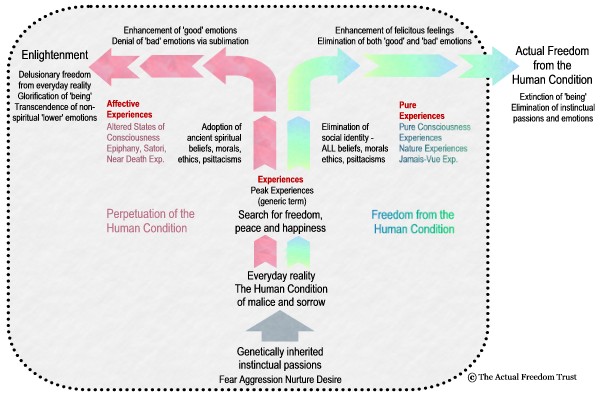
VINEETO: Hi Alan, I have dug out our diagram of ‘180 degrees opposite’ in the library and we have added two columns to it, noting the differing experiences that occur on the path to Enlightenment and on the path to Actual Freedom. Note that Peak Experiences, as the general generic term, can include affective-spiritual experiences as well as ‘self’-less experiences.
Given that everyone who has been searching for freedom up until now has been searching on the traditional paths, everyone has been searching for an Altered State of Consciousness type freedom. Out-of-the-ordinary experiences that occur in the pursuit of a permanent ASC aka Enlightenment are in general of the affective and imaginary kind and include near death experiences, feelings of dread, bliss, universal sorrow and oneness, epiphanies and Satoris as well as transgressing into atavistic psychic realms such as channelling, reading Akashic records, telepathy, etc. All of these experiences are epitomized by feelings, ‘bad’ or ‘good’ feelings. On the Actual Freedom side of the diagram we have listed the pure experiences that one has on the path to Actual Freedom – the Pure Consciousness Experiences. A pure experience can sometimes be known as ‘nature experience’ and as ‘Jamais Vu’ experience, provided that there is no affective component in them whatsoever. As Actual Freedom is totally new to human experience, and nobody has lived in a Pure Consciousness Experience before for 24hrs a day, every day, all expressions describing pure experiences are bound to be tainted, polluted and grabbed by ‘me’ at some time in the course of the experience. One needs to make a clear distinction between a ‘self’-less ‘nature experience’ and an affective experience wherein one merely marvels at nature with one’s heart full of beauty, love and religious awe. Richard provides clarification for this ‘self’-less type of ‘nature experience’ –
These ‘self’-less pure experiences are one’s ultimate authority, one’s guiding light and touchstone on the path to Actual Freedom. * ALAN: Yes, I agree – accuracy in use of terms is vital and the spiritually inclined use many slippery words. So, I think it is beneficial that we are further refining some definitions. I think we got off to a bad start. VINEETO: I don’t think I got off to a bad start at all. I’m simply trying to make clear some definitions that we frequently use and that we have been increasingly refining over a period of some three years. * VINEETO: I went searching on the net for Mr. Maslow’s definition of peak experience and found plenty of references. ALAN: I realised that what I was positing was different from his definition, which is why I began by saying ‘I have started by redefining ‘peak experience’’. On reflection, I did not put it over sufficiently well and it may have been better had I used a different expression, though I cannot think what – we are running out of adjectives! What I was attempting to do was differentiate between these experiences and the PCE, as you went on to illustrate in your mail. So we agree there – the difference is one of dimension, not just degree. VINEETO: I don’t quite understand, which kind of experiences do you think need defining and differentiating from the PCE? When I feel happy – that’s good, when I am excellent – that’s excellent, I enjoy it a much as possible. When an issue, a feeling or an emotion surfaces, then I investigate them in order to get back to being happy as quickly as possible. Should any affective experience arise on the path, then I know that I have something to look at, something to investigate. I am not so much concerned as to how I should differentiate between those affective experiences, even when they are ‘out of the ordinary’, but instead I am looking for the ‘self’ that is in action in all of those affective experiences. * VINEETO: Personally, I stopped using the term ‘peak experience’, because for an actualist it is absolutely vital to make a clear distinction between a selfless pure consciousness experience and an emotional/ spiritual peak experience, including any Altered States of Consciousness. Both ASC and PCE have been clearly defined and exhaustively written about on the Actual Freedom Trust website – thus I am of the opinion that introducing ‘peak experience’ would only confuse the distinction. ALAN: As I said, it was my attempt to do precisely this, which caused the confusion! While the PCE and ASC have been extensively written about, our current correspondence shows there is still some confusion – for me anyway – and I consider it would be beneficial to all to further examine and explore exactly what we mean. It is also fascinating to do so. To start with the ASC. From the library:
The first question to be addressed – is an ASC one and the same thing as ‘enlightenment’? From the above, the answer is plainly, yes. Though, in the quote you posted from Richard, he does seem to contradict this view:
I think we are agreed that enlightenment only occurs when the ego is permanently expunged, as happened to Richard in 1981 and, from what I have read, this seems to be generally accepted. VINEETO: Those who know by their own experience use the word enlightenment when referring to the permanent Altered State of Consciousness, the death of the ego, the expansion into Being. While one can revert to normal from a temporary Altered State of Consciousness because the ego is not permanently extinct, Enlightenment is an irreversible, permanent state where the feelings run rampant, now uncontrolled by any personal self or ego. Viz.:
There is, however, a vast diversity of how the word is used in New Age spiritual circles. On one of the lists, where Richard occasionally writes, I found the following correspondence –
For me, it is enough to have sufficient experiential knowledge of what I need to avoid – the instinctual grasp for ‘my’ psychological and psychic survival experienced in an Altered State of Consciousness. Now, from a state of Virtual Freedom, any Altered State of Consciousness would be dilapidation and has most definitely lost all of its former seduction of grandeur. * ALAN: Turning to the PCE, you wrote: VINEETO: In the interest of having clear, definable terms, a pure consciousness experience is just that – an experience of pure consciousness, where the ‘self’ is temporarily absent, completely. This means that there is no affective experience in a PCE whatsoever, no ‘love, bliss, rapture’ or the imagination of being ‘the saviour of mankind’. Whenever there is any feeling or emotion experienced whatsoever, it is not a PCE. For most people, the experience may well start as a PCE, but invariably ‘I’ will step in and seize the experience as ‘mine’ and interpret and feel it to be a spiritual experience. One needs to understand and practice actualism to be sufficiently aware of one’s beliefs, feelings and instinctual passions in order to avoid the trap of Enlightenment on the path to Actual Freedom. ALAN: This seems to contradict what Richard wrote to me – Richard: A ‘difference in degree’ sounds like an apt description ... I cannot, of
course, recall with 100% accuracy what happened twenty-odd years ago (plus there is too much other stuff that happened which blurs
precise recall), so I would have to say there was an affective response which varied from experience to experience from virtually
non-existent to full-blown grandiosity. VINEETO: Yes, I think, Richard is in trouble here. Joking aside, I’m sure he’ll explain it to you. * ALAN: This is the nub of what I am getting at – the affective response during the experience. I agree with you that, after the experience, ‘‘I’ will step in and seize the experience as ‘mine’ and interpret and feel it to be a spiritual experience’. I am discussing what happens during the experience – when ‘I’ am not extant. It may be that we need another definition for what these experiences are and you went on to define ‘peak experience’: ‘VINEETO: The affective response during the experience’ proves that the experience is not a PCE. Affective means there is the feeling ‘me’ present, alive and kicking as in. ‘When ‘I’ am not extant,’ when there is no ‘self’ whatsoever, there won’t be any affective response. * VINEETO: Peak Experience is obviously a generic term used for a wide variety of exceptional experiences, which can range from being very happy to feelings of great love or beauty, from pure consciousness experiences to epiphanies, Satoris or full-blown Altered States of Consciousness. ALAN: But, this is too wide a definition for what I am talking about. VINEETO: Exactly, it is because the term is so wide – that’s why we no any longer use the term peak experience. For actualism, I found it enough to make the distinction between any affective experience with the ‘self’ in action and a PCE with the ‘self’ in abeyance. ALAN: I mean experiences when ‘I’ am temporarily in abeyance – let us call it an ‘I’-less experience, for the moment. So, if I rephrase what I wrote:
I have added the words in square brackets. The PCE would then be defined as an ‘I’-less experience in which ‘me’, as soul, is no longer extant – i.e. there is no sense of self or being. VINEETO: From the library – Peter: In fact there are three I’s and only one is actual –
Which ‘I’ did you refer to, Alan? Given that there are three I’s, I find the term ‘‘I’-less experience’ confusing. My sole interest is to eliminate all of my ‘self’, both the normal ‘I’ and spiritual ‘I’, in order to be the actual I, ‘what I am’, this flesh-and-blood body brimming with sense organs. As such, any experience that is not a PCE, however unusual or seductive, needs to be thoroughly investigated. That’s what makes the pursuit of Actual Freedom so simple. The difference between the spiritual search and actualism is that spiritual people give great significance to a temporary absence of the ego in a out-of-the-ordinary experience, Satori or ASC, while for an actualist such absence of the ego only signifies the unabated and uncontrolled presence of the soul, the animal-instinctual part of the identity. Whenever one removes only one’s personal ‘self’, the ‘ego’, with one’s ‘soul’, the animal-instinctual ‘self’, still intact, this will result, by its very nature, in the ‘soul’ running amok, unfettered by a personal ‘self’, inevitably evolving into an impersonal ‘Self’. Given Richard’s experience of going through enlightenment and struggling to come out of it into the actual world, it is now an unnecessary, arduous and convoluted enterprise to unwittingly allow oneself to become enlightened and then torturously endeavour to free oneself of enlightenment ... ... in order to become actually free. In actualism one incrementally dismantles and eliminates both ego and soul, both one’s personal ‘self’ and the instinctual passions until both components of the identity become extinct in one great finale – bingo. I know there are a lot of terms that might seem confusing at first – ‘I’,
‘identity’, ‘self’, ‘ego’, ‘soul’, ‘social identity’ and ‘instinctual passions’. That’s why the Actual
Freedom Trust glossary or explanatorium, accessible through the ALAN: I have spent several days tinkering with and altering the above reply, including reading quite a bit of what I had already written on the subject. I wrote to Richard, shortly after discovering his web site – ‘I would like to explore the difference between PE’s, PCEs and actual freedom (‘AF’)’ – so it is obviously a subject which fascinates me!! VINEETO: I think it is great to bounce off ideas and clarify thoughts, and writing on the mailing list is the perfect opportunity for this. I am in the serendipitous position that I can talk to Peter and Richard and nut out my experiences along the way and from the past years I know how much thinking and reading and conversation that involves. It is indeed fascinating to make sense of the Human Condition.
VINEETO: What a pleasant surprise! Sounds like one lazy bird has nudged another lazy bird to reply. * VINEETO: I have stopped writing a few weeks ago because I seem to have written about and reported everything I know so far about Actual Freedom, and any further attempt so far appeared to me a mere repetition of what I have already talked about, available on the website. ALAN: I wonder if you are going through the same as I have for the past several months? I have not even been reading the mailing list much and am about 5 weeks behind (looks as though it has been quite lively!). I certainly have had a sense of, there is nothing new to write or report – and maybe that, in itself, is worth reporting. VINEETO: I don’t know what you have been ‘going through’, but I can tell you a bit about my recent life. Last October my correspondence on the Krishnamurti mailing list came to a conclusion, and apart from it being great fun, the conversations gave me valuable insight into the teachings and following of a yet another spiritual master. I have summed up the experience of writing on (Richard’s) Mailing List B at the time –
Since October there was simply no incentive to explore the Human Condition via writing on mailing lists and instead I have been exploring experientially the fact that I am utterly and completely redundant – in short, I have been practicing ‘doing nothing really well’ for the last several months. In this time I found that I am redundant as a ‘useful member of society’ and as a ‘friend’ to other friends, and by stopping writing on the Actual Freedom Trust mailing list I was able to examine in hindsight the role that I had played other than sharing useful information. I deliberately abandoned polishing my ‘baby’, the website, and did nothing of meaning or consequence that could give ‘me’ any importance in any way whatsoever. A training course in ‘doing nothing really well’ includes examining various shades of boredom, resignation, avoidance, feelings of redundancy and meaninglessness – doing bugger all day after day (apart from the obvious task of making a living) and sensately enjoying the simple fact of being alive for no other reason than being alive. To discover that I am already here anyway and that I don’t need to do anything to justify and prove my existence is not just the adventurous practice of whittling away the unwanted bits of ‘me’, it is ‘throwing the baby out with the bathwater’ as the complete redundancy of ‘me’ altogether. ALAN: I think I have also been examining the (for me) final unexplored instinct of nurture. I think I previously wrote that I had been having emotional reactions to certain scenes on television – tears running freely, without there being any obvious feeling extant. It seemed to occur when people were doing things which ‘brought out the best’ in humanity. At one stage, I even considered whether it could be some manifestation of Divine Love trying to sneak in by the back door, so to speak. But, I could detect little in common with my previous experiences of Divine Love – other perhaps than pathos and the fact that I would also then have wept at the same scenes. VINEETO: I found that the instinct of nurture shows up in many, slightly varying, expressions once one gets past the more obvious feelings of love, friendship, relationship, compassion and Divine Love. Watching human beings in all sorts of enterprises and mischief on the planet via television is and has been a great source of exploring my subtle and not so subtle ‘good’ instinctual feelings that all serve only one purpose – to keep me tied and connected to humanity as a suffering and malicious species. Having an opinion and affective response about what is supposedly ‘right’ or ‘wrong’, ‘good’ or ‘bad’ gets me going round in circles, while looking for the facts of a situation makes it obvious what is silly and what is sensible. And then, in most cases, my opinion and assessment is not required at all and taking sides only serves that ‘I’ stay in existence – emotionally engaged and connected to Humanity. Whenever I was moved by watching heroic acts of compassion or sentimental stories of
hope and love for all, I made it a point to investigate the facts of the situation that are so rosily presented. I always found
the loopholes, the unmentioned malice, the hidden selfishness, the suffering necessary for good deeds to happen and the inherent
sickness of the genetically encoded program we call the Human Condition. There is no good without evil – or, as The instinct of nurture has the sole function of keeping the species thoughtlessly producing yet more of the same, just as aggression, fear and desire have the function to keep the human species fighting against extinction. There is neither intelligence nor any other inherent value in our blind instinctual drive to nurture, it is the same drive that makes us attack others, defend our territory, fear the stronger ones and grab all one can grab in blind desire. I found Accidental Hero, the movie you mentioned, an excellent example of what can develop out of a sensible response to an emergency situation when the hero’s instincts and ‘self’-preservation catch up with him and everyone else’s ‘self’-centred passions make a confusing emotional drama out of a simple humane response. Lately we had here on the news 3 small children declared as national heroes for dragging their drowning grandfather out of the family swimming pool, whereas they just did the obvious thing in that particular moment. ALAN: Other than that, it has been a pretty unremarkable few months – almost zombie like and maybe it is now coming to an end, as I have noted in my post to Richard. Perhaps it has been a time of R & R for the troops, a mustering of resources for the final assault on ‘my’ psyche, eh! As you see, I have not yet lost all my Prima Donna abilities! VINEETO: It’s good to have you back writing, Alan. And there is not much ‘R & R’ when you discover that there is no hiding from being here because the faculty of hiding is disappearing into thin air. A few weeks ago I went to the dentist for a tooth extraction and, being a bit acquainted with Eastern spirituality he suggested that during the treatment I could go ‘somewhere else’ so as to avoid the discomfort and apprehension that usually comes with dental surgery. But there was nowhere else to go, the spiritual realm of imaginary peace and pseudo-security simply does not exist in actuality. I lay back in his comfortable chair with local anaesthesia while he wiggled my tooth out of the bone and was fascinated by the sensations in my jaw and the surprising absence of fear. In the face of fear, desperation and aggression the idea of a spiritual ‘somewhere else’ has been such an alluring promise that some people have even managed to reinterpret Actual Freedom as a promised land ‘somewhere else’. Making the practical method of actualism into a spiritual belief is merely another attempt to avoid being here as a flesh and blood body only. For me it was essential to investigate and eliminate all of my reasons for wanting to go ‘somewhere else’ – my aggression, my dread, my dissatisfaction, my desperation and my dependency on others – in order that I can enjoy being here in this moment of being alive. The daily ‘practice’ of enjoying being here over a considerable period of time – Virtual Freedom – weakens, and eventually eliminates ‘me’ and with it the insidious tug of wanting to go ‘somewhere else’ that has given rise to all the different spiritual beliefs and practices on the planet. What a fascinating time to be alive!
VINEETO: Good to have you back writing again. I do find it fascinating to hear what has been going on for you over the last few months. The last part of your letter to the list gives me an opportunity to report about my own experiences in the process of ending ‘me’. ALAN: Or could it even be that this is the end of the road, that Richard is a ‘freak’ and that for most people an actual freedom is not achievable. The few PCEs, which have occurred in the last few months, indicate that this is not the case. They have been of a different ‘degree’, as I wrote in my last mail to Richard. Peter has also written of this experience –
You may be correct Peter, and this is a period of ‘acclimatisation’. However, I am still left with the question Richard last asked of me – ‘what is preventing ‘me’ from proceeding?’ And I have got no further than the answer I gave some time ago – because ‘I’ want to remain in existence. VINEETO: The question that presses me on to proceed is this – ‘do I have the supreme confidence that ‘I’ will see my job through to the end, the irrevocable dissolution of ‘me’?’ The answer has been gradually changing – from ‘mmhh’ to ‘ah, yes, I think so’ to ‘o.k. let’s do it to get over with it’ to ‘what else is there preventing me’ to ‘ok, ok, I’m almost ready’ to ‘what am I waiting for’ to a more and more beaming, superbly confident ‘of course!’ – and the thrill of it is immensely sparkling and terrifyingly satisfying. In order to overcome my hesitation and my sometimes alarming fear I had to examine every inkling of my instinctual nurture and its resulting sympathy, compassion and atavistic universal sorrow for a suffering humanity to invoke a clean and non-affective altruism – because without also doing it for others there is no way of ‘me’ ever escaping the grip of my instinctual survival mode. I have experienced and come to see ‘face to face’ this raw animal survival instinct in action – that which drives me to silently scream or freeze in fear. This core soft-ware program of surviving at any cost is short and simple, it would fit on a floppy disk – at its most basic and primitive level it is: ‘what can I eat and what can eat me.’ Experiencing this core programming in action and understanding its purpose and consequences enabled apperceptive awareness and I became keenly conscious of adrenalin and other related chemicals racing through my system. After the chemicals subsided, all I was left with was a storm that had passed. A bit like – oops, what was all that about? It’s a great sport to live so close to the brink, Alan, as exciting as bungee jumping without a bungee.
VINEETO: I am once again head down, tail up into the website, this time with the self-invented task of dating all our posts and creating a chronological index that will appear as ‘selected archives’ on the Actual Freedom Trust website one of these days. It makes interesting reading to re-visit whatever has been written and talked about in the last 3 years on our mailing list and quite a few correspondents have come and gone. I do like our conversation about these topics of effort and altruism – to muse about them for several days now, discussing them with Peter, contemplating on them, and now being surprised at what comes out when I let my fingers run over the keyboard... * Now to your letter – ALAN: Yes, it is good to be writing again, though it took a huge effort to do so. I guess ‘I’ had found a way of avoiding proceeding further – by sitting back smugly and pretending ‘I’ had done all that was possible and there was nothing more to be done. After all I was virtually without beliefs, virtually without emotions, virtually happy and virtually harmless. Surely that was sufficient? Bullshit! Your reply has encouraged me to continue. To digress for a moment and expand a bit more on ‘I’ do not want to do so and it is much easier and more comfortable to retain the status-quo, even though it be epitomised by malice and sorrow. After all, these are the things ‘I’ thrive on. And it is pure intent which gives one the reason and the impetus to make the effort. It is pure intent which provides motivation to get out of ‘stuckness’. <snipped> And, once one has made the effort of ‘getting off one’s backside’, there is no longer any effort involved at all. VINEETO: Going by my experiences with whatever I have achieved in life and particularly with the successes that I have had with the method of actualism, I can only say that it always took enormous effort to move out of my initial inertia, apprehension and laziness and apply endeavour, diligence and persistence in order to reach my goal. The process of becoming free from the Human Condition is not something that falls into one’s lap whereby one only needs to stop resisting and then it will all happen by itself. It took courage and a immense stubbornness, that exceeded anything I have ever needed before, to extract myself from all of my inherited and deeply imbibed beliefs and social conditioning and to face and investigate my deepest fears and my wildest passions. The natural tendency of our ‘being’ is to ‘be’, to feel, believe and do as others feel, believe and do, to succumb to the sweet temptation of belonging and to fervently resist change – to ‘stay in existence’ as an entity, as you say. The gravitational force in human beings is to play safe, conform, stay as we are, to be feeling, deeply passionate beings – whereas to become free from being a feeling being requires continuous application of attentiveness, contemplation and effort. Of course, when a PCE occurs by a serendipitous ‘glitch’, sparked by ‘my’ gay abandon, and ‘I’ disappear for a temporary holiday, there is no effort to simply be here and delight in being this sensate, sensual and reflective flesh-and-blood body bouncing about in this perfect universe. But the ‘gravity’ of the instinctual passions soon pulls me back into being a ‘self’ and it has been my effort in the last four years to reduce that gravity by weakening the influence and fervour of both my social identity and my instinctual passions. This process goes little step by little step, finding and eliminating the more obvious beliefs and investigating the clearly evident feelings and then becoming more and more perceptive to the not-so-obvious beliefs and the subtler, mostly tender, passions disguised as beauty, desire, longing, love, need and dependency, compassion, sympathy and rapture. The belief that becoming free from the Human Condition requires no effort is certainly a belief and has its roots in the spiritual worldview that describes the world as Maya or illusion and therefore all one has to do is effortlessly change one’s perception, thus passionately imagining that ‘I’ have risen above Maya and the rules of Maya do not apply for ‘me’. The belief is that if only I follow the right ‘path’, the right god, have the right insights, realisations or ‘truths’, then I will be specially protected from the evils of the illusionary world. This particular belief fits very well with our inherent automatic reaction to always think of ‘me’ as being special and unique. Considering oneself to be immune to disaster, disease and death is a basic ‘self’-protective measure designed to hold fear at bay and to cope with all the frightening occurrences of danger, violence, death and disease we see in the world. From there it is only a little step to believe that, in the Grand Scheme of Things, sickness, disaster and sorrow only happens to the ‘bad guys’. When I dismissed the fairy-tale of the all-powerful Christian God who supposedly runs the universe and became a disciple of a Guru, it did not even dent my underlying subtler belief of being immune to calamity, disease, or fatal accident, it only got stronger. However, when several close friends including my revered spiritual master died, it finally hit home as a fact that death won’t bypass me just because I believe that I’m doing the ‘right’ thing. It was an enormous shock to realize that I was neither immune nor above it all, despite my following the ‘right path’. I started to comprehend that neither my ‘right belief’ nor my belonging to the ‘chosen ones’ nor following a perfect dietary discipline would save me from disease, old age or death, let alone loneliness and despair. Once that self-protective belief-structure was destroyed, it became increasingly impossible to see myself as special and unique, i.e. less bad, less mad or less human than everyone else. This first viral infection of the facts of life into my spiritual beliefs proved to be the instigating crack in the door that motivated me to further question what else I had blindly taken on board. * ALAN: And I have got no further than the answer I gave some time ago – because ‘I’ want to remain in existence. VINEETO: In order to overcome my hesitation and my sometimes alarming fear I had to examine every inkling of my instinctual nurture and its resulting sympathy, compassion and atavistic universal sorrow for a suffering humanity to invoke a clean and non-affective altruism – because without also doing it for others there is no way of ‘me’ ever escaping the grip of my instinctual survival mode. ALAN: Despite writing about it in my postings earlier this year, I seem to have ‘lost’ altruism, though I can recall a couple of weeks ago, while watching a programme on Northern Ireland, again ‘getting’ (as opposed to intellectually knowing) how unnecessary it all was. I find it very difficult to remember any experiences – I guess because there is almost no affective element contained in them. I can recall what I did yesterday, the day before and last week (sometimes with difficulty!). Not entirely sure what I am getting at here and perhaps it is a non point. But, to take the current example – I cannot remember experiencing altruism. I know that I did, because I wrote about it at the time. Is altruism a feeling? Or, perhaps it is something which can only be experienced during a PCE? VINEETO: And in your second post – ALAN: A bit more on altruism. After writing the mail to Peter, I guess I got ‘off my backside’! I was sitting in the garden reflecting on something Richard had written, when suddenly I ‘got it’. The peace and perfection and purity of this actual universe is here all the time – every moment for ever and ever and ever. And, this body is experiencing that purity and perfection for every second of its existence (the body’s existence, that is). Which led to the question – if that purity and perfection is always in existence why am I not aware of it? A few bricks tumbled down – because ‘I’ can never be aware of it. ‘I’ do not actually exist. ‘I’ am all that is standing in the way of that purity and perfection evincing itself each second. For so long as ‘I’ exist the purity and perfection (which is always there) cannot manifest. So, why should ‘I’ get out of the way and allow that to occur? Why should ‘I’ cease to exist? After all, ‘I’ am all that ‘I’ am. And, the only reason for ‘me’ to self immolate is to demonstrate to others that the actual world actually exists. To demonstrate that peace on earth is not only possible but, achievable. Hence, altruism. Of course ‘I’ cannot do it for ‘me’. ‘I’ can only do it for others and for the sake of peace on earth. Facts are such deliciously wonderful things, are they not? VINEETO: I used to have a bit of trouble defining altruism myself. When I discovered actualism the first thing I wanted was to become free for myself. In the beginning I couldn’t quite relate to an altruistic motive because I first had to investigate and eradicate the moral of unselfishness and the passion of compassion. I have written about unselfishness that had run deep in my original Christian conditioning and I think this I where your observation to Peter applies –
However, these acts are not done with an altruistic motive at all. People are merely obeying the morals of ‘thou shalt be unselfish and ye shall be rewarded in heaven.’ In order to discover my altruistic intent I first had to wipe out all traces of this particular moral in me together with the persistent feelings of guilt for doing something for myself instead of doing good in the world by trying to change others. When I first started applying the method of actualism I quite selfishly wanted to become happy and to get rid of my debilitating habits of misery, my crippling feelings of fear and my embarrassing bouts of anger and neediness. A few months into the process of investigating my emotions I noticed that I had also become less and less ‘self’-centred and less and less ‘self’-ish. This was something entirely different to the hypocritical moral of being unselfish because by taking apart my emotions and passionate beliefs I was breaking down the very content and substance of my ‘self’. In my actions I became more considerate of other people and more sensitive to others’ preferences and needs. That’s when harmlessness slid to the top of the laundry list and being happy without being harmless became simply impossible. At this point in the process compassion and universal sorrow started to come to the surface. By being less occupied with my own problems and less consumed by my own feelings – because they were simply disappearing into thin air – I started to clearly see the misery and fighting, the corruption and starvation, the injustice and torture, the rapes and murders, the child abuse and poverty, the devastating plagues and shocking wars that afflict everyone’s lives in one way or the other. There were days when I was simply soaked in helpless sorrow about the misery in the world, a misery so vast that it spread from one end of the planet to the other, an endless reservoir of sorrow stretching from the beginning of the human race until the present day. The only way to extract myself out of this overwhelming feeling of sadness for others was to apply common sense – it doesn’t help anybody that I sit in front of the television and cry my eyes out. However, it is clear that it certainly helps me and everyone else I come in contact with that I am becoming free from malice and sorrow ... and this is where the feeling-only state of compassion was turned into active altruistic intent. The feeling of compassion then became the action of altruistic intent – I am ploughing on despite my fears, against any tendency to rest in comfortable numbness in order to bring an end to malice and sorrow, to prove that actual freedom is possible – not for one person only but for anyone who wants it desperately enough. Peace on earth is not a small matter, it is enormous. Actualism is the participation in the process of making peace-on-earth a scientific, i.e. repeatable, fact ... to prove that it is possible to live free from the human condition, 24h a day, everyday. When actual freedom is proven to be repeatable then it is really an irrefutable fact. After I cleaned myself up from the moral of unselfishness and the blind passion of compassion, altruism started to become more and more apparent – not so much as a feeling but rather as a continuous striving towards my avowed aim of ‘self’-immolation. This altruistic intent results in the deliberate obsession to do whatever is necessary to turn the dream for peace into a fact and to be considerate, caring, good company, harmless and perfectly happy in the world as it is with people as they are. In order to turn my dream for peace into a fact constant application, stubborn determination and keen awareness are needed – in one word, effort. What fuels this effort is altruistic intent and this is what gets me off my butt every day. To sum it up – The process of actualism for me so far has been – to use Gary’s analogy of the Dutch boy with his finger in the dyke – to successively and deliberately dismantle and break down the ‘dyke’ of my social identity, thus allowing occasional ‘torrents’ of my raw instinctual survival passions to leak through. By this stage I was already virtually happy and harmless and as such experiencing the instinctual passions at their most basic did not result in any dangerous or malicious actions. By experiencing these passions in action I was able to examine and deeply understand their workings, giving particular scrutiny to the tender passions of nurture and desire, including any variation of love and libido, so as to safely avoid the famous trap of Enlightenment. In the course of this investigation I could more and more turn all these raw passions into fuel for one single obsession born out of my understanding of numerous PCEs – to altruistically ‘self’-immolate. This process via the state of being virtually free from malice and sorrow has worked for me so far and I personally cannot see how a simple realisation that ‘ if ‘I’ accept that ‘I’ do not actually exist then ‘I’ will cease to ‘be’’ could transport me from ‘there’ to here. However, I am merely reporting my own experience of what worked for me and other actualists could possibly discover other methods to become actually free. So far there has only been one hindsight report but I am determined to add to that, and soon. * VINEETO: It’s a great sport to live so close to the brink, Alan, as exciting as bungee jumping without a bungee. ALAN: I’ll pass on the latter. VINEETO: Well, you might find out that the difference between a temporary PCE and a permanent actual freedom is nothing but a missing bungee cord – ‘I’ can never return again.
VINEETO: A pleasure to hear from you, Alan. Your letter tempted me to add some comments to your ponderings. ALAN: As you will have seen, I have not posted to the mailing list for some time and have not read much either. Your email prompted me to ponder why. And I came up with: everything has already been said I had nothing new to report when the writing is not doing itself there is no point. VINEETO: I can only say that from my own experience with writing, that the writing is never ‘doing itself’. Apart from sitting in front of the computer and moving my fingers, I also have to put my brain in action, search for the appropriate words I want to say, often with the help of Thesaurus and Oxford dictionary, and then consider the grammar so as to convey as accurately as possible what it is I want to say. Sometimes it takes me a day or two to write a letter and in this time some processing happens that makes the issue I’m writing about clearer and more transparent to me. I always get something out of writing – it is as much part of my investigation into the human condition as is watching television, talking to people, doing nothing really well or working in the marketplace. ALAN: On further investigation, I discovered a belief lurking in the depths – that it seems to be just as difficult to attain a condition of actual freedom as it is to ‘achieve’ enlightenment. VINEETO: I’d like to throw in my observation that achieving enlightenment is
peanuts compared to becoming actually and permanently free from the human condition. Why do you think hundreds of people have
become enlightened in the last millennia while Richard is still the only one who is actually free? And to add my own experience as
evidence – some six months into my practice of actualism I arrived at I therefore agree with you that it is purely a belief – it is not ‘just as difficult’ but it requires much more sincerity and far more ploughing into the depth of one’s psyche to become actually free from the human condition in toto than it does to become enlightened. After all, in the identity-swapping fantasy of enlightenment one is merely replacing a shoddy ego with a grand soul, comparable to swapping a rusty old Morris Minor for a brand-new Rolls Royce, whereas for actual freedom ‘I’ am required to persistently and willingly whittle away at my very ‘being’ until ‘I’ arrive at a point where ‘my’ immolation is inevitable. ALAN: And, perhaps it is so. That does not, however, justify a cessation of investigation, because it is only a belief. I suppose if millions had investigated actual freedom and it had only been achieved by a handful, then there would be some justification. Until then – and knowing from the PCE what is possible – it would be logical to continue the investigation. VINEETO: For me nothing justifies ‘a cessation of investigation’, until the fat lady has sung. That is my aim in life and it does not matter how long it takes because for me there is no other game to play that is worth playing. I left the real world behind when I found that it sucks and I left the spiritual world behind when I found it to be a shallow fantasy and a hypocritical delusion. ALAN: Having come this far, surely it would be worthwhile continuing a bit longer? VINEETO: An actualist is investigating issues that are at the forefront of human evolution, pursuing something that has never been done before in human history, penetrating not only ancient beliefs commonly-held truths and superstitions, but also exploring experientially sacred feelings and the core instinctual passions themselves. By examining the whole range of the ‘good’ emotions and socially sanctioned feelings as well as those deemed bad and unacceptable, one is venturing beyond the universal human threshold – beyond humanity itself. In actualism one is reprogramming one’s brain that has been genetically programmed for survival and procreation as well as socially and spiritually conditioned to ensure that each new member born fits in with the existing status quo of humanity – given the all-inclusive scope of this reprogramming, it is certainly not a small thing we are doing. Therefore it is not only ‘worthwhile continuing a bit longer’, but to me it is the obvious only thing to do – to pursue this task until it is done. ALAN: And therein lies the problem. Having stepped up to the brink, so to speak, in the first half of last year, ‘I’ know there is nothing more to investigate, no more discoveries to be made. The only thing left is the final step, the complete elimination of ‘me’. VINEETO: How can you say that ‘you’ ‘know there is nothing more to investigate’, when ‘you’ are the very entity that is to leave the stage in order for you, the flesh-and-blood body, to be free? How can you say that there are ‘no more discoveries to be made’ when you just reported discovering a belief ‘that it seems to be just as difficult to attain a condition of actual freedom as it is to ‘achieve’ enlightenment’? I know at times I was as impatient as you seem to be and I consequently got upset when I still discovered another bit of ‘me’ and then another, until I realized that it was the very expectation that freedom should fall into my lap tomorrow that was preventing me from continuing to sincerely question every little bit that ever keeps me from being happy and harmless 24 hours a day. Two days ago I re-discovered something that I had known before in a PCE but experientially ‘forgotten’ since. I was busy watching a report on National Geographics where several guys were chasing and filming a big tornado in Colorado, US, in order to get more accurate data for weather predictions and also for the thrill of the adrenaline rush of being so close to danger. Suddenly something in me snapped and an ever-so-subtle tension of feeling a part of their adventure disappeared when I realized that I was here safely of my couch, while they were there, on the other side of the globe, in stormy and rainy weather. With the absence of this subtle tension I also realized that a thin thread of emotional connectedness with humanity is almost always latently present, ready to become apparent at the tiniest trigger. My receiver for psychic currents is almost always automatically switched on, connecting ‘me’ to humanity, and it is these subtle psychic currents that I am going to be watching now more closely in order to ween myself away from these insidious bonds to the passions that exemplify human-ness. I found again and again that it is not enough to discover something once and then rest in the assurance that ‘I know it now’ but I also have to put this understanding into practice until it is part of my daily experience, actual and tangible, an obvious and undoubted fact, an implicit experience on a cellular level. That’s what takes time, and constant practice. There is a constant leaning forward, as it were, inherent in being a practicing actualist, which means one is actively and increasingly progressing towards one’s goal. And to round it up to what I said at the top – writing is part of this practice because when I am forced to put my understanding into coherent words and explain my understanding to someone else, then a mere mental understanding won’t do, I’ll have to have walked the talk in order to be able to know and have experienced what I am talking about. ALAN: And so, I am left with the question you first asked on 28 January 01? Viz.:
My only answer, at present, is fear. And from 10 June 01:
Yes – and only as required by the circumstances – and the circumstances have not yet arisen! Alan to Richard, 7.6.2001 VINEETO: Do you mean to say there is a right time when the right ‘circumstances’ arise and then actual freedom will happen on its own accord as in ‘when the writing is not doing itself there is no point’? From my experience serendipity only happens when I take the opportunity presented to me with both my hands and go for it. In actualism I am the master of my own destiny because ‘I’ make the circumstances happen that eventually lead to ‘my’ extinction, whereas in my spiritual days I used to wait for circumstances – or a sign from Existence – that should announce my ripeness for liberation. Needless to say it never happened. Personally I have been very suss about everything that sounded like ‘it just happens’ or ‘you only have to stop believing the wrong beliefs’, because that was exactly the essence of the spiritual chimera I chased for seventeen fruitless years. Actualism appealed to me because, for the first time, I found a method that was totally concerned with hands-on practice. The practice of actualism evinces genuine practical change as opposed to a mere altering or adjustment of ‘my’ consciousness and it produces tangible results as opposed to an imaginary climb up a spiritual ladder to ‘somewhere else’.
VINEETO: I can only say that from my own experience with writing, that the writing is never ‘doing itself’. Apart from sitting in front of the computer and moving my fingers, I also have to put my brain in action, search for the appropriate words I want to say, often with the help of Thesaurus and Oxford dictionary, and then consider the grammar so as to convey as accurately as possible what it is I want to say. ALAN: When I say the ‘writing doing itself’ I mean spontaneously flowing, words tumbling over themselves to get on the page (or screen), thoughts clamouring to be expressed – this writing is me, it is no longer ‘me’ doing this writing. VINEETO: According to your formula of waiting until ‘it is no longer ‘me’ doing this writing’ I would have to be actually free before I would write about my experiences in becoming free. * ALAN: On further investigation, I discovered a belief lurking in the depths – that it seems to be just as difficult to attain a condition of actual freedom as it is to ‘achieve’ enlightenment. VINEETO: I’d like to throw in my observation that achieving enlightenment is peanuts compared to becoming actually and permanently free from the human condition. Why do you think hundreds of people have become enlightened in the last millennia while Richard is still the only one who is actually free? ALAN: Because only a handful (measured in the hundreds, at most) of people have, so far, even heard of actual freedom, let alone investigated it? VINEETO: The point I was trying to make is that actual freedom has only be discovered a few years ago for the simple reason that no one had dared to question everything, both the ego and the soul, whereas many have dared to question the ego and then aimed and settled for the delusion of enlightenment. An actual freedom from the human condition has always been available – it is only that Richard was the first to dare to question everything. ALAN: By Richard’s account, achieving the delusion of enlightenment is much more difficult than accepting what actually exists. VINEETO: ‘Accepting what actually exists’ is a spiritual term promoting the idea that the ‘I’ which resists to ‘what actually exists’ transforms into the ‘I’ which accepts ‘what actually exists’. And J. Krishnamurti for one made it very clear what is meant by ‘what actually exists’ –
In the process of actualism I am not aiming at ‘accepting’ ‘what actually exists’ but I dismantle the entity that prevents me from experiencing the perfection that is always already here. Only when the entity is not, does this perfection become apparent. For ‘me’, the social-instinctual entity, it is much easier to become enlightened than to disappear off the stage forever – that’s the very reason why nobody has done it before Richard. * VINEETO: And to add my own experience as evidence – some six months into my practice of actualism I arrived at an altered state of consciousness that had all the elements of enlightenment and only Richard’s strong warning not to run aground on the Rock of Enlightenment and rigorous sincerity saved me from entering permanent delusion. ALAN: Yes, the Glamour and the Glory and the Glitz is a mighty attractive proposition for ‘me’ when the only alternative is oblivion. VINEETO: For me, the only way to deflate this ‘mighty attractive proposition’ was to experience an altered state of consciousness with my wits intact and get as much information out of it as possible. Because I was able to both experience and observe this deluded state, I knew by my own experience that an ASC is indeed a poor choice compared to a pure consciousness experience. For me, this clear experiential observation was the end of the attraction of ‘the Glamour and the Glory and the Glitz’ and the rock of enlightenment eventually disappeared over the horizon. * VINEETO: I therefore agree with you that it is purely a belief ... ALAN: Perhaps I should have said, ‘a passing thought occurred’ rather than ‘found a belief lurking’. Perhaps ‘I’ seized on the opportunity to post something interesting to the mailing list? VINEETO: I always found it essential to be attentive to my thoughts in case there is a belief lurking or even a feeling or emotion that I have rationalized away by calling it a thought. * VINEETO: ... it is not ‘just as difficult’ but it requires much more sincerity and far more ploughing into the depth of one’s psyche to become actually free from the human condition in toto than it does to become enlightened. After all, in the identity-swapping fantasy of enlightenment one is merely replacing a shoddy ego with a grand soul, comparable to swapping a rusty old Morris Minor for a brand-new Rolls Royce, whereas for actual freedom ‘I’ am required to persistently and willingly whittle away at my very ‘being’ until ‘I’ arrive at a point where ‘my’ immolation is inevitable. ALAN: As above, it is a mightily attractive proposition for ‘me’. This does not, however, mean that an actual freedom is more illusive than ‘enlightenment’ – merely that the seduction of ‘enlightenment’ will be apparent (and a pitfall) to all those who earnestly investigate the possibility of actual freedom. VINEETO: I know by experience that it is possible to get past this ‘mightily attractive proposition for ‘me’’ by examining experientially the mighty feelings of attraction as compared to the actuality experienced in a PCE long before ‘self’-immolation. The other point is that if you have done a thorough demolition job on your spiritual beliefs, the idea of ‘getting out of it’ by escaping into an imaginary Greater Reality is seen to be patent nonsense. It may be attractive in theory but the more you progress in demolishing your ‘self’ the more you delight in the sensory experiences of the physical world. * VINEETO: For me nothing justifies ‘a cessation of investigation’, until the fat lady has sung. That is my aim in life and it does not matter how long it takes because for me there is no other game to play that is worth playing. I left the real world behind when I found that it sucks and I left the spiritual world behind when I found it to be a shallow fantasy and a hypocritical delusion. ALAN: And, for ‘me’, ceasing the investigation is what ‘I’ most want. VINEETO: The other day I heard a woman say in a TV drama discussing her emotional state: ‘I like being messy because that’s who I am’. I find her statement a good description of normal existence because to be a social-instinctual identity is to be emotionally messy. In that context, my sincere intent is that I don’t ‘like being messy’, both for my own sake and for that of others, no matter what consequences it has to ‘who I am’. Speaking personally, rather than wanting to ‘cease the investigation’, I have found the process of self-investigation both thrilling and fascinating – it gives ‘my’ life both meaning and purpose. The way you formulated your reply it appears that there is a ‘me’ who wants to be actually free and a ‘me’ who doesn’t. Yet in fact there are not two ‘me’s’, there is only one entity, who may sometimes want to be free and other times not want to be free. With the memory of the PCE ‘I’ could clearly see that ‘I’ am standing in the way of perfection and therefore ‘I’ agreed to take ‘myself’ apart. The impetus to examine, investigate and change comes from ‘me’ – ‘I’ am willing to die because ‘I’ have unmistakably understood it to be the best and only solution to the human condition. Once ‘I’ made the full-hearted decision to actively stage my own disappearance, the journey became easier and I could make use of my instinctual passions to help ‘my’ mission. Now desire helps me to achieve the best possible, aggression to stubbornly stick to my goal, nurture to altruistically sacrifice my ‘self’ for the benefit of this body and every body, and fear, well, fear gives me the impetus to end fear forever. But it is ‘me’, and only ‘me’, who is willingly doing all the work of becoming free. For comparison –
ALAN: Perhaps this is where there is an advantage in living with like-minded people – it is more difficult to ignore? VINEETO: Other like-minded people, i.e. practicing actualists, are of no benefit whatsoever as long as ‘what ‘I’ most want’ is ‘ceasing the investigation’. Unless an actualist is eager to roll up his or her sleeves and do something in order to become free from the human condition, other people who talk about their experiences with the method and demonstrate its success by being increasingly happy and harmless can even be perceived as nosy intruders. Personally, I cannot ‘ignore’ the lure of actual freedom, not because I live with Peter or occasionally chat with Richard, but because I am haunted by the memory of the perfection that already always exists and that only becomes apparent when ‘I’ am absent. My backpressure to become free doesn’t come from ‘like-minded people’ asking probing questions but from having tried the normal-world and spiritual-world solutions and found that they failed. * ALAN: During my sojourn in the sun, I again experienced the pain at the base of the skull, which Richard well described. Despite the excellent search facility, I have been unable to find the pertinent quote – it was something like he experienced it as a rearranging of the brain cells. VINEETO: I presume this is the part of Richard’s journal that you are talking about –
The ‘turning over’ happened as part of Richard’s enlightenment experience, and so far nobody knows if it also occurs when one is becoming actually free. Given that there are no comparable data on physical symptoms relevant to the process of becoming actually free, I have learnt to disregard physical phenomena such as tensions in the neck or ‘pain at the base of the skull’ as having any relevance to where I am on my journey to actual freedom. I measure success rather by the tangible increase of happiness and harmlessness and by the fact that I sensately enjoy being here for longer and longer periods of time. In that I consider it great success that the desire to ‘go somewhere else’ into some imaginary feeling state has completely disappeared. ALAN: I am convinced that this is what is occurring and was greatly encouraged by a recent television programme about people who have had strokes. Using brain-scanning equipment, it showed that new pathways were formed in parts of the brain, which had not been damaged, which enabled the stroke sufferers to regain some of the functions, which had been lost. So, it is possible to realign the neurones and eliminate the instincts – the brain is not ‘hard wired’. VINEETO: As far as I understood the brain research from empirical scientists like Joseph LeDoux, the brain is indeed capable of re-wiring. It seems to be capable to form new synapses and old, unused synapses seem to wither away. However, this is but a working theory, as there are no verifiable visible data on what the brain cells actually do when the ‘self’ is expunged nor what happens while I am investigating my social conditioning and my instinctual passions. What is verifiable, however, is how I experience life, how I am with other people and how clearly I am now able to understand how ‘I’ tick. * ALAN: And therein lies the problem. Having stepped up to the brink, so to speak, in the first half of last year, ‘I’ know there is nothing more to investigate, no more discoveries to be made. The only thing left is the final step, the complete elimination of ‘me’. VINEETO: How can you say that ‘you’ ‘know there is nothing more to investigate’, when ‘you’ are the very entity that is to leave the stage in order for you, the flesh-and-blood body, to be free? How can you say that there are ‘no more discoveries to be made’ when you just reported discovering a belief ‘that it seems to be just as difficult to attain a condition of actual freedom as it is to ‘achieve’ enlightenment’? ALAN: As I said, above, perhaps it was not a ‘belief’. There was certainly not the ‘seeing of a fact’ that accompanies the discovery of a belief. VINEETO: Even thoughts can contain beliefs because your statement was certainly
not a fact. Further, the moment ‘there is nothing more to investigate, no more discoveries to be made’ will be the
exact same moment of ‘your’ extinction. For me as an actualist, the examination of the psyche is not over until that happens.
If you read Richard’s description of becoming actually free, you will notice that he describes ‘a vast understanding of the
enormity of the Human Condition’, brought on by contemplation about ‘attitudes toward the environment’, that
pulled the carpet from under his psyche, so to speak. He continually searched, contemplated, questioned, probed and examined until
his understanding ‘of the enormity of the Human Condition’ was complete – and there was no time gap between that
complete understanding and actual freedom. ( * VINEETO: I know at times I was as impatient as you seem to be... ALAN: No, there is no impatience at all. VINEETO: ... and I consequently got upset ... ALAN: and no upset VINEETO: OK. * VINEETO: ... when I still discovered another bit of ‘me’ and then another, ALAN: I suspect there is no more bits of ‘me’ to discover, which is what I was trying to say. There is only the basic ‘me’ left – ‘me’ at the core of ‘being’ – ‘being’ itself, which is ‘me’. Hence, no more discoveries to be made, nothing more to investigate – only oblivion. VINEETO: For me, the very activity of constant attentiveness flushes out previously obscure objections to being here and sometimes this process can bring instinctual passions to the foreground. It is not ‘oblivion’ I am looking forward to but an ever increasing sensuous awareness and the sensate enjoyment of being here, less and less interrupted by the automatic affective interpretations that are the very attribute of the human condition. * VINEETO: My receiver for psychic currents is almost always automatically switched on, connecting ‘me’ to humanity, and it is these subtle psychic currents that I am going to be watching now more closely in order to ween myself away from these insidious bonds to the passions that exemplify human-ness. ALAN: Continuing on from what I posted yesterday, I can no longer ‘feel part of’ anything I watch on TV. I have only, now, realised this from what you posted, above. Nor can I ‘empathise’ with another – understand their feelings, sure. I still have a ‘tear reflex’, discussed with Richard some time ago. Tears appear when watching certain scenes on television, yet there is no ‘feeling’ associated with them. So, perhaps I do still have something to investigate – but what to investigate when there is no feeling? VINEETO: As long as ‘I’ am a ‘being’ there is feeling. And, as we discussed years ago, a feeling can disguise even as a ‘no-feeling’ if I have an investment in not feeling. But it might also be something different. Viz. –
* VINEETO: And to round it up to what I said at the top – writing is part of this practice because when I am forced to put my understanding into coherent words and explain my understanding to someone else, then a mere mental understanding won’t do, I’ll have to have walked the talk in order to be able to know and have experienced what I am talking about. ALAN: I like that – ‘I’ll have to have walked the talk in order to be able to know’. And maybe that is what I mean by ‘the writing doing itself’. Unless I am writing from my experience of what is occurring there is no point in writing. VINEETO: Now I understand what you mean by ‘the writing doing itself’, but you can always write about what you are experiencing now. After all, the whole purpose of this mailing list is to share personal experiences, no matter what the experience – good, bad, uncomfortable, excellent and so on. To write about actualism without reporting one’s own experience is a waste of time and there is already too much of vain waffling and vacuous wanking in the world. I only started writing because I had tried out Richard’s method as to how to become happy and harmless and was fascinated how well it worked. Even today, some of my letters on this list may take days to complete because writing is often an incentive for me to contemplate over an issue, to discover a subtle feeling about the topic and to more clearly understand a certain aspect of the human condition. That’s what makes it so fascinating. Vineeto’s & Richard’s Text ©The Actual Freedom Trust: 1997-. All Rights Reserved.
Disclaimer |