|
Selected Correspondence Peter Naiveté
GARY: But I do, I think, recognize you and some of the others to be ahead of me on the road. I struggled a bit for awhile with the whole process of making Richard into a hero or a guru, and I am by now well acquainted with the process, having been sucked into it in the spiritual world and also as a part of my enculturation and conditioning. But I am not making you nor Richard nor Vineeto into any kind of heroes. I do think that you and the others are extremely perceptive, or I might say discerning. For instance, your recent post to me on sex came like a swift kick in the rear end and got me off my backside and into action about some things. I seem to be hearing from people lately that I am ‘too intellectual’ and it almost seemed to me like you were saying the same thing when you advised that, although thinking about issues is essential on this path, it is no substitute for doing it. So thank you Peter for the swift kick in the pants. I also agree 100% when you say it is important to let down one’s guard. PETER: Again at the risk of seeming over pedantic, you are on your own in this exercise, which is exactly what makes the process so thrilling. Nobody but you can journey into your psyche, nobody but you knows what is the next thing you have to do, the next vital issue to be faced. I have no special perception, or sense of what is going on, other than what you report and all I, or any other experienced or expert actualist, can do is pass on knowledge, experience and technique – the most valuable of information, for it is all factual. I like the term ‘to let one’s guard down’. It addresses the issue of one’s instinctual survival
program, it requires an active naiveté, and it allows one to experience firstly one’s personal psychological and emotional programming and then
to experience the collective psychological and emotional programming of the human species. It beats spiritual vulnerability by two country miles
for the spiritual people retreat inwards and create a protective bubble around themselves in order to be ‘present’ in the world. To let one’s
guard down is to be considered insane by both real world and spiritual world viewpoints, which is why neither will understand what you are doing
– but that is simply the way it is for all pioneers. * PETER: Courage and intelligence has a way of eventually winning out over brute fear and superstition – a brief view of the facts of history attests to this. We don’t live in caves and hunt like animals anymore, we just instinctually act as if we do because that is the way we have been programmed to act. It is if of no use at all to feel guilt or shame about this genetic programming, or feel resentful or be cynically embittered about one’s lot in life – the situation we find ourselves in calls for an unfettered investigation and the instigation of sensible action such that we can become free of this condition we are all inevitably born into. GARY: You are optimistic. Usually when I look at the facts of history, I see brute fear and superstition winning out over courage and intelligence. I say that because I see that the human species has been unable to, despite the ardent hopes of many for a solution, end war and eliminate violence. If we as a species were so intelligent, we would have learned something from all this bloodshed down through the ages. Perhaps I am being a pessimist. It is true that we don’t live in caves and hunt like animals anymore, but doesn’t the observation that we instinctually act as if we do negate your observation about courage and intelligence? Maybe, though, I am taking this the wrong way. PETER: I am neither optimistic nor pessimistic, neither a soothsayer nor a doomsdayer, neither gullible nor cynical. What I am is naïve. For whatever reason I could not fully turn away into acceptance and the escapist fantasy of the spiritual world, nor was I sucked into resignation and the fatalistic cynicism of the real world. Methinks you are thus far underestimating the significance of actualism and its tried and tested method of eliminating malice and sorrow, which is more than understandable. This is no little thing we do here – the very beginnings of the ending of war, rape, murder, torture, child abuse, corruption, despair and suicide is being forged on this mailing list. It’s the only game to play in town. * GARY: It is remarkable how firmly the Christian fairy-tale has gotten a hold of people down through the ages. But understanding something about one’s emotions, passions, and calentures helps one to see the enormous emotional appeal of religion to ‘me’ as a soulful entity. I like what you said about spiritual talk being ‘music to my soul’. It is indeed so. At one time, not so long ago in fact, I thought that the enormity of the bloodshed of the World Wars, Nazism, nationalism, etc, etc., all the tremendous turmoil of the last hundred years or so in the West, could be blamed all on Christianity. But I think that is a gross oversimplification. The problem really is the emotions, passions, and calentures. Religious figures whip up such passions in their followers. I remember clearly being in the grip of such powerful emotions and it is indeed potent stuff. At the time, I had little or no understanding of the destructiveness of these emotions. It was interesting to read the article, a while back, on the Actual Freedom website about the relation between Zen Buddhism and the Japanese warrior cult and atrocities that were committed during WW2 by the Japanese. Also, the article about the atrocities in China. This is important information. Christianity, as one of the world’s major religions, is not the only religion that inclines its followers to violence. I can clearly remember believing that the religions of the East were much to be preferred because they had ushered in a reign of peace and harmony in the Eastern world. Clearly not so. This is another myth we have been fed. PETER: I have posted links tothat article (http://www.darkzen.com/) to several people, but have never received comment back. The revelations cut to the quick of what can happen if one takes the belief that ‘I am not the body’ to heart – complete and utter dissociation from what ‘the body’ is doing and what is actually happening. In the town where I live there are many people practicing martial arts, all of them seemingly in ignorance of the real significance of the philosophy that underpins the practice. What is most clear for me is that dissociating from and feeling that one has transcended the malice and sorrow in the world can only be achieved by dissociating from one’s personal malice and sorrow – or to put it into play ground language, ‘I am one of the good guys and the others are the baddies’. As you said, there is indeed a great deal of myth about peace and harmony in the East, yet a little reading reveals an almost continuous history of warfare, conflict and brutality in the East exactly as there is in the West. Further, the combination of a fatalistic acceptance and dissociative religious beliefs has ensured the faithful believers, in India in particular, remain ensnared in appalling poverty and suffering. It is amazing to think I once believed that the religious philosophy that enshrines and perpetuates the poverty, repression and superstition in India was Wisdom or the Truth, but then again I was simply thoroughly investigating the only alternative to being normal that was available at the time. It is an interesting exercise to be able to look back over my life experiences without any emotional memory clouding or colouring the events. What I see is ‘failure’ writ large and clear. I am definitely a failure in real world terms. I have failed at love – and eventually I gave it up. I have failed to find meaning and fulfillment in my career – eventually I worked in order to buy myself time to do nothing. I have failed at fatherhood – I eventually gave up when my son was able to take care of himself and I cut my emotional bonds. I failed to be a ‘good’ member of society for I saw no sense in fighting for causes while blaming others for the ills. In short, I failed to play the game of belonging, or not belonging, to the various groups that make up society and I failed to play the games I was supposed to play. With the benefit of hindsight, whenever I found something that didn’t work, and by its very nature was unworkable, I eventually abandoned it and kept looking for a better way of doing something – to find something that actually worked. It was exactly the same thing when I was on the spiritual path when I eventually discovered and finally admitted religion/ spiritualism didn’t work and never could work to bring peace on earth. Again in hindsight, it is clear to me that the most important attribute that kept me from settling for
second best was integrity, combined with a naïve and deep-seated desire for peace on earth.
GARY: One of the realizations I had recently, after all the business of quitting my job, was that spiritual values, or spiritual-type thinking still has a hold on me. I still have within me, probably from hundreds of thousands of years of conditioning, the tendency to think of myself as a flawed ‘sinner’, which results in considerable ‘self’-castigation and ‘self’-loathing. I thought I saw this rather clearly in operation when I was filled with ‘self’-recriminations and ‘self’-criticism after leaving the job. I measure myself to an impossible standard of perfection, and naturally do not measure up and then berate myself most strenuously. I literally flagellate myself. It is, I think, a hangover from my spiritual days. It is form of behaviour which characterizes spiritual believers who blame themselves when they do not measure up to the impossible standards of their chosen spiritual teachings. I observed myself doing the same thing with actualism. Turning it into some kind of Almighty system that I had to measure myself against, and then berating myself because I didn’t measure up. It is something that was quite literally operating in my own psyche and not something that I have picked up from actualism. This is, I think an important insight, and I have caught myself up to the same shenanigans from time to time since then and I am quicker on the uptake this time. So, I think I am still extricating myself from the spiritual world, even though I do not hold any blatant spiritual beliefs, I do still have spiritual-like thinking and behaviour which causes me to berate myself mercilessly. I’m about sick of it and want something better for myself. PETER: I can assure you that what you are going through is par for the course for an actualist. It is not something I have written about much but it is something that everyone will go through in one way or another. I saw myself as being so perverse that I would never entertain doubt in all my spiritual years, turning a blind eye to all sorts of shenanigans and skulduggeries, and yet here I was, not prepared to give my all to becoming happy and harmless. I eventually came to recognize what an extraordinary level of gullibility is required to be a spiritual believer and what an extraordinary level of naiveté is required in order to deliberately set upon a course that leads to ‘self’-immolation. Always the memory of the potential of what is humanly possible – as I know from a pure consciousness experience – would serve to lift me out of any downward spirals. The only solution to being continually consumed by these entrenched feelings is to make your own pure consciousness experience your focus, your objective. This way any dodgy comparison, insidious feelings of guilt and doubt and impractical notions of perfection are all seen for what they are – ‘me’ raising all sorts of objections to ‘my’ demise. It is as though you attach a rope or mental thread to your PCE and use it as a guide to what is your touchstone or loadstar – the exemplary innocence of a ‘self’-less experience. Until you are actually free from the human condition, the living of a pure consciousness experience 24 hrs. a day, everyday is ‘your’ goal, ‘your’ measure, ‘your’ standard ... and ‘your’ business to do. This is what makes actualism – the business of becoming free of the human condition – the adventure
of a lifetime.
PETER: Well, having said that about writing, I do enjoy our correspondences and their increasing casualness and intimacy, so no doubt I will keep on keeping on, for as long as they go on. I was re-reading some of our past correspondence before filing them away and a few topics caught my eye to make comment on. There is neither rhyme nor reason to the selection, and no continuity at all between the topics, hence the title pot-pourri for this post. GARY: Having access to these discussions is an invaluable help because without the encouragement and ability to compare notes with others one might easily despair and give up. Few people that I come into contact with in my day-to-day life seem to be interested in ‘becoming free from malice and sorrow’. Having an infusion of the energy and enthusiasm of others from time to time for the process of actualism is an invaluable aid, and it is what this mailing list was set up for. PETER: I was talking to Vineeto the other night about our life experiences and what lead us to actualism. A common thread was a dissatisfaction with the pseudo peace of the spiritual world – the sham of the talk and feelings of ‘we are all one’ vs. the actuality of the selfishness, divisiveness and isolationism of all religious/spiritual fantasies. Many of our contemporaries coped by being cynical about ‘the organization’ or the people in it and went on about their own selfish pursuit of Self-realization while others adopted a Sunday-spirituality approach to life. In talking we both agreed that cynicism is the pits – it hurts, as it is the most debilitating of human attitudes. So overwhelming is cynicism both in the real world and the hallowed cloisters of the spiritual world that the only way to continue spiritual pursuit is to pretend to be absolutely gullible in order to veil the underlying pain of cynicism. Spiritual followers need to be absolutely gullible in order to abandon all intelligence and common sense, to turn a blind eye to all the ‘evils’ perpetrated in the name of ‘goodness’ and to opt for believing puerile fairy stories that there is life after death for ‘me’ as a spirit-only being in an imaginary spirit-world. To be a spiritualist one needs to be both deeply cynical about human existence on this fair planet and absolutely gullible in order to believe in the archaic fairy stories of good and evil spirits. It takes an enormous amount of naiveté to consider that there is indeed a third alternative – that peace on earth, in this lifetime, as this flesh and blood body only is not only possible, but definitely attainable. To be an actualist it is imperative to abandon cynicism and gullibility and actively cultivate naiveté – the closest thing to actual innocence. PETER: ‘To be an actualist it is imperative to abandon cynicism and gullibility and actively
cultivate naiveté – the closest thing to actual innocence.’ * GARY: I remember you talking about ‘cranking up one’s naiveté’ in a long ago post and I didn’t exactly know what you meant at the time. I am not sure I know exactly now either but I think I have a better inkling of what this means. When one is experiencing naiveté, there is not that curious ongoing sense of being ‘on guard’, defence systems at the alert, on the lookout for threats and evil, that there is usually in the self-centred experience. I sometimes experience this, for instance, at work when I am going about my duties, just doing the next sensible thing and not worrying about the outcome. It is really a wonderful experience and each moment is experienced more fully and seems in some way to be set apart from every other moment. There is not that sense of continuity or time. I don’t know how to put this exactly but it is something that I have noticed at other times and it seems important to describe it. Despite the feeling that I don’t know exactly what the hell I am talking about, I shall try to describe it. Each moment in time, the present, is so utterly fascinating and enjoyable that when one is experiencing naiveté (or at least what I think is being described as naiveté) there is no sense of this moment being other than ‘now’ – it is somehow set off from or set aside from one’s ordinary sense of there being a past, present, and future. Perhaps because there is no intervening ‘me’ with my cares, worries, anxieties, anger, resentment, and longings, there is not that centre by which everything is judged relative to ‘me’ and ‘my life’. Does that make any sense? One is fully engaged in experiencing the delight of living in the present moment, and one goes about one’s day meeting people, interacting freely, and events happen of their own accord, unaffected by any ‘me’ pulling the strings making things happen. There is no sense of strain whatsoever and if strain does arise, it arises chiefly because there is a controller, again – ‘me’ – calling the shots and controlling events. This is, at the moment, my best description of the closest thing to innocence. By fully experiencing the delight in being here at this present moment, I am blithely unaware of any dangers encroaching – I am not caught up in the instinctual drama of survival. I am free to be here and enjoy the company of other people as I like, or, alternatively, to be by myself and enjoy the solitude. PETER: Yep. And there is no greater cynical self-isness than to seek a greater reality, or an ‘actual reality’ as some now refer to it, and thereby accept that the on-going reality of the human condition on this fair planet need not, or indeed can not, be changed as it is somehow part of some perverse divine and therefore ‘perfect’ plan. To preach this nonsense is to actively perpetuate the ancient dualistic beliefs of Good and evil, Right and wrong, Truth and illusion, Spiritualism and materialism, Glory and damnation, Heaven and hell. An actualist sets his or her sights far higher than feeling Glorious. If one allows oneself to be at all sensitive, it is clear that what human beings do to each other is indeed hellish. But to then trip off into a personal greater reality is to turn away from the possibility of becoming aware of one’s own anger and sadness and the change this very awareness engenders. It is ultimately cynical to continue believing that human beings cannot live together in utter peace and tranquillity and it is only one’s own naiveté that emboldens an actualist to prove that this is possible. Proving that peace on earth is possible is a dare, a challenge that has now come of age given the
increasing exposés of the legendary failure of all forms of spiritualism to bring anything remotely resembling peace on earth.
GARY: I seem to recall, as a child, having times when I had the most intense fascination with what I was doing at the time, whether I was playing with something or studying something, or just experiencing something. Later, these experiences I tried to re-create through drug use. The ordinary cares and woes fell away and there was this intense fascination and absorption in the moment and what I was experiencing. Later, and more recently, I found in the Pure Consciousness Experience what I was looking for: this incredible vibrancy, aliveness, scintillating, coruscating (all those Richard-words and more to describe the experience) quality. It is the most amazing thing when one shifts into apperception, and one experiences naiveté. It is not for nothing that Richard describes naiveté as ‘the closest approximation to innocence one can have whilst being a ‘self’’. In this state of naiveté, there is such an experience of wonder and one is in touch immediately with the purity and pristine-ness of the physical actuality of the world around one. When this happens, one has connected with the long-sought Meaning of Life. The search is over – there is nowhere else to go. PETER: One thing about the spiritual path that did not sit well with me, apart from feeling increasingly isolated and dissociated from the world of people, things and events, was the fundamental cynicism that underpins all spiritual belief – that the human experience is one of essential suffering. Because of this spiritual cynicism about life on earth meeting Richard, hearing of his experiences and reading his words was quite literally a breath of fresh air. By taking on board what he had to say, and being able to relate to what he was saying by my own experience in a PCE, I was very soon able set off on the path to actual freedom. In doing so, I was able to forgo my cynicism and reconnect with my naiveté, I was able to cease practicing dissociation and begin being fascinated with being here, and I was able to begin the enthralling business of investigating all of ‘my’ beliefs and passions that make ‘me’ an inseparable constituent of the human condition of malice and sorrow. Cynicism is the pits. It’s so delicious to have abandoned cynicism, to get in touch with my naiveté
and devote myself fully to the business of becoming free from malice and sorrow.
ALAN: I wrote the above almost two weeks ago and since then have been in a real ‘zombie’ state. There has been an overwhelming sense of ‘what is the point of it all?’ and by that I mean what is the point in doing anything when I know it is all a fantasy of ‘my’ creation – what is the point of writing this, when I know it is only ‘my’ imagination. Perhaps the above realisation was too much to take all at once, perhaps it was getting, for the first time, that as ‘I’ was all that was standing in the way of peace on earth, ‘I’ had to go before this peace on earth could actually be realised. Maybe this is the beginning of the end of ‘me’ – I’ll let you know what transpires. PETER: I have been tootling along with a few more words and a bit of tidying up of the Glossary on the web-site recently, and the latest word was ‘benevolent’. I found myself writing it slanted a bit towards naiveté – that ‘oh so, so essential’ ingredient on the path to freedom. It takes a bucketful and more to counter one’s personal fears and resistance and a mountain full to overcome the cynicism, despair and gloom of Humanity. One needs to concoct it, remember it, access it, resurrect it, find it, dig it up, fuel it, play with it, carry it in your pocket, stash a bit under the bed, season your meals with it, and stock up on it as much as possible from a peak experience. Be foolish, gullible, silly and extremely naïve in ‘real-world’ terms for you are actually doing what is foolish, gullible, silly and extremely naïve in real-world terms – not to mention ‘spiritual-world’ terms – you are becoming free of the Human Condition. One needs to be naïve to believe it is possible in the first place, but as one gets into it you find your naiveté is supported by facts and incremental success (ie. finding that it works). This then produces confidence which then grows into surety, then an obsession takes over, naiveté‚ blossoms, and a benevolent inevitability ensues. For me, naiveté was absolutely essential to counter any fear that arises. With pure intent as a golden cord, as Richard saw it, and naiveté‚ as a constant companion, becoming free of the Human Condition of malice and sorrow is inevitable. It would be foolish to think otherwise. I’ll leave you with the bit I wrote on benevolence –
So Alan, always good to get a post from the over there ... * ALAN: On my way to cash & carry this morning I was continuing to contemplate the realisation which I had about a fortnight ago – ‘I’ was all that was standing in the way of peace on earth. I suddenly realised (‘got’) that ‘I’ had to go in ‘my’ entirety to achieve actual freedom. Not almost all of ‘me’, not 99%, not just the beliefs, but every single smidgen of the personality which considered itself to be Alan. PETER: The ‘not 99%’ bit twigged me, as I take it the 99% comment relates to my last post to you where I used the phrase in connection to Virtual Freedom. ‘This process, if undertaken with a sincere intent, will inevitably lead to a state of Virtual Freedom. One then goes to bed in the evening knowing that one has had a perfect day, and knowing that tomorrow, without doubt, will also be a perfect day. Unless one is willing to contemplate being happy and harmless, free of malice and sorrow, 99% of the time – then forget the whole business.’ While it is both fascinating and intriguing to contemplate upon an Actual Freedom – what would it be like, how would it be, etc. – it must always remain unknowable to ‘me’ as I am now. The only thing ‘I’ can actually do to facilitate an actual freedom from malice and sorrow is to get myself to a state of Virtual Freedom as rapidly as possible. This involves ridding myself of my social identity and instinctual-based sense of ‘self’ as much as is ‘humanly’ possible. To get to the 99% stage is what ‘I’ can do to facilitate ‘my’ demise. There is work to be done and plenty of it, for continual perfect days are well beyond normal human expectations anyway – for one becomes virtually happy and harmless, 24 hrs a day, every day. Depression, sadness, loneliness, boredom, resentment, anger, animosity, annoyance become but vague memories as ‘I’ become less and less substantial, less of the one who is experiencing, less of the one who is controlling, less of the one who is thinking and feeling. Apperception, naiveté and sensate experience replace confusion, doubt, fear and alienation. The other facet to the path to Actual Freedom – to the 99% stage – is that realisations are clearly
seen for what they are, sudden and dramatic flashes or glimpses of a belief exposed as merely fictitious and not factual. These realisation have a
feeling ‘high’ associated with it, as a sense of liberation and startling clarity is affectively interpreted and experienced. While extremely
useful and ‘par for the course’, as beliefs are exposed and eliminated, it is what one does with the realization, what action or change is
evinced, that is important and significant, not the realization itself, per se. One needs to be aware of realisation addiction, to put it bluntly,
as one can spend an inordinate amount of time and effort looking or waiting for them and as such ‘not being here’. They are but curiosities
and will eventually subside – to have had their day, exactly as will the rest of impassioned feelings and irrational imagination, if peace is
one’s aim. A personal peace in the world-as-it-is, with people as-they-are, that is.
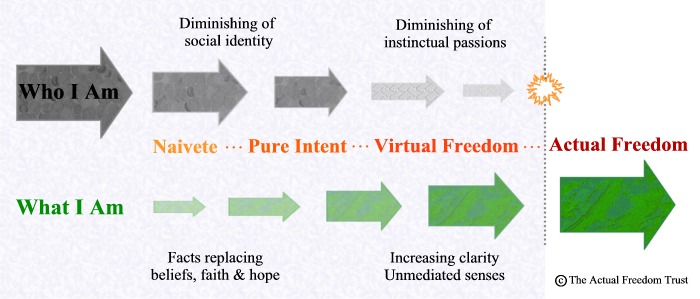
PETER to Alan: As you can see, the title is ‘What I am vs. Who I am’, and the diagram essentially addresses the issue of the process of the extinction of ‘who’ I am – the psychological and psychic entity and the emergence of ‘what I am’ – this flesh and blood body only, actually free of ‘who I think and feel I am’. The diagram quite deliberately separates out the active diminishing and eventual extinction of ‘who I am’ – and the emergence and eventual freedom of ‘what I am’. ‘What I am’ has always been here, it is just that it has been obscured and totally dominated by ‘who I am’ – and it is only by systematically and methodically daring to peel back the layers of social conditioning, beliefs, morals, ethics, psittacisms and instinctual passions that ‘what I am’ is more and more able to become apparent. ‘What I am’ thus becomes incrementally freed, strengthened, gaining confidence from the surety of facts, the increasingly unfettered intelligence and the heightened senses – all actual, down to earth, sensible and verifiable experiences. ‘What I am’ is not a new creation, a new identity – it is simply what remains when the ‘who I am’ disappears in total. To put it another way, the ‘who I was’ when I first met Richard will never meet the ‘what I am’ that will emerge when ‘I’ become extinct. Of course, one has glimpses of this ‘self’-less state in the PCE, when for a period ‘who I am’ exits the stage, or is temporarily absent, but ‘what I am’ can only be totally free when ‘who I am’ ceases to exist permanently. ‘Who I am’ is capable of resurrection or fighting back at any stage – indeed it is passionately driven to do anything possible to survive – including selling off Grandmother if need be – which is where the middle line of the diagram comes into play. This is a simple representation of the wide and wondrous path to Actual Freedom – from naiveté to Actual Freedom. We have started the line with naiveté, for it surely requires naiveté to not only consider that an actual freedom from the Human Condition is possible, but that you, personally, are the one who can do it. To fly in the face of the Wisdom of the Ancients – ‘to go where no man has gone before’ in Star Trek terms, as I put it in my Journal. I conveniently ignored Richard in my dramatization as I figured that the next pioneers were plotting a brand new course – avoiding the instinctual seduction of the Rock of Enlightenment that had dashed the efforts of all before. The other point about naiveté is that the spiritually cynical and the worldly cunning, by their very attitude, exclude themselves from the adventure, and this has been evidenced by the many who have met Richard, or read a bit about Actual Freedom, and turned away. For those willing to consider the possibility of an actual freedom, the next step is to tap into pure
intent – an intent to make it something one is willing to dedicate one’s life to and a purity such that one will settle for nothing less than
the purity and perfection so obviously experienced in a Pure Consciousness Experience. If it is possible for a brief time it must be possible as a
permanent state – purity and perfection is possible as a flesh and blood human being, it requires one’s sincere intent to become a ‘self’
consuming passion in life.
PETER to Alan: In the early months on the path to Actual Freedom I was intensely involved in what I was feeling and thinking – ‘a psychic search-and-destroy mission’ was how I termed it. This introspection was not selective as to the good and bad feelings as is the spiritual practice but was concerned with all emotion-backed thoughts and all passions. I was determined to eliminate all that was in the road and stopping me being happy and harmless, and sincere intent is vital in this stage of the process. This process fairly rapidly bought on a state of Virtual Freedom – being virtually happy and virtually harmless. What was then necessary was to abandon control, and abandon any notions I had of a ‘me’ being aware and simply let awareness happen by itself. This awareness is not ‘me’ being aware for this only serves to keep ‘me’ in existence. This is not an outer intense ‘on-guard’ awareness for this wariness only serves to keep the instinctual ‘me’ in existence as a fearful guarding entity. Naiveté is vital in this stage of the process, but beware of being gullible for the world is still as-it-is and people are still as-they-are – it is only me who is changing. It still necessitates keeping my wits about me and making a few practical adjustments now and again, but the emotions have all but disappeared from what would have been tumultuous events not so long ago. Thus it is that more and more I can look with soft eyes at a friendly world, let my guard down, relax
my defences, give up being in control and I, as this flesh and blood body, can be here in this actual world where I have always been. * PETER to Alan: Just a note to reassure myself that I can still write. I have been busy re-inventing myself, yet again – this time as a CAD architect and not a pen and paper architect. I have been learning a Computer Aided Drafting program for the past fortnight and it’s an amazing process. What was a familiar hands-on craft for me, now becomes a mouse-clicking computer operation. In the first learning stage, what would take me ten minutes to draw by drawing board took me ten hours by computer. After 2 weeks the ratio is down from 1 to 60 to 1 to 10 so I am well pleased. In a few months I can see myself being productive time-wise and I will be a cyber age architect rather than an industrial age architect. Initially, I had some resistance to changing – at age 51 who wants to go back to kindergarten again, and I could well have struggled through in old-style until the pension kicked in. But I figured I had the computer and what the heck. It is so easy to miss the opportunity to move and change. It is an amazing and thorough change because none of my drawing manual skills are applicable, CAD is a totally different process. When I was considering buying a program I talked to an architect friend who said he went through 12 months of hell learning and obviously was still suffering from the experience. For me, the fascination of doing the same thing totally differently – reinventing my profession – was the prevailing experience. What can I do and how does it work? I was reminded as I undertook this change how difficult it is for many people to change. Some people are tempted to some form of change in their lives, some rebel against their upbringing,
some swap religious beliefs, some swap partners, some move countries, some change jobs, etc. These forced changes are usually knee-jerk,
emotion-driven reactions to particular circumstances, are painful transitions, and are very rarely fundamentally life changing. Much of the old
patterns and habits are retained with the new partner, job, country or religious belief. The essential set-in-concrete personality they have
formed by puberty remains intact and unchanged, the only difference being that any residual naiveté is replaced by a deep cynicism at having to
cope with change or conform to changing societal restrictions. No wonder the option of escaping even further into an inner world of denial and
imagination is so attractive to these people. * PETER: Hi Alan, (...) I have just finished watching a TV documentary about Timothy Leary of ‘turn on, tune in ... and drop out fame’. In the late 1960’s he was at the forefront of experimenting with and publicizing the use of LSD and other chemicals that act to interrupt and temporarily alter the fixed, robotic electro-chemical circuitry in the brain. A few aspects of the documentary were interesting and none more so than to see a historical documentary where so many of the characters were playing themselves. Many of the main figures of the 60’s psychedelic scene were interviewed for the film and these clips were spliced with old interviews and archival footage. Someone who was now 60 or 70 years old was interviewed, juxtaposed with film of them as 20 or 30 year olds. What was revealing to see was that the naiveté of youth and the well-meaning 60’s aims of peace, love and brown rice for all, had wilted and been replaced by a turning away, a foreboding cynicism, an introverted self-love and a lust for immortality. Two of the central characters who demonstrated this best were Timothy Leary himself and Richard Alpert who is now known as Ram Das. Both said they had taken LSD hundreds of times and both had developed different interpretations of
their experiences. Richard Alpert had a taste of the Divine, an altered state of consciousness, and became a mystic, a spiritual teacher, and a
full-on devotee of an Eastern God-man. His experience when in an altered state of consciousness was that he was not the body and not the mind. He
described stepping out of illusion of the real world into God-Consciousness. He then talked of Timothy Leary saying ‘he wasn’t into mysticism’.
RESPONDENT: As for other sannyasins on this list, these guys are smart they can make their own conclusions, or not make any conclusions. BTW, I know only No 7 being here, No 14 is probably gone and No 4 does not like sannyas to begin with, I do not know if he likes or dislikes Osho. PETER: I presume this comment is in response to my comment –
I wonder why you related this comment to other people on this list? Do you not have an opinion, comment, conclusion yourself apart from saying any topic is ‘not of interest to you?’ My main evidence about Rajneesh’s disciples apart from those in the community I live in is the near-universal cynicism, fatalism, defeatism, doomsday-istic pessimism, resignation and self-centred complacency that was evident, and well-documented, as a response to Vineeto and I on the Sannyas mailing list. I would have assumed that anyone on this list was here because they had an interest in the subject matter being discussed here – how to actualize a personal peace on earth and thereby offer oneself as proof that peace on earth is possible, in this lifetime, as a flesh and blood human being and not in some spurious afterlife. As a part of this discussion it is pertinent to undertake a clear-eyed, intelligent assessment of one’s own efforts to date and the efforts of billions of one’s fellow human beings. To look at the efforts to date and acknowledge their failings to bring anything remotely resembling peace on earth. To undertake this investigation requires naiveté not cynicism, determination not fatalism,
bloody-mindedness not defeatism, confidence not pessimism, a stubborn refusal to settle for second best not resignation, and a burning
discontentment with the Human Condition of malice and sorrow not a self-centred complacency. If you are content with your life as it is, if your
spiritual pursuits have bought you peace, happiness and freedom or if you are certain they will, then this discussion list is clearly not for you.
PETER to No 3: What I have discovered on the path to Actual Freedom is that layer upon layer of
aggressiveness is revealed when one begins to become aware of malice in operation in one’s own psyche. All of this malice can ultimately be
sheeted home to a ‘me’ inside this flesh and blood body who feels attacked, who loves to fight, who likes to blame others, who likes to see
others suffer, who thinks he is right, who likes to feel superior, who feels resentful, who is ever on-guard and who feels and thinks he needs to
be in control. It takes an enormous amount of naiveté and sincere intent to dare to let one’s guard down and acknowledge the rottenness of the
instinctual passions that are programmed in this body. Both naiveté and sincere intent are gleaned from the pure consciousness experiences we
have all had in our lives and these experiences form the very basis of the inherent knowledge we all have that there must be something better than
normal life within the human condition.
RESPONDENT: Well I’ve spent enough time reading the site to know that my letter will be blocked by Richard’s ego as No 4’s was or replied to ‘predictably’ with Richard’s usual over excited egotistical arrogance, feigned harmlessness, cut and paste laziness and of course those impressive ‘big words’ that make him look like an inconsiderate idiot. Then one of his parrots will come to their guru’s defence using his cloned vocabulary and corrupted aggro attitude. Yet after all this ridiculous ‘get out’ my question is; why do none of you have the intelligence to work out why the list only gets 2 letters a day! Why does it not dawn on your thick skulls how alienating your exaggerated attitudes are and why on earth is Richard trotting out a may listening-l post? To keep something already dead, alive and wanking??? PETER: Well, it does look as though the spiritualists are circling the wagons with the latest ‘observer’ waving that hoary old flag – ‘If only we would love each other ...’. I am curious as to what brought you to this list – was it just for a bit of flaming? Vineeto and I went on to the Sannyas mailing list a few months ago, to see if there were perhaps others who may be dissatisfied with the spiritual path and eventually got cyber-executed for daring to question Rajneesh. As an ‘ex’ I was wanting to let others know there is now, for the first time, an alternative available to the spiritual ‘freedom’ offered by Eastern Religions. A few people did come across to the Actual Freedom List but apparently none are sufficiently interested to take the jump out of the spiritual world. In my experience, it does take a burning discontent with life as-it-is, and I wonder if that applies to you. This discontent can take different forms – for me, one of the discontents was the continual failure of my ‘love’ relationships and a desire to free myself from sexual inhibitions, instinctual compulsiveness and ignorance. Another factor was, having had children, there was nothing I knew that I could pass on to them – I was confused, bewildered, bedevilled ... and definitely not free! I had no answers. A bit of ‘cut and paste’ to briefly tell you my story –
Maybe you have a story to tell, a reason why you’re on the list, an aspiration or goal in life, some
discontents with life as-it-is? I would be interested to hear from you because I also liked what you wrote on the Listening-L list – such
passion for investigation is rare in people these days, and most particularly on spiritual lists. Peter’s Text ©The Actual Freedom
Trust: 1997-. All Rights Reserved.
Disclaimer |