|
Selected Correspondence Peter How to Become Free from the Human Condition
PETER to Alan: Good to discuss with you these matters. I think the operative word here is pure, as I have discovered. The PCE offers a glimpse or window out from the ‘real’ world everyone is born into (and therefore assumes this to be all there is), and suddenly one finds oneself in the unimaginable actual fairytale-like physical universe. My experience was that each time this occurred I was increasingly able to feel comfortable, at ease, as this new ‘me’ – this flesh and blood body. And every time these glimpses had a different experience to them as I explored carefully the actual physical universe that ‘I’ had normally perceived (like every other human being) to be a place of sadness, fear and aggression. Initially the contrast between the actual, benign, safe, and delightful, and the imaginary world of churning emotions, raging hormones and consuming passions is so startling that the memory is either buried or the experience appears wondrous and awesome. With a sincere intent operating to want to live the experience of the PCE every moment, 24 hrs. every day I was able to use the time when I wasn’t actually here living the PCE to root around in the Human Condition – to investigate, discuss, read, think and contemplate on all those instinctual urges and social Truths, Wisdoms and accepted beliefs that made up the particular psychological and psychic entity that dwelled in me and which had taken ‘me’ over. No wonder humans feel alien on the planet. So, for me the PCE sparkled like a diamond, and when it wasn’t there it meant that I wasn’t here – I was being angry, sad, impatient, proud, humble, fearful or whatever. So then I had something to do – something to firstly acknowledge existed in me and then work to eliminate it by whatever means appropriate. Neither repression or expression will satisfy anyone with sufficient sincere intent. Elimination by contemplation – rooting around to eliminate the very cause, the source. And then to have confirmation by the actual experience of emotions and feelings (both the Good and the Bad) disappearing like a strange fantasy that once played out inside my head and was taken by me to be actual by the hormonal reactions in this body. To experience it working is fascinating beyond normal belief. But then the actual always is. I found in the end the best and surest way to invoke a PCE was to deliberately, steadfastly, and bloody-mindedly clean myself up. Free myself of the disease called the Human Condition – that mutually agreed acceptance that we are above all ‘feeling’ beings, the only trouble is the hallowed feelings are, at the core, malice and sorrow. Competition, aggression, revenge, retribution, violence, murder, rape, war and torture not to mention sadness, resentment, sorrow, depression, despair and suicide are the inevitable result of being a normal human. It was so good that I always had something to do – to clear the dirt from the diamond – to clean myself up so that I can take my rightful place, play my delightful role, doing what is happening now, as a happy and harmless human free of malice and sorrow. Confident that malice and sorrow have had their day. But it is excellent to have something that works, a way out of the insanity of misery and violence, fear and aggression. So that is my experience, I have written about it before but it’s nice to have the chance to write of
it again. It is such an adventure and can be both weird and fearful business particularly being among the first to pioneer a method of becoming
actually free.
PETER to Richard: Thought I would put on to the list a report of what we were talking of the other day, so the words are not lost and the experience can be shared with the other intrepid investigators into this new freedom. I was wondering where to start, but I might try a little summary of the stages I have experienced so far on the journey to freedom. It’s been two years now since we met and about 9 months since I finished writing my journal. If I could put it into phases I would say that the first 12 months were essentially making sense of being a normal human being, simultaneously ridding myself of malice and sorrow, as much as is possible, while still having a ‘self’ inside this body. The very act of making sense of the facts of the Human Condition as opposed to the beliefs forces one to change, to eliminate what is essentially learned and societal re-enforced behaviour. This first process had two components – an intellectual understanding such that the fact of being a human being made sense, and this involved a rigorous, challenging, exciting and revealing investigation into the Human Condition and its bedrock of Ancient Wisdom. This is essentially the understanding of the non-spiritual nature of Actual Freedom. The second component was the practical day to day stuff (and what else is there anyway?) of what it is to be a human being – the theory into practice if you like. The experience that Actual Freedom is not a philosophy, not a theory, but a down-to-earth experience as a flesh and blood body. In my case this was demonstrated in the delights of living with a woman in peace, harmony and equity and the resultant revealing of the sheer fun of sex – the fire test, the proof of the pudding, if you like. If you can’t live with someone in peace then there is no hope for anyone else. One’s life gets better and better to the point of a sublime ease, carefree-ness and delight that was inconceivable 2 years ago. The actual experience is of coming to one’s senses. I have always had a cautious reluctance to state that there is a definable state called Virtual Freedom whereby one is virtually free of the Human Condition – a 99% state or the best one can do while still remaining a ‘self’. I think that the point is that this state is not irreversible – unless there is a sincere intent and a desire to evince the best possible one could waver. It simply means I will be the best I can, and if one has had a peak experience then the best is glaringly obvious. So, throwing my caution to the wind – I would say that the last 12 months have been a stage of Virtual Freedom – the use of capital letters to indicate a definable state only. The next phase is to an Actual Freedom – the complete extinction of the psychological and psychic entity, in short the ‘me’ who I think and feel I am. There is no doubt that I am travelling a different path to the one you travelled, one that you have carefully mapped and explored with your companion at the time. Because of this your experiences of becoming Enlightened and clawing your way out are not relevant to my experiences. But the end result and aim is the same – an actual freedom from the Human Condition – a definitive and decisive release from, and extinction of, the alien entity inside this body. In trying to make sense of my different path and your two-stage extinction, I have had a cautious approach as the Rock of Enlightenment always looms large. Having seen and experienced the power-crazed God-men in action and the willingness of their desperate followers to surrender to them and worship them has proved a valuable, if sobering, experience. The other part is having experienced the seduction of an Altered State of Consciousness. As a consequence I have been well warned and well prepared. Despite the fact of having had a substantial peak experience (PCE) some 15 years ago and a substantial experience of Divine Love (ASC) some 3 years ago there was still a piece missing. It all seemed to involve either a looking back into my past or sideways to your experiences and trying to draw a parallel. The other nagging issue was a feeling of the unfairness or even perversity of being born into the Human Condition, of being who I thought and felt I was, finding out it was a pretty rotten mess and then having to die, or self-immolate in order to be free. To do that in order to become Enlightened is one thing as one gets to have worshipping disciples, psychic power, fame and wealth – ‘Money for nothing and your chicks for free’ as I cheekily put it. Becoming God seems a not too bad reward for the effort involved – well on the face of it anyway, as long as you are not too discriminating. Of course, once you see the down-sides of Enlightenment, it very rapidly loses appeal – but at least ‘I’ am around to enjoy it. But self-immolation, extinction, the end of me? And even the memory of a peak experience in the past and an intellectual clarity of the whole Human Condition including the delusion and appalling consequences still seemed to leave a slight gap, a wee doubt. Virtual Freedom had brought me to a position where it became obvious that ‘I’ could do no more to clean myself up, I seemingly had done all that ‘I’ could. Something more was needed, and – loh and behold – it came along. The other morning a peak experience snuck up on me – after a particularly good ‘romp’ with
Vineeto. It was one of particular clarity marked by a complete absence of any sense of ‘self’ or ‘being’ within my body. All was perfect
and pure with a magical intensity that was palpable. Not merely static – a sense of the whole universe happening at this moment with a vibrancy
that was sensately experienced.
PETER to Richard: This first process had two components – an intellectual understanding such
that the fact of being a human being made sense, and this involved a rigorous, challenging, exciting and revealing investigation into the Human
Condition and its bedrock of Ancient Wisdom. This is essentially the understanding of the non-spiritual nature of Actual Freedom. The second
component was the practical day to day stuff (and what else is there anyway?) of what it is to be a human being – the theory into practice if
you like. The experience that Actual Freedom is not a philosophy, not a theory, but a down-to-earth experience as a flesh and blood body. ALAN: Couldn’t agree more. The combination of the two is vital – and perhaps inevitable. Sort of convincing ‘me’ that it is possible, while experiencing its actuality. PETER: Just to clarify my post. Up until now the only path to freedom has been a spiritual path to a spiritual freedom – the traditional path of denial, renunciation and transcendence leading to an Altered State of Consciousness known as Enlightenment. The path leads to There – another dimension, a metaphysical realm. The aim of the path to Actual Freedom is to come here to the actual world. The actual world is that which is evidenced and apparent in the PCE or peak experience and that is where the path to Actual Freedom leads. The actual world is the world as-it-is, stripped of the veneer of reality or Reality that the ‘self’ or ‘Self’ layers over it. However, as the aim is to come here and be happy and harmless, one always has an immediate goal and aim
every moment – to be as happy and harmless as one can possibly be right now. ‘How am I experiencing this moment of being alive?’ is the key
to firstly ascertaining how one is doing relative to one’s aim in life and, if necessary, finding out what is inhibiting my happiness, in this
moment. This gives ‘me’ something to do – ‘I’ clean myself up as much as possible by rigorously and remorselessly examining all the
beliefs that constitute the Human Condition – all the truths and Truths that form my social identity, and the instinctual behavioural patterns
that blindly run ‘me’. This process, if undertaken with a sincere intent, will inevitably lead to a state of Virtual Freedom. One then goes to
bed in the evening knowing that one has had a perfect day, and knowing that tomorrow, without doubt, will also be a perfect day. Unless one is
willing to contemplate being happy and harmless, free of malice and sorrow, 99% of the time – then forget the whole business. One is back aiming
for some ‘pie in the sky’, some miracle event to ‘make it all better’. And the Sannyas list was an eye opener as far as that was
concerned. When offered an alternative to ‘getting out of it’, such that being happy and harmless became one’s aim in life – none were
interested in this aspect; peace on earth got a similar response, living with a companion in peace and harmony hardly raised a murmur. Nobody
believes that it is possible to be happy and harmless in the world as-it-is, on earth, here, now, as a flesh and blood body. This is, after all,
the core of Ancient Wisdom – the sacred and inviolate centre-piece of the Human Condition.
PETER to Alan: To finally realise that there is no solution to the Human Condition other than its eventual extinction and the superseding by a new species – actually freed from instinctually-sourced emotions and feelings. The ending of ‘me’ will be another, not insignificant, step in that inevitable process. As a footnote, I would add that this clarity about the Human Condition has happened not by retreating or retiring from the world of people, things and events but by being fully involved and vitally interested in the fact of being a mortal, flesh and blood human being – here and now. Here – as in the actual world as perceived by the senses; and now – as in this very moment. In this way, one’s Virtual Freedom is ‘tested’ by full involvement, not falsely ‘sustained’ by avoidance or denial. It is this very ‘boots and all’ involvement in the actual world that makes the act of self-sacrifice – as I see it and have experienced it – a sensible, obvious and necessary step. I don’t say this lightly. I am usually very cautious about writing of ‘experiences’ as they can have an individual bent, vary in intensity or importance from one to another, but this issue of the ending of ‘me’ is useful to write of. I probably would have waited for more evidence but given that you have raised the issue, Alan, I was moved to write. In talking to Richard, we kicked around the word ‘altruism’ for this self-sacrifice and, while I usually dislike ‘isms’, I think it fits. However, I know that Vineeto is not keen on its other emotional connotations and I would prefer to stick to self-sacrifice – as an instinctual program – to describe the ‘key to the door’. Well, if I keep going the footnote will be bigger than the post itself. This is such a fascinating subject – and experience! I am sure we will write more about it. I know Mark is vitally interested in this very issue. So finish and get this away on the copper. Bloody excellent, Hey. *
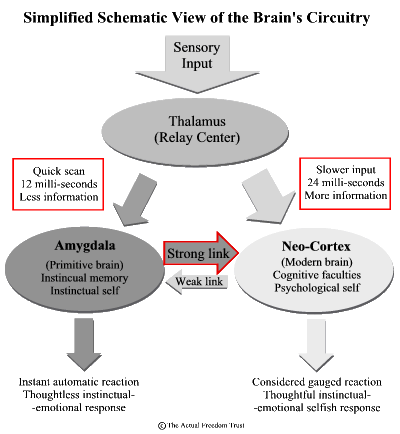
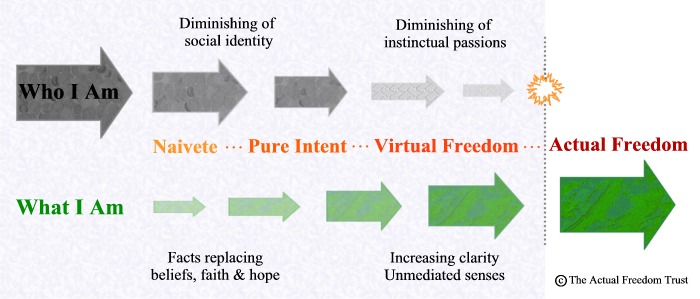
PETER to Alan: As you can see, the title is ‘What I am vs. Who I am’, and the diagram essentially addresses the issue of the process of the extinction of ‘who’ I am – the psychological and psychic entity and the emergence of ‘what I am’ – this flesh and blood body only, actually free of ‘who I think and feel I am’. The diagram quite deliberately separates out the active diminishing and eventual extinction of ‘who I am’ – and the emergence and eventual freedom of ‘what I am’. ‘What I am’ has always been here, it is just that it has been obscured and totally dominated by ‘who I am’ – and it is only by systematically and methodically daring to peel back the layers of social conditioning, beliefs, morals, ethics, psittacisms and instinctual passions that ‘what I am’ is more and more able to become apparent. ‘What I am’ thus becomes incrementally freed, strengthened, gaining confidence from the surety of facts, the increasingly unfettered intelligence and the heightened senses – all actual, down to earth, sensible and verifiable experiences. ‘What I am’ is not a new creation, a new identity – it is simply what remains when the ‘who I am’ disappears in total. To put it another way, the ‘who I was’ when I first met Richard will never meet the ‘what I am’ that will emerge when ‘I’ become extinct. Of course, one has glimpses of this ‘self’-less state in the PCE, when for a period ‘who I am’ exits the stage, or is temporarily absent, but ‘what I am’ can only be totally free when ‘who I am’ ceases to exist permanently. ‘Who I am’ is capable of resurrection or fighting back at any stage – indeed it is passionately driven to do anything possible to survive – including selling off Grandmother if need be – which is where the middle line of the diagram comes into play. This is a simple representation of the wide and wondrous path to Actual Freedom – from naiveté to Actual Freedom. We have started the line with naiveté, for it surely requires naiveté to not only consider that an actual freedom from the Human Condition is possible, but that you, personally, are the one who can do it. To fly in the face of the Wisdom of the Ancients – ‘to go where no man has gone before’ in Star Trek terms, as I put it in my Journal. I conveniently ignored Richard in my dramatization as I figured that the next pioneers were plotting a brand new course – avoiding the instinctual seduction of the Rock of Enlightenment that had dashed the efforts of all before. The other point about naiveté is that the spiritually cynical and the worldly cunning, by their very attitude, exclude themselves from the adventure, and this has been evidenced by the many who have met Richard, or read a bit about Actual Freedom, and turned away. For those willing to consider the possibility of an actual freedom, the next step is to tap into pure intent – an intent to make it something one is willing to dedicate one’s life to and a purity such that one will settle for nothing less than the purity and perfection so obviously experienced in a Pure Consciousness Experience. If it is possible for a brief time it must be possible as a permanent state – purity and perfection is possible as a flesh and blood human being, it requires one’s sincere intent to become a ‘self’ consuming passion in life. As an ongoing experience one moves into a state of Virtual Freedom whereby one goes to sleep at night time knowing one has had a perfect day and that tomorrow will also be a perfect day. This perfection is not the perfection of Actual Freedom but a 99.9% perfection and the hic-ups or stumbles are so minor and brief, that they fail to daunt one on the journey. Serendipity abounds and a fascination with life activates delight and sensuousness as one does all one can to mimic the perfection and purity that becomes increasingly apparent all around in the physical world. One’s mind, more and more freed of imagination and the chemical influence of instinctual passions, is capable of great clarity, and as apperceptive awareness replaces self-centred neurosis one knows one’s days are numbered. By this total and sincere dedication to what is actual, pure and perfect, one abandons control, so to speak, whereby the very process of self-immolation is set in motion – then it is not a process that one has any control over, it is happening by itself. The ending of ‘me’, when seen dispassionately, is the amygdala doing its survival thing – one encounters surges of chemicals from an obsolete program playing out its death throes – fighting for its very survival as it is programmed to do. This last stages of the ending of ‘me’ is both a psychic and psychological affair, thus accompanying the chemical rushes (fear) one also experiences the psychological equivalent (angst), but one is committed by now – there is no ‘back door’, no turning back, no phoenix to rise from the ashes. ‘My’ end is nigh. However, to even get to the point where one abandons control requires sincere intent, lest one settles
for second-best. sincere intent is one’s companion on the journey from beginning to end.
ALAN to Vineeto: Or, perhaps it is another of ‘my’ tricks – an apathetic way of attempting to continue ‘my’ existence? Perhaps it is a necessary next step in the process – as Peter wrote to Gary –
 Peter, Actual Freedom List, Gary-i, 9.4.2001 Peter, Actual Freedom List, Gary-i, 9.4.2001
PETER: What I wrote to Gary may appear to be contradictory to what I have just said above but I will attempt to throw a bit more light on what I think is going on. The path to virtual freedom is clearly high adventure – the decision to start at all is daunting, the on-going discoveries intimidating, tumultuous and disconcerting, to say the least. Oft times it feels as if one is losing all bearings, all sense and all direction, which is exactly what is happening, as most of one’s cherished beliefs and values are shattered and most of one’s past familiar persona is deliberately demolished. One often feels as though one is being torn apart as everything safe and familiar is thrown into question – by one’s very own questioning. Eventually the more crass and obvious aspects of one’s social identity and the more strident and gross expressions of one’s instinctual passions are eliminated such that one is virtually happy and harmless. Feeling good is an almost constant state – no more does melancholy and sadness have a lasting grip, nor does irritation or anger have any staying power. One is then free from the more insidious passions and thus more ready and able to investigate the underlying stygian nature of the human condition. In my case this included my Christian conditioning that lay un-investigated beneath my later-in-life Eastern religious conditioning, the precise nature of the tender passions that we humans hold so dearly and the last remnants of my social identity that I held most dear. Feeling excellent eventually became ‘my’ normal experiencing and I was able to go to bed at night knowing the next day would be perfect – as perfect as possible while remaining a ‘self’. This stage is typified by clarity of thinking and a continual state of almost-bare awareness. Increasingly I was able to see that it is only the human condition in general, and experience that it is ‘me’ in particular, that stands in the way of peace on earth. Then one finds oneself left with no choice – to mark time is to waste time, to turn back is impossible if one has done one’s homework with sufficient thoroughness – so one gaily abandons all that is considered reasonable, safe and sane and ploughs on regardless. One raises the bar from feeling excellent and one begins to marvel in wonder and amazement and unquestioningly sets off towards one’s destiny, realizing that ‘I’ can never prepare myself for what lays ahead, for what lays ahead will not be of ‘my’ doing. As such, the reference in I hope that makes what I was saying a bit clearer. It is easier to report happenings and events in
hindsight, a bit riskier to try and assess what is happening while it is happening, but all that can happen by taking the risk is that I stuff up.
Which I obviously did to some extent ...because here I am writing again. But hey ... as they say, ‘who’ is perfect? Certainly not ‘me’.
RESPONDENT: I am new on this mailing list, and the concept of Actual Freedom is also new for me, very interesting though. I have followed the debates with the highest interest and I have also read some of the texts on the Actual Freedom web. English is not my first language, so you might find some peculiar sentences and wordings. Please have some indulgence. PETER: Welcome. It is good to have you writing on the list. No doubt if you persist in your interest you will not only discover more about Actual Freedom but your English will also improve. English is my first language but when I first read Richard’s Journal I had to go out and buy a good dictionary. At first I found his extended vocabulary use a bit frustrating but I soon found having to look up the meaning of certain words aided me enormously in understanding what was being written. It took me months of reading to begin to break through my inherent, and inherited, ‘blindness’ – as in cognitive dissonance – to the fact that there could be another human experience other than remaining normal or becoming spiritual. RESPONDENT: I recognize major parts of the concept or method, described in Actual Freedom, from a book I read about cognitive behavioural therapy (CBT). This book (only available in Swedish and not very scientific, more practical) also recognizes the phenomena of pure consciousness experience (PCE), as something important. Even more interesting is that the described approach to ease fear and psychological pain is almost identical compared with the methods described on the Actual Freedoms web site. Actual Freedom has as I see it a much more radical goal. What I find interesting is the similarities in method. CBT have a good reputation as a proven effective treatment method. This gives credibility also for Actual Freedom’s method, despite the methods different goals. PETER: The similarities seem to be in the fact that both are pragmatic approaches and both address the issue of one’s immediate anxieties, emotions and behaviour in the world of people, things and events. The aim of cognitive behavioural therapy (CBT) is to reign in the excesses of emotions so as to return the patient to normal – i.e. normally aggressive and normally sad. The aim of actualism is to eliminate the whole psychological and psychic structure – ‘who’ I think I am and ‘who’ I instinctually feel I am, as opposed to what I am – so as to completely eradicate the root cause of malice and sorrow. I know little about how cognitive therapy is used and applied by the hands-on practitioners in the field but this more practical approach to therapy does seem to be having more success than the previous approaches based on moral and ethical reconditioning, emotive expression, self-acceptance, self-love, shamanism and mysticism, chemical restraints, etc. In order to explore the differences between the method of actualism and cognitive behavioural therapy, not only in intent but also in the processes, I have accessed a brief summary of CBT from the Net. info@mindstreet.com ‘Negative or distorted automatic thoughts’ is simply another way of saying feelings and emotions. Close and constant observation will reveal that feelings are most commonly expressed as emotion-backed thoughts. Thinking, when freed of the automatic influence of the emotions that arise from one’s instinctual passions, is a benign functional activity. Eastern religion and mysticism has always laid the blame of evil on thinking per se, while giving full vent to the so-called good emotions to run wild, unrestrained by any sense whatsoever. It would appear that CBT adopts a similar stance and lays the ills of the patient at the door of wrong thinking. It is inappropriate in the real world to question the instinctual passions themselves, for human beings hold their passions dearly to their bosoms, stubbornly and deliberately maintaining their blindness to the fact that these passions are none other than savage and brutal animal survival passions. Just a note about the feelings and emotions that one notices by running the question of ‘How am I experiencing this moment of being alive?’ Many men in particular, because of their gender programming, have great difficulties in getting in touch with their feelings. As this is generally the case, then it may be useful to begin with observing what you are thinking in this moment of being alive. If you describe your thinking as a bit dull for instance, it may be that you are feeling lackluster. If you are thinking about what someone said or didn’t say to you, it may well be that you feel annoyed which is a mild form of anger. If you are thinking that someone has wronged you, then it is useful to label and identify the feeling that is happening in that moment – be it resentment, indignation, righteousness, envy, etc. For women this process of investigation is identical, but given that they have usually been taught to identify more strongly with their emotions, their difficulty can be in sorting through a bewildering array of unrestrained input. Again, momentary awareness is the first thing – to catch the feeling while it is happening – and then to label the feeling is the next step. Then complete the investigation by finding the cause, the trigger, of the feeling or emotion that is ruining, clouding or standing in the way of you feeling good right now. This awareness is an experiential awareness of how ‘you’, as an entity, have been programmed to react to the world of people, things and events. This is 180 degrees different to practicing spiritual awareness, which is to either accept, ignore or deny one’s reactions to the world of people, things and events and retreat into an inner world of one’s own imagination. Spiritual awareness leads to the ‘self’-centred psychotic states of dissociation or the more extreme state of solipsism whereas the actualism method is an ongoing self-investigation that breaks the stranglehold the psychological and psychic entity, eventually leading to a ‘self’-less pure consciousness.
Again we have ‘negative or fearful automatic thoughts’ or ‘distorted cognitions’ that ‘stimulate painful emotional reactions’, as though it is wrong thinking that causes emotional suffering. It’s a bit like putting the cart before the horse but then again, CBT is concerned about treating and reducing the symptoms and not about acknowledging the source of emotional suffering, let alone finding a permanent cure.
What initially twigged my interest in CBT was a television program, which showed a patient being treated for agoraphobia. The treatment was very matter-of-fact and not at all esoteric or airy-fairy. The patient, at her own pace, was allowed to experientially discover for herself that her psychological and psychic fear was nothing other than a feeling, i.e. while it may have felt very real it was not a fact. By becoming aware of her fear, labelling it, discussing it, and thinking about it she was gradually able to desensitize herself to its influence. In her case the fear was not eliminated but it was reduced to tolerable levels such that she could function reasonably normally. Another patient had a fear of a particular insect and by increasingly prolonged contact he was able to become desensitized to the fear, thus replacing the feeling of fear with the fact that he was not being hurt. I don’t see this as a triumph of rational thinking over irrational thinking, I see this as a triumph of fact over feeling.
This is where terminology tends to be confusing. ‘Templates, or basic rules, for interpreting information from the environment’ or ‘core beliefs’ seems to be referring to our instinctual ‘self’-centred survival programming. If so, these are not beliefs, this is a genetically-encoded neural program. This is where all therapy comes up against a brick wall and any ‘modifications’ can only be fiddling with the controls, or rearranging the deckchairs on the Titanic.
Breaking ingrained habits was another of the features of CBT that made sense to me.
Are they saying that success breeds success? If the success is tangible, then confidence grows which leads to a change in behaviour that happens almost without one noticing it.
Is this a disclaimer? Obviously the successes are limited but the success of such a pragmatic down-to-earth approach to therapy can be seen as more evidence of ‘the good sense of actualism’, as No. 13 put it. I know in the early days it was this good sense that lead me to establish a prima facie case in favour of actualism. RESPONDENT: One problem raised by Mr. No 12 is if it really is possible to extinguish ‘self’. If it is possible to exist without ‘self’ as a human being. I have to investigate the concept ‘self’ more before I can decide if this idea is sensible or not. PETER: May I suggest that running the question ‘How am I experiencing this moment of being alive?’ will put you in touch with your ‘self’ and then you will find that ‘self’ is not a concept but a reality – it is none other than ‘who’ you think and instinctually feel you are. You may well discover that it is ‘he’ who is running and ruining your life and standing in the way of perfection and purity. RESPONDENT: Another problem is the schematic descriptions of our brain works. The origin of instincts and their effect on our perception of our self and the world we all live in. I have to do some more studies in this area. PETER: And I would welcome more discussion in this area for actualism is non-spiritual and down-to-earth, which is why I enjoy exploring what facts the scientists are discovering and what methods really work for the real-world practitioners of therapy. If in your studies you find any inaccuracies in the schematic diagrams or have any comments about them I would appreciate you letting me know as I am a layperson, more than a little stretched in purely scientific areas. RESPONDENT: I find though the ideas interesting and one thing I have experienced during the last weeks is that it is almost impossible not to ask oneself the question ‘How am I experiencing this moment of being alive?’, perhaps not all times but often. The thought gives some perspective for sure. PETER: I have just realized I have assumed from your name that you are male and that was why I commented about feelings most commonly being expressed as emotion-backed thoughts. Anyway, for either sex it is useful to be aware that our feelings are most often cunningly disguised as, or described as, thoughts – unless you are overcome with rage, gripped by fear, overwhelmed by nurture or beset by desire, in which case the feelings are obvious as the chemical surges are so intense. Well enough for now, it’s dinner time. I just wanted to say hello, reply to your comment about CBT
and to have a bit of a dig around in that field.
RESPONDENT: One PCE in 1976 which lasted for a few hours was actually ‘only’ tantalizing Enlightenment... Divine Love. An extraordinary and powerful phantom that only fades to nothing but memories. I particularly liked the way Richard explained AF as being like a blind man who has his other senses heightened... as if our energy is concentrated when appropriately focused or perhaps when our inner conflicts are not allowed to detract from the purity of the moment...??? PETER: My experience of the sensate-only experience of the PCE is that there is no psychological or psychic entity whatsoever inside this flesh and blood body. There is no ‘I’ being ‘focused’ or thinking rightly or concentrating on the senses. There is no inner conflict for there is no ‘inner’ at all. With no ‘inner’ there is then no ‘outside’ to experience as feeling separate from or feeling at-one with. All affective, self-centred feeling disappears as if by magic as do all self-centred neurotic thoughts. One is able to think, and my thoughts are usually one of amazement at the physical, magical fairy-tale like universe. The contemplation upon the fact that we sit somewhere on of a huge lump of rock that hurtles through space orbiting around a sun that gives life to plants and animals, that there are cycles like days, seasons, tides, life-cycles, that there are land masses, oceans, mountains, rivers, snow, rain, that the universe is infinite and eternal and that it is all happening right here, in this very moment. The senses are literally on stalks, imbibing the sensory input from all that is happening around – and we can see it, smell it, hear it taste it and touch it and we are made of the same stuff as all around. There is no separateness, rather one is directly and sensually intimate with everyone and everything. In the PCE one is literally the universe experiencing itself as a human being for there is no self, and definitely no Self, as an entity inside the body affectively experiencing an outer world – let alone passionately imagining an inner world. The other thing that is startlingly obvious in a PCE is that amidst this always present perfection and purity of the actual world, the human species battle it out with each other to the point of waging horrendous wars, resent having to be here at all and are generally miserable to the point of depression. When I met Richard I decided to devote my life to the eradication of the Human Condition within me. I wanted to live the experience of the PCE – the self-less state of purity and perfection – 24hrs. a day every day. So, I rolled up my sleeves and got stuck into the doing of it. It was so liberating to be able to do something about myself and my behaviour and not allow myself to be blindly led, not to believe what others told me was true, not to merely do what everyone else was doing simply because everyone else was doing it, not to keep doing things that didn’t work and not to be automatically driven and run by my instinctual passions. To become incrementally free of the Human Condition. The amazing thing about the doing of becoming actually free from malice and sorrow is that one becomes more happy and more harmless on the way. And one literally comes to one’s senses such that the senses do become heightened, one thinks less neurotic thoughts and feels less passionately driven by one’s instinctual drives. It is a win, win and more win situation on the path to actual freedom. RESPONDENT: Now I only want 24 hour Actual Freedom. PETER: Well, roll up your sleeves – there’s plenty to do! You are talking about ‘changing Human Nature’, but the best thing is – you only have to change yourself and nobody else. Changing everyone else is what most people aim for – a physical impossibility. Changing only you is eminently achievable – and scientifically verified as possible. It is possible to re-program one’s own brain from all the social programming and it is possible to evince a mutational adaptation to eliminate the instinctual passions. A bit I wrote recently explains this very point –
RESPONDENT: Keep up the great work. PETER: I do like writing, which is all I do – it’s simply common sense to tell others what is now available. It’s more of a hobby than work and most of my writing has been my sorting out and reporting on experiences, understandings and facts discovered. Whenever I read any spiritual twaddle nowadays I am astounded as to its duplicity, confusion and blatant self-centredness, so it’s a joy to write of something as down to earth and non-spiritual as Actual Freedom. Writing also is great exercise for the brain given that independent and clear thinking is stifled in childhood and school years by countless putdowns and strict regimentation and is even further strangled, admonished and literally demonized on the spiritual path. The other point is that I am not working to change anyone else – as I said, that is an impossibility and it is also a ‘self’-serving exercise. It’s good to be free of that one. I noticed your heading to the first post was about convert numbers. There can be no converts to actualism for the simple reason that one has to do it for oneself, by oneself. There are no meetings, rallies, practices, groups, etc. Just a handful of people so far, their words, a web-site, and a mailing list. The other reason is simple – actualism is a life-as-you-know-it threatening occupation and, as such, not of great attraction to many. Actualism is about quality not quantity. The best, not the most. Good Hey.
RESPONDENT: Hi all, Have just been thinking about virtual freedom for the masses... There must be a far better way to publicly examine and share our experiences and ideas than this primitive type-written listbot method? PETER: I for one can’t think of a better one at the moment. I can write heretically without the threat of physical retaliation or retribution, I can write to anyone, anywhere in the world, the medium is largely and remarkably un-censorable and anonymous. And the act of writing itself has multiple advantages. Writing avoids the traps of ‘energy’ transmission, authoritarianism or Guru-ism, it necessitates thinking and clearly expressing oneself – an experiential exercise in ‘How am I experiencing this moment of being alive?’ Writing on the list gives me a chance to get down in words what I have been thinking – rather than let the thoughts simply wander around uncommitted and unformed – in a way that makes sense to another. What we glibly call communication and fail at so often as human beings. As you can see I am a fan of writing – I find it a useful freedom tool and an excellent hobby. RESPONDENT: Richard’s, Peter’s and Vineeto’s books are really excellent but limited to only a few who discover the AF Web-site. This is not only a personal revolution, is it? PETER: Yes. It is only a personal revolution – which is what makes it 180 degrees different to every other so-called revolution which are really revolutions, as in go round and round in circles within the Human Condition. They are revolutions of the ‘if only everybody ...’ type, as in ‘if only everyone would stop fighting there would be peace on earth’ – the ideal of pacifism. Or the ‘if only everyone was of a higher consciousness, like me’ – the ideal of everyone following one God, that one God being Me-as-God or my God. Actualism is about changing No 13 – full stop. There may well be some flow on from that – certainly you will stop being sorrowful and stop being malicious to those around you. This is of incalculable benefit to those you come in contact with, not that they will necessarily see it that way. RESPONDENT: If our brain washing was a mass insane socialization then the solution might be a mass deprogramming ... or at least a mass awareness of the alternative... to find a critical mass to speed up the sleeping masses? PETER: I do like and encourage your enthusiasm. This same enthusiasm was what encouraged me to sell my car and buy a computer to write my journal. I wanted to let my friends know about Actual Freedom, but the direct result was nil. What I quickly came to realize was that I was really writing for me – to make sense of the Human Condition, my role in it and how to become free of it. Any side benefits for others will be a bonus, but not the main event. RESPONDENT: I remember someone explaining that to save an endangered species one needed to exploit the species commercially, to ensure its survival. An unconvincing argument for anyone interested in the species’ quality of life, but it had a pragmatic kind of logic. PETER: I think there is no doubt that the human species is an endangered species but not from external threat, nor from any ‘environmental’ disaster or earth resources’ depletion, but from the simple fact that human beings cannot live together in anything remotely resembling peace and harmony. As a practicalist, when I came across Richard, I chose to disprove the logic of Ancient Wisdom that you can’t change Human Nature. Otherwise a human existence of perpetual malice and sorrow is indeed a sick joke. I saw in a PCE that the universe is too magnificent, too grand, too perfect and too pure for me to continue to be sorrowful and malicious. So I set out to change the only thing that was wrong – as in silly and senseless – and that was a ‘me’ inside this flesh and blood body. As for ‘endangered species’, I realized I was not alone in this exercise of seeking peace on earth. It is an almost universal hope and wish, but everyone looks to others to bring it about, to actualize it. Peace on earth is already here, of course, and only you can find it for yourself. A bit from my journal –
This is no small thing we do. RESPONDENT: OK there are advantages to deprogramming, recording and examining, (in a very exact manner), how the words, experiences, beliefs and morals, ‘we’ the community often take for granted, are used for ‘ourselves’... but is it the best? PETER: It is a curious thing when I contemplate my own path to freedom. I lived down the road from Richard and spent a good deal of time sitting in his living room, talking about life, the universe and what it is to be a human being. After about 9 months that stopped and I went off to write my journal – to get on with the business at hand, becoming free from the Human Condition. And most of that process has involved writing – it is the best form of ‘contemplation in action’ that I know of. It is this process that put in action the ‘deprogramming, recording and examining, (in a very exact manner), how the words, experiences, beliefs and morals’, which ‘I’ had taken for granted. For me it was the best method. RESPONDENT: It would be faster with ICQ, telephone, or even multimedia productions, I think? If we are serious about sharing and promoting AF with the world let us stir the mass media...? Television, magazines and newspapers are where most people are. Why must the powerful determine what ‘we’ see, think or what is possible? PETER: Well, in the world as-it-is, that is the way it is. Even the mild-mannered loving ladies at the local New Dark Age book shops did not want to stock my journal. I did get one very mild article printed in a newspaper but when I ‘upped the ante’ to be just a touch heretical it was no go. I am at present trying the same exercise with a local New Dark Age magazine, so I am still on the case. It is really that Actual Freedom is not a popular subject. No one wants to change themselves. It is much more convenient to blame others for one’s own misery and unhappiness and then one can have the fun of battling with and being angry at others. In the Human Condition anger is a pleasing self-gratifying emotion. The other point is that there is no ‘we’, as in a group, who promote Actual Freedom. Richard has his experience, interests and ‘style’, I have mine, Vineeto hers, Alan his. Each person who becomes interested in Actual Freedom and takes it on will no doubt make their own contribution – in proving that it is possible to become free from the Human Condition something will spin off that will be valuable for others. The world is full of those who don’t live what they teach and unless one proves it is possible for oneself ‘tis but more piss in the wind. I include writing about being virtually free of the Human Condition in that I experience that ‘not quite, but almost’ state I live as eminently worthwhile trumpeting about. Thus, I write from practical, down-to-earth, everyday experience not from theory or wishful thinking. (...) * RESPONDENT: ‘I’ realize the delusion of community but can the delusion become aware of itself? PETER: Most have too much invested in their escape into the spiritual world to be aware of what
is actual and the Truly Deluded are beyond being aware of their delusion, as in ‘Above and Beyond’ RESPONDENT: Any ideas? Workshops without the tried and failed God, guru or ego-centred methods? PETER: Well, I personally have no interest in ‘changing the world’. The Human Condition is unchangeable – it simply needs to be abandoned for it is rotten to the core. The only people I could possibly help would be those who are interested in changing themselves. And even then, all I can do is relate my personal experience and success at applying the method to becoming free from the Human Condition. Having said that I also have the ‘sheep in the field’ theory. I see everyone as ‘sheep in a field’ busy doing what they have been told to do and programmed to do – fighting with each other and being miserable. One sheep manages to break free and finds that he can be happy and harmless but it does mean he is no longer a sheep and he is on his own. A few other sheep look over the fence and see that this sheep is having a good time on his own – he suffers not, quite the contrary he is having a bloody good time of it. So, a few more break out and as even more break out a momentum builds up, as it seems more and more silly to stay with the fighting, feuding miserable herd. But it’s always a free choice – whoever wants to break out can – you just have to be willing to pay the price of leaving the herd. So my ‘breaking out’ means freedom for me and it encourages others by proving it is possible and adding to the numbers on the other side of the fence. It’s a win, win and more win situation. Perfect, in fact. Like all analogies and metaphors, the story is a little flawed for one does not ‘escape’ from it all into a ‘next field’ but an actualist mixes, mingles, works with and lives with, one’s fellow human beings as-they-are in the world-as-it-is. The trick is to do this while being free of the shackles of feeling and being part of a group – of needing or having a social identity. The next level is to be free of being blindly, obsessively and instinctually driven to impassioned acts of fear, aggression, nurture and desire that give rise to malice and sorrow. For this to happen one needs to have lived a virtual freedom in the world-as-it-is with people-as-they-are in order to gain confidence that one can stop being a being who is instinctively on-guard or ready – and eager – to attack one’s fellow human beings. This confidence, surety and experience also means, when the moment of self-immolation occurs, one will
not instinctively grab for the delusion of freedom – feeling one is free rather than being actually free. The simple check is that
those who merely feel themselves to be free are inevitable ‘up themselves’ and passionately feel themselves to be so, so superior that they
truly believe themselves to be God-on-Earth. It is a ‘sincere’ and commonly held delusion, given credence both by Ancient Wisdom and
impassioned feelings – but a delusion never the less.
RESPONDENT: I have just taken your lead and purchased my own computer... I want to write down my story... but I don’t know how it will unfold as yet... essentially it will be for myself... or should that be for the demise of myself ...??? PETER: I do find it odd that I now write as a hobby given that it was never an interest, I was not a great reader of books and struggled with English at school. I always thought that those who wrote and taught were not necessarily those who did things well. I chose the doing things well path but it is delightful to mix the skills these days. I remember buying the computer and setting it up and wondering what I was doing and more particularly how and where to start. So I took a note pad out to the balcony with a cup of coffee and sat down .... ‘As I sit on the balcony of our small flat contemplating life, I am moved to start writing my story.’ ... and away it went. It proved to be an amazing introspective process ... to see that all ‘I’ am is nothing more than the sum total of the beliefs, morals, ethics and psittacisms that I had been instilled with since birth. To see that all ‘I’ am is automaton from a social and genetic assembly line, both fettered and fated to be malicious and sorrowful, is such a blow to one’s pride. But naiveté and genuine intent produces such an honesty that one finds oneself gladly ‘spilling the beans’, so to speak. To conduct a review of one’s history, one’s actions, thoughts and feelings in the light of being ensconced and trapped within the Human Condition is an extraordinary ‘inner’ journey that beats any other form of therapy hands down. One literally puts oneself under a microscope and amazing discoveries are there for the making – things one was avoiding, things one was ignorant of, things one dared not to look at, things no one had told you, things that were completely different from what you assumed and believed to be so. This is the very business of an actualist – it is only by making this ‘inner’ journey of discovery by oneself, for oneself, that one is able to become free from belief. You get to find out what you are as distinct from ‘who’ you think and feel yourself to be – the ‘who’ that others and blind nature have programmed you to be. I particularly remember writing of my spiritual years and making discovery after discovery that literally shocked me to my core. Events that I had doubts or misgivings about at the time became crystal clear – insights and realizations came clanging along, one after the other. One that particularly sticks in my memory was of being with thousands of other disciples in a hall in India shouting ‘Yah Hoo’ to an empty chair where a dead God-man, ‘my’ Master, had sat. The Sacred Chair where He last sat – the symbolic equivalent of the Cross for Christians. I had had a peak experience at the time – a brief moment of startling clarity – and saw the stupidity and desperation of my situation, and of the whole Master-disciple business in general, and yet it still took me years to act on the realization and get out of spiritual world. It was only by meeting Richard that I finally garnered the confidence to go all the way. Writing my Journal was excellent in aiding and abetting a Virtual Freedom. The realizations about, and knowledge of, the Human Condition in action, both in others and myself, was liberating to the extent that a virtual freedom from the Human Condition was possible. ‘One establishes a firm and stable base camp from which to launch the final assault’ was how I once described Virtual Freedom. Methinks you are about to launch yourself on the adventure of a lifetime. It’s a fascinating business being a human being. It never ceases to amaze me. So, sounds bloody excellent news to me.
RESPONDENT: Concern and hope may push or pull ‘me’ towards an AF ‘belief system’ and it binds while ‘I’, (and others), persist in being superior, inferior, unequal instinct-ridden or problem-ridden. PETER: Is this you writing this or is this ‘I’ writing this? I’m not being clever here but are you, No. 13, saying you are persisting ‘ in being superior, inferior, unequal instinct-ridden or problem-ridden’ ? If you are, why would you want to do this? Why would you not want to change? If you can see this – be mindful of it, to use your term – then how can you not do something about it. Not only for you, but for those around you? The question is – do you want to be free of the Human Condition of malice and sorrow and are you willing to pay the price? We are simply talking of being happy and harmless, nothing more – and nothing less. RESPONDENT: I like the AF glossary very much by the way. PETER: A glossary usually comes at the end of a book to elucidate the terms used in the book, which is why I wrote it. To read the glossary is not the same as reading the book, and Richard’s Journal is still the authoritative document on Actual Freedom. The glossary was always meant as a supplement, not a stand-alone, for as a stand-alone it makes no sense. But I like it that you find it useful. The road out of the spiritual world is not an easy one for it is coated with feel-good treacle, ‘self’-indulgent twaddle and deceitful cunning which is why I was moved to write the glossary to drive a wedge between spiritual dreams and belief – and actuality and fact. I am not discouraging you from feeling good, or feeling that your life is getting better. This is indeed the point of running the question ‘how am I experiencing this moment of being alive?’ The aim is always to actually remove the impediment that is preventing one from being happy and harmless now, and then get back to being happy and harmless as quickly as possible. But one does need to keep one’s feet on the ground, which is where actuality, sensual-ness and facts are essential, lest yet another head-in-the-clouds saviour of mankind is born-again. Actual Freedom is, after all, a down-to-earth freedom.
RESPONDENT: A method may be useful to a certain point but then one has to fly on one’s own. PETER: What method are you talking about, what results have you achieved, what difficulties did you encounter? Are you saying you personally are beyond the ‘certain point’ where a method is useful? If so, when did this happen and can you describe flying ‘on one’s own’? This is valuable information to share with others on this list if it is substantiated by personal experience and experiential evidence. RESPONDENT: In my posts to Gary I referred to the actualists’ method but any ‘method may be useful’ especially leading to expertise i.e. to acquire any skill or number of interconnected skills, eg: living ‘harmlessly and happily’, driving a car or typing a letter. PETER: Well, given that this mailing list is devoted to peace on earth and the personal eradication of malice and sorrow, I suggest we limit a discussion on methods to that particular aim. Actualism is a proven method whereby one can eliminate one’s personal malice and sorrow – i.e. become actually happy and actually harmless. I know of no other method which offers this potential, let alone even points in this direction. Certainly none of the ancient Eastern spiritual methods do – they are specifically designed for one purpose only – to retreat from the real world, and the actual world, and to lead the practitioner to self-aggrandizement, as in God-realization. Are you saying there are other methods possible that will lead to peace on earth? Have you discovered something else other than the traditional spiritual methods? RESPONDENT: The comment, ‘flying on one’s own’, refers to the proficiency one acquires without the mental effort and physical clumsiness first encountered when first one tries an unfamiliar task. Do you remember the first time you learnt to drive, Peter? PETER: Not really, and I fail to see the relevance. Competent car drivers are thick on the ground where I live, but there is a dearth of any people who are happy and harmless, as is clearly evidenced by the inability of even two people to live together in utter peace and harmony, let alone any group or community anywhere in the world. Becoming free of malice and sorrow is patently a far more difficult exercise than learning to driven a car, otherwise there would be peace on earth by now. * PETER: What method are you talking about, what results have you achieved, RESPONDENT: Ok. Lets start with simple physical task examples. I am better at living now than I have ever been before in any number of these tasks however the certainty accompanying such expertise comes with the gradual measurement and incremental improvement clearly observed in everyday normal life situations compared against my aims. How well I communicate with you may depend on my criteria of being understood or by how well I type and spell and form grammatical syntax, etc. So far I seem to score very poorly on all counts. I may also measure my performance by how emotional I am during and after a task, and so on and on until I have improved. PETER: Perhaps a few practical examples, relating to specific incidents, would serve to communicate what you mean. As you have reported them, your results do appear a bit woolly and nebulous and could be read as an exercise in ‘self’-improvement and not ‘self’-immolation. I spent years on the spiritual path becoming more holy and more superior, ‘being in the world, but not of it’, etc., so I know the ethereal nature of the spiritual path very well. The reason I wrote my journal was both to explain the falsehoods and failures of the spiritual path and to trumpet the practical, down-to-earth benefits of pursuing actualism. As such, one of the core themes of the Journal was my success in finally being able to live with at least one other person in peace and harmony, certainly the most difficult of task for any human being to accomplish, be they normal or spiritual. It is these practical, very pragmatic examples of ‘improvement’ that give authenticity to what otherwise can be misinterpreted as nice-sounding wordiness or misconstrued as another rehashed form of spiritualism. Spiritualism only offers the feeling of ‘we are all one’, while in fact each Guru, and his or her followers, are separate and competitive. Spiritualism only offers the feeling of harmlessness while in fact actualizing peace on earth is not on any spiritual agenda. Spiritualism only offers the feeling of happiness, but only if one goes ‘inside’ and dissociates from the world of people, things and events. An actualist, however, is vitally interested in actualizing happiness and harmlessness and not just imagining it as a fickle and illusionary inner feeling or ‘realizing’ it as an aggrandized altered state of consciousness. For an actualist the proof that the method works is to be found by a demonstrable lack of malice and sorrow in the robust and fully committed living in the world of people, things and events. Do I get pissed off at other drivers when driving? Do I get moody around my partner? Am I 100% committed to living with my partner? Am I avoiding intimacy? Am I affected by the weather? Do I bitch about, or blame, other people for my moods and emotions? Am I affected by other people’s moods? What makes me angry and why? An actualist looks for pragmatic answers and practical evidence of change – not as an inner feeling but as a demonstrable fact. Alan said it well recently when he was involved with setting up his computer system in his new house. Despite all the protocols and pit-falls, networks and nuisances, set-ups and setbacks, he found that he accomplished the task without the usual anger and frustration that would have been present had he not been practicing actualism for a goodly time. RESPONDENT: By the asking of the question each moment again ‘how am I experiencing this moment of being alive’, (as I might ask when learning to drive a car by asking ‘how relaxed am I while driving in this moment of being alive?) I make ‘my’ ‘purpose’ and ‘my’ ‘method’ more in the moment each time again until the two merge. I have found that by practice, keen observation born of the repetitious asking of ‘myself’, ‘I’ can improve more quickly than by not asking any questions until I am virtually free of ‘purpose’, ‘method’ and ‘myself’. PETER: Why do you imagine that you will become virtually free of ‘purpose’ before you are actually free of malice and sorrow, assuming that this is your purpose? It does sound a bit like the spiritual practice of acceptance to me. Why do you imagine you will be virtually free of ‘method’ before you are actually free of malice and sorrow, assuming the method is what makes you virtually free of malice and sorrow? It does sound a bit like Van Morrison’s ‘No Guru, no method, no teacher’ popular spiritualism to me. As for improving until you are virtually free of ‘myself’, you would have to provide some personal anecdotal evidence of both the inevitable turmoil that the process of becoming virtually free produces and of the tangible down-to-earth successes it produces, otherwise it sounds a bit like the usual spiritual delusion to me. Spiritualism has a long, long tradition of ambiguous wordiness solely devoted to promulgating ‘self’-indulgent feelings, imaginary states and ever-promised but never-delivered outcomes. T’would be a waste to miss the opportunity that the actualism method offers by remaining ensnared in this archaic tradition of double-speak. * PETER: What method are you talking about, what results have you achieved, what difficulties did you encounter? RESPONDENT: The full gamut ... fear, love, awe, wonderment, dread, clumsiness, awkwardness to name a few. PETER: Perhaps you could elaborate a bit on just one of the full gamut. The only value in a communication such as this is to be as specific and clear as possible, both for you and for others on the list. Then we can exchange experiences, swap stories and proffer any information that may be useful in becoming free of the debilitating effects of malice and sorrow, as fellow human beings and not as competitors. * PETER: Are you saying you personally are beyond the ‘certain point’ where a method is useful? RESPONDENT: No. I was simply reminding myself, (as much as anyone else), that method is not the goal but a means to becoming the happening moment without a self/ ego/ soul, i.e.: by definition ‘no method/ purpose’ by a ‘me’. When the lawn mows itself, for example, it is quite extraordinary and perfect. After all, life is made up of all these little happenings as much as by the grand historical newsworthy events you may witness on TV. PETER: Indeed the grass does grow by itself as the spiritual dimwitticism My experience, both in my normal and spiritual lives, was that it was quite easy to feel good while mowing the lawn – provided the mower started easily, of course. It was often something I really enjoyed but there were many, many things I did not enjoy, many times I was melancholic, many times I was annoyed, many times I fought and battled. Your comment about the grand historical newsworthy events witnessed on TV may be related to my comments in the post about the appalling lack of anything even remotely resembling peace on earth. If so, my writing about the broader, less myopic, aspects of the Human Condition in operation, happening right now even as I write, all over the planet, obviously did not strike you as more significant than your own ‘extraordinary and perfect’ ‘little happenings’. This does sound a bit like spiritual ‘self’-centredness to me. * PETER: Are you saying you personally are beyond the ‘certain point’ where a method is useful? If so, when did this happen and can you describe flying ‘on one’s own’? This is valuable information to share with others on this list if it is substantiated by personal experience and experiential evidence. RESPONDENT: On many, many occasions too numerous to mention. When mowing the lawn for example, I am the senses. The smell of freshly cut grass, the warmth of the sun, the limbs moving in rhythm and the brain doing its own thing without a ‘me’ operating a No 13 identity. PETER: Perhaps you could offer a more emotionally-challenging occasion than lawn mowing where you moved beyond the ‘certain point’ where a method is useful? What about an occasion where you would normally have got upset, pissed off, sad or moody and you suddenly found that it didn’t happen as it usually does? In that case surely one would have even more reason to see the method as useful for one would want more of this happiness and one would want to be even more harmless towards one’s fellow human beings. You would be brimming with success at using the method and eager and willing for even more success. You also said in your post to Gary –
Yet, this same ‘I’ am the doer of the happening moment is the only substantial evidence that you offer in reply to my question for evidence of being beyond a ‘certain point’ where a method is useful. In the light of this previous statement perhaps you could offer other evidence. As for your phrase ‘without a ‘me’ operating a No 13 identity’, this does seem to leave
the door open to the possibility that there is a ‘me’ operating another identity ... maybe a Grand identity this time?
RESPONDENT: By asking, ‘how am I experiencing this moment of being alive?’... I have ‘gone into’ the feelings of sorrow without blocking, or distracting, myself from their horror. I have felt over-whelming pangs of sorrow, too. Spontaneously, on one occasion, eleven years ago, I saw that there was no purpose to it all. I have experientially grasped the emotion of both sickness and death to find that it was a toothless tiger. I have realised that life itself must end someday ... along with all the hope, love and nurturing, (as well as fear and anger) ... but the grip of sorrow is almost gone from my life now. <Snip> I did not seek it out to ‘go into’ sorrow to wallow in it ... but when it came to me I refused to hide any longer and I faced it down until it lost its grip and ‘it’ eventually weakened and before long it withered and died. The rewards are incentive enough to continue, (not to wallow in, run from or fight sorrow), but to embrace and examine, ‘that which came my way’ and to live an automatically peaceful/ joyful/ sensible life one delightful moment at a time. No 13 to Gary 8.12.2001 PETER: What interests me particularly is your description that when sorrow came to you that you ‘faced it down until it lost its grip and ‘it’ eventually weakened and before long it withered and died.’ Your description is markedly at odds with my own experience of investigating and becoming progressively free both of my social imprinting as well as the feelings, emotions and passions that give substance and validity to ‘me’. In the process of actualism I was often aware of and involved in investigating a number of intertwined issues and therefore it was often difficult to separate out one particular emotion, track the course of its demise as well as be aware of how the process in fact worked. I was often too busy separating out and making sense of my social programming – looking at my moral stance and ethical values that stood in the way of me clearly seeing and experiencing the emotion in its raw and basic state to have an overview. Because I was busy doing it as it were, I was much more fascinated that the process worked rather than in how it worked. Often I would be startled to discover that what had been a major worry or a pervasive and debilitating emotion had disappeared out of my daily life and all I had done was investigate it, root around in it, make sense of it, understand how it operated, look at it from all angles in order to get to the bottom of it. I did, however, eventually come to realize that the very process of focussing my full attention on the feeling or emotion, investigating it as it was happening in all its aspects and then thinking about it afterwards in order to make sense of the experience was exactly what weakened its grip. As Richard describes it – if I remember rightly – you shine the bright light of awareness on the issue, problem, debilitating feeling or consuming emotion and it will eventually wither in the light of awareness. The work you have to do, and it is indeed work, is to be willing to bring it out of the cupboard and be stubborn enough to stick with it until it is resolved. Speaking personally, I would not describe this process as ‘facing it down’ – it being the particular feeling or emotion – because that to me implies keeping the lid on it or forcing it further down or away from one’s awareness. It may be your choice of words but your description fits with what I did in my spiritual years. I, exactly like everybody else, was taught to separate my feelings out into two piles – the good ones that earned ‘me’ kudos and brownie points and the bad ones that got ‘me’ into trouble and that ‘I’ then felt ashamed of. Thus ‘I’ was forever on the lookout, forever on guard, just in case my dark side showed through. And invariably, every now and again, it would despite my best efforts and good intentions and these bleed-throughs were what finally twigged me to begin to really investigate my dark side as well as its opposite number, my ‘good’ side. There’s another experience I had that might shed some more light on the issue of attentiveness and awareness. It relates to an event that happened about 5 years before I met Richard and became immersed in actualism. At this time I was following the spiritual principle of ‘self’-ishly sorting my feelings into good and bad, right and wrong, desirable and undesirable rather than going any deeper into investigating how ‘I’ ticked. I had a consuming experience of grief after my son died that served to put my spiritual smugness on the sidelines for a while. I wrote about it in my journal and I’ll just include a snippet for reference –
In hindsight, and it is only hindsight for at the time I was following no method at all, I simply became aware one day that the grief had gone – that the feeling had left me. All I had done was allow it to run its course without judgement, without indulgence, without suppressing it or repressing it. What I did was a lot of experiencing of, and thinking about, grief and one of the most striking aspects I clearly remember was how much this emotion was a part of my identity. When the emotion finally left me I was no longer a grieving father with all that being that identity involved. It was literally as if a part of ‘me’ had disappeared along with the associated reoccurring emotional memory. This is why I can’t relate to the description of facing the emotion nor embracing the emotion, which is another description you used. It wasn’t as though a stronger ‘I’ faced the emotion down or a loving or wise ‘me’ embraced the emotion but more like the grief went away by itself and took a bit of ‘me’ with it. In hindsight I would describe my experience with grief more as sitting with it, or walking with it in my case, feeling the feeling, thinking about it in all its aspects and checking out ‘my’ investment in hanging on to it, suppressing it, rejecting it or whatever. It was as though I had a good look inside the feeling and I do mean a good look. I sometimes plumbed the depths into despair and dread, I went up all the side alleys looking at all the related feelings such as guilt, self-pity, resentment, altruism, and the like. It took about four years in total until, as if by magic, one day I found I could no longer even dredge up the feeling of grief and until Peter, the grieving father – that particular aspect of my emotional identity – finally disappeared along with the feeling. It is clear to me now that the most vital aspect of finally ridding myself of grief was my becoming aware of what I described in my journal as my ‘personal investment in continuing my grief’. What I experienced was that the feeling formed an integral part of ‘my’ identity, so much so that there was most often no distinction between the two. When I was in the throes of grief, ‘I’ was grief and grief was ‘me’, so consuming was the feeling. Eventually it became apparent that if the feeling of grief was to go, then that part of ‘me’ would have to go – and I willingly acquiesced to that happening. Just to make this perfectly clear – at this point, only at the end of a long and exhaustive period of experiencing and investigation, ‘I’ willingly agreed to this part of ‘me’ disappearing. ‘I’ did not actively do anything to finally bring an end to this part of ‘me’ – ‘I’ simply agreed to its demise. This particular event sticks out in my mind as typifying the actualism method even though it predated my becoming an actualist by some years. It stands out particularly only because it was a one-off solitary event and not part of the kaleidoscope of investigations that typified my early years of actualism. However, all of my actualism investigations have followed the very same pattern and all of them invariably end up with the same result ... provided I have been persistent enough, and thorough enough, in my investigations. It is important to discern and make clear the differences between the traditional spiritual practices
of selective awareness, which is designed to be shallow and superficial, and the down-to-earth, all-inclusive, attentiveness that is the actualism
method. Only by understanding the full extent of the difference between the two is it possible to go beyond the moral and ethical restrictions of
spiritual belief and indoctrination and be able to dive deeper into the instinctual passions that are the root cause of malice and sorrow. Freedom from the Human Condition – Happy and Harmless Peter’s Text ©The Actual Freedom
Trust: 1997-. All Rights Reserved.
Disclaimer |