|
Selected Correspondence Peter Instinctual Passions
PETER to Alan: I always liked Richard’s description that people desperately put on rose-coloured glasses when looking at the real world, seeking relief in the feelings of gratitude, ‘higher consciousness’, beauty, goodness, love and compassion. In order to do this, they start with a view of the world as-it-is based on wearing grey-coloured glasses – the real world being a fearful place of resentment, ‘unconsciousness’, ugliness, evil, alienation and suffering. The solution is to dare to undertake a process that involves removing both the rose-coloured glasses and the grey-coloured glasses, and to see the actual world for what it is – perfect, pure, sensually abundant, benevolent and delightful. One then sees clearly that one’s social and spiritual / religious conditionings and beliefs actively conspire to paint and perpetuate a grim worldview. One then sets to, with gay abandon, on the path of exploring, investigating, scrutinizing, understanding, and eventually eliminating all that is not factual and actual. The act of doing so eliminates one’s social identity – one wipes one’s slate perfectly clean of all beliefs, morals, ethics and psittacisms. What one then discovers – hidden underneath – is one’s biological heritage – the primitive animal instincts of fear, aggression, nurture and desire. I recently watched a TV program on animal behaviour in which the instincts of the more primitive
animals were described as ‘What can eat me? – what can I eat?’, and added to this was the instinctual program for reproduction. Hence the
animal instincts are fear, aggression, nurture and desire. In the human animal, this instinctual program is translated into instinctual passions,
emotions and feelings. We hold the feelings derived from our animal passions in high esteem and value them proudly as our greatest possessions –
t’is even claimed that these very feelings are what separates us from being animals! Unless we humans are willing enough, daring enough and naïve
enough to dig deep to this level beneath belief and eliminate this instinctual programming, we will be forever merely pissing into the wind or
being reduced to humbly praying to some fictitious God to bring peace on earth.
PETER: What is so appallingly evident global-wide is potentially in each of us, should we submit to, or be overwhelmed by, the instinctual animal passions. From the introduction – Fear hobbles us with a desperate need to belong to a group, to cling to the past, to hang on to whatever we hold ‘dear’ to ourselves, to resist change, to fear death and consequently to desperately seek immortality. Fear drives us to seek power over others or to support the powerful in return for their protection. Aggression causes us to fight for our territory, our possessions, our ‘rights’, our family and our treasured beliefs – seeking power over others. At core, we love to fight or see others fighting. ALAN: I am still amazed at how blindingly obvious all of this is. And yet the evidence is there shouting at us every time one picks up a newspaper, or turns on the TV. Only yesterday, there was a (yet another) demonstration here. Supposedly peaceful, with participants singing ‘peace songs’, while marching, it took only a handful to change most of the participants from beings exuding ‘love’ to instinctual animals attacking police and property, with hatred and malice. It still overwhelms me when I contemplate that all of the wars, murders, suicides, rapes, child abuse etc. are absolutely unnecessary and solely caused by the human condition. PETER: What has twigged me to write was the fact that you posted back the ‘bad’ or ‘savage’ instinctual passions, while making no comment on the ‘good’ or ‘tender’ passions. Something nagged me a bit and, as I thought about it, I realized two things. In the Introduction I have just put together a good deal of it dealt with the failure of human being’s well-meaning attempts to end violence and stop warfare. The traditional solutions of instilling social morals, ethics and values and maintaining law and order and the traditional spiritual solution of denial and transcendence have both failed to bring peace to the world. Thus both the good and God have failed to bring an end to human malice and sorrow – always have and always will. The traditional way we are taught to deal with instinctual passions is to emphasize and highly value the ‘good’ instinctual passions while repressing and controlling the ‘bad’ ones. The spiritual way is to enhance the ‘good’ emotions via imagination while denying the ‘bad’ emotions via sublimation. The third alternative is to neither express nor repress and see what happens. Pretty soon some little feeling will creep in and bingo! .... one has something to do, something to investigate, something to name, something to discover. The thing that I have found over the course of my investigations, in writing and talking and lately with the Introduction that it is the notion of good and bad, right and wrong, belief and fact that have to be tackled first if humans are to get a grip on the core of the instinctual passions. Already the Evolutionary Psychologists are trumpeting the good instinctual passions as the solution to tackle the bad instinctual passions – so much for any sense coming out of academia. The other fact I find telling is that it took Richard months to tackle the bad and evil, yet years to tackle the good and Divine. Personally I found that my social conditioning as to what it was to be a man, to be a good member of Society, to do the ‘right’ thing, to play my expected role as husband and father was to be as though I had ‘shackles’ on – I yearned to be break free of these shackles. One can see this in youthful rebellion in operation in each generation, yet when marriage or parenthood sets in it’s a quick revert to type. One then does one’s expected duty and then one merely parrots to the next generation what was parroted to us. When my ‘normal’ world view collapsed it was off to the ‘spiritual’ world – out of the frying pan into the fire. So, just another plug for that other set of instinctual passions that are so glamourized and glorified, that Humanity puts such trust, faith and hope in ...
Of course, on the path to Actual Freedom one cannot ditch feelings by simply deciding to do so. As such, until one is actually free from the instinctual passions, one will have feelings so one aims at the felicitous feelings. However, given one’s intention to become both happy and harmless one will inevitably be confronted with investigating human beings’ ancient attraction and fascinating fixation with the ‘good’ as well as the devious deceptiveness of the ‘good’ in operation as part of one’s ‘self’. I’ll wrap this up with something Richard found the other day that says a lot about the Human Condition. I remember writing once of the Human Condition – ‘Thus it is established that ‘we are the way we are, because this is the way we are’ and further – ‘this is the way we will always be, because this is the way we have always been’ – simply translated as ‘You can’t change Human Nature’. But this little story illustrates it really well ... [endquote]. Cute Hey ...
RESPONDENT: Anyone know why animals don’t have an affective response to music but human babies do? PETER: Broadly speaking, all animals who are capable of detecting sound have an instinctual response to sound whereas human animals have, in addition to this instinctual response, a culturally- induced affective response to the specific arrangement of sounds they refer to as ‘music’. As to your specific question, I have heard of farmers who play soothing music to their cows whilst milking, presumably in order to keep them calm during milking. Similarly I have heard of mothers playing soothing music in order to calm their babies and I have even heard that unborn babies still in the womb exhibit what can only be an instinctive response to sound when music is directed at the womb. I don’t have more to add but I am sure you would find that there is a good deal of research done on the subject – as well as a wealth of lore, myth and misinformation of course – most of which is only a mouse click away. I notice that this thread has now moved on to discussing the behaviour, instinctual reactions, emotions and/or feelings of cats and dogs – something I have no interest in at all. What I did however find fascinating in my early years of studying the human condition was the behaviour, the instinctual reactions, emotions and feelings of chimpanzees, given that that particular animal species is often referred to as ‘genetic cousins’ to we human animals. (Homo sapiens and chimps reportedly share some 98% of the same DNA.) The fact that wild chimps exhibit a gamut of emotions that range from blind homicidal rage at one end
of the spectrum to utter despair at the other, that their natural behaviour Recently I came across a book authored by a primate researcher who had studied chimps in the wild for many years. In the book the author explored and documented the most salient aspects of human violence and in doing so detailed the parallels of violence within chimp communities. It turned out that one of his motivations in writing the book was his frustration at social anthropologists and the like who continue to unabashedly lay the blame for human violence on socialization whilst continuing to ignore and deny the evidence that such behaviour is in fact instinctual. One paragraph in particular stood out as what he has to say mirrors the difficulty that most correspondents have on this mailing list in discussing human instinctual passions let alone dare to become self-aware of when and how they operate –
This head-in-the-sand attitude that Ghiglieri talks of is in no way confined to the social sciences. The current ‘new dark age’ is fuelled by an increasingly mindless fervour for all things spiritual, mystical and metaphysical, a fervour that is exemplified by the ascendancy of pantheistic and animistic beliefs that are the very core of the new world-wide religion of Environmentalism. Obviously breaking free of all head-in-the-sand belief is the necessary first step to take before one can be able to freely discuss the pivotal role that the genetically-encoded instinctual passions have in both generating and perpetuating human animosity and anguish. Which, curiously enough, is what actualism is about.
RESPONDENT to No 60: My point was more about the thought processes involved in the investigation, especially where I reach a dead end. I recall Peter briefly mentioning that Richard was not aware that what he was dealing with were the instinctual passions when he dismantled his identity and explored the instinctual self. When I investigate a feeling I will often wonder at how it fits into the instinctual self. If I didn’t know that what I was dealing with was the instinctual self, I wouldn’t ask that question. Richard was able to carry the process through without that specific knowledge on how the instincts work in our brain. Is understanding that the self is not real the same sort of deal? PETER: I thought to comment on your post because either your recollection of what I said is not accurate or I didn’t make myself clear at the time. The point I was making in my comment was that whilst Richard had extensive experiential knowledge of the instinctual passions he did not have a good deal of intellectual knowledge about them. And the reason I made the comment was to emphasize that one doesn’t need to be an intellectual wiz kid in order make sufficient sense of the feelings and passions one is experiencing such that one can understand clearly what it is that is happening and why. To put my comment about Richard in context – in my early days of chatting with him the subject of the deep-seated passions came up. If I can roughly paraphrase the conversation from memory it could well have gone something like this –
I won’t go on as this is a somewhat fanciful attempt at reconstructing a long-lost conversation but it will give you the flavour of the fact that Richard was well aware of what he had discovered and what he was dealing with, it was just that I prompted him to put it into terms that made sense to me. It is good to remember that he was born on a farm and had an intimate knowledge of the animal instinctual passions, whereas I was born in the suburbs of a city and as such was a step removed from such first-hand experience. But the moment Richard said ‘instinctual’ I knew what he meant … and the deep-seated passions he was talking about then made sense to me. Not only had I seen the instinctual passions in action in other animals but I had seen them in action in human animals and more tellingly, I had also experienced them in action in me. I had felt the blind rage of jealousy, I had felt the overwhelming urge to obliterate someone or something, I had experienced the dread of fear, I had felt the over-powering anguish of grief, I had experienced the compulsive lust for power and been besieged by sexual craving. If you have experienced any of these instinctual passions in action then you will have experienced that, whilst the instinctual ‘self’ is not actual – as in not having a physical existence that can be located as a distinct entity existing somewhere inside the flesh and blood human body – it is nevertheless very real in that it is the root of human malice and sorrow. And it doesn’t get more real than that. An intellectual understanding that the ‘self’ is not real is the usual spiritual line of thinking – but the experiential understanding that the instinctual ‘self’ is very real is vital if one aspires to become free of malice and sorrow. I say this because it is impossible to dare to do whatever is necessary to rid oneself of the
instinctual passions of fear, aggression, nurture and desire if you are in denial of, or are dissociated from, your own instinctual passions of
fear, aggression, nurture and desire.
PETER: You recently wrote a general post to the list to which I thought to reply. I particularly liked your post as you were upfront in saying you have been doing some thinking about the subject lately – and autonomous thinking is something that is to be encouraged. I know from experience that many things Richard said forced me to think about what he was saying and whenever I did I invariably found one of ‘my’ beliefs – one of ‘my’ emotion-backed thoughts – preventing clear thinking from happening. I was simply going to post my encouragement for your efforts but I will make comment on some of the points you raised mainly because I personally found the whole subject of the instinctual passions to be crucial to my understanding of actualism. I came to understand that the whole mythical battle twixt good and evil which infuses all of human thinking and feeling is nothing more than the covert or overt expression of the battle between the ‘good’ and ‘evil’ instinctual passions. Simultaneously I came to understand that the whole spiritual notion that good and evil were the result of good and evil spirits – or for the male of the species, right thinking and wrong thinking – was nothing more than what it is, archaic superstition. These understandings were the final straw that broke the back of my remaining spiritual goody-two-shoes beliefs. This in turn opened the door to my understanding, and then experiencing in a PCE, that all of human malice and sorrow is the result of the ‘self’-centred instinctual passions of fear, aggression, nurture and desire. Armed with the knowledge that ‘my’ instinctual passions were the very sustenance of my ‘self’-centred identity I was the able to observe and successively disempower these passions such that I could increasingly become more happy and more benign. RESPONDENT: I’ve been thinking and asking and reading about this subject lately too. I think we should separate instinct and passion. That is if we take passion to be the equivalent of emotion. Now maybe what we mean by ‘passion’ is ‘strong expression’, but I think it would be better to assume that instincts are something that always tend to express strongly. PETER: All animate life forms have certain defensive and offensive instinctive reactions. However as an actualist I am vitally concerned about the instinctual survival passions because they are the source of all human malice and sorrow. In my experience, I would agree that when the instinctual passions really break through and come to the surface, they are the strongest emotions that a human being can experience – when fear turns to dread, when aggression manifests as a lust to obliterate, when nurture turns to self-sacrifice and desire turns to insatiable lusting. However their effects are pervasive in that they are the very motivating force of the human condition of malice and sorrow.
RESPONDENT: That way we can separate emotion/passion from instinct and get a better look at it. The way I see it at this moment is that instinct is an inherited tendency, something a being is born with, and passion/emotion is something learned after conception. PETER: The survival instincts are genetically-encoded in all human beings and are inevitably manifest as instinctual passions in all human beings. Contrary to ancient beliefs, human beings are not born pure and innocent – they are all pre-programmed to feel fear, aggression, nurture and desire and these emotions are usually evident in action in all children by about age 2 –
* (...) RESPONDENT: The emotions are learned later and coloured by the specific environment and linked to the instincts to better assist the organism’s instinctual expression in the environment in which it finds itself. PETER: This is what the therapists and spiritualists would have us believe but it flies in the face of scientific evidence to the contrary. It was a blow to my pride when I discovered that the extent to which holding on to spiritual beliefs involves denial of empirical fact. In the end the only reason I pushed on was that it was even sillier to remain being silly. RESPONDENT: I’d say only the higher animals have this additional adaptive quality. I think there are many who believe emotions exist only in humans, some who acknowledge their existence in apes and chimps and a few who think other animals experience them. PETER: The human species, no longer needing to fear and fight other animals in order to survive, are by and large nowadays left with only each other to fear and fight and they do that with gusto. An estimated 160 million human beings were killed by their fellow human beings in wars in the last century alone, not to mention all the genocides, murders, rapes, assaults, child abuse, domestic violence and so on. The question I asked myself was why would I want to remain an instinctually-driven animal? RESPONDENT: So we, as humans, have an instinct that incites us to want to belong to the family and the tribe. Previous relations who did not have this instinct did not survive and reproduce as successfully as those who did. PETER: We have had some discussions in the past about ‘an instinct to belong’ but that the survival instincts in human beings is species-specific and this specificity manifests itself as a feeling of wanting to belong to the species – a strange longing given that we are all fellow members of the same species. But the main reason for the longing to belong is that ‘me’, the parasitical entity trapped inside this flesh-and-blood body, always feels separate from similar-feeling parasitical entities and always feels isolated from the actual physical world.
PETER to No 3: I thought it might be useful to look at instinctual aggression and see what the state of play is within the human condition. It is a topic that spiritual people are unwilling to look at for they are usually so identified with being pious, feeling self-righteous and being so proud of their sanctimonious achievements as to be totally unaware of their myopic viewpoint. Some New Dark Age spiritual teachings integrate cathartic exercises as a way of expressing anger and hostility in the belief that catharsis is effective in reducing aggressive behaviour in spite of the many studies that provide evidence that catharsis encourages and reinforces angry and hostile behaviour rather than reduces it. But, apart from paying a bit of nominal lip-service to the more modern concepts of societal conditioning, the Ancient Wisdom of all spiritual teachings is firmly rooted in the belief that instinctual aggression was a result of being overcome by evil spirits. I went searching on the Web for information on instinctual aggression and found it to be a not very popular topic of discussion. One article I came across offered a summary of the basic psychological theories of aggression and I thought it might be useful to post some relevant sections. The author writes –
The first issue that I found interesting was the up-front distinction made between aggression and assertiveness. This distinction is the fundamental premise upon which all psychological studies of aggressive behaviour are founded. It is universally accepted – i.e. held to be a fact – that human beings need to be aggressive towards other human beings in order to survive – to assert one’s rights, to get one’s way, to survive in the struggle, etc. To walk this fine line of socially acceptable behaviour whereby ‘Aggressiveness infringes upon the rights of others, whereas, assertiveness prevents others from infringing upon one’s own rights’ requires constant vigilance and ‘self’-control. One is forever tip-toeing around and attempting to balance varying conflicting rights, morals and ethical values – the only possible result being a sad and unsatisfactory compromise for all involved. Nobody wins, everybody loses and everybody pays the price of having to continue the battle another way on another day or by feeling resentful at losing or having to surrender. Unless one is willing to look at both aggressiveness and assertiveness, whether overtly or covertly expressed – the whole package – it is impossible to be free of malice. I don’t intend to comment on the three psychological theories of the basis of aggression in detail for the whole issue is well documented on the Actual Freedom Trust website, but rather I posted them for information and contrast. All of the traditional solutions within the human condition to bringing an end to malice and sorrow have been found wanting. Despite the well-meaning efforts, none of the ploys, constraints or noble feelings have managed to bring an end to human malice, for aggressiveness is indeed a genetically-encoded instinctual passion and is ultimately ‘self’-centred – based upon the instinctual animal self. These instinctual reactions result in thoughtless, inconsiderate and utterly self’-ish and ‘self’-centred emotions, feelings and actions. The modern way is to dare to eliminate this instinctual ‘self’ – the redundant wiring in the reptilian brain that automatically causes this flesh and blood body to blindly react to people, things and events. What I have discovered on the path to Actual Freedom is that layer upon layer of aggressiveness is revealed when one begins to become aware of malice in operation in one’s own psyche. All of this malice can ultimately be sheeted home to a ‘me’ inside this flesh and blood body who feels attacked, who loves to fight, who likes to blame others, who likes to see others suffer, who thinks he is right, who likes to feel superior, who feels resentful, who is ever on-guard and who feels and thinks he needs to be in control. It takes an enormous amount of naiveté and sincere intent to dare to let one’s guard down and acknowledge the rottenness of the instinctual passions that are programmed in this body. Both naiveté and sincere intent are gleaned from the pure consciousness experiences we have all had in our lives and these experiences form the very basis of the inherent knowledge we all have that there must be something better than normal life within the human condition. Just as an example of real-world beliefs about aggressiveness in humans, I came across this review, which I thought worthy of posting –
The last sentence had me rolling on the floor – if only he knew! It’s interesting to dig around and to see the real-world views on aggression and to see what the psychiatrists and sociologists, theoretical biologists and evolutionary biologists, are making of instinctual aggressiveness. The spiritual search is based on the notion that ‘you can’t change human nature’, hence the search for one’s divine (non-human) nature or true Self – and the same premise operates in the real-world, hence the continual need to be ever on-guard, lest one runs amok. What I found was that the harmless part of wanting to be happy and harmless was the key in pushing myself beyond what I considered safe limits – beyond the normal definition of aggressiveness into questioning the need for ‘me’ to be assertive in order for ‘me’ to survive, to get what ‘I’ wanted, to get ‘my’ way in every situation. In order to move into these areas of ‘self’-examination it is clear that one needs to firstly investigate and abandon the moral and ethical restraints that cause the welling-up of feelings of shame and guilt simply for having felt these savage passions in the first place. Guilt and shame are crippling and debilitating feelings, an integral part of one’s instilled social identity. To go beyond these feelings is a daring action and a clue is to see one’s inner investigation as an investigation of the Human Condition in operation in one’s own psyche. To see the instinctual passions as no fault of yours; you are not bad or evil for thinking these thoughts, for having these feelings, for being blindly driven to want to act this way. Keep your hands in your pockets, neither expressing nor repressing the passions, but observing them in action inside – knowing that what is going on is only in your head and your heart. What fascinating explorations – to see how ‘I’ operate and to actually feel ‘me’ in action. This seeing, this investigation, is the very ending of ‘me’ for all the mystique, mystery, cunningness and deviousness is exposed to the light of sensible understanding. There is an enormous dare in being here, in the world as-it-is with people as-they-are – free of the instinctual passions, held to be necessary in order to survive, and free of the crutch of having ‘God by one’s side’ for protection. Well, enough for now. I just wanted to write a bit about the putting into action of actualism – for
to treat it as a philosophy is to miss the main event and thereby completely miss out on the rewards of becoming actually happy and harmless.
RESPONDENT: If you will please excuse the digression from the study format I would like to ask; is it a premise of actualism that emotions are objective states that can be owned and manipulated? PETER: Digress away. Personally I find your question both pertinent and incisive. All normal flesh and blood humans born of a fertilized egg are born with a genetically-encoded set of instinctual passions, the main ones being fear, aggression, nurture and desire. These instinctual passions are experienced as deep-seated emotions, overwhelming desires or impulsive urges, and as such are not at all objective, as in unbiased, impartial, neutral, even-handed, equitable, fair, or just. The sole purpose of these blind instinctual passions is to propagate and perpetuate the survival of the species, as they are in any form of animate life. As such, these passions are biased, erratic, irrational, compulsive, self-centred, often uncontrollable, often brutish, often debilitating and are never equitable, fair or just. To put it plainly, humans are often overcome by anger, plunged into despair, consumed by greed, compelled to seek revenge, overwhelmed by fear, driven to procreate and impelled to seek power over others. One does not ‘own’ these passions – they are part and parcel of one’s identity, for these passions form the very core of ‘who’ every instinctual human animal being thinks and feels themselves to be deep-down inside. Thus far the best way to find relief and respite has been to ‘disown’ the undesirable savage passions of fear and aggression and identify only with the desirable tender passions of nurture and desire. However, as both ancient hand current history has clearly evidenced, this practice does not eliminate malice and sorrow – it rather institutionalizes it into a commonly accepted fairytale belief-system of good and evil, Gods and Devils. Up until now human beings have had only two choices – One can remain the social identity one was taught to be since childhood and attempt to suppress, control or manipulate one’s instinctual passions, lusts and drives, making the best of one’s lot in life. If one is sufficiently dissatisfied with this normal existence, or if one is sufficiently appalled by human malice and sorrow, one can deny and dissociate from one’s savage passions and give full reign to one’s tender passions, thereby imagining one’s self to be above and beyond malice and sorrow. This cunning manipulation of the instinctual passions, propagated by the churches, Popes and priests, Godmen and shamans and their eager and willing followers, is an escapist fantasy fuelled by one’s own and other’s impassioned imagination. These spiritual/religious delusions of Grandeur would be an amusing human foible except for the fact that it does stuff all to eliminate the instinctual passions and emotions that are the very cause of human malice and sorrow. Actualism is a new non-spiritual down-to-earth third alternative to remaining normal or becoming
spiritual – a tried and tested method aimed at eliminating one’s own malice and sorrow.
RESPONDENT: I have a question regarding the role of the passions in actualism. I currently have two conflicting images of what the actualism method entails. One idea involves throwing myself heart and soul into the process of self-immolation, co-opting every aspect of the self in order to direct its passionate energy toward the goal. The other involves living sensibly without much passion until the ‘organs’ of malice and sorrow gradually atrophy like unused muscles. Which is the better approach? PETER: Rather than offer an intellectual answer perhaps I would refer you to the track record thus far of those who have tried the approaches you outline. Thus far there have been several people who have come across actualism and have apparently opted for the all-or-nothing method as in ‘throwing myself heart and soul into the process of self-immolation, co-opting every aspect of the self in order to direct its passionate energy toward the goal’ and none have reported success in becoming free of the human condition – on the contrary many continue to be afflicted by the human condition to varying degrees be it by being sorrowful, becoming angry, feeling resentful or of blaming others for standing in the way of their freedom. By way of contrast the track record of those who manage the sensible approach of doing both at once – being passionate about being free from the human condition by doing whatever they can to become free of malice and sorrow until the moment comes when they become actually free from the human condition – is that all who are doing so report that they have benefited from what is a win-win situation, in that they all report the benefits of living virtually free of the debilitating feelings of malice and sorrow, benefits not only for themselves but benefits for all of their fellow human beings with whom they come in contact with. Given that you have said you have two conflicting ‘images’ of what the actualism method involves I
can only suggest reading further on the Actual Freedom Trust website and following the conversations on this mailing list as you will find that
there has been a good deal written about the down-to-earthness of actualism that will help you make up your own mind as to what it is you want to do.
PETER: As a somewhat callow young man aged 20, I went to Europe for the first time and was particularly struck by the fact that literally every square metre of Europe had been soaked in human blood at some stage in history, be it in pre-historic times, the stone age, the iron age, the bronze age, medieval times or modern times, given that World War Two had only ended less than a quarter of a century prior to my visit. Wherever I went I found monuments to some battle or other and remnants of defensive walls and embattlements from all cultures and all epochs and visited field upon field, village upon village, and city upon city where hundreds, thousands and sometimes millions of human beings had either deliberately killed and maimed their fellow human beings or had been deliberately killed and maimed by their fellow human beings. I was also struck by the fact that these same disputes, skirmishes, battles and wars are still being waged all over the planet, either overtly or covertly, and will keep on doing so for no other reason that it is human nature for human beings to keep doing so. Faced by the utter futility of ever being able to do anything about the situation, I, like countless others before and since, learned to turn a blind eye to what I had seen with my own eyes and in doing so desensitised myself from feeling such feelings as sorrow, grief, despair and hopelessness when confronted with the extent of human beings’ perpetual animosity towards other human beings. RESPONDENT: I don’t know what I am supposed to comment here. It is fact that people are killing people. PETER: I have always taken that as a given, an undeniable irrefutable fact that I first became aware of as a ten year old when I first saw photos of piles of corpses from what has become known as the holocaust on my parents black and white TV. RESPONDENT: Question: Why do they do kill each other? Answer: Because they are subject to the passions. PETER: I have since come to know that such killings as the holocaust – an estimated 4,200,000
to 5,800,000 human beings killed – are in fact but the tip of a very big iceberg indeed in that an estimated 160,000,000 human beings were
killed by other human beings in wars alone in the last century and perhaps even more tellingly an estimated 174,000,000 human beings died at the
hands of their own autocratic governments in the last century alone RESPONDENT: Question: Why are they subject to the passions? In the answer to this question you come up with all these theories (evolution, biological heritage, social conditioning), which, eventually, lead you into an explanatory dead-end street: It is all due to blind nature! PETER: The explanation that the passion for killing, for example, is a biological inheritance passed down through the genes that we human animals share with all other animals was traditionally a dead-end street but this no longer the case nowadays. Prior to the discovery that an actual freedom from the instinctual passions of malice and of sorrow is possible, the spiritualists had the meaning-of-life market cornered in that they proposed that life on earth was fundamentally miserable because the ‘true’ meaning of life was to found ‘elsewhere’, i.e. somewhere other than in the physical world. Materialists were then left with the counter-proposition that there is no such thing as a meaning of life that needs to be sought and found in order to find fulfilment – a position which leaves them espousing various coping mechanisms and ideologies aimed at ‘making the best of reality’. The recent discovery of actualism means there is now a third alternative to the usual either/or alternative of spiritualism vs. materialism and one no longer needs to deny or ignore the fact that human beings are instinctually driven beings – nowadays one has the option of taking a clear-eyed look at this fact and get on with the business of becoming free from the instinctual passions themselves. As always, the ball is in your court to do with this change in circumstance what you want.
PUBLISHER No 1: Apropos the experiment you talk about: there were many others that demonstrated this as well and from memory I thought it was done in the early seventies not the swinging sixties. It didn’t shock me at all when I read about it, (and no I haven’t been desensitized to violence) it has always seemed as if most people are happy to comply. PETER: The original experiments were done from 1960–63 at Yale University and the source of the posted descriptions was from ‘Obedience to Authority’ by Stanley Morgan, Harpers. 1974 . I see you use the words ‘most people’ without making any comment about yourself, and seem to not be interested as to why people are so ‘happy to comply’. When I read of this study I was not in the slightest concerned with what most people would do, I was concerned about me and what inner compulsion drives me to violence. Authority then became only one factor and explained my willingness to kill to defend my beliefs – and the beloved God-man – in Rajneeshpuram. This was a ‘what-if’ situation for I was not there at the end of the Ranch and Rajneesh fled before any blood was shed, but I did ask myself the question and was shocked at my honest answer. But merely obeying others or defending beliefs, does not account for the willingness, indeed eagerness, of human beings to be malicious. Since the 1960’s there has been an emergence – albeit tentatively – of an empirical understanding of the genetically-encoded animal instinctual passions in human beings. These scientific studies, firmly based on empirical observations, make nonsense of the traditional denial that instinctual animal passions exist in humans and of the ancient belief that we are born ‘innocent’.
There is a dare in Actual Freedom that sends most people scurrying for cover, for very few are interested in radical and permanent change. I am very interested in your comment that ‘ there were many others that demonstrated this as well’, for I haven’t come across any other experiments. If you can remember any specific studies, can you let me know? Although this particular experiment was repeated many times, in the end it was declared unethical and any similar research was frowned upon. This restriction on human behavioural research represents denial of facts in action, but given the Galileo precedent, this denial usually only lasts for a few hundred years before common sense eventually prevails as the empirical evidence becomes widely accepted. It was left to this current Pope to begrudgingly give the earth the right to orbit around the sun. And one doesn’t hear much of the Flat Earth Society after the stunning photos of earth were taken by the Apollo astronauts. A similar begrudging process of on-going denial will happen with the empirical evidence that human beings are genetically-encoded with the animal instincts of fear, aggression, nurture and desire. It is this hundreds-of-years time span from initial publication to begrudging acceptance that I find most interesting. In fact, I understand that the theory that the earth may revolve around the sun had been around about 2000 years ago, was mathematically calculated by Copernicus in 1543, and then empirically confirmed by Galileo’s observations in 1613. If one takes this process from initial thought to empirical proof to final Papal approval of the earth’s behaviour, then the time span is in millennia, not centuries. In the case of acknowledging animal instinctual passions in human beings, we are looking at a time span of maybe one hundred years from theory to the current emergence of empirical neuro-biological evidence – given, of course, that everybody conveniently ignores the blatantly obvious behavioural evidence of all the wars, murders, rapes, tortures, domestic violence, corruption, loneliness, despair and suicides that are endemic on the planet. What is apparent to me is that peace on earth will be a long time coming and many, many human beings will miss the bus. And that the spiritually-inclined will do everything in their power to deny the existence of instinctual animal passions in human beings for without the mythical belief in ‘bad’ and Evil, there is no need for the mythical belief in ‘good’ and God. It is good not to have missed the bus as it passed by.
PETER: Just a brief note to your comment on the Otto Kernberg article – RESPONDENT: Later on in his interview he describes ego as something that develops from birth. At birth an individual comes with a bag of core functions that are native to the ‘central nervous system’. From this point on, the individual baby’s significant associations, lead to two way relationships (dyad symmetries), and a function of how they relate to each other, in the brain-memory. All these come together to form the individual/ego. PETER: The more easily understood description for this would be one’s social identity. ‘Who’ you are programmed to think you are by your parents, peers and the tribal group you grow up in. RESPONDENT: This is a persuasive theoretical framework. All possible observations are accounted for, in this theory. However when one asks, what is the core function that an individual comes with, in the first place? – the answer lies in biology (?). PETER: The core function is a set of survival instincts, the main one’s being fear, aggression, nurture and desire. These are blind nature’s somewhat clumsy software program, genetically encoded in every human being so as to ensure the survival of the species. This core function is our instinctual self – ‘who’ we feel we are, deep down inside. This is the other half of our identity. The modern challenge is to free ourselves of both of these programs – both social and instinctual. To do this we have to push beyond the traditions of the past, for they have failed to address the elimination of the instinctual passions. Traditionally the ancients ones regarded the instinctual passions as bad spirits and Evil, hence the spirit-ual search is to transcend or rise above these spirits and become one with the good spirits and God. Surely we can do better than that?
PETER: The survival instincts are not ‘conditioning’ – they are a genetically-encoded program that automatic responds to input producing almost instantaneous robotic bodily reactions. In human beings these bodily reactions cause chemicals to flood the thinking and reflective neo-cortex and thus become passionate reactions or deep-seated emotions. The instinctual reactions are thus psychological and psychic reactions in human beings. Fear hobbles us with a desperate need to belong to a group, to cling to the past, to hang on to whatever we hold ‘dear’ to ourselves, to resist change, to fear death and consequently to desperately believe in a life-after-death. Fear impels us to seek power over others or to mindlessly support the powerful in return for their protection. Aggression compels us to fight for our territory, our possessions, our family, our ‘rights’ and our treasured beliefs and values – striving for power over others. At core, we love to fight or to see others fighting. Nurture causes us to care, comfort and protect but also leads to dependency, empathy, pity, resentment, senseless sacrifice for others and needless heroism. Women are programmed to reproduce the species and men are programmed to provide for, and protect, the offspring – a blind and unremitting instinctual drive. Desire relentlessly drives us to needless sexual reproduction and sexual hunting, senseless avarice, inevitable corruption and insatiable greed for possessions and power. These instinctual animal passions in humans are not ‘feeling a need to protect the images we had of ourselves’, they automatically operate to protect both body and self and unless they are eliminated they will continue to run amok and forever act to spoil our peace and happiness. RESPONDENT: That is the definition of conditioning. PETER: Well, let’s look have a look at what your previously stated definition of conditioning and see if we see any similarities –
Just to remind you that you also said elsewhere that ‘The ego has always been just conditioned thought’ and from this it is clear that your definition of conditioning is not something that is a ‘genetically-encoded program that automatic responds to input producing almost instantaneous robotic bodily reactions’. The animal instinctual passions programmed in human beings are something very real. They are the very cause of human malice and suffering. To call them ‘a phantom in the mind’ is to call all ‘all wars, all hatred, all suffering’ that these instinctual animal passions cause a phantom of the mind. To regard the genetically-encoded animal instinctual passions as a phantom in the mind is the old-fashioned out-dated Eastern philosophical view of human existence on earth that comes from the ancient superstitious belief in spirits – hence the very world spiritual.
What I am saying is that there is now solid empirical scientific evidence that confirms what we see with our very eyes and can confirm in our own experience, if we are sufficiently aware – that human malice and sorrow is the direct result of our instinctual animal passions in operation. This is a shocking thing to realize, let alone acknowledge, and one only does so with the firm knowledge that it is possible to eradicate them otherwise one stares into a black hole of terror and dread. This is where the pure consciousness experience is invaluable as it provides the proof that it is not only possible, but utterly essential, to eradicate all of these instinctual passions in order to actualize peace on earth.
You are also on record as saying ‘but if any science can find it, (the truth) it will come by way of the ‘theoretical mystical science’’ – a further indication of your denial that the instinctual passions are real and genetically-encoded i.e. physical. You go even further into denial and insist that the source of ‘all wars, all hatred, all suffering’ is meta-physical – ‘a phantom in the mind’. Viz:
Here you make a cautious but clear distinction between ‘animal instinctual conditioning’ and
your meta-physical, mystical view of the cause of ‘all wars, all hatred, all suffering’.
RESPONDENT: Well said, Peter. I have said that the instinctual animal part of us is at the root of the ego fear. PETER: Whereas I said ...
‘Ego fear’ makes no sense. Fear is an instinctual passion that we share in common with many other animals and, as such, is a deep-seated emotion, not a thought. RESPONDENT: That as the human brain evolved and saw itself as a separate being it carried over the instinctual need to protect the body into feeling the need to protect this false sense of self. PETER: It is only the human self that cunningly divides itself into a false, unwanted mortal self and a real desirable immortal self. The self is one entity consisting of who we think and feel we are. To split one’s self into two is to create a duality of false and Real, bad and good or Evil and God. RESPONDENT: I guess I haven’t made this clear. We are really in agreement on this. PETER: Despite your insistence we are not in agreement at all. What I am saying is that the root cause of human malice and sorrow are the instinctual passions. To tackle half of the problem just leads to a soul cut loose from any common sense whatsoever, so much so, that the world is increasingly full of people who insist that they are God-on-earth. RESPONDENT: I’ve just been pointing out that the ego is a phantom and has no reality in itself. I have found that as the phantom is seen through the instinctual processes change. PETER: But you will not question whether the other half of your self is equally illusionary. If the ego is illusionary, why can you not entertain the idea that the soul may well be illusionary as well? As for the ‘instinctual processes change’, all evidence of the Enlightened state is that
fear and aggression are sublimated but not eliminated – as you would know – and nurture and desire are given full, uninhibited reign such that
people feel Divine Love and even God-realized.
RESPONDENT: Certainly we are driven by our instincts to a degree but that doesn’t mean that we need to surrender to our instincts. I think that that is what you are implying in a way. PETER: Quite the opposite, in fact. The grand experiment of suppressing the savage instinctual passions by the carrot of instilling ‘good’ morals and ‘right’ ethics and the stick of imposing and enforcing regulations and laws has clearly failed, and will continue to fail, to actualize peace on earth. The current fashionable notion of transcending the savage instinctual passions while giving full reign to, and indulging in, the tender passions, has clearly failed as it has done for millennia in the East. What is now available, for anyone sufficiently interested and motivated, is a method whereby they can eliminate these redundant instinctual survival passions, thereby actualizing peace on earth for themselves and freeing one’s fellow human beings of the burden these passions impose on others. RESPONDENT: This is important, how to eliminate these ‘instinctual survival passions’? This is where I’m getting stuck, I think. You mean that repressing the ‘negative’ instincts and indulging in ‘good morals etc’ is the spiritual predicament and what we need is to free us from ALL survival passions, good and bad, and in doing so we’re released from our ‘instinctual cage’. So I suppose the outcome of this would be that we aren’t creating suffering for ourselves and others through our ignorance anymore. Is that it? When we see actuality there’s no need to for pretence anymore ...? PETER: It is not a matter of ignorance. This is the spiritual concept whereby we are born innocent and then corrupted by ignorance (or evil, in the more fundamental traditions) and it is only when we discover the truth or Truth do we become free of ignorance ... or evil.
The understanding that we are born the way we are and are fated to be ‘who’ we think and feel we are is enormously liberating in itself. No longer do we need to feel guilty for the way we are, no longer to we need to pray to God or grovel before God-men, no longer are we helpless victims, no longer do we need to feel resentful at having to be here in the first place. The fact is we are here and the challenge then becomes how to fully embrace being here.
RESPONDENT: To recap from the ‘Freedom’ discussion –
The first quote, while a beautiful statement of an ideal that many of us hold, is only hypothesis. The latter statement, which some may label cynical, is rooted in direct or secondary observation, and so has a weight we cannot ignore. PETER: What I did, once I observed that the Gurus and revered sages were still subject to the full range of human emotions, i.e. fear, aggression, nurture and desire, was to turn my awareness on my ‘self’, and my predisposition for ‘self’-aggrandizement, in order to facilitate the ending of ‘me’ and ‘my’ associated blind instinctual passions. RESPONDENT: My experience is more in accord with the second choice that No 14 gave: ‘Or are they free to not act in reaction to them? Free to choose their actions (or stillness)...’ Even the most powerful of emotions derived from the ego/ self preservation, can be overridden. Think of the Buddhists who self-immolate. PETER: An impassioned entity will do anything to survive – even kill the body it thinks and feels it lives in. Religious belief in Gods and an afterlife have meant that human beings have readily sacrificed their lives defending their beliefs or fighting for their God against Heathens from other tribes. In many religions it is taught that this sacrifice or martyrdom guarantees that one’s soul goes directly to heaven. Eastern religion takes this a stage further with the concept of spiritual suicide whereby the practitioner deliberately dies – or ‘kills the body’ – so as to transcend into a higher realm. These acts of killing other human beings, or committing suicide, are in fact instinctual passions in action – they are fuelled by a deep sorrow at having to be here at all, a desperate belief in the overarching power of God and the seductive lure of a life after death. I can think of no more graphic and senseless passionate illustration of not wanting to be here and wanting to go ‘somewhere else’ than a Buddhist monk pouring petrol over himself ... and lighting a match. RESPONDENT: What is the relationship between ego and willpower? PETER: The instinctual ‘self’ every human being is born with is pre-programmed with a set of defence and propagation instincts, namely fear, aggression, nurture and desire, which form a primary and automatic impulse and in most cases deep-seated emotions override the supposed free will of ‘who’ we think and feel we are. In spiritual practice one surrenders one’s will to a higher force, placing one’s life in gloried service to God – thus ‘it is not my will but Thy will’. For someone like Ramesh Balsekar this means that if he kills another human being it is perfectly okay ... for it is ‘God’s will’. By surrendering their will to God many people literally get away with murder. Surrendering one’s will to God is a cop-out that instantly allows one off-the-hook from even acknowledging that one has instinctual passions – let alone begin investigating them, let alone consider eliminating them. RESPONDENT: Between willpower and pride? PETER: Any entity, either normal or spiritual, is instinctually and socially imbued with both
willpower and pride. On the spiritual path one is encouraged to surrender one’s will to God and to cultivate one’s humility. There are none so
proud than those who have humbly surrendered their will to God for they stand on the side of Good, Truth, Right and the Almighty, by whatever
name.
RESPONDENT: I think that this can be very tricky to talk about. In the ‘Ego’ issue of WIE it was pointed out that there are at least two ways to think about the ego. If we are talking about the ‘self-organizing’ principle. That sense of self that allows us to act in the world, to walk, to talk, etc. Well, then an argument can be made for that being natural. PETER: It is very clear from observing the rest of the animate world that a self, or more correctly, a social and instinctual self, is not at all necessary to ‘act in the world’. All animals are automatically programmed to act and do whatever tasks are necessary to survive and flourish. Animals hunt, eat, sleep, fight, mate and reproduce without any ego, or self, at all. The only exception being chimpanzees, our closest genetic cousins, who share 99% of human genes and who have an instinctual self corresponding with the human instinctual self. RESPONDENT: But if we are speaking about pride, self-infatuation or that image of self-importance that allows human beings to literally destroy other people, other forms of life and the very world in which we live and then to rationalize these actions. PETER: Of all the animals, chimpanzees exhibit emotional-instinctual behaviour closest to humans but have none of the human capabilities and advantages of being able to think, plan, reflect and communicate. Rape, murder, warfare, cannibalism, infanticide, jealousy, grief, sorrow, anger, possessiveness and selfish cunning have all been documented in chimpanzee behaviour. Of course, chimps don’t have the ability to rationalize these emotions and actions, it is entirely normal for them. Only human beings are capable of rationalizing these actions and instinctual passion as being the result of Evil or ‘wrong’ thinking and thus stubbornly ignore the fact that their behaviour and emotions are the result of exactly the same genetically-encoded instinctual passions as is evident in chimpanzees. RESPONDENT: If that is part of the natural order of all things ... then maybe we would all be better off being a little more unnatural. PETER: Exactly my point. It is time for human beings to stop being ‘natural’, or frantically trying to be Super Natural, and get stuck into doing something completely unnatural – ridding themselves of their social identity and instinctual self such that they become totally free of malice and sorrow. The first essential step in this process is to stop blindly following the socially-instilled, and universally believed, escapist fantasy of praying to mythical Gods, or trying to become Gods. RESPONDENT: Regardless of what we define as natural or unnatural, it seems to me that it is of crucial importance how we are living in the world. I don’t see any reason that a human being would ever want to participate in destructive actions even if they are natural. PETER: Nobody ‘wants’ to participate in destructive actions – we are all programmed with
an instinctual survival and propagation program that is primary, automatic and ruthless efficient in nature. Human beings with their ability to
think about and be aware of their own mortality, have turned this program into psychological and psychological ‘self’-centred will to survive.
Thus, not only are we programmed with instinctual passions, we will do anything to hold on to them for they are an integral part of ‘me’, the
psychological and psychic entity that is ‘who’ I think I am and ‘who’ I instinctively feel myself to be.
RESPONDENT: Over these many years things have become ever clearer. I have seen that it isn’t so much that we are acting from our animal instinctual conditioning as it is what took place as we developed the ability to abstract life into words, pictures, concepts, etc. As that process developed what had been our instinct to protect our bodies was carried over into feeling a need to protect the images we had of ourselves. The ego has always been just conditioned thought that formed as a sense of personal identity. PETER: This is the old-fashioned out-dated Eastern philosophical view of human existence on earth. The East has always seen the physical world as a dream, an illusion, Samsara, Maya, etc., and thinking was seen as the link to suffering in this dream world. Basically the idea is if you stop thinking about the suffering in the physical world it will go away. By a process of abandoning sensible thought and common sense they attempted to dissociate themselves from this ‘illusion’ by shifting their identity to become a new non-personal identity, yet another illusion. The cause of malice and sorrow is the identity or ‘self’ that dwells within the flesh and blood body. To rearrange this identity by shifting, polishing, making it holy, making it impersonal, making it Real, making it True, or whatever trick is used, is not eliminating it. The human body is instinctually programmed to do anything to survive and the alien psychological and psychic entity in the body, fuelled by the flush of chemicals released from the amygdala will thus do anything to survive. The multitudinous variations of real self, true self, Self, atman, pure being, Godliness, etc. offered up by Eastern religion and philosophy are a testament to cunning ‘self’-survival in action. The survival instincts are not ‘conditioning’ – they are a genetically encoded program that automatic responds to input producing almost instantaneous robotic bodily reactions. In human beings these bodily reactions cause chemicals to flood the thinking and reflective neo-cortex and thus become passionate reactions or deep-seated emotions. The instinctual reactions are thus psychological and psychic reactions in human beings. Fear hobbles us with a desperate need to belong to a group, to cling to the past, to hang on to whatever we hold ‘dear’ to ourselves, to resist change, to fear death and consequently to desperately believe in a life-after-death. Fear impels us to seek power over others or to mindlessly support the powerful in return for their protection. Aggression compels us to fight for our territory, our possessions, our family, our ‘rights’ and our treasured beliefs and values – striving for power over others. At core, we love to fight or to see others fighting. Nurture causes us to care, comfort and protect but also leads to dependency, empathy, pity, resentment, senseless sacrifice for others and needless heroism. Women are programmed to reproduce the species and men are programmed to provide for, and protect, the offspring – a blind and unremitting instinctual drive. Desire relentlessly drives us to needless sexual reproduction and sexual hunting, senseless avarice, inevitable corruption and insatiable greed for possessions and power. These instinctual animal passions in humans are not ‘feeling a need to protect the images we had
of ourselves’, they automatically operate to protect both body and self and unless those passions are eliminated they will continue to run
amok and forever act to spoil our peace and happiness.
MODERATOR: Perhaps the greatest challenge for anyone who discovers the utter simplicity of the ‘PCE’ is to remain humble, to realize that, for all the ‘malice and sorrow’ that has been waged in the name of religion, at the heart of each tradition is a vast body of REAL wisdom about not only the ultimate fact of our essential non-dual nature, but about how a human being can come to realize and ultimately express that nature as themselves – an area about which all but those few perfected beings among us still have much to learn. PETER: Anyone who has experienced a pure consciousness experience will know that there is no ‘I’ or ‘me’ to be either proud or humble. There is nothing but an overwhelming sensuousness, an astounding clarity of thought, a glaring obviousness and a sheer delight at being the physical universe experiencing itself as a flesh and blood human being. Pride and humility, good and evil, right and wrong, illusion or delusion, spirits and other worlds and spiritual searches are all seen as human inventions of ‘me’, the alien entity.. What is clearly seen is that human beings are still involved in a grim and desperate battle for survival fought out either covertly or overtly. The spiritual search, spiritual wisdom and all meta-physical ideas are clearly seen as escapist nonsense. With the knowledge gleaned from this ‘self’-less clarity, when one returns to normal one merrily sets about the task of ‘self’-immolation in order to live the pure consciousness experience 24 hrs’ a day, every day. The actual becomes the seduction, not the synthetic. As for your comment that ‘the greatest challenge is ... to remain humble’, we need to be clear about spiritual humbleness. Humbleness is just pride stood on its head. There are none so proud of their humbleness as the spiritual seekers. Humbleness is highly valued and prized as a virtue in all spiritual traditions for the follower is proud of being a humble follower and the God-man is humbled before his or her God. The Dalai Lama continuously claims to be a humble monk and is revered and admired for saying it. If he is sincere, why doesn’t he get down off his throne, throw of his Kingly and Godly mantles and be a humble monk. When I became aware of how proud I was to be a chosen one, how special it made me feel, how being humble was but a front for rampant pride, it was extraordinary revealing. What I was able to clearly see was that it was my pride that ensnared me in the spiritual world and this awareness made getting out so much easier.
As for our ‘essential non-dual nature’, I take it you are talking of
the idea that we were born innocent, the ancient Tabula Rasa theory. The spiritual aim is then to return to our natural state of innocence – our
true selves as we came into the world and before we were corrupted by evil. This is old-fashioned and out-of-date thinking that requires a blatant
denial of modern empirical scientific research on the subject of human genetically encoded instinctual behaviour by Josef LeDoux As for our ‘non-dual’, ancient spiritual belief has it that we are a spirit trapped in a physical corporeal body in a physical material world and the only way to transcend this duality was to becomes spirit only, or pure being. This duality is most often expressed as material / spiritual or evil / divine for in ancient times the material world was imagined as evil and the spirit-ual world was felt to be divine. Anyone who has plumbed the depths of their ‘essential non-dual nature’ sees the terror, dread and the diabolical and goes for the divine feelings which does nothing but confirm, sustain and make very REAL the human invention of good and evil. There is no good and evil in the actual world. There are simply human beings who are still driven by their instinctual passions and rather than ditch the lot, they deny the ‘bad’ ones and pump up the ‘good’ ones like all get out. Better to ditch the lot and then one is aware that any ideas of duality, non-duality or even beyond non-duality are but figments of human imagination and not actual. How long will we continue this denial of the central role that genetically-encoded instinctual passions have in causing human malice and sorrow? And how long will people keep turning away from the facts and proudly indulging in utterly ‘self’-ish theories and beliefs? What I did was keep asking questions until all of my beliefs were replaced by substantiated verifiable facts. I would not settle on anything if I only felt something to be right and true or because someone else said it was so. I kept asking myself questions until I removed all doubt from my life. It became obvious that if I had to trust, have faith, believe or hope that something was so then it was not a fact but merely a belief or a feeling. When I came across the radical proposition that there was a third alternative to remaining normal or becoming spiritual I ran with the question: ‘What if there isn’t a God, by whatever name?’ This question can easily lead people into despair and hopelessness but when combined with the question: ‘What if there is a way that I can actually rid myself of malice and sorrow’, a whole new exciting and challenging ball game opens up. A marvellous opportunity is now available for any who are willing to face facts. No longer do we humans have to feel guilt or shame, pray to God for redemption or salvation, seek to escape from evil into an ‘inner’ world of isolation and feeling-only existence, no longer do we have to humble ourselves before God-men. Simply acknowledging the fact that our malice and sorrow results from an instinctual program instilled by blind nature in order to ensure the survival of the species is the first step towards becoming actually free of malice and sorrow. To continue to deny factual empirical evidence is to indulge in denial and this denial actively prevents your chance at experiencing peace on earth in this lifetime. MODERATOR: Thanks for your engaging posts. PETER: It’s been a pleasure to again have the opportunity to write about my favourite subject.
I do realize my posts are long compared to the usual mailing list style, but I do have a lot to say and convey, given the subject matter is so new
and radical.
RESPONDENT: Can the peace and harmony you are experiencing with your partner remain inviolate when all about you the ignorance and suffering of human misery abounds? PETER: Firstly, the word ‘ignorance’ is usually used in spiritual terms as meaning ‘those who are ignorant of the Truth’. Spiritual seekers who have the Truth revealed to them feel both specially blessed and humbly grateful to Existence, God or the Guru, for having seen the light, felt God in their heart, etc. From this exalted position, they see others as ignorant – as in following a false Guru or God, having ‘false’ beliefs, being the perpetrators of violence and the cause of suffering in the world. When I abandoned my skewered good vs. evil, right vs. wrong, enlightened vs. ignorant, them and me view of the world, I was able to clearly see the fact that I am one of 6 billion human beings on the planet. When I was born there was little programmed in my brain, in fact, I remember nothing of my first years and my earliest memories are about age four. Before that I was like this computer before the Windows operating system was installed. This fact is confirmed empirically by modern brain scanning equipment. There was, however, a DOS-like base operating program – genetically encoded – and this began to fully kick in about the age of 2 years. This is easily observable in children when fear, aggression, nurture and desire begin to surface, no matter how or where the infant is raised. We are, contrary to ancient belief, not born ‘innocent’ but every human being comes into the world pre-primed with a set of crude animal instincts. With the first signs of the emergence of this instinctual behaviour we all begin to be instilled by our parents and peers with a social identity consisting of morals – ‘good’ and ‘bad’ – and ethics – ‘right’ and ‘wrong’ – together with a full set of social beliefs and psittacisms. This social identity is instilled essentially to curb the excesses of the instinctual passions and to make one a fit member of society. No one escapes this instinctual and social programming – it is the way-it-is. The recognition and acknowledgement that this simple biological and social programming forms the very substance of ‘who’ we think we are and ‘who’ we feel we are deep down, is in itself immensely liberating. One can then begin the process of gaily abandoning the whole duality of good and evil, resentment and gratitude, and guilt and pride that underpin all the religious beliefs as to why we are here, and why we are the way we are. An essential liberation is from the feeling of sorrow, both from having being born into this world in the first place – ‘life’s a bitch and then you die’ and from feeling sorrow or pity for others – compassion. Compassion literally means suffering together and being free of sorrow means being free of the mutual agreement that human life on earth is ultimately a suffering existence. In the spiritual world compassion is upheld as a virtue as it justifies one’s feeling of superiority by looking down on, or back at, those who are suffering. To be free of sorrow one must be free of the mutually-agreed sorrow that is inherent in the human condition. By becoming free of the feeling of sorrow is it possible to take a clear-eyed look at the world-as-it-is and people as-they-are. Then one is moved to get off one’s bum and do something about the appalling malice and sorrow that is endemic in the human condition. RESPONDENT: Do you have to ‘ignore’ anything to maintain this state? PETER: No. It was only by ceasing to ignore and deny the fact that I was as mad and as bad as everyone else in the world, that I was able to get stuck into doing something about myself. To see that, at the core of my ‘being’, I am an instinctual animal – robotically programmed for fear, aggression, nurture and desire. To explore and plumb these depths and see the dread and despair, the lust for violence and the diabolical was to experience the raw animal passions at ‘my’ core. Most people who have glimpses of this dark side in themselves, as in dark nights of the soul, frantically seek to identify with the supposed good passions and become good, more loving, grateful, humbly superior and God-identified. It was only by ceasing to ignore and deny the animal instinctual passions in me, and abandoning my seductive indulgence in ancient spiritual belief, that I was able to free myself of the instinctual passions and live happy and harmlessly in the world as-it-is with people as-they-are. Practicing denial and renunciation leads to rejection of, and disassociation from, the sensuous delight of this actual physical palpable world we live in. It was only when I stopped ignoring facts and stopped indulging in my beliefs and feelings that I could begin to experience the ever-present actual world of sensate delight, purity and perfection. Paradise is here on earth – not in our hearts, nor in heaven.
RESPONDENT: We can see in our modern world many signs that humans are becoming more and more conscious of the need to reform human characters and solve our problems with dialogue, not violence. PETER: Usually we divide our instinctual passions into groupings of ‘good’ and ‘bad’ and try either to repress or deny the ‘bad’ ones – fear and aggression – while giving full vent and validity to the ‘good’ ones – nurture and desire. Unfortunately the well-meaning attempt to curb fear and aggression by moulding ‘good’ and ‘loving’ citizens has had precious little success as is evidenced by all the wars, murders, rapes, tortures, domestic violence, corruption, loneliness, despair and suicides that are still endemic on the planet. The passions of love and hate, forgiveness and retribution, compassion and selfishness, etc. come inseparably in pairs, as is testified by the continual failure of humans to live together in anything remotely resembling peace and harmony. We still rely on lawyers and laws, courts and jails, police, armies and guns to enforce law and order – a poor substitute for actual peace and harmony. The failure of morals, ethics, values and ideals to bring anything remotely resembling peace to this fair planet is legendary. The currently fashionable ideal of Human Rights serves only to reinforce the rights of various ethnic, religious and territorial groups to firstly, hold conflicting beliefs and then, to fight for those beliefs. Retribution is also highly valued as the right to ‘justice’ and, as such, resentments and grievances between rival groups of humans or individuals are passed down from generation to generation. When appeals to moral and ethical values fail to end human conflicts, temporary ceasefires are maintained at the point of a gun. Whenever conflict erupts again a truce is then renegotiated and a ceasefire reinforced and the whole cycle of suppression, justice and retribution is set in motion yet again. Given the human genetic-heritage of animal instinctual passions, it is a tribute to human perseverance and stubborn will that the species has survived and flourished as well as it has. It is obvious that a new solution needs to be found, for the traditional solution of instilling unliveable ethics, preaching pious morals and maintaining law and order at the point of a gun has clearly failed in the past, is still failing, and always will fail to bring actual peace on earth. The next great challenge for human beings in this time of increasing safety, comfort, leisure and pleasure is to eradicate and eliminate human malice and sorrow. To do this means to actively challenge and confront the ‘mother of all beliefs’ – that ‘you can’t change human nature’. The questions I asked myself were ... ‘why not?’ ... and ‘who said you can’t?’
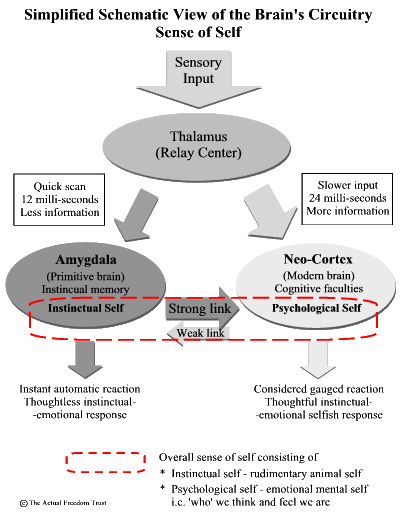
RESPONDENT: A friend of mine had his lover leave him for another man. He was heart broken and was talking about how evil his lover had been for leaving him and how bad the other man was for taking her away. I asked him if he loved her? He said he did. I said, then if you love her you only want for her happiness. It became clear that he was not speaking from love, but from insecurity and a feeling of loss that was coming from the ego. He saw the point and changed his perspective and showed her love and understanding. In about a week she came back to him. They are now far more open with each other. Relationships are a very rich field for growth and learning to express more love. PETER: My experience with Vineeto is that love and its accompanying roller coaster of deep-seated emotions and feelings is what really prevents actual intimacy – the direct experience of the other. How can two people relate to each other as human beings with this constant churning of deep-seated emotions and feelings? Love is but a failed antidote to fear and loneliness, an attempt to bridge the separateness that inevitably occurs when two lost, lonely, frightened and very, cunning entities attempt to live together. The only solution is to get rid of the fearful and lonely ‘self’ in order to allow the direct intimacy hidden beneath. To get rid of all imagination and belief enables one to experience the wonder of the actual and physical. We have found that living without this emotional burden of love allows us to live together with an ease, comfort, delight and level of consideration that we never thought possible. The Eastern approach of blaming thinking and letting the emotions that arise from the instinctual passions get off scot-free is a process that can only lead to an altered state of consciousness – not peace on earth, in this lifetime. Instinctual passions when freed of any sensible thought and earthy sensuousness results in impassioned delusion, altered states of consciousness and finally, the infliction of theomania. Human beings are unique among the animal species in that we have a large ‘modern’ brain – the neo-cortex – capable of thinking, planning and reflecting which overlays the primitive reptilian brain – the amygdala – the source of the animal instinctual passions of fear, aggression, nurture and desire. Recent studies by LeDoux and others empirically confirm that the ‘quick and dirty’ instinctual, passionate responses of the primitive brain are primary and automatically over-ride the thoughtful, considered responses of the neo-cortex. We humans are, in fact, genetically programmed to be driven, consumed or overwhelmed by the animal instinctual passions that give rise to malice and sorrow. Thus, in spite of all our best and well-meaning efforts to keep our malice and sorrow under control, we are but ‘animal’, at our very core. These instinctual passions produce the feelings of love and hate, compassion and sorrow, humility and pride, belonging and loneliness, bliss and dread, etc. The constant tightrope of balancing the extremes of mood swings produced by the chemical flow from the amygdala is exhausting work but to seek solace and succour in a fantasy world of so-called good feelings does nothing to eliminate the instinctual animal passions. The Ancient Ones have got it 180 degrees wrong – it is feelings and emotions arising from the instinctual animal passions that are the problem, not sensible thinking, contemplative reflection or sensate sensuousness. I noticed No 20 is beginning to cotton on to this fact as well, when he said in a recent post to you –
‘Self’-immolation is the only way to eliminate human instinctual malice and sorrow because it
brings a permanent irrevocable end to the psychological and psychic reactions caused by the primitive reptilian brain.
RESPONDENT: What is our collective will? Do we even have one? PETER: The collective will of the species is a will to survive as a species. Blind nature wires each species with an instinctual response mechanism in order to perpetuate the particular species. It is a very clumsy package and in many species it actually conspires, making survival difficult. The migratory patterns of many birds and animals are such as to cause the futile death of many. For humans these instinctual responses are fear, aggression, nurture and desire. Fear and aggression are necessary to attack and defend against other animals that would kill or eat us. In the human species this includes to attack and defend against other humans in competition for territory, food, mating partners, etc. Nurture is essentially the instinct to procreate, provide for, protect and pass on any knowledge, customs, morals, ethics and beliefs to the next generation. Desire is the drive to survive – it translates into sexual conquest, power over others, and attaining the necessities of survival such as territory, food, offspring, and the protection of others. Played out by 5.8 billion humans these instinctual patterns combined with tribal conditioning results in the Human Condition as we see it in operation on the planet. This is what we humans agree we are, and we further believe that you can’t change human nature. So we all agree that we can’t change ourselves, so no one dares to try. It is now possible to become free of the collective will. But it does take the courage to stand on one’s own two feet, to stop believing what others tell you as truths and start looking at facts. Then one discovers and sensately experiences the delight, ease, magic and perfection of the physical universe. (...) * RESPONDENT: This is what we get if we decide that ‘survival of the fittest’ is the name of the game, though very few will survive. PETER: We don’t casually decide that ‘survival of the fittest’ is the name of the
game, we are instinctually driven. It is wired in us in what is commonly known as the Lizard brain, the seat of our instincts of fear, aggression,
nurture and desire. Unless one faced this fact one either spends one’s life trying to be good or chasing some Altered State of Consciousness
wherein one became ‘not the body’. Head in the sand or heart in the clouds?
PETER: What I was interested in was the willingness to kill – the instinct of aggression. This instinct is often triggered by fear, but has been implanted in humans to ensure that the offspring are protected sufficiently to ensure the survival of the species. Having had 2 children, one of whom died at an early age, I know the powerful urge to give my life as a sacrifice to ensure my offspring’s survival. It is this ‘blind’ instinct in me that I was interested in investigating, understanding and eliminating. Such that I would never again blindly kill, or be killed, for ‘love’ of country or ‘love’ of God. To free myself of malice. RESPONDENT: Now, with only one small comment and a reservation, I could say that I have had the same interests. My comment would be, the willingness to kill stems from two different sources, either to catch food, or to defend oneself from one’s enemies, the first I would consider (in today’s terms) the greed for acquisition, and second is still defence (or fear). I would associate aggression more with the first of the two, and what happened on the Ranch was more of the second sort. PETER: Firstly, the human species, as a whole, is ‘pre-wired’ with the instincts of fear aggression, nurture and desire. The source of this programming is in the primitive or ‘Lizard’ brain. The instinct of aggression is well documented, studied and acknowledged in our closest genetic species, chimpanzees and apes. ‘Ethical’ considerations have inhibited studies in humans such as the Milgram experiments, but ‘Blind Freddie’ would have to acknowledge that we humans have the same primitive instinct of aggression. It is acted out in many situations on the planet, even as I type these words, when the urges well up to become uncontrollable, whenever emotion overcomes reason or control. It is easily recognizable in each of us as a feeling. The feeling of wanting to hurt someone, the feeling of wanting Justice done, the feeling of wanting to kill someone. This feeling is the sure pointer to the instinct of aggression in operation within us. Any one of a number of things can trigger this instinct to come into play – physical danger, threat of loss of territory or possessions, jealousy, revenge, etc. Moreover the instinct is often activated without any obvious cause, it is then simply the impulsive aggressive drive in operation. This is then played out, sometimes physically, as in physical violence, power, domination, subjugation, repression, etc – sometimes verbally in argument, snide comments, sarcasm, innuendo, gossip, etc. – or more often covertly as withdrawal, psychic vibes, psychic power, psychic manipulation, etc. The Ranch was a passionate mix of them all, with the added grand psychic and physical power-play between two groups, with Rajneesh and his followers taking on the Christian God and his followers. RESPONDENT: Because the first is an attribute of the more successful of our species it is still, in most forms, respected in our society, while the second is more condemned as it is an attribute of weakness. (I speak more in relative terms, rather than absolutes, yes, there are exceptions). My reservation is with the last sentence. I would associate malice with wanting to cause harm without regard to the above causes of aggression (I.e. neither for acquisition not defence) but simply from a desire to hurt another. Why? Well, most likely to improve one’s self image. PETER: No, aggression, as well as fear, nurture and desire is ‘hard-wired’ into all of us, but given that it is only a ‘program’ in the brain, it can be deleted, eliminated. The solution is both radical and ruthlessly effective. Eliminate the feelings, emotions and instinctual passions that are the very cause. The psychological and psychic entity has to self-immolate in order to free us of malice and sorrow. Merely to attempt to ‘transcend’ the programming by giving full reign to the imagination and feelings of good and God in order to battle the bad and Evil, has never been a solution and never will be. ‘Tis but a fairy-story, a wished-for imaginary solution to what is a practical problem. RESPONDENT: Of course, freeing yourself from malice is an excellent objective, but I would differentiate it from the two basic causes of aggression. PETER: You are confusing what are the triggers and symptoms of aggression with what is the
cause. There is only one cause of aggression in human beings and that is the instinctual programming of Blind Nature, instilled only to ensure the
survival of the species. Freeing yourself from malice is not only an excellent objective it is now an obtainable, realistic, practical and realizable
objective. It does, however, involve ‘self’-immolation, which is not the fashionable, feel-good, fantasy type of thing that appeals to many. Freedom from the Human Condition – Happy and Harmless Peter’s & Richard’s Text ©The
Actual Freedom Trust: 1997-. All Rights Reserved.
Disclaimer |