Affective Experiencesvs. Pure Experiences
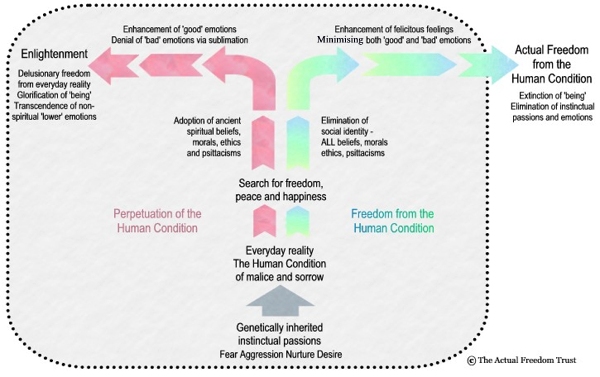
Peter: In order to make clear some definitions that we frequently use and that we have been increasingly refining over a period of some three years, I have dug out our diagram of ‘180 degrees opposite’ in the library and we have added to it by noting the differing experiences that occur on the path to Enlightenment and on the path to Actual Freedom. Note that Peak Experiences, as the general generic term, can include affective-spiritual experiences as well as pure experiences. Given that everyone who has been searching for freedom – up until now – has been searching on the traditional paths, everyone has been searching for an Altered State of Consciousness type freedom. As such, any out-of-the-ordinary experiences that occur in the pursuit of a permanent ASC, aka Enlightenment, are in general of the affective and imaginary kind and include near death experiences, feelings of dread, bliss, universal sorrow and oneness, epiphanies and Satoris as well as transgressing into the atavistic psychic realms such as channeling, reading Akashic records, telepathy, etc. All of these experiences are epitomized by feelings, ‘bad’ or ‘good’ feelings. On the Actual Freedom side of the diagram we have listed the pure experiences that one has on the path to Actual Freedom – the Pure Consciousness Experiences. A pure experience can sometimes be a ‘nature experience’ or a ‘Jamais Vu’ experience, provided that there is no affective component in them whatsoever. As Actual Freedom is totally new to human experience, and nobody has lived in a Pure Consciousness Experience before for 24hrs a day, every day, most pure experiences are bound to be interpreted within the traditional context depending upon one’s cultural, spiritual or religious conditioning. As such, most pure experiences will therefore be tainted, polluted and affectively tinged either during or after the experience. As there is no affective faculty operating in a PCE and therefore no emotional memory available to draw on afterwards, it is often hard to clearly remember the experience itself and therefore it tends to be placed in the category of a traditional affective experience. This re-interpretation happens as one is more likely to remember the emotional interpretation after the event rather than the non-affective experience itself. A pure consciousness experience is just that – an experience of pure consciousness, where the ‘self’ is completely absent, for a brief period of time. This means that there is no affective experience in a PCE whatsoever, no ‘love, bliss, rapture’ or the imagination of being ‘the saviour of mankind’. Whenever there is any feeling or emotion experienced, it is not a PCE. For most people, the experience may well start as a PCE, but most often ‘I’ will step in and seize the experience as ‘mine’ and interpret and feel it to be a spirit-ual experience. One needs to understand and practice actualism to be sufficiently aware of one’s beliefs, feelings and instinctual passions in order to avoid the seductive lure of affective experiences and the instinctual trap of Enlightenment on the path to Actual Freedom. These pure experiences are one’s ultimate authority, one’s guiding light and touchstone on the path to Actual Freedom. One also needs to make a clear distinction between a pure ‘nature experience’ and an affective experience wherein one merely marvels at nature with one’s heart full of beauty, love and religious awe. Richard provides clarification for this ‘self’-less type of ‘nature experience’ –
Peter: The term ‘peak experience’ is an all-encompassing phrase … a ‘catch-all’ term for many and varied experiences, a generic term used for a wide variety of exceptional experiences, which can range from nature experiences to feelings of great love or beauty, from pure consciousness experiences to epiphanies, Satoris or full-blown Altered States of Consciousness. Personally, I stopped using the term ‘peak experience’, because for an actualist it is absolutely vital to make a clear distinction between a ‘self’-less pure consciousness experience and an emotional/ spiritual peak experience, including any Altered States of Consciousness which are well documented as self-aggrandizing experiences. Both ASC and PCE have been clearly defined and exhaustively written about on The Actual Freedom Trust website – thus I am of the opinion that introducing ‘peak experience’ would only confuse the distinction. When I feel happy – that’s good, when I am excellent – that’s excellent, I enjoy it a much as possible. When an issue, a feeling or an emotion surfaces, then I investigate them in order to get back to being happy as quickly as possible. Should any affective experience arise on the path, then I know that I have something to look at, something to investigate. I am not so much concerned as to how I should differentiate between various affective experiences, even when they are ‘out of the ordinary’, but instead I am looking for the ‘self’ that is in action in all of those affective experiences. My sole interest is to eliminate all of my ‘self’, in order to be ‘what I am’, this flesh-and-blood body brimming with sense organs. As such, any experience that is not a PCE, however unusual or seductive, needs to be thoroughly investigated. That’s what makes the pursuit of Actual Freedom so simple. There is a vital difference in understanding and evaluating experiences between the spiritual search and actualism. Spiritual people give great significance to a temporary absence of the ego, or personal self, and the much sought-after emergence of a new identity, the real ‘me’, in a out-of-the-ordinary experience, Satori or ASC. Whenever one removes only one’s personal ‘self’, the ‘ego’, with one’s ‘soul’, the animal-instinctual ‘self’, still intact, this will result, in the ‘soul’ running amok, unfettered by a personal ‘self’, inevitably evolving into an impersonal ‘Self’. For an actualist, however, such absence of ‘I’, the ego only signifies the unabated and uncontrolled presence of ‘me’, the soul, the animal-instinctual part of the identity and can give great insight into the psychic power and lure of an Altered State of Consciousness and the animal instincts in action. Those who know by their own experience use the word enlightenment when referring to the permanent Altered State of Consciousness, the death of the ego, the expansion into Being. While one can revert to normal from a temporary Altered State of Consciousness because the ego is not permanently extinct, Enlightenment is an irreversible, permanent state where the feelings run rampant, now uncontrolled by any personal self or ego. For me, it is enough to have sufficient experiential knowledge of what I need to avoid – the instinctual grasp for ‘my’ psychological and psychic survival experienced in an Altered State of Consciousness. Now, from a state of Virtual Freedom, any Altered State of Consciousness would be dilapidation and has most definitely lost all of its former seduction of grandeur. Given Richard’s experience of going through enlightenment and struggling to come out of it into the actual world, it is now an unnecessary, arduous and convoluted enterprise to unwittingly allow oneself to become enlightened and then torturously endeavour to free oneself of enlightenment … … in order to become actually free. In actualism one incrementally dismantles and eliminates both ego and soul, both one’s personal ‘self’ and the instinctual ‘self’ passions until both components of the identity become extinct in one great finale – bingo. I know there are a lot of terms that might seem confusing at first – ‘I’, ‘identity’,
‘self’, ‘ego’, ‘soul’, ‘social identity’ and ‘instinctual passions’. That’s why The Actual Freedom Trust glossary or the
Library topics, accessible through Editorial note: update here: Further related discussions and topics A Down-to-Earth Freedom from the Human Condition – Happy and Harmless in this Lifetime Richard's & Peter’s Text ©The Actual Freedom Trust: 1997-. All Rights Reserved.
Disclaimer |