Introducing Actual Freedom
Actual Freedom – The Third Alternative
|
Please note that the entire text of the Introduction was written by the feeling-being ‘Peter’ while ‘he’ lived
in a pragmatic (methodological), still-in-control/same-way-of-being Virtual Freedom before becoming actually free. |

Some background information |
|
The key to freedom from the Human Condition is
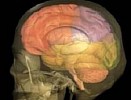
the unique capacity of the human brain to be aware of its own functioning. Human beings are thus capable of being aware of both what they
are thinking and what they are feeling – feelings being ‘my’ emotional-mental interpretation of the instinctual passions in
operation. This ability is commonly known as self-awareness. |
|
|
|
|
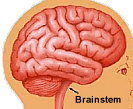
In recent decades, scientific studies of the
neuro-biology of the human brain are heralding the beginning of an empirical understanding of the genetically-encoded instinctual passions.
These scientific observations make nonsense of the traditional denial
of the existence of instinctual animal passions in humans as well as the ancient belief that transcending the bad or
Evil passions by aggrandizing the good or Divine passions would provide a solution to all the mayhem and misery on the planet. |
|

|
|
‘Self’-awareness is possible in human beings in that we have the ability to
develop and maintain an ongoing awareness of both the social conditioning of beliefs, morals and ethics one has been instilled with since
birth as well as the feelings and deep-seated emotions that are the result of the instinctual passions in operation.
What one is ultimately attempting to do by sustaining an ongoing ‘self’-awareness is to eradicate ‘who’ one thinks one is and ‘who’
one feels oneself to be by the simple process of exposing both one’s social and instinctual identity to the bright light of awareness.
‘Self’-awareness is not a natural phenomenon and one will no doubt discover an innate
resistance to getting it up and running – a resistance that can only be overcome by the sincere intent to become happy and harmless, as one
was in a pure consciousness experience, for 24 hrs. a day, every day. Even then this ongoing attentiveness needs to be actively cultivated and
then persistently practiced in order to ensure success.
The method of becoming happy and harmless, 24 hrs. a day, every day, is both
devastatingly simple and ruthlessly efficient. One needs only to continually ask oneself the question … |
|

|
|
The continual asking of this question until it becomes a wordless on-going
attentiveness is the key to cultivating and developing ‘self’-awareness but it does require sincere intent and a continual perseverance in
order to ensure success …
The essential purpose of this on-going attentiveness is to undertake a total investigation into
anything that is preventing one from being happy and harmless now – after all, if one’s aim is to experience being happy then one needs to
be happy now, not some imagined happiness in the future, nor some remembered happiness in the past. The question to ask oneself is – ‘How
am I experiencing this moment of being alive?’ – this moment is, after all, the only moment I can experience being happy.
As you begin to get your attentiveness up and running you soon become aware of feelings or emotions
such as worry, boredom, frustration or anger that are causing you to be unhappy and /or antagonistic towards others. When you become aware of
any such feelings or emotions it is important to get back to feeling good again as soon as possible and then trace back to what caused you to
stop feeling good in the first place whether it be an incident, a thought, an expectation, a memory, something someone said or didn’t say
and so on. By making such an investigation you soon discover that you are in fact gaining an experiential understanding of how and why ‘I’
tick, both as a social identity and as an instinctual being.
The potent combination of a continual awareness and a sincere investigation can actually
dis-empower the debilitating influence of one’s social conditioning as well as one’s instinctual passions such that one is more easily
able to feel happy and more easily able to be benevolent towards one’s fellow human beings.
The method soon presents success incrementally, as freedom from beliefs, morals, ethics and
psittacisms and the feelings and emotions that arise from the instinctual passions is indeed a palpable freedom that results in increased
peace and harmony for oneself and in one’s relating with one’s fellow human beings. The method does bring up fear and resistance, because
one is dismantling one’s very ‘self’, those very beliefs and passions one holds so dearly.
Of course, the major fear is that it will work and as a consequence ‘I’ will ‘be’ no more. |
|

|
|
This method of ‘self’-awareness is both concise and down-to-earth in that it
concentrates one’s awareness on this moment in time – this very moment, right now, in this very place. The whole emphasis is on ‘how am
I experiencing this moment’? This is not to deny that one has a goal and that this goal is in the future – to be happy and harmless,
24hrs. a day, every day, but it does take time to work through each of the beliefs, morals, ethics, psittacisms and instinctual passions –
to thoroughly investigate them.
By bringing one’s attention to the fact that this is the only moment I can experience being
alive, the fact becomes obvious that if I was happy ten minutes ago and I am not happy now, then I am not happy now. If not, why not? What is
that feeling I am feeling? As soon as you catch yourself not feeling good, you get back to feeling good and then ask yourself what it was that
caused you to stop feeling happy? You then have something to do, something to investigate in order that you don’t fall back into the same
trap again in similar circumstances.
Always your immediate aim is to be happy now, in this only moment you can experience being alive,
whilst your ultimate goal is to have an uninterrupted continuous moment of happiness such that you are then happy and harmless 24 hrs. a day,
every day.
|
|

A curious thing begins to happen when one contemplates upon what it is to be a human
being, when one ponders the Human Condition, when one becomes ‘self’-obsessed. Soon every interaction, every emotional reaction, every
thought and every feeling is scrutinized in terms of ‘How am I experiencing this moment of being alive?’ This is definitely not meditation
– it is 180 degrees opposite. This is not sitting with one’s eyes closed, retreating ‘inwards’ and fearfully hiding from the world
as-it-is and people as-they-are but being fully occupied in the world of people, things and events.
The vowed aim of meditation is to escape from the world, transcend the ego and ‘become’ the
soul – an imaginary and delusionary shifting of one’s identity from mortal to Immortal, from animal to Divine. Whereas the whole point of
the process of actualism is to be aware of, identify, investigate and eliminate both one’s social and one’s instinctual identity – both
ego and soul – for both are the source of one’s malice and sorrow. The goal is to become actually happy and harmless, on earth, in
this very lifetime.
|
|

|
|
|
|
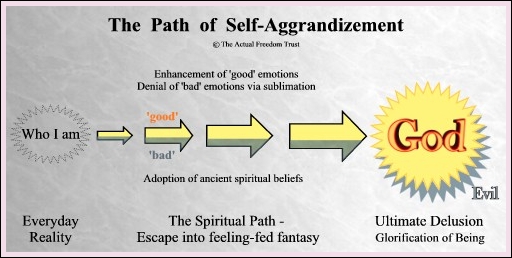
In order to avoid the delusionary trap of Enlightenment, it is vitally important
that one thoroughly investigates all of the spiritual and meta-physical beliefs that are imbibed as part of one’s social identity as well as
investigate and diminish both the so-called ‘good’ and ‘bad’ instinctual passions.
An actualist’s naiveté and connection to pure intent, firmly based on the purity and perfection
evident in the Pure Consciousness Experience, will ensure that one avoids the instinctual lust for the power of feeling oneself to be God as
well as the seductive lure of being worshipped as such by others. |
|

|
|
It is vital to explore and investigate the affective feelings and emotions that
arise from the instinctual animal passions – both the ‘good’ and the ‘bad’ – for the secret to being actually free of
malice and sorrow lies in this very exploration. It is also essential to understand and fully comprehend that one’s feelings and emotions
are part and parcel of the Human Condition and not a personal fault, failure, stigma or ‘evil’. Fear, aggression, nurture and desire are
innate passions that every human being is programmed with by blind nature.
There is a third alternative in investigating affective feelings, emotions and instinctual passions
and it involves neither repressing nor expressing – the traditional either/or approach. This alternative approach requires breaking the
habit of either expressing or repressing feelings, emotions and passions. Clearly seeing what one is doing to others by expressing, or
attempting to suppress, anger is surely sufficient to stop if one’s intent is to become harmless.
The other good reason to stop expressing feelings such as anger is that one then stops the endless
cycle of being angry, feeling guilty, wallowing in shame, seeking solace in resentment, plotting revenge and building up to being angry again.
By neither suppressing or repressing your feelings and emotions, you are then able to feel the feelings as they happen. This observing and
investigating – neither suppressing or expressing – has the added advantage of both getting men fully into their feelings for the first
time in their life and getting women to examine their feelings, one by one, instead of being run by a basketful of them all at once.
Few spiritual believers are prepared to make this investigation of feelings, emotions and
instinctual passions for they see that if they dare to question the spiritual ‘good’ feelings they will simply end up back in the ‘real’
world that they have been desperately trying to escape from. Some also feel that to question their spiritual beliefs is to go towards the
devil or evil while others see it as ending up in some sort of robotic catatonic state of non-feeling. What belies these fears is the PCE
where the purity, perfection and benevolence of the actual world is magically apparent ... solely due to the fact that both ‘I’ as ego and
‘me’ as soul are temporarily absent.
|

Text, Design & Images ©The Actual Freedom Trust: 1997-. All Rights Reserved.
Disclaimer and Use Restrictions and Guarantee of Authenticity Image Credits |