|
Selected Correspondence Vineeto Social Identity JAMES: I am not clear on how one eliminates the instincts. Does this happen on its own or is there something that ‘I’ need to do? VINEETO: As for eliminating instincts, I found that the method works as effectively for discovering, experiencing, investigating and eliminating instincts as it does for investigating the beliefs, morals, ethics and values that shape our social identity. Personally, I had to get rid of my moral, ethical and spiritual restrictions first in order to be able to admit to, acknowledge and recognize the ‘gross’ instinctual passions that lie at the core of my ‘self’. First I had to question my ideas about right and wrong, good and bad, before I was able to recognize and investigate my own raw survival instincts of fear, aggression, nurture and desire. A week ago I discovered in a National Geographic magazine from 1989 an article from Jane Goodall about the life of chimpanzees in the wild. She observed them over years and describes in detail their social behaviour. I found the article very relevant to the Human Condition. Being busy with the topic for a few days gave me plenty of time to ponder over the remarkable similarity between humans and chimps, which are our closest genetic cousins with their DNA-structure being 98% identical to humans. One night the realization hit that at ‘my’ core that ‘I’ am the same makeup as a chimp, an instinctually driven creature, but fortunately equipped with the capability of self-awareness. I can now see that the instinctual program in humans is no different to the instinctual survival program of chimps or gorillas. The understanding has been stunning, to say the least. I suddenly saw how simple it all is. ‘Me’, the chimpanzee, ‘me’, the instinctual survival program is the very core of my identity. This is what has to die. Guided by pure intent and self-awareness I have removed the imprinted ethics and morals of my social and spiritual identity that kept the lid on those primary instinctual passions, and now I am able to see those bare instincts operating in me. Neither expressing nor repressing any emotions really does the trick and sets the magic in motion that carries me through again into the actual world of delight and perfection. Does this answer some of your question? Further, there is a plethora of writing on our website, you can either go to the JAMES: My understanding of what you have said is to keep using the method and deal with issues as they come up. Although I have been working on beliefs and emotions for a long time this area of instincts is new to me so I don’t know exactly where I’m at with it. For instance, if I don’t name a feeling and stay with it there is an energy that seems to be in the area of the old brain. Is this an instinct that is producing this energy? How do I become intimate with the instincts? VINEETO: Having been programmed first with the Christian and later with Eastern religious belief, the fact that humans are born with a set of instincts – and not born ‘innocent’ – has been quite a new discovery for me. Christians say that one is born with original sin because of Adam’s disobedience, and in a way they come close to the fact that without moral and ethical restraint, we humans behave no differently than wild animals, instinctually driven. Slowly, slowly, after I removed the layers of moralistic and ethical values I could dare to acknowledge and experientially discover that ‘me’, at the very core, consists of nothing else but crude and cruel survival instincts – fear, aggression, nurture and desire. Discovering and seeing in action each of these instincts was an adventure by itself, thrilling, fascinating and very revealing into the human nature. First one removes the ‘truths’, convictions, intuitions and feelings that were instilled in us to make us a fit member of society – a man, a woman, a wife, a husband, a scientist, a clerk, an American, a follower or a ‘true’ believer. And it is great fun to dismantle those identities and eventually become an anonymous nobody. Then, on honest investigation, you will be able to recognize these instinctual passions as ‘you’, all of ‘you’. It is not a matter of having an ‘ intimate ’ relationship with one’s instincts, but to acknowledge, feel and experience that ‘I’ am my instinctual passions, nothing else. ‘I’ am rotten to the very core. That experiential acknowledgment that underlying one’s precious feelings are the animal instinctual
passions of fear, aggression, nurture and desire, gives one the motivation and sincere intent to actively devote one’s life to irrevocably
changing oneself.
JAMES: I have a new situation to deal with since talking with you last. My Mom is in the hospital and I am spending most of my time taking care of her. This subject of fear is still appropriate in relation to how I am dealing with this situation. The second I start thinking about it I am overwhelmed with fear, worry, etc. However, I find that running the question ‘how am I’ is helping me to deal with the situation. Asking the question has helped me to stay in the moment and what I find is everything is ok in this moment right now. All my fears are in regard to how am I going to manage taking care of her at a future time. Right now at this moment in time she is taken care of. VINEETO: Life seems to have given you a serendipitous opportunity to have a closer look at the instinctual passion of nurture, its correlating feelings of love and belonging and the implications of being a social identity as a family member. Quite an exciting range of possible discoveries that could help answer your earlier question of ‘How do I become intimate with the instincts?’ Love and compassion, sympathy and empathy are our usual ways of relating to family and friends and through the same emotional ‘channel’ we also invite their fears and worries, sorrow and resentment, anger and hatred. There is only one way when one relates to people affectively and that is within the rules and ways of the Human Condition. The moment I feel sympathy for someone I am also swamped by their fears, the moment I am empathic for someone’s suffering I plug into the collective misery of mankind. The need to belong makes one susceptible to everybody’s feelings, be it anger or fear, greed or suffering. This is not just a poetic expression, it is my very experience. In order to become happy and harmless I had to examine my every relationship – to Peter, to my peers, to my work-mates, to my parents and relatives. Whenever I ‘reached out’ emotionally, understanding someone’s sorrow, fear or anger, I could not help being affected – that’s the very idea of ‘sharing’ and the common remedy against feeling lonely in the first place. But there is no choice of feeling just the nice, good feelings with or for someone and disregarding their negative feelings – by the very nature of emotions I am being hooked into the emotional web the moment I choose to go along with affective feelings. The alternative was to consciously and deliberately decide to leave the cozy nest of bitter-sweet feelings, to abandon the ‘squabbling and miserable humanity’ and examine and then eliminate feelings and emotions in myself. I have found that the ‘good’ emotions were even more insidious than the ‘bad’ ones. Many people would like to get rid of anger, sadness and fear, but who would want to abandon love, compassion, beauty and bliss? But once I understood the intrinsic connection between love and fear, compassion and sorrow, empathy and suffering, I decided to get free of the lot. When I love someone I am afraid to lose him or her. In order to have compassion for someone the other needs to be ‘in the pits’ emotionally – otherwise there is no use for my compassion. Empathy is even more insidious – the suffering creeps under the skin and one never quite knows what is happening. And all this sorry-go-round for the sake of not feeling lonely, bored and fearful? I discovered that by examining and eliminating my very identity as an appreciated and valued member of society I eliminated loneliness and boredom at the same time. And not even the closest friendship can ever take away one’s fear of death – for fear to stop the very ‘I’ that generates this fear has to become extinct. Love is not the solution, love is the problem. With love disappearing I could for the first time live in peace and harmony, ease and equity with another human being, day-in, day-out, 24 hrs a day, without bicker or quarrel, crisis or boredom. Without love, actual intimacy and genuine benevolence became possible for the first time. What a serendipitous trade-in! It seems mad to everyone else but they don’t know what I’ve got! * VINEETO: Love and compassion, sympathy and empathy are our usual ways of relating to family and friends and through the same emotional ‘channel’ we also invite their fears and worries, sorrow and resentment, anger and hatred. There is only one way when one relates to people affectively and that is within the rules and ways of the Human Condition. The moment I feel sympathy for someone I am also swamped by their fears, the moment I am empathic for someone’s suffering I plug into the collective misery of mankind. The need to belong makes one susceptible to everybody’s feelings, be it anger or fear, greed or suffering. JAMES: I saw yesterday what you are saying about sympathy and empathy. By not buying in to her suffering I was relieved of my suffering and I was better able to take care of her. Also have seen that ‘I’ am rotten to the core because a lot of my suffering has been worrying about ‘me’ having to take care of her. VINEETO: To examine the so-called ‘good’ emotions of nurture, affective care, sympathy, friendship, duty, love and compassion is a fascinating subject and can only be done by questioning and examining at the same time the morals and ethics of society that forms one’s very social identity. If one wants to be actually free of the Human Condition, one has to examine and recognize that ‘good’ simply means ‘morally acceptable’ and ‘right’ is just another ethical value, both of which vary from tribe to tribe and from society to society. The ‘good’ is a much a bondage as the ‘bad’ – even more so because it seems much more desirable. As humans we don’t want to lose the other’s affection and reassurance, the appreciation of our peers, the cozy safety of being part of a family or group, the comforting knowledge of doing what everyone considers the ‘right’ thing or the ‘good’ deed. Freedom lies in the opposite direction. On the path to actual freedom I did not bother to try to solve the moral or ethical problems of what is ‘good’ or ‘right’ but focussed my attention instead on discovering my own ethical and moral values – my social identity in action. ‘Ah, I’m trying to find out what is right? I’m upset that someone did the ‘wrong’ thing? I’m aiming again to be a ‘good’ person?’ These were indications that my moral identity was in action and I used my awareness to examine this very identity and learned to step out of it. What is now left is a simple sensible solution – and mostly my worries were seen to be an S.E.P.-situation, Someone Else’s Problem. Once I understood that it is only me who can set myself free I also understood that everyone has to do
it for themselves as well. What perfect arrangement. It for sure saves one saving people. * JAMES: It is clear that the only one I can change is me. VINEETO: What I was trying to clarify is that the first thing to change was my perception of
what had to change. All my life I had tried to change for the better, first according to the Christian standards of ‘good’ and ‘bad’
–heaven and hell – and later according to the spiritual standards of ‘good’ and ‘bad’ – nirvana and bad karma. What I needed to
understand was that both are only slightly different standards of morals and ethics, and to shift one’s inbuilt instinctual passions from
aggression to compassion, from sorrow to devotion, from fear to hope and from bondage to dis-identification is nothing other than rearranging the
deckchairs on the Titanic. The structure of one’s being is not changed – the ‘feeling being’ itself needs to be questioned and
investigated, uncovered and eliminated.
JAMES: I am not accepting that I cannot change but I don’t know if I can change. This leaves the possibility open. I have awareness but pure intent and courage seem clouded by doubt. VINEETO: Doubt is an interesting phenomenon. The other day I talked to a woman who confided in me that she was continuously tortured by doubt if she was doing the right thing. When I asked who it was she ultimately needed to please, she said, ‘my mother’. I was rather surprised – the woman has grown-up children herself and her mother has been dead for many, many years. When she asked what was my solution to doubt, I simply said that I follow my own – very high – standards and that doubts have disappeared out of my life. I then realized that in order to follow my own standards of silly and sensible I first had to get rid of the emotional issue of authority, I had to investigate and abolish every belief in authority that had ruled my life until then, including the Almighty, All-knowing and punishing God. At the time, that was quite an amputation by itself! The other implication of following my own standards is that I am always ruthlessly honest, so when I find some feeling lurking beneath the seemingly smooth surface, I have to ‘get off my bum’, on to the couch to contemplate and root around until I have investigated the emotion in question. My guiding light is the purity and perfection of the actual world experienced in a PCE and the way to live in the actual world permanently is to whittle away at the ‘self’ until it self-immolates. In the clarity of a pure consciousness experience I could see doubt for what it is – my ‘self’ scurrying for cover. So again, intent and courage grow and multiply by taking action and gathering confidence from the ensuing success. One simply has to start somewhere – to merely think about possible victories and failures only feeds doubt. Courage only happens in the doing of the action, not before, and intent grows out of the determination not to settle for second best. Of course, one can use the method also to do some minor adjustments to one’s social identity, clean out some bad habits, get rid of some particularly troubling problems and then stop further investigation. I know quite a few people who have done exactly that and who are now a little bit happier with their lives than before. The outcome is not Actual Freedom, but a little bit more sensibility, less gullibility and a little bit more freedom from one’s burdening social role-play. It is purely a matter of what you want to do with your life. Personally, I function differently. I can’t stop halfway down the road when I know what is possible.
Whenever I have encountered fear, I also experience a stubborn bloody-mindedness that has initially surprised me. When I looked back on my life
from where I drew the strength and courage to pursue I recognized that all my major turning points had to do with one desire – to be free.
Freedom had different notions and definitions in the course of the years, but the desire to discover the best freedom possible always kept me
going. Now that I know what I want and how to get there, any obstacle is turned into a challenge, a research and an adventure – the adventure of
a lifetime. * VINEETO: Talking to Peter later on I realized that there is only one solution to any problem that occurs – only when I have enough of it am I ready to get out of it, I simply stop feeding the feeling and, bingo, the problem disappears with the bit of identity that had kept it in place. It might take a long time until one has had enough – and some people are obviously tough and stubborn sufferers – but once the limit is reached, a curious decision can be made and then it is only a matter of minutes to be free of the burdening feeling. If the understanding and decision is total, that feeling won’t come back. And then, one is able to make sensible responses to the situation, free of affective feelings. JAMES: If this is true then obviously I haven’t had enough. I am suffering right now. VINEETO: Actual Freedom is not a miraculous event that will one day appear all by itself and then all suffering will be over. Actualism, the process to becoming actually free, is a verified method which provides one with the means and tools to investigate the nitty-gritty of the Human Condition in oneself and – when applied with persistence, sincerity, diligence and pure intent – one can successively and permanently free oneself from one’s social identity and then from one’s instinctual passions. The first thing to investigate is one’s social identity. Unless one has freed oneself from the social mores and ethical rules, from the various role-models that we have learned and adopted throughout our life time it will be impossible to tackle the deeper layers of the instinctual passions. Richard has outlined the social identity in his last letter to No. 13 –
* VINEETO: Which confirms what Richard has said:
JAMES: I’m not there right now but I am going to be with why I am not ready to leave the ‘self’ behind. VINEETO: Alan once called a similar attempt the 64,000-dollar question. Why not start with the easier task of tackling your identity as a son, as a man, as an American, etc. There is a plethora of social (and spiritual) rules and regulations to discover, and there is an immense freedom to be gained when leaving those various identities behind. (...) * VINEETO: Love is the longing to bridge separation. Without separation there is no need and no possibility for love. The greater the separation the greater the longing, as is confirmed in all heroic romantic tales. The feeling, the bitter-sweetness of the longing, is very real and very seductive and yet, for love to stay in existence one has to maintain the separation. So, in the very nature of things, love never occurs without its identical twin, loneliness, and in order to actually and permanently get rid of separation one has to get rid of love first – personal love, family love, love for those who suffer, love for humanity, love for the good, love for an imaginary God, etc. Only when I recognized love as the problem, instead of the solution, did actual intimacy have a chance to happen, actual intimacy between two human beings, free of identity and self-centredness. And what a vast difference there is. Love is merely an old chewing-gum compared to the gourmet meal of direct intimacy. JAMES: I hear this but I’m not sure that love is the problem. However, I do recognize the instincts as being the problem. VINEETO: Yes, the instinctual passions are the underlying problem, yet the Human Condition also consists of the various emotionally backed-up beliefs that constitute our social identity. Once one digs into the roots of love and inquires why one has feelings of love in certain situations then it will become clear that love is directly linked to the instinctually based feeling of nurture and the need to belong. When you experiment with ‘How am I experiencing this moment of being alive?’ and follow up the feeling of being shackled and bound by love, you will discover for yourself that love is the problem and not the solution. For actualism to work is it crucial that you don’t just believe what I say, or what we write, but
that you verify for yourself that questioning and investigating dearly-held beliefs and affective feelings can free you from malice and sorrow.
The Human Condition can only be unveiled step-by-step, belief-by-belief and emotion-by-emotion. Then, one day, a Pure Consciousness Experience
occurs and the actual will be startlingly obvious.
JAMES: I have a strong sense of abandoning humanity. VINEETO: In order to abandon humanity as an actuality and not as a feeling or fantasy one needs to know one’s humanity, one’s beliefs, emotions and instinctual passions through and through because ‘I’ am humanity and humanity is ‘me’. ‘How am I experiencing this moment of being alive?’ is the way to come to know all the ingredients of this ‘humanity’ in oneself. Whenever I am not happy there is something to investigate and this ‘something’, these emotion-backed thoughts and vague feelings are the stuff that constitute ‘I’ and ‘me’. ‘I’ as ego and ‘me’ as soul are nothing other than all the beliefs, emotions and instinctual passions that, in due course, one will encounter and discover in oneself on the path to becoming happy and harmless. Investigating one’s beliefs and emotions, one by one, will enable one to leave them behind, one by one. Then, without a social identity, life is a pleasure and a delight and the ongoing experience of Virtual Freedom gives one the necessary backbone to encounter the underlying instinctual passions. Abandoning humanity is only possible after one has rid oneself of one’s social identity first and
thus has the confirmation and confidence that the method works. Moreover, without experiencing the purity, magnificence and perfection of the
actual world in a pure consciousness experience one’s abandoning humanity can only lead to feelings of dread and despair or the grand delusion
of Oneness. * VINEETO: I don’t know what ‘never-never land’ represents for you, but I am reminded of Peter Pan’s dreamland for children, where one is transported from the misery and dullness of the ‘real’ world into the unreal land of imagination, where one never has to become a grown-up. JAMES: Never-never land was not a good description to use because you have no way of knowing exactly what I meant. It did seem like an unreal land but it is more of a void or not-knowing. Kind of a disconnected feeling which is what I meant by a feeling of abandoning humanity. VINEETO: ‘Abandoning humanity’ in Actual Freedom terms stands for gaily taking the pen-ultimate step before self-immolation. After one has removed one’s social identity of being a son or daughter, a man or woman, an American or Englishman, a seeker, a writer, a doctor, etc. and has become an utter non-identity, one is then able to investigate the collective psyche, the result of the instinctual passions that all human beings have in common. Applying attentiveness and awareness to the instinctual passions as they arise enables one to stop acting as per the instinctual software in the brain and thus one can slowly, slowly reduce the automated reactive and emotional impact that instincts have on our feelings, thoughts and behaviour. In doing so one not only becomes happy and harmless but also stops being part of the biggest fold of all, humanity itself. One is no longer a member of the species that ‘nourishes malice and sorrow in their bosom’ to quote Richard’s expression. Whereas ‘a disconnected feeling’ is clearly an affective feeling, arising out of the instinctual passions of fear, aggression, nurture and desire. To have a ‘a disconnected feeling’ has nothing at all to do with ‘abandoning humanity’; it is, on the contrary, common to all human beings and arises out of the Human Condition in each of us. You see, in order to communicate about the possible advantage that Actual Freedom could have for your
life, it is essential to not mix up the terms that we use with emotional or spiritual terms. For instance, ‘not-knowing’ is used by
Buddhists and other Eastern religions as an expression for the highest achievable wisdom when one enters the ‘Unknowable’, synonymous for the
‘Truth’. Aspiring to or succeeding in achieving the ‘Truth’ and reaching a state of ‘not-knowing’ is well accepted in the
‘book of rules for humanity’. When achieving a state of ‘not-knowing’ one simply exchanges the illusion of the ‘self’ for the grand
delusion of a higher ‘Self’.
JAMES: Ok, it sounds like what you are saying is that once the root is revealed and understood completely then it disappears. This does make sense to me. This answers my question clearly and completely. Thank you. VINEETO: Given that you still seem to hold to the conclusion that ‘sorrow comes from fear’ you now jump to a further conclusion that once ‘the root is revealed and understood completely’ then fear ‘disappears’ . You are therefore not concerned about eliminating what you call the ‘superficial emotions’ of malice and sorrow but that your sole aim in life is to become fearless. The aim of eliminating fear without aiming at eliminating one’s malice and sorrow is well-established in all the spiritual teachings – becoming fear-less by realizing ‘who you really are’, a process also known as Self-Realization. Thus one feels oneself to be all-powerful, i.e. fear-less, and is then no longer afraid of being malicious and sorrowful. The result of this transcendence can be observed in all the realized teachers who are known to pluck the heartstrings of sorrow in the name of feeling divine compassion and who unabashedly display their anger and displeasure from time to time, particularly when their disciples don’t ‘get it’ or fail to surrender. The method of actualism aims at becoming aware of one’s beliefs and emotions and finding out the facts for oneself – I don’t wait for ‘the root’ to be ‘revealed’ to me by some Divine Intelligence but I actively search for the causes of malice in me and eliminate them one by one and I actively search for the causes of sorrow in me and root them out. In the course of becoming increasingly happy and harmless in the world-as-it-is, with people as-they-are, the instinctual fear of actually being here in the world-as-it-is, with people as-they-are, incrementally disappears on its own accord. Maybe it will further clarify the difference between spiritualism and actualism by describing the process of examining a particular feeling – a process that, if thoroughly completed, can lead to the virtual elimination of that feeling together with that part of my identity who harboured and was nourished by this feeling. I will use sorrow as the example, given that the thread of our conversation initially started with the topic of exploring the causes of sorrow. Whenever I experienced sorrow, the examination began right at the moment when I first became aware that I was experiencing the feeling of sorrow. Due to our social upbringing, every human being is taught to cope or deal with these undesirable feelings in very specific ways, amongst them being repressing one’s feelings, expressing them, accepting them or indulging in them in socially-acceptable ways, seeking solace and protection from some mythical God, Divine Intelligence or Divine Teacher or denying and transcending undesirable feelings by becoming a Higher Self. Examples of this social programming are the spiritual belief that sorrow is good for me – therefore making feelings that are debilitating and devastating into something desirable, and the normal-world conviction that sorrow is part of human nature and you can’t change it – a fatalistic acceptance of all sorrowful feelings. We are taught a form of wishful thinking that by denying our feelings of sorrow they will somehow go away or at least not surface too often and men in particular are taught to believe that it is possible to think one’s way through sorrow and thereby rationalize it away. This socialization programming does have slight variations according to cultural conditioning, spiritual beliefs and gender, but all of this programming has a universal thread – it is solely designed to enable one to either cope with sorrow or, if that fails, to then dutifully follow the traditional religious/spiritual path of denial and transcendence. The common thread of this socialization programming is to think that because fear is the most basic human emotion that one has only the two traditional choices – either make the best of being fearful in the real-world or seek to become fearless by following the spiritual path. To continue to believe this to be true means that one cuts oneself off from becoming aware of the fact that it is malice and sorrow and not fear that are the most salient emotions that characterize the human condition. This is where the discovery of actualism breaks entirely new ground because it does not pussyfoot around with denying the instinctual passions – it directly addresses those passions that prevent human beings living together in peace and harmony on this planet – malice and sorrow. To theoretically think about and draw spurious conclusions about sorrow, i.e. ‘sorrow comes from fear’, only serves to bypass the first prerequisite of any investigation – the direct experience of the feeling itself – and one is therefore unable to become aware of what actually happens in the body and in the brain when one feels sorrow. Unless one personally observe right here, right now, the feeling while it is happening, it is not a scientific examination. The only way to find out what is fact and what is fiction, theory or speculation is to find out for oneself and conduct one’s own hands-on scientific investigation. So when you find that what you understand to be the root of a feeling does not result in the
elimination of that feeling, then you might have to go back to the ‘outer layers’ and investigate the traditional beliefs, values and
conclusions that you are unwittingly taking for granted. Unless you question everything – and find a definite unambiguous factual answer to each
of your questions – there is no way of ever experientially understanding the root of an emotion, let alone an instinctual passion.
VINEETO to No. 47: Taking people’s word’s at face value has nothing to do with trust or mistrust, but is a matter of a simple and straight-forward way to communicate. A ‘hidden double meaning’ is almost always an emotionally charged meaning and trying to second-guess what this is in any situation does nothing to enhance sensible communication. Nowadays I always assume that if people find it important that I take notice of any ‘hidden’ meaning then they will tell me – it is not my responsibility to discern what another is trying to convey through unmentioned hints and allusions. As for being ‘distrustful of the words of some’ – the good news for me was that by examining and understanding my own social and instinctual identity I had less and less reason to fear that people would emotionally hurt me with insinuations or outright sarcasm – identity-slashing intimations from others now rarely reach a target. RESPONDENT: Understood. My problem is that I sometimes forget to focus on the content because of distractions of how it is conveyed. VINEETO: Of course, that is the very purpose of people conveying a message in an emotional way.
Those ‘distractions’ are the very stuff to explore in order to determine how you are in relation to other people. Other than the words
themselves there is usually a whole layer of invisible and inaudible interaction happening and this is how Richard explained it – (
JAMES: This could explain why I have a sense of not belonging here or anywhere else for that matter because there is no psychic connection. I am an actualist in the sense that I have seen that matter is animate thru a pce although I am not positive of this because it could be a physiological process in my own body that makes matter look that way. Also, I don’t practice Actualism per se because it seems that would connect me to the group I see here. I also don’t feel I belong on any spiritual list or group. Not having any psychic connection could explain why I don’t belong and don’t want to belong as opposed to the usual use of belonging which means one wants to belong. Makes sense? VINEETO: I didn’t want to tell you, but since you have been so persistent I will let you in on the secret. There are regular out-of-body group meetings with members of the Actual Freedom mailing list each week where we come together in a sacred hall, worship Richard, chant hymns such as ‘Freedom, Freedom, from the Human Condition’ and ‘Happy, Happy, Happy and Harmless’ and at the end of the gathering slaughter a one-eyed one-horned flying purple people-eater which symbolizes the instinctual passions in everybody. The holy smoke of the burning of this wild animal is then spread onto everyone as a blessing to be protected for the rest of the week until the next disembodied ritual meeting. We have never invited you to those gathering for all subscribed members of the mailing list because you were so insistent that you don’t want to belong but you must have picked it up via the psychic web anyway. Makes sense? JAMES: No, it doesn’t make sense because it doesn’t have anything to do with what I said but I like your humour anyway. :) VINEETO: Okay. The connection between this joke and what you wrote is that your belief that actualists are a group or a cult to which you don’t want to belong has persisted despite continuous explanations that this is not the case. So in reply to your latest protestation, rather than yet again explaining that there is nothing to belong to in actualism, I followed your lead and jokingly volunteered that actualists are cult-members performing dark spiritual rituals in out-of-body meetings. If you can see the humour in the above description maybe you can also see the humour in your belief that actualists are members of a cult and understand that your belief has no existence outside of your own head and heart. JAMES: I was looking to see if the psychic web or lack thereof may or may not have anything to do with my sense of not belonging. VINEETO: The psychic web is a network of emotional currents or vibes that connects impassioned human beings and every impassioned human being is embedded within this net via their own emotions. Thus like-minded people feel they have a connection with other like-minded people (and as a consequence feel antipathy towards those who are not-like minded), people of the same cultural conditioning feel that they are connected with those of the same cultural conditioning (and as a consequence feel alien towards those who are not of the same cultural conditioning), people of the same religious or spiritual belief feel that they are connected with those of the same religious or spiritual belief (and as a consequence feel separate from those who are not of the same religious or spiritual belief) and so on. By investigating these feelings and emotions – both the ‘good’ feelings of belonging and the bad’ feelings of not-belonging – and by examining how they formed part of my social identity I incrementally unhooked myself from the psychic net. That means that psychic vibes have almost no effect on me and the psychic barbs cast by others don’t find a responding hook in me and thus miss their target or go unnoticed. When I started to investigate the emotional makeup of my social identity I discovered that the issue of belonging is solely an issue of ‘I’, as a social identity, belonging to a group of people with a similar social identity – ‘Vineeto the German’ belonged to the German people, ‘Vineeto the daughter’ belonged to my biological family, ‘Vineeto the sannyasin’ belonged to followers of Rajneesh, ‘Vineeto the woman’ belonged to the sisterhood of like-minded women, ‘Vineeto the lover’ belonged to the man I loved, and so on. And just to head off a popular objection before it gets resurrected yet again – ‘Vineeto the actualist’ has no chance of ever being an identity because the only thing that happens when I am using the actualism method is that all aspects of my identity are investigated and eventually dissolved to the point of ‘self’-immolation. In other words, anyone sincerely practicing actualism does not belong to any group, let alone a cult, because an actualist’s sole aim is to take one’s own identity apart in order to become unconditionally happy and unconditionally harmless and ... autonomous. As such I am now un-afflicted by a need to belong or not to belong, I relish in standing on my own two
feet and I enjoy being autonomous.
RESPONDENT: James, ... my observations for all they are worth. VINEETO: I would like to take the offer and investigate the presented points for what ‘they are worth’ for an actualist and in what way they can be used as a starting points for further inquiries into the Human Condition. RESPONDENT:
VINEETO: ‘Being mothered’ is clearly an expression for not only a physical taking care but also a close emotional relationship. Mother-child is the most primary relationship for a human being when starting life. A mother – or a substitute mother – is essential for the baby to physically survive and in later years – together with the father – essential for the child to learn the basic functions and rules in the world. From the parents one gets one’s first and strongest imprint and conditioning, and scientist say that in the first seven years one’s character is basically formed. In a physical sense it may well be that one ‘no longer need[s] to be mothered’ from the time one leaves home, but the roots of one’s identity are shaped by mother or father and the positive and negative feelings for mother or father usually play a considerable part in one’s life – unless one leaves home emotionally and physically. Although I had done various primal therapy groups to investigate my emotional ties with my parents, there was still a lot to do and to investigate when I came across actualism. Psychology gives great credence and value to one’s memories of childhood feelings, be it anger, resentment, love, dependency or trauma and works to reconcile the now-adult with the past feelings of childhood – while actualism aims to find the root of a particular emotional hang-up, to understand the cause and eliminate it as part of one’s identity, as a son or daughter. For instance, when the question of ‘How am I experiencing this moment of being alive’ brings up a feeling of guilt connected to the values instilled by my mother, I would contemplate about guilt in the Human Condition as one of the moral functions that keep the social and religious system in place. With this understanding guilt is no longer a personal issue between two individuals, but an issue of the Human Condition instilled in me. With enough courage and the firm intent born out of a PCE I can then step out of that part of my social identity and leave the values of being a ‘good daughter’ behind. The same procedure applies for any other issue connected with the mother-daughter, mother-son relationship, like loneliness, authority, fear and security, duty, peer pressure, etc. One needs not delve into the unreliable memories of childhood hurts but only investigate the feeling that is arising now as it applies to one now and as one is experiencing it now. Understanding is only needed in order that one can take action to be free of the feeling in any future moments where a similar situation may trigger a similar feeling. Be wary of trolling past memories for if one lifts the lid, the garbage bin will forever fill itself up again. Psychological and psychic therapy that focuses on childhood issues has failed for this very reason. Only then I can say with confidence that I ‘no longer need to mothered’. RESPONDENT:
VINEETO: I can go along with your statement that the mother needs to be ‘ professionally cared for, nursed and hospitalized etc.’ , if that is the case, but there is also the issue that people want to be taken care of in the emotional sense of the word. It is usually the demand for emotional care, the pressure to ‘give back what I have given to you’, etc. that creates conflict and stress. An actualist will deal with this conflict like with any other conflict – not trying to change the other (which is impossible), but changing oneself in that one removes the stranglehold of the Human Condition in oneself and thus becomes un-afflicted and un-affected by the emotional demands of others, be they mother, doctor, brother or peers. Then one can, with ease and delight, sort out the practical necessities and find the best and most sensible solution for everyone involved. RESPONDENT:
VINEETO: As you point out, to say that ‘emotions, (like love and compassion), will only ever get in the way...’ is not enough to free oneself from their clutch. Usually one attempts to suppress one’s feelings by calling them inappropriate. As we know from Richard’s experience of 11 years of enlightenment, love and compassion, the ‘good emotions’, have a strong grip on the ‘Self’ and need extensive investigation into what it is that ties one to this big club called Humanity. So, any opportunity is a ‘serendipitous opportunity to explore the cause’ of the underlying feeling, emotion and instinctual passion of one’s concern. What’s left is genuine benevolence and actual concern for one’s fellow human being. RESPONDENT:
VINEETO: Most people believe that one will forever be tied to one’s mother by the law of ‘nature’. It is factually wrong. The moment I left home, my mother ceased to physically take care of me. Since then I have supplied my own food and shelter, my body-cells have renewed themselves many times over since my mother gave birth to me. I am not the same body that I was 20 years ago, let alone at birth. My mother cannot claim any credit for me as I am now. Emotionally, the bond on both sides continued – for me, until I stopped being a ‘daughter’, for her it may well never end. * RESPONDENT:
VINEETO: Yes, ‘we live in a very medically advanced society’. Therefore it is very well possible to have an old age that is as pleasant and as comfortable as one’s middle age. One can also have an old age that is as emotionally traumatic as one’s middle age unless one does something about it, and this will have the added advantage that one then won’t be an emotional burden to one’s children! Strangely enough I have hardly met anyone who was interested in changing his or her painful, sorrowful or traumatic situation for a happy and harmless life, whatever the age or gender. Emotional traumas are for those who like to keep their emotions and their identity. But, in fact, there is no need to have an emotional trauma at all, provided one is ready to give them up and willing to investigate into the source of one’s feelings and emotions. Eliminating one’s identity and leaving Humanity behind has the great advantage that one does not need to suffer with the sufferers and/or rescue the victims of self-imposed suffering. In my experience, most people want sympathy and com-passion (the word means literally – company in suffering), but nobody is interested in practical methods to bring about actual change – so any attempt to rescue others or offer advice is only like pissing in the wind – you get wet for trying. But it is always good fun to tell my story...
* RESPONDENT: Vineeto, I shall have to write in more detail, (when I have time), but when you wrote; ‘I would like to take the offer and investigate the presented points for what ‘they are worth’ for an actualist and in what way they can be used as a starting point for further inquiries into the Human Condition.’ Your response was excellent but don’t under-estimate what others have come to understand and what others may or may not believe. VINEETO: I read through my last letter to you very carefully and I could not find anything that indicates that I ‘under-estimate what others’ – in this case you – had to say in your seven points to James. Neither did I say anything about what you ‘may or may not believe’. Since the points were very short, I found it appropriate and useful to explore your statements on a deeper level in order to have a clearer understanding of the Human Condition. Actual Freedom is not about what ‘others may or may not believe’ but about ascertaining the facts of the situation. This is, after all, the very purpose of this Mailing List. Knowing my own process, and therefore having studied the Human Condition in detail, I indeed know a lot about ‘what others may or may not believe’ and what may therefore be useful hints or clarifications in order to free oneself from one’s social identity and one’s instinctual passions. After all, the Human Condition is common to all and does not vary very much in each person. Aggression is aggression in man or woman, young or old, East or West, as are the other instinctual passions. The social identity has a few more possible variations according to the particular culture that one was raised in, but the basic moral and spiritual beliefs are very much alike. Everyone believes that an immortal spirit or soul inhabits this flesh-and-blood body and that for the sake of one’s ‘eternal future’ one should aspire to follow the ‘good’ and ‘right’. Underpinning the ‘good’ and the ‘right’ there is also instilled the common fear of retribution, punishment, ostracism and ridicule should one dare to stray from the well-worn path. (...) * RESPONDENT: To assume can be to egotistically presume superiority. VINEETO: The other day I had a pure consciousness experience where I understood once again that the Human Condition of malice and sorrow is indeed the particular flavour of human beings on planet Earth. I experienced a broadened awareness that gave me an overview of planet Earth floating in space, observing all that is going on and seeing its common flavour of humanity, whatever the place, race, gender or age. Human beings, by their very nature are inflicted with the genetically-encoded instincts that produce malice and sorrow. They pervade every thought and action, are the fuel for every emotion and passion and make ‘life a bitch and then you die’. The social identity and the instinctual ‘self’ are intrinsic to and a result of the evolution that took place on this fair planet, the third rock from the Sun, in the Milkyway galaxy, in the infinite universe. Yet now the evolution has reached a point where humans can free themselves from the now unnecessary ‘appendix’ of the social identity and the animal survival instincts. What serendipity! In this PCE I could also see that even though a staggering six billion people think, believe, feel and act within these parameters of the Human Condition, the actual world is nevertheless infinite, eternal, perfect, silent and magical. The actual world is always and everywhere present underneath the doom and gloom of our ‘self’-centred perception and can be discovered any moment. In such a PCE I can see that it does not matter that right now there is only Richard who lives in the actual world 24 hours a day, every day. This blithesome, magnificent and benevolent actual world exists always and everywhere around us, it is always here, always now and immediately experienced when I leave all of humanity behind. Out of this and similar experiences, I don’t need ‘to assume’ – I know the Human Condition in its totality, in myself and therefore in everybody, because I can see it from not being afflicted by it for a certain period of time. Such experience is the opposite of ‘egotistical’ because a PCE is only possible when the whole ‘self’ is absent – in spiritual terms, both ego and soul. And yes, such an experience, even for a short period of time is vastly superior to any experience within the Human Condition. That’s why I want to live it every day, 24 hours a day. I don’t need to ‘presume superiority’, I simply write from the memory of the superior state evident in a pure consciousness experience and from the ongoing experience of Virtual Freedom. * RESPONDENT: I note you describe yourself as, ‘virtually free’. VINEETO: Yes I do. Richard describes Virtual Freedom like this (apart from what
For me, Virtual Freedom includes being happy and harmless 99% of the time and being guided by pure intent in order to leave the ‘self’ behind permanently, to ‘self’-immolate. Implicit in Virtual Freedom for me is that there is no backdoor, no return possible into the normal or spiritual world where everybody lives. From here, the anti-chamber to ‘being no more’, the only jump possible is into an Actual Freedom. Virtual Freedom is living in peace and harmony with Peter without the slightest quarrel ever and being in peace with my fellow human beings. This is only possible because I have investigated all the components of my social identity, be they gender, culture, race, nationality, profession, belief, religion, peer-group, etc. including their particular values of right and wrong, good and bad, true and false. Leaving the social identity behind is the first and most essential step before one can begin to inquire about the instinctual passions that lie beneath our social conditioning. I have written about Virtual Freedom earlier:
VINEETO: When you say you must be doing something wrong because you are ‘stuck’, it might also be that you did something ‘right’ and then hit a major issue which might generate fear. RESPONDENT: You have got this one right, Vineeto. There is an undercurrent of fear/sadness still there. I am going against it head on two ways: first, going to the daily life situations in which I would have dreaded to go into, 3-5 years ago, and apprehensive of going for them about 1-2 years ago. Second, keeping my eyes open to look for causes which brought this fear in the first place. This one is a difficult one as, to best of knowledge, I cleaned myself of fears arising from the incidents from the age of 3 years-now. But I remember I had this undercurrent of fear/sadness at the age of ~4 years too. So, the causes for this fear/sadness must have their origins before the age of 3 years. The best I can think of is that my mother might have beaten the crap out of me before the age of 3, but I cannot have any memory of that. I am not sure how to go about it but I am working on it. VINEETO: In my spiritual years I believed that I was ‘cleaning myself of fears’ by doing lots of Dynamic Meditation and lots of therapy but I gradually noticed that fear had only shifted to other issues, but it never disappeared or even diminished. I would not be afraid of one particular situation, but nevertheless apprehensive of another, fearful of change, of being alone, of being raped, of not getting what I desired or of not being appreciated by others. Yet, knowing no other alternative at the time, I kept going. So, from my experience, I can say that digging into the past will never wipe out the causes of fear. Only when I met Richard was I able to understand the reason for it. It is a common belief that human beings are born innocent, ‘tabula rasa’, a clean slate, without any malice and sorrow, and that all evil – fear, anger, sadness – is only created by bad treatment in our childhood years – or maybe by ‘repressed memories’ of bad past lives. The very premise of that belief is wrong. Human beings are born with certain distinguishing instincts, the main ones being fear, aggression, nurture and desire. These instincts are blind Nature’s rather clumsy software package designed to give one a start in life and to ensure the survival of the species. So despite our good intentions and moral codes, we are relentlessly driven to act instinctually in each and every situation in our lives and this is the base cause of all our angst, suffering and confusion. We, as human beings, also have a highly developed sense of self, overlaid with a social identity, consisting of the beliefs that had been instilled in us from the time when we were first rewarded for ‘good’, or punished for ‘bad’, behaviour. This identity includes the morals, values and ethics that ensure that we are a fit member of the particular society into which we are born. We then take on these beliefs and develop them as our ‘own’ identity. This innate sense of self, reinforced by our social identity, is the very ‘guardian at the gate’, sabotaging any well-meaning, but inevitably futile, attempts at fundamentally and radically changing the Human Condition of malice and sorrow within us. When I put away my pride and dared to question this emotional, therapy-enhanced, yet utterly useless
and harmful identity, I had to acknowledge the reason why the concept of therapy had never worked. One never gets to permanently experience the
‘innocence’ of a baby after digging into one’s memories of birth- or childhood-traumas – because the baby has never been innocent and
without fear in the first place! Geneticists are now finding neurological evidence of those innate instincts, yet nobody except Richard has
devised a method to get rid of those insidious buggers.
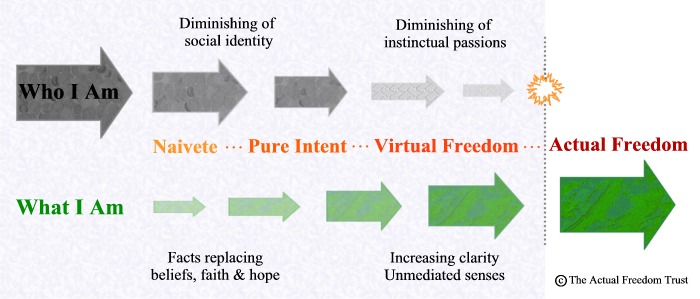
VINEETO to Alan: Our recent discussions and the schematics has inspired me to talk a bit more about the double approach to Actual Freedom. Among the many other topics, we have talked about – ‘Why is it that one seems to have less PCEs in Virtual Freedom than at the beginning of the discovery journey?’ I remember an earlier correspondence with you on that issue – what is this change in the experience of a PCE when one settles in the daily delights of Virtual Freedom? But I will start at the beginning –
This schematic diagram depicts the dynamic between ‘who I think and feel I am’, ‘me’ as a selfish, self-centred, lost, lonely, frightened and very, very cunning entity inside this body, afflicted with the Human Condition of malice and sorrow, thereafter called ‘the grey arrows’ and ‘what I am, this flesh and blood body only, living in the actual world, the universe experiencing itself as a sensate and reflective human being’, thereafter called ‘the green arrows’.
The green arrows: During Pure Consciousness Experiences one is taking short excursions into the actual world, for minutes or hours, experiencing life as a kind of holiday stripped of the restricting, burdening, agonizing selfish and self-centred worldview of everyday life. In the beginning those PCEs open one’s eyes to a world never experienced before, never considered possible. On the path to freedom those PCEs are vital, absolutely necessary to determine the direction, to kindle one’s naiveté, to tap into pure intent. The actual world is seen for what it is, and everything is self-evidently clear and obvious, and one recognizes that ‘what I am’ has always been here, I just never got a word in edgeways. Nevertheless, once the PCE is over and the ‘self’ takes control again, there is only a faint memory left. The world of ‘grey arrows’ and the world of ‘green arrows’ never meet. Given that during a PCE one is without beliefs, feelings and emotions, there is consequently no emotional memory to draw from when one comes back to the ‘real’ world, and the experience can vanish without a trace unless one is very aware. Likewise, back in the world of beliefs, feelings and emotions, the faint memory of the purity and perfection can only be vaguely remembered but not relived or imagined. That’s where naiveté and pure intent are absolutely essential if one wants to experience an actual freedom state for 24 hours a day. One other important point – spiritually inclined people, and that is almost everyone who is on a search for freedom, peace and happiness, usually confuse the ‘green arrows’ with some sort of spiritual higher ‘self’, Satori, god-experience, beauty, love, bliss or enlightenment. The ‘green arrows’ have clearly nothing to do with any emotion- or feeling-based experience, any Altered State of Consciousness or anything happening in the head or in the heart. ‘Green arrows’ is the sensate-only, sensuous and pure experience of the actual physical universe in its pure, magical, delightful and sparkling perfection. * The grey arrows: Due to the intrinsic quality genetically built into the physical fabric of the universe to be the best it can be, every human being has the potential to evoke naiveté and intent – the innate drive to look for a way out of the grim everyday experience of life. Given that Richard has discovered that one can totally eliminate one’s identity, conditioning and instinctual passions, and has also devised a practical and effective method to do so, it is now possible to use the experience of a PCE to reach to a permanent actual freedom from the Human Condition. It is no longer necessary to interpret one’s glimpses of the perfection and purity of the actual world as some kind of ‘god-given Grace’, thus degrading and distorting the experience of pure magnificence into a feeling-based self-centred interpretation of beauty, love or ‘the divine’. Out of those moments of a pure consciousness experience one can dare to acknowledge ‘what I am’, a living and apperceptive organism, lived by this splendid and perfect universe, without any sense of ‘being’ whatsoever – and take the first step in direction of an actual freedom. In order to get closer to one’s avowed aim, the living of a PCE for 24 hours a day, one then has to get off one’s bum and dismantle the ‘grey arrows’ – who one thinks and feels one is. The change that needs to happen can only happen in the ‘grey arrows’. The only thing ‘I’ can do is actively diminish ‘me’ – examining and investigating my social and spiritual conditioning and my set of survival instincts – all my passionate beliefs and my affective imaginations. So when I get confused, or impatient, or fearful, or greedy for more PCEs or discouraged, or, or, or ... this is where I have to look, this is where I can change something. This is where ‘I’ can speed up ‘my’ demise. When I am emotional, slightly off-track or very disturbed, I am the ‘grey arrows’ – and I can only do something about the ‘grey arrows’. That means, ‘I who I think and feel I am’ is the thing that needs to be taken apart, the thing that needs my full attention, intent and concentration. The ‘grey arrows’ is the only thing I can do something about, because that is ‘me’, obstructing and preventing the perfection that is already here from becoming apparent. In that sense the ‘green arrows’ don’t really get bigger, ‘what I am’ becomes more and more apparent. As I pointed out to No. 4 in a previous post, there is no point in waiting for the ‘Grace of Existence’ to descend and deliver a PCE. When all is said and done, waiting for a PCE derives from a grim-world view where one doesn’t want to be here but wants to go somewhere else – into a PCE. There is nothing I can do about the ‘green arrows’ – ‘what I am’ is already perfect, it is already as it should be. But I can actively do something about the obstacles that prevent me from experiencing the actual world; I can remove, slowly and meticulously, the stuff that the identity consists of. I can investigate into each belief, each hope, faith and ‘truth’, examine experientially each feeling and emotion that is triggered by people or situations, until I finally uncover the bare animal instincts. By that time the ‘grey arrows’ have become rather thin and transparent so that the ‘green arrows’ of ‘what I am’ can be more and more clearly experienced. * During the first year on the path to Actual Freedom I could clearly distinguish when a PCE started and when it ended. It was like a chandelier had been switched on in a very dim room, and suddenly everything was stunningly clear and obvious, the emotional problems from minutes before suddenly disappeared and – if I wanted to – I could also determine which problem and belief to tackle next. In Virtual Freedom the situation is a bit different. The size of the ‘grey arrows’ diminished and the ‘green arrows’ – ‘what I am’ – becomes more and more prevalent and apparent. The days are filled with delight, hardly any emotions interfere with my happiness and life itself becomes more and more obvious, there are neither problems to solve nor insights to achieve. I simply know that every belief is wrong just because it is a belief – it is only a question of ‘where’ or ‘how’ this belief is false. At this stage, the instincts can be clearly seen for what they are – chemical surges of the dying entity. When the ‘who I think and feel I am’ becomes so weak and transparent, a pure consciousness experience is not as outstanding and not as sought after as in the beginning. But PCEs are not my main concern now. My main concern is the ending of ‘me’. My main concern is sitting it out and enjoying the final jerks of the dying identity as much as possible, with as little emotional worry or fear as possible. Life is fantastic as it is, I know my direction as clearly as I can see the moon in a cloudless sky. Now there is no question of going off-track, which had been one of my biggest worries, and now there is no question about the inevitability of success. All the ‘grey arrows’ only point in one direction and that is towards the ‘pop’. And so everything is perfectly perfect, and utterly normal, deliciously excellent and thrillingly
delightful – with sometimes the curious experience that I want to stop being here because it gets all too much – but that seems to have become
impossible. So I go for a walk, jump up and down and then ‘give in’ to enjoying the thrill of it all.
VINEETO: I was asking what you meant by the phrase ‘rejection of emotional behaviour’ and suggested three possibilities. Are you saying that your method is ‘sitting it out without much ado about it’? Of course you can choose any method, the question is which one works. Does method ‘C’ work for you in that the emotion does not come back or are you sometimes faced with the same emotion (over the same cause) again and again? RESPONDENT: In some cases bad habits etc, yes. My rejection of emotional behaviour means that I do not get drawn into the drama of it all. I recognize the spell that emotions have, so I do not treat them as essential to my operating. There is though still the occasional reluctance to explore so I am sometimes unwittingly caught in their spell. VINEETO: I found that to effectively explore emotions to the point of (virtually) eliminating them I had to experience them fully. Only by neither repressing, nor expressing, nor in any way rationally twisting the emotional experience could I meticulously observe, become fully aware of and sensibly contemplate on what is happening in my head, heart and guts and thus investigate the root cause of that particular emotion. Knowing that every emotion is part of the Human Condition relieved me from blaming myself or being resentful for having an emotion in the first place. In order to eliminate the particular emotion such that it would not return again and again, it was essential to explore it deeply at its core and to understand experientially how each emotion originated in my social identity and/or in my very sense of ‘being’. Once having seen the emotion in operation and understood its ramifications to their full extent there was no way I could feel the same way about a particular issue or situation – by having understood this specific piece of my identity it had been extinguished. Needless to say, this method has not the slightest thing to do with plain rationalization or spiritual dis-identification – proven by the very fact that it works, that it gets rid of the emotion permanently while increasingly allowing the sensual sensuousness and the pure delight of being alive. I know well the ‘occasional reluctance to explore’, yet the frustration of obviously going round in
silly circles has always given me courage to stop wasting my time, to face the fear and ‘reluctance’ and do whatever was necessary to return
to being happy and harmless. RESPONDENT: This brings up a dilemma in my mind. One of influence and existence. Sometimes I seem happy just to have removed an emotion’s substantial influence without trying to get to the core of it. I find it difficult going into emotions when I’m working so I guess that is why I only attempt to draw on what I have discovered about them to stay out of the spell of any arising emotions. I’m sure there is more to it than that though. For example I think self-doubt needs more investigating as I find sometimes that considering another’s point of view, the basis of some confusion. VINEETO: Fair enough, you only go as far as you want as fast as you want. As long as you ‘seem happy’ then that seems to work. I simply suggested a way to explore further in case the option to ‘stay out of the spell of any arising emotion’ is not enough for you. RESPONDENT: Actually it is not really good enough and I keep persisting even after many failed attempts to get at the root of an emotion. Being free to use bare awareness and not be caught by the emotions is I feel an important step and one which I seem to be gradually, getting the knack of. VINEETO: Yes, ‘to use bare awareness and not be caught by the emotions’ is absolutely essential for becoming actually free from the Human Condition. Emotions, feelings and beliefs (passionate convictions) are how one sees one’s instinctual passions in operation. They form the layer of our social conditioning which needs to be explored and removed – both for a happy and harmless life in Virtual Freedom and for an experiential understanding of the raw instinctual passions at our very core. And you probably have experienced the instant gratifications when a belief disappears, an emotion doesn’t turn up anymore, a snide remark from someone else falls flat and as being alive becomes gradually a play and a pleasure. RESPONDENT: Although, the suggested method of trying to recall a PCE to get out of stuckness only helped in that it brought the obstacle into focus. VINEETO: This is great success, don’t you think? To have ‘brought the obstacle into focus’ and to know what the obstacle is about which keeps you in ‘stuckness’ is an excellent starting position for investigation. Now this obstacle can be identified, labelled and experientially explored, using apperceptiveness to detect its reasons, connections, source and implications. This has nothing to do with the Buddhist method (Vipassana) of labelling a feeling and then dis-identifying from it. 180 degrees opposite again. An actualist labels the feeling to get the bugger by the throat, to explore it as a scientist, to check out its silliness or sensibility, to determine how it is part of the Human Condition and then, when all is said and done, to permanently step out of having that emotion. This final stepping out often results in a pure consciousness experience. Last night I was contemplating about Alan’s description of his ‘reflective contemplations’, ‘practising the actual’ and arriving here in the actual world and how this records with my experience. Further Alan says:
Recalling step by step my own process into a PCE last night I found that contemplation serves to focus on the direction – being happy, dismantling the self, comprehending enough of the real world in order to see the self in operation and to step out of it. Contemplation always helps to focus on and remove obstacles and then, with no feeling or belief interfering I can build up the sensuous awareness of this moment of being alive. The wind on the skin, the sounds around, the wiggling of my toe, visual delights, tastes and smells ... Increasing sensuousness tips over into gay abandon, the self as both the controller and the feeler are abandoned and bingo ... I am experiencing what I had previously only reflectively contemplated about – this moment of being alive as a flesh and blood body only. The gay abandon can, of course, also happen without the reflective part, as a nature experience, in sex or any time when sensual pleasure is sensuous enough to tip over into the self-less experience of being alive as a flesh and blood body only. RESPONDENT: Many times I find that an emotion withers away before I get a good look at it. It’s almost as if it is avoiding a detailed look. Up to now I’ve been unable to find a reason for this and guess that all that is required is more attempts and that it will eventually become clear. VINEETO: Emotions are a slippery lot. They build the basis for our identity, which is as cunning as all get out. Yet the actualism method can be applied to discover every trick – whatever the feeling or emotion that keeps me from being happy here, now, needs to be examined and understood and then, presto, I go back to being happy again. I find that emotions can wither for different reasons. Either I understand that it is silly to be
emotional and make a deliberate choice to move on and ‘smell the coffee’ instead. Or the emotion has been investigated in detail and is just a
leftover bad habit to be thrown out and then I can go back to enjoying the moment. If I have avoided an emotion it will for sure come back in a
similar situation and thus give me another opportunity to notice it, feel it, face it, label it, explore it, understand it and step out of it.
RESPONDENT: When I removed the top layers of my censor, the self-image which covered up my inner ‘being’ and formed a layer of denial of my ‘negative’ feelings, I found some fascinating stuff. ‘I’ had learnt from childhood how to cover them up and sometimes express the opposite: if ‘me’ hated somebody, ‘I’ would express ‘friendliness’ so that the inner hate goes undetected; this cover-up job gave a great strength of not revealing my weaknesses and reprehensive feelings and ‘I’ was considered a very good person. However ‘I’ forgot that ‘me’ exists in the process and started believing that ‘I’ portrayed the ‘me’: whereas ‘I’ was mostly false and totally opposite of the true ‘me’. And the structure of ‘I’ was so contradictory because of denial on the top of denial – because circumstances, group loyalties kept changing and ‘I’ totally lost track of my ‘true’ feelings if there was any such consistent whole. When ‘I’ dared to go deeper, ‘I’ saw that ‘me’ had never been felt totally – though it was breaking the stranglehold of ‘I’ a lot – which was contributing to the hypocrisy and corruption. VINEETO: One of the most fascinating discoveries in actualism for me was to look under the carpet, so to speak, of the social identity – and find the pure instinctual being in its raw passions underneath. In spiritual practice I had learnt to suppress, disregard, deny and discard some of my previous social identity and replace it with an ‘enhance-the-good-instincts-dissociate-from-the-bad-instincts’ spiritual identity – a cunning ploy which slightly shifted the goalpost but did not reveal the core of ‘me’ – the raw instinctual passions that form themselves into my ‘being’. One’s social identity has a vital role to play to curb the instinctual passions from running rampant so as to prevent unrestricted violence amongst humans. However, guided by pure intent to become as happy and harmless as human possible, an actualist can dare to lift the lid of the social straightjacket of morals and ethics and begin to experientially discover the instinctual animal passions that are inherent to all sentient beings. Isn’t it fascinating how the very act of bringing those passions to the light of awareness, coupled with sincere intent, can actually diminish their power, intensity and frequency of occurrence and by doing so reduce their influence on one’s life? – that’s at least my experience from my explorations into my psyche. RESPONDENT: One of the interesting feeling was some kind of dislike (fear? hate?) towards Richard and Peter and Vineeto though I was doing a good cover-up job – ‘I’ was impressed by their clarity, expertise, achievement though ‘me’ was generating a negative reaction. Questioning deeper revealed that the factors that contributed to the feeling was their stubbornness and authority (though they were not desiring power over ‘me’): they were incorruptible by ‘my’ tricks that ‘I’ had known all along: become a ‘friend’ and then corrupt using ‘my’ inner agenda: ... VINEETO: I can well understand the fear of being naked but I also know the relief and joy of having nothing to hide. One outcome of digging beneath the layer of the social identity with the intent to becoming happy and harmless and seeing ‘me’ as I am – an instinctually driven ‘being’ – was that self-honesty and integrity came to the surface because I was exposing myself. This has now made hypocrisy, obscuration and pretence along with the fear of being found out a thing of the past. RESPONDENT: ... they were critical of my very ‘being’ and it looks like nothing will impress them: except being ‘genuine’. And isn’t it being naked to be ‘genuine’? VINEETO: To be precise, I am not ‘critical of [your] very ‘being’’ – I am only interested in my own freedom from my ‘being’ – and I share my experiences along the way for those who want to try it out for themselves. Personally, when I met Richard and felt uneasy because it soon became obvious that it made no sense to hide anything, I turned these feelings into a ‘bugger-it-if-he-could-do-it-so-can-I’ resolution, which in turn helped me a lot to ease and resolve the internal battle I was fighting with myself. As for ‘nothing will impress them except being ‘genuine’’ – it is useful to remember
that everyone who is sincerely doing the process of actualism does so not only for their own benefit but also for the benefit of all human beings
hence the aim to be both happy and harmless. As such, when you are on the journey to your own genuineness and ‘self’-immolation then any kudos
from some imagined ‘self’-created authority will quickly fade into insignificance.
VINEETO to No. 47: When I disentangled myself from the spiritual practice of dissociation I began
to allow myself once again to become sensitive to my own undesired feelings as well as to the perversities and horrors of the human condition. In
short I allowed myself to feel the full range of my emotions in order to examine them and trace them back to ‘me’, the affective identity
inside this flesh-and-blood body. When a reaction to a certain situation kept creeping up again and again, avoiding giving it ‘credence’ was
not enough. I had to feel the feeling, label it, sort it out, understand it in the context of my social identity and figure out which part of
‘me’ was responsible for my emotional reaction in order to become free from it. Then I could go back to feeling excellent again and, as a
result of this rooting around, was less prone to be disturbed by a similar situation.
RESPONDENT: Thanks for the very lucid and succinct description of the actualism method; I would like to just add my observations to what you said (I have divided your description into three parts):
I think a) is extremely important. If not done diligently, it leads to denial of the feeling and also distortion of steps b) and c). If I don’t fully feel and acknowledge the feeling/ emotional reaction, it means that I have not fully come to terms with the whole of the feeling; I still have some vested interests in continuing to feel that way and I would trick myself to lie in the surface if I don’t take a good look at the whole of the feeling. It seems to be so difficult to stay with the feeling. VINEETO: It’s usually difficult to acknowledge and feel a feeling when the particular feeling is either socially unacceptable or personally undesired, i.e. when to feel this way does not concur with one’s morals and ethics and/or one’s image of oneself. You described it well in your recent letter to No. 4 when you said –
That’s why the questioning of one’s spiritual beliefs and one’s moral and ethical values is crucial for successfully investigating one’s feelings – I had to dare to go past the ‘guardians at the gate’ and take apart my social identity.
One thing that I found useful in this process of dismantling my social identity was when I became aware of a feeling that interrupted my feeling good and I had given it a name, I then identified this feeling with a specific aspect of my social identity. In my case when I felt annoyed with something that Peter said or didn’t say or did or didn’t do I would acknowledge that I was annoyed and then recognize that it was ‘Vineeto the woman’ and ‘Vineeto the lover’ who was annoyed and this made it clear that if I wanted to stop reacting in that way then ‘Vineeto the woman’ and ‘Vineeto the lover’ would have to go. (...) * RESPONDENT: c) brings back the focus on enjoying the moment and the purpose of the investigation is to find and remove the obstacle that took away from feeling good/ excellent/ perfect. The real test for correctness of the above steps is simply that it becomes once again possible to get back to feeling good/ excellent/perfect. At least the current problem has been understood and eradicated. VINEETO: Yes and when the problem reoccurs I examine it again, I shine the bright light of awareness onto it, maybe explore it on a deeper level and come to understand how ‘I’ tick more deeply and comprehensively. In every investigation a crunch point eventually comes when ‘I’ realize that the only way I am going to raise the bar of actually becoming more harmless and consequently feeling more happy is to let go of, or drop, a significant part of my social identity – in my case I was no longer a German, no longer a spiritualist, no longer a socialist, no longer a member of the sisterhood, and so on. Change does mean change and change does have consequences. For an actualist the over-arching intent to
become more happy and more harmless outweighs any consequences that the stripping away of one’s social identity may have. * RESPONDENT: The identity is comprised of (not necessarily distinct) these parts: ego aka thinker, feeler aka soul, social identity, instinctual self, correct? VINEETO: When I began to write on mailing lists about my experience with actualism, I first used the terms mainly used in spiritual circles to describe the identity – ego and soul, or thinker and feeler. However, as I explored more and more of my psyche and became more familiar about the nitty gritty of ‘me’ in operation, I found that the terms ‘social identity’ and ‘instinctual identity’ describe more accurately the two layers of my identity, the social identity being the layer of conditioning acquired after birth in order to curb the instinctual identity and its genetically encoded instinctual passions. This is just a preference that I have as I personally find the terms to be more descriptive and concise in conveying what I mean to others – contrary to what some believe there are no rules governing terminology around here. RESPONDENT: Also the attributes or even the material by which the identity is made of is – feelings and emotions, instinctual passions, and thoughts (seldom free of emotions when an attribute of identity). Is this correct? VINEETO: To the list of what the identity consists of I would add beliefs (feeling-fed thoughts about who rules the ethereal world and ‘my’ place in the hierarchy of the spiritual world), concepts (feeling-fed thoughts about ‘my’ place in the hierarchy of the materialistic world), moral and ethical values (feeling-fed thoughts about what is good and bad, right and wrong), vibes, myths and psittacisms. There is no material by which the identity is made of, in that there is no ego in the head, or a little man pulling the levers and controlling the body, nor is there a soul located in the heart or a real me deep down inside as an actuality. However both aspects of one’s identity, whilst not being actual and having no material existence, are experienced as being very real – feelings are very real to the person having them. Beliefs are very real to the person who holds them dear, morals and ethics can dominate a person’s thoughts, actions and feelings, instinctual passions are very often overwhelming in their strength, and so on. In fact, the identity and his or her associated attributes are so real, so dominating and so overwhelming that they cause human beings to be nearly always in wary mode, defence mode, or attack mode – exactly as other animals are. RESPONDENT: Is there a hierarchical structure to these various parts of the identity? Is it that one is operational at a given time not others – or – they all orchestrate with each other one feeding on the other like the legs of the millipede? VINEETO: I found that because my social identity was mainly a training to curb my instinctual passions, particularly the so-called bad passions, I first had to whittle away at this layer of my identity in order to allow the deeper and stronger passions to emerge such that I could take a good look at how and why they operated. But this is not necessarily a smooth operation – sometimes just a crack in the outer layer reveals a bit of what is underneath, sometimes a big crack opens up and one gets a quite often shocking glimpse at what can be described as ‘the raw animal inside’ and sometimes one breaks right through the lot and a pure consciousness experience results when all of a sudden the whole centre and the protective circumference of my identity disappears … as if by magic. RESPONDENT: The baby is born with these raw instinctual passions, basic software to protect itself from some of the dangers and situations – also with things like ‘theory of mind’ (which is later programmed or tuned more) – this is the instinctual self. As I understand it the ‘theory of mind’ develops at about age 2-3, therefore I would say all humans are born pre-primed to think and feel themselves to be a separate ‘self’. RESPONDENT: And with time – are these same instinctual passions fine-tuned to give rise to various feelings and beliefs and emotional behaviour patterns by societal conditioning? VINEETO: The instinctual passions are never fine-tuned – in my experience they were only overlaid with social conditioning. I was only able to conduct a clear-eyed investigation of the instinctual passions in their full force once I was ready, able and willing to incrementally lift the lid of my beliefs, morals, ethics, values, ideals and principles that are the very constituents of my social identity. RESPONDENT: When do I know I have come face to face with a raw instinctual passion – not just a conditioning of social identity – is this when the ‘social identity’ is deleted to a great extent – so as to see the underlying ‘instinctual passion’ devoid of the thinking distortions that usually accompanies it? VINEETO: This is how Peter described it in the ‘The Actualist’s Guide’ –
RESPONDENT: Or is it (I think I read it in Peter’s journal) when I get to this point where I don’t see any reason for the fear or the strong emotion – it is just there – then I know it is an instinctual passion? If this is the case, I have come across situations where I have a strong emotion and I see that there is no reason for it to be there, at least I don’t believe that it is apt at that time. VINEETO: The way I determined that I had come across an underlying instinctual passion was by the sheer intensity of the passion that welled up like a giant octopus, sometimes for no apparent reason. In such instance it was not that I had become upset about a belief that was attacked or that an aspect of my social identity that had been exposed – I knew I was experiencing something deeper and far more substantial than feelings – it was naked fear, pure rage, bottomless dread, sheer lust to kill, or the mindless intoxication of nurture. RESPONDENT: Also I thought about another ‘Spiritual Freedom’ vs ‘Actual Freedom’ item when I was reading one of the pages (if this is not already tabled): In the former, one is a saviour of humankind (at least (s)he feels/thinks so) and in the latter ‘one is an expert in human condition’ (unless in the future, the babies are born free – in which case they will be without such expertise except vicariously). VINEETO: Yepp, I have felt, and in that moment experientially understood, the overwhelming feeling of ‘knowing it all’ and the urging need to spread this wisdom revealed to ‘Me’ in a full-blown ASC that lasted several hours. As for ‘one is an expert in human condition’, I can only talk from the perspective of Virtual Freedom but I would say I am only partially an expert in the human condition in as far as I have explored my own psyche, which to a certain extent is the human psyche, and I am certainly an expert in how I became virtually free from the human condition. However, there are many, many aspects of the human condition, cultural nuances, tribal rites, personal obsessions, weird passions, senseless beliefs and elaborate philosophies that I don’t know and neither have I the slightest interest in gaining such expertise. In any case, everyone has to do the job to take himself or herself apart if they choose to become free from the particular bent of their own social identity in order to firstly become virtually free of malice and sorrow. For this, one doesn’t need to be an expert in the human condition – ‘you’ only need to be an expert in what it is that is stopping you from being happy and harmless, no more and no less. As an example of this, Richard had little intellectual knowledge about the instinctual passions before he became free of them – it was only Peter’s curiosity that prodded him to find out more and to write about them in more detail. Actualism is after all an experiential business, not an intellectual one. The idea that in some distant future babies will be born free from the instinctual programming … can
only be speculation at this stage.
Vineeto’s & Richard’s Text ©The Actual Freedom Trust: 1997-. All Rights Reserved.
Disclaimer |