|
Selected Correspondence Vineeto Social Identity VINEETO to No. 7: I don’t see how this – Dell-Carnegie-style – method could work in long term. It suggests attempting mind control over emotions, it does absolutely nothing to get rid of the emotions themselves. It does not get to the root cause of the emotional reaction – the Human Condition, inherent in the psychological and psychic entity within the body. RESPONDENT: From my experience, certain emotions like anger can be dealt with by plain common sense. Just by understanding (and I am talking of only intellectual understanding), that anger is not going to improve or help the situation and on the other hand, it is going to harm yours and others’ mental and physical peace, the anger vanishes. I have tried and tested it and it works. It is not repression so it doesn’t come back even in long run. Not that the anger does not arise, but as soon as it arises, you can see it vanishing in the light of your understanding. VINEETO: What you are describing sounds like more than just intellectual understanding and more
than the method of ‘positive thinking’ that [ If that is so, then you have found the first ‘key’ to eliminating anger – seeing the actual situation, sensibly considering everyone involved and understanding that your particular feelings will do nothing to help the situation, on the contrary, they are harmful. You can apply the same understanding to any other emotion arising, be it love, gratitude, resentment, doubt, anguish, sadness, etc. None of our so-called precious feelings are useful for dealing with practical, every-day situations. Care, consideration, attention, intelligence and common sense can do the job much better. The trick is to question the ‘good’ feelings as well as the ‘bad’ feelings, and a great part of the social identity will disappear, issue by issue. The second ‘key’ is to examine the underlying reason why anger (and any other feeling and emotion)
arises in the first place. What is ‘my’ perception of the world, which of ‘my’ expectations are not met, what is it that ‘I’ am
imposing on the world-as-it-is and the people-as-they-are that ‘I’ feel angry about? Persistent questioning of the root cause of my getting
angry as well as applying common sense had immediate and drastic results – more and more the ‘self’ was seen for what it was in the light of
this awareness; it was seen as an alien intruder that continuously spoiled the joy and ease of being ‘here’.
VINEETO: (...) Spiritualism vs. actualism is a great topic to nut out and absolutely vital for the path to an actual freedom. It takes great courage and persistence to disentangle oneself from the net of spiritual beliefs, which pervade each and every issue of life, from love and relationship to the way we look at the physical universe, people and events. This psychic net of beliefs and emotions is such a thick cobweb laid over our sensate-only perception that, once removed, even for a short period, you think you looking at a completely different world. But let’s stick to one point at a time – RESPONDENT: Anyway I am still on this topic ‘Spiritualism vs actualism’. You mentioned that I don’t differentiate between Ego and Soul. This is very true. With my experience, I really can’t differentiate the two. When I look at myself I see only one identity. What I understand from both spiritualism and actualism is that this identity has to die. VINEETO: You say, you understand that both, ego and soul, have to die. Great. Now, what is this soul? The easiest way to understand ‘soul’ for me was to see it as the sum of my emotions, feelings, beliefs and passions. Love is ‘me’, affection is ‘me’, sadness is ‘me’, anger is ‘me’, being annoyed is ‘me’, being grateful is ‘me’, being hopeful is ‘me’, being frustrated is ‘me’, being impatient is ‘me’, being fearful is ‘me’ – you can add anything you like to this list. All ‘I’ am is my feelings, all ‘I’ am is my beliefs and all ‘I’ am is my instincts. ‘I’ consist of nothing else. Although ‘I’ am not actual, as in palpable, tangible, tactile, corporeal, physical, material, ‘I’ am real, ‘I’ am my feelings and the actions that result from having these feelings are real. To imagine otherwise is but a cunning trick and an act of blatant denial. ‘I’ am not merely an illusion that can be ‘realised’ away as in the spiritual teachings. As such, the death of ‘me’ will also be a real event. ‘I’ in ‘my’ totality, who is but a passionate illusion, must die a dramatic illusory death commensurate to ‘my’ pernicious existence. The drama must be played out to the end ... there are no short cuts here. The doorway to an actual freedom has the word ‘extinction’ written on it. This fact of what ‘I’ consist of has to be discovered, acknowledged, investigated and experienced, over and over again. Only then is one willing to ‘get down and get dirty’, willing to experience and examine one’s feelings – not merely ‘observe’ them – and investigate into the hidden beliefs and instinctual passions that cause those feelings. By neither repressing nor expressing but by meticulously exploring each feeling I was then able to determine the underlying cause – be it a hurt pride, a bit of my social identity, a fear linked to my survival mechanism, a cherished belief disguised as ‘truth’ – there was always an issue beneath the initial emotion. And each of these feelings and emotions is ‘me’, my identity, my ‘self’, my ‘soul’. ‘I’ consist of nothing else but a great collection of passionate imaginations.
RESPONDENT: Peter just sent a
I think I have understood the first lie, more or less. VINEETO: When you say:
You have just defined ‘God’ as ‘a situation when ‘I’ do not exist’ and thus put it all nicely back into the spiritual belief system. If the spiritual ‘God’ is a non-identity, how come Rajneesh, Krishnamurti and all the other enlightened gurus had such glamour, glory and glitz about them, how come they needed heaps of devoted disciples and couldn’t live as a fellow human being among other fellow human beings? Is this not the most obvious proof of having an identity, now even bigger, brighter, shinier and ‘wiser’ than everybody else? No more ego, but the soul in full swing. When ‘I’, the complete identity, both the one ‘I think I am’ and the one ‘I feel I am’ have disappeared, there is no sense of identity whatsoever, nobody that can identify oneself as God or Existence or ‘All That Is’. Then there is only a body with limbs and senses, blood-circulation and a brain that is aware of being alive. There is no identity holding it all together, no identity experiencing each moment, nothing that has a past and a future, no sense of ‘being’ and nothing that has any emotional memory whatsoever.
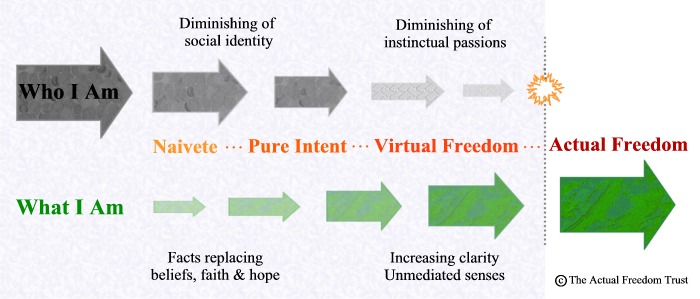
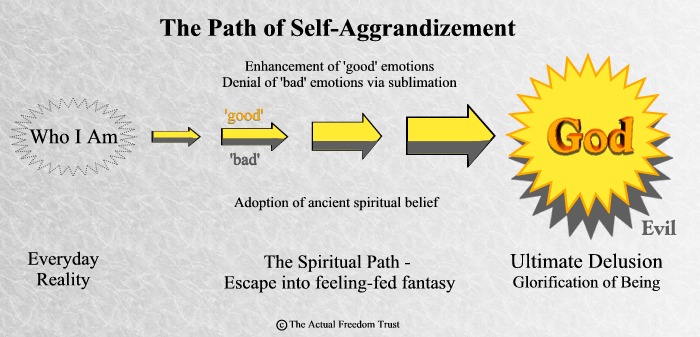
RESPONDENT: Now I have to realise the second one, which I understand intellectually, but not experientially. I am not interested in branding my understanding as either actualism or spiritualism. If this is what actualism says and maintains that this is different from spiritualism – fair enough. As an expert on actualism, if you confirm that my understanding conforms to what actualism says, then the next question is whether spiritualism also says the same thing! I am not an expert on spiritualism. In fact I know very little of it compared to you. But what I am quite sure of is my understanding. VINEETO: An intellectual ‘understanding’ that ‘I’ am a ‘big lie’ won’t do anything. It will just be putting another intellectual belief on top of an existing belief, a new dress over the old corpse. The diagram is trying to make clear, that all we know, all we are, is this grey mass of ‘who I am’. This ‘who’ has to be dismantled, piece by piece, gradually and meticulously – and there are no short-cuts such as meditative mantras of ‘I am but an illusion’, ‘I am only a belief’. Because this ‘who I am’ is not only a mental construct that can be dismissed with an intellectual understanding, this ‘who I am’ is an emotional and instinctual package, supported by the chemical surges of our survival instincts, by ancient beliefs of our ancestors, a firm social structure of beliefs, morals, ethics and psittacisms, and on top of it a dearly held, carefully constructed, individual personality. There is a lot at stake when one decides for the path to freedom. Logic is not going to make you free. Logic is a plain mental activity that avoids any real change. Actualism is about digging into one’s beliefs, tearing them apart, facing the upcoming fears and leaving one’s social identity behind. One has to fully experience each of the upcoming feelings in order to get to the bottom of it all. Then, out of this in-depth investigation, I am compelled to change my behaviour, and I am leaving my ‘self’ behind, piece by piece. RESPONDENT: ‘I am not an expert on spiritualism. In fact I know very little of it compared to you.’ VINEETO: First I had to understand my own spiritualism, my own complex belief-structure that existed in my brain. First, I had to acknowledge that, yes, I am full of unquestioned beliefs, assumptions, vague feelings and intuitions. You see, nobody thinks he believes. Everybody is convinced that they ‘know’, that they ‘see the truth’. A passionate conviction, a belief fed into us with mother’s milk is never seen as a belief – it is conceived as being the very truth. Why would people kill for what they consider a mere belief, an idea – no, it is the bloody truth for them, and they are ready to defend it with their lives and kill for it. So, first of all, one needs to acknowledge that there is belief. And believing is being spirit-ual, non-factual, substantiating ideas with one’s spirit. Every idea, every assumption, every opinion is spirit-ual, produced in the head – or in the heart. Once I understood that the word ‘spirit’ describes the passionate yet imaginary entity inside of me, I could also understand that Spirit-ualism – Eastern Religion – is merely aiming to enhance that entity into glorious grandeur. Actualism is to get rid of one’s ‘spirit’ in total in order to experience the actual world that is already here. It’s a great journey discovering facts, facts verifiable by the senses, repeatable, explainable,
describable, non-emotional, non-affective, simple and actual – facts. As Peter has already mentioned in his letter to Alan, in the library you
will find a good detailed description of The path to actual freedom is paved by facts and the sensuous experiencing of the physical universe.
RESPONDENT: So, the intellectual part asks questions about the nature of the programs. Some programs are completely obvious, others not so, and it’s difficult at times to differentiate between the elemental physical responses, and the learned reactions. VINEETO: Yes, some programs are ‘completely obvious’, and at first it was far easier for me to observe them in other people. The trick, implicit in the actualism method, however was to search for the same programs in myself because the human condition is common to all and that includes ‘me’. The ‘learned reactions’ are those that make up the social identity – my identity as a male or female, a member of a family, profession, peer group, nation, ethnic group, religion, political and ideological orientation. Each of these aspects of your social identity gives plenty of opportunities for ‘self’-investigation. By examining what is preventing you from being happy and harmless now you are successively questioning and challenging your ‘learned reactions’ and feelings that arise from being a social identity. The elimination of one’s social identity requires the replacement of the moral and ethical arbitrary judgments of good and bad and right and wrong with an open-eyed evaluation and intelligent judgment based on what is sensible and what is silly. The beliefs and psittacisms one has been instilled with in childhood, or has later taken on as one’s own, need to be replaced with observable and verifiable facts. The actualism method allows you to separate ‘elemental physical responses’ such as hunger, thirst, cold, heat, physical pain, discomfort and so on from your instinctual survival passions of fear, aggression, nurture and desire. The more you investigate into your social identity and peel the layers of your beliefs and feelings associated with the ‘learned reactions’, the more those ‘elemental’ instinctual responses will come to the surface where they can be experienced and observed. To keep it simple and less confusing – first work first, and that is investigating the social identity. RESPONDENT: The direct half did have a glimmer today though ... I grokked for a moment how I have been interpreting ‘How am I experiencing...’ as ‘What am I experiencing...’, which is a whole different kettle of fish. VINEETO: When I looked up the word ‘grok’, the Oxford dictionary defined it as ‘understand intuitively or by empathy’. Spiritualism teaches that intuitive understanding is always ‘right’ and that intellectual understanding is at best incomplete, and mostly ‘wrong’. In actualism I learned to question my learned notions of right and wrong, good and bad and slowly replaced them with a common sense assessments of what is silly and what is sensible. Instead of intuition and gut feelings I looked for the unmistakable certainty of facts, which is far more accurate than any intuition can ever be. But you are right that ‘what am I experiencing’ is indeed a different kettle of fish. Using the actualism method is a matter of intent – what is my aim, what do I want to achieve by questioning how I experience this moment? Sometimes I would get lost in following my affective experiences down the garden path, making them bigger and more intense the more I provided indulging attention. But whenever I remembered my goal to become free from malice and sorrow, my wandering observations changed into the search to find out how to get out of this insidious ‘self’-centredness of feeling-experiences and come back to being happy and the sensate experiencing of being alive. Unless you have an intent or reason for asking how am I experiencing this moment of being alive you will have neither the motivation to make it your first priority in life nor the impetus to overcome the reluctance to admit to unpleasant or undesirable answers. The cute thing is that you don’t learn anything new but rather unlearn everything you’ve been told
since the day you were born and then you even get to undo the genetic program of the instinctual survival passions. It is a fascinating journey,
full of wonderful adventures, thrilling realizations and life-changing discoveries.
RESPONDENT: Animals appear to thoroughly enjoy life, unless they’ve been damaged psychologically. Is being happy our birthright, which we typically squander? VINEETO: As for ‘is being happy our birthright’ – it does not make sense to call happiness our ‘birthright’ because there is no court where you could claim your ‘right’. I would rather describe it that the animal survival passions, universally manifest in humans as malice and sorrow, are our biological heritage – ‘me’ being as old as the first human – but a path to freedom from this software programming is now laid out. You can jump right on with both feet and complete the next step in human evolution. RESPONDENT: Wouldn’t the social conditioning be the software programming, and the instinctual passions be the hardware programming? I’m mincing words here, but I am an engineer after all and tend to go a bit overboard on deconstructing things. Or maybe you hadn’t noticed ;-) VINEETO: The idea that ‘the social conditioning be the software programming, and the instinctual passions be the hardware programming’ is instilled by spiritual teachings and psychological theories that lay the blame of all the ills of mankind on social conditioning. The uniqueness of Richard’s discovery is that he proved by example that one’s instinctual passions
are permanently deleteable and therefore as much software as one’s social conditioning. One need not trust Richard that this is so because
everyone has had a PCE at some time in their life when both ‘I’ as ego – one’s social identity – and ‘me’ a being – one’s
instinctual identity – are temporarily in abeyance. In a PCE both ‘software programs’ crash simultaneously, leaving this body free of any
identity whatsoever – as such, a PCE is experiential evidence that the instinctual passions are not hardwired. * RESPONDENT: I could suggest that the developed intelligence has a cultural bias, and hence is affected by conditioning, but that’s starting to get a bit nitpicky and probably not worthy of pursuit. VINEETO: Why should exploring the link between intelligence and social conditioning be ‘nitpicky’ on a list dedicated to exploring the human condition? On the contrary, it’s absolutely ‘worthy of pursuit’ to investigate how one can free one’s intelligence from one’s inevitably acquired ‘cultural bias’, which is not part of intelligence per se. As such any of my cultural bias, which prevents me from harmoniously living with my fellow human beings, needs to be eliminated. To give you an example – when I was a young student I believed that certain German traits were common to all humans on the planet until I came to India and discovered that Indians lived by a whole different set of traits, often quite opposite to those I had learned. My ‘self’-oriented horizon widened even more when, living in an international community, I had opportunity to study all sorts of national cultural traits. I also discovered that whilst I could easily let go of some of my acquired traits, other traits were deeply rooted in who I thought and felt I was. To separate intelligence from its cultural bias is fairly easy in practice – whenever you are not happy and harmless, then it is either your social identity or your instinctual identity that is interfering with the free operation of your intelligence. RESPONDENT: The point I was making was that our intelligence is a developed faculty and is biased by our upbringing. The boy who is raised by wolves exhibits intelligence, but it has a wolf-ish flavour. If the wolf boy were to practice actualism and succeeded in deleting the wolf-cultural bias and the instinctual programming, the remaining intelligence would still have been shaped by his upbringing. It would not remotely be the same as yours, or mine. VINEETO: I wonder what’s the point of your point, i.e. what’s the relevance of this hypothetical example. My experience with the various aspects of my social identity, such as spiritual beliefs, belonging to a nation, a group, a family, a gender or a work-related social club, was that particular aspects of my social identity, when investigated and understood, disappeared without a trace – often I had trouble remembering what it was that I had hung unto so desperately or what had been so important and defining ‘me’ just a little while ago. Each aspect of one’s identity, when understood in its totality, vanishes without leaving as much as a scar or even a memory. It all becomes clear in the doing. As for your example of a man having grown up amongst wild animals – when a person is actually free then he or she is completely free from his or her instinctual passions as well as from his or her social identity – no matter what the content of his or her previous identity had been. Therefore the intelligence in a person free from the human condition is unencumbered by their former identity. You could safely assume that just as my previous German social conditioning does not bias my intelligence today, his belonging to the wolf-tribe wouldn’t bias his intelligence. In that sense his intelligence would indeed be similar to yours or mine – intelligence being solely a function of the brain, an organ of the flesh and blood body – provided all three were free from the human condition. Something Peter wrote in his Journal goes along with this assumption –
As for a person’s sensuous preferences, choices, particular behaviour or personal quirks, when free from the human condition, one can only speculate and such speculations are of no relevance to the actualism practice. If you want to experientially discover in what ways your intelligence would benefit from actualism, you
will need to abandon philosophizing about what would happen if a ‘wolf boy were to practice actualism and succeeded in deleting the
wolf-cultural bias and the instinctual programming’ and begin to actively inquire into your own cultural bias, i.e. into you own dearest
beliefs. You will then discover that intelligence improves in direct correlation to the diminishing of beliefs.
VINEETO: As for ‘I just keep discovering more fear and malice and compassion’ – it is quite amazing what is revealed when the light is switched on in the hidden corners of one’s psyche, so to speak, and all the previously unseen and unknown ‘ghosts’ come to the fore. Whilst this can appear at times as if things are getting worse, this discovery is the very result of taking the lid off the hypocritical morals and ethics and paying exclusive attention to what is really going on. It is important to always keep in mind that actualism is not about abandoning the spiritual world and going back to reality. Actualism is about leaving both grim reality and its panacea Greater Reality behind and stepping into the actual world of benevolent perfection that is temporarily but unmistakably evident in a PCE. As such, it is vital to remember that actualism is not about dwelling on the invidious emotions that one invariably becomes aware of in the process of actualism but that the aim of the process is to encourage the flourishing of the felicitous/ innocuous feelings – those that are happy and harmless. RESPONDENT: Thanks for writing Vineeto, coming from a military family I tend to forget that it’s not just about whipping myself into shape. I can get stuck there like a fly to fly paper. It is possible to get back to being happy and harmless, thanks for the nudge. VINEETO: Yes, the social conditioning of ‘whipping myself into shape’, be it the practice of beating yourself up or the practice of ‘self’-empowerment, is just as interfering with one’s being happy and harmless as indulging in emotions or expressing them towards others. The actualism method is specially designed to detect these deeply imbedded patterns. Increased attentiveness to either ‘self’-punishing or ‘self’-indulging behaviour reveals that I can stop acting along those lines and that I have a choice to be sensible. It takes a good deal of persistence because not only have those patterns been imbibed since very early childhood, they are also literally the building blocks of one’s precious identity, ‘who I think and feel I am’. As you seem to be discovering, it needs sincere intent and investigative attentiveness in order to bring about lasting change. 
RESPONDENT: The main point is that I don’t want to hurt anybody while resolving my issue. I have noticed that this tendency of mine has, in a subtle way, been used by my wife (or maybe it is used by women in general) to make it very difficult for me to break up with her by apparently denying the issue while simultaneously making me feel guilty. I think that honesty and clear communication is crucial in any relationship, be it with a lover (this seems easy but not painless, however) or my wife. So ... I will proceed the best I can in hope of a peaceful separation and maintaining a friendship with my wife. The separation which will allow me to cultivate the relationship with the woman I am attracted to and hopefully to live together. Well, this is my update as to what’s happening in my life. There are some spontaneously peaceful and perceptive moments combined with some confusion and fear of making a painful decision. VINEETO: As this is obviously your adventure and your exploration into depth of the Human Condition in you there is nothing much I can add. I myself had several complicated relationship situations in my life, so I know it is not an easy task. I have learned a lot from those situations, about me, about relationship and about the things that don’t work. The most important point for me when starting on the path to Actual Freedom was to remember that it is always only me that I can change and that I can make free. I can never do anyone else’s job and nobody can do anything for me. That’s the very nature of an actual freedom. One of the first things I had to learn and successively understand was that obeying the ethical and moral rules of society or religion was not going to help me to reach the purity and perfection so clearly experienced in a pure consciousness experience. As long as I oriented myself on the ideas of right and wrong it always left one party ‘right’ and the other ‘wrong’ and neither peace nor equity were ever achieved. My ideas of what was morally good or ethically right would stop me inquiring, fearing to do something ‘wrong’, violating the moral code and ethical value of the tribe, the peer group and the spiritual / religious group I had belonged to. First I had to understand the workings of those moral and ethical rules in me before I could inquire further into the nature of my feelings, emotions and passions.
Having experienced the purity and perfection of the actual world and the intent to live that pure consciousness experience 24 hours a day, every day I could safely begin to abandon the moral and ethical codes that society imposed on me. Thus I whittled away at my social identity and its ensuing notion of right and wrong, good and bad. Now I can dig into the feeling that arises, find the root cause and understand why, when and how I feel this way, without the fear of ‘being wrong’ or ‘being bad’. Knowing the actual world from the memory of my PCEs I can determine what is ‘silly’ and ‘sensible’ and act according to what is sensible and best for everyone involved. I dug out some questions that Richard has answered on the subject of ethics and morals – the first obstacle to be tackled before one can really decide about silly and sensible action ...
RESPONDENT: Re: gender issues. I am a human first, secondarily a woman. I enjoy being female and have no problem with the idea that there are some real bio/chemical distinctions between males and females, but I differ strongly with the idea that there is a masculine and feminine side to existence, a cosmic tantric dance of masculine & feminine forces that is the key to the meaning of existence. From a scientific point of view, sexual reproduction of any type is a pretty recent development in the history of the cosmos as we know it, and the presence of humans in the sexual scheme of things is the briefest of all. So, to think that the universe is founded on a masculine/feminine principle is, well, very primitive, to say the least. VINEETO: A good point, I never looked at it that way. In my investigation into my social identity I was not so much concerned about the alleged masculine/ feminine principle of the universe but I was much more interested in the differences of conditioning, beliefs, behavioural and emotional patterns and the continuous power battle between man and women, no matter how subtle or covert. New age therapy blurred the distinctions of the roles a bit on the surface but underneath one’s ‘flirtation’ with the so-called inner male or female is hidden an instinctual desperate battle for power which has up to now prevented couples from peacefully living together in equity, parity and intimacy. I had to dig into my identity of what I felt and instinctually knew I was as a woman, and investigate and eradicate each single idea, notion, belief and feeling of ‘woman-ness’ in order to experience the actual intimacy with a member from ‘the other camp’ that we now enjoy. After an initial rocky time, Peter and I were able to put a permanent halt to the battle of the sexes and had immense fun in comparing notes, having ‘a spy in the other camp’, so to speak, and digging deeper and deeper into the so-called mystery of gender and the supposed mystique of sex. RESPONDENT: Last night I was out with the visiting relatives in a country setting. The sky was brilliant with stars, much clearer than what I can see at home with city lights, etc. I wondered what I would make of the stars if I hadn’t learned that they were similar to our sun, burning masses of unbelievably hot gases, that warmed the solar systems around them, etc. What if I had no knowledge about those heavenly bodies, what would I make of them? Probably something akin to what ‘ancient wisdom’ came up with. Similarly with the masculine/ feminine principle. Not knowing better, it would be easy to think that there was some heavenly design related to being male or female, that certain activities related to gender were prescribed and others proscribed. Where real knowledge and technology are absent for whatever reason, superstition, imagination, and intuition will prevail. Man will use his brainpower to increase his chances not only to survive but to better himself and will fantasize as readily as reason to get a handle on the situation he finds himself in. And, obviously, he will choose fantasy and intuition over cold, hard facts if fantasy affords a better possibility for him than fact, e.g. the immortality offered by spirituality. VINEETO: As a second stage, underneath the obvious socially and religiously / spiritually learnt differences between the sexes, I discovered the workings of male and female instincts. It was utterly fascinating to observe the sexual instincts in me in action, after the sexual taboos, the moral limitations and feelings of love and authority had been stripped away. It was daunting and bewildering at first, perceiving myself as nothing but a female animal wanting to become pregnant, to be filled with the male’s sperm to fulfill my instinctual destiny – the fact that I had been sterilized fifteen years earlier did not change that urge at all. Exploring these instinctual passions to their full extent, and comparing notes with Peter, I finally understood the dilemma of male-female instinctual behaviour that spoils every relationship. While males, besides fatherly care, are instinctually driven to spread their semen as far and prolific as possible for the benefit of the species, females are programmed to search for and then hold on to one reliable protector to care for them and their offspring. It is one thing to have read about those instinctual differences, amongst other theoretical, psychological and spiritual deliberations, it is quite something else to experientially explore one’s instinctual sexual core – there is nothing refined or intelligent about our core passions. Blind nature does not care a bit about anybody’s well-being, natural forces are merely concerned about the survival of the species, and this happens by the traditional recipe which has worked for other mammals for millions of years. Possessiveness, jealousy and rape are all part and parcel of this instinctual animal drive for reproduction. Love is merely a human invention to cover the embarrassment of being animal at one’s very core. RESPONDENT: Now, to move from the broader picture to the more personal picture: I was about 40 years old before it ever occurred to me that sex could simply be for sex. I don’t want to give the impression that I was dysfunctional, everything worked fine, but there was always a more primary purpose for sex than just enjoyment. As a young Catholic girl, you were told to hold out on sex for marriage. As a member of the 60’s generation, there was lots of sex, but the payoff was love, sex for love. As a married person, sex was to improve the relationship. As a person involved in spiritual discovery, sex was a tool towards enlightenment. Every cultural/spiritual influence of my life has said sex is for something else, besides yummy, delicious enjoyment. Just like life itself is the journey to heaven, or bliss, or freedom from the wheel of birth and death, etc. VINEETO: I was raised a Catholic and I know the implications. Sex was always dimmed by the dark shadow of guilt, sometimes enhancing the thrill but always keeping me within the boundaries of society’s values. In my twenties I explored emotions via primal therapy but sex was strictly excluded from the explorations. The early years in Poona in Rajneesh’s ashram were a wide field of sexual experiments for me, but as you say, I always wanted more than sexual pleasure – attention, affection, love, recognition, being part of a group, etc., etc. Only when I came across Actual Freedom, I came to understand that one has to remove one’s identity completely in order to enjoy sex for the pure sensuousness of it – ‘I’ will always feel abused and neglected when ‘I’ am not recognized with affection, love and gratitude. Sex as a ‘tool towards enlightenment’ was a theory and/or practice so full of
contradictions, hypocrisy and loopholes that in the end I could not make any sense of it anymore. As I said to No. 8, investigating and enjoying
sex as integral part of a journey towards purity and perfection was for me one of the first attractions of Actual Freedom.
RESPONDENT: Yes, I think I do understand that Actualism is quite a radical break from what’s traditionally known as ‘expressing emotion’. Maybe I can change a bit what I’m trying to say... I suppose I don’t have to use any ‘expression of emotion’ as an ‘interim solution’. Looking into the matter, I find that the reason I find that is important so that I don’t feel ‘run over’ by others. I do see now that my preferences can be stated non-emotionally and that any sort of emotional language (and expression) can be effectively deleted. And all the better for it. Maybe what I’ve been calling a ‘crutch’ or ‘interim solution’ can be better expressed by saying that I’m not perfect. I do realize that even though I now have the intent (and a method) of becoming happy and harmless, I’m not perfect – that inevitably an emotion will occasionally slip out. Yes, I welcome those as opportunities to apply attentiveness. But, at times, I have basically castigated myself for the expression of an emotion and was looking for some way of recognizing that ‘slipping up’ is inevitable. I don’t mean to justify ‘slipping up’ – only to say that it is going to happen – but that gives me opportunity to investigate the emotion that slips. I don’t really mean to ‘condone’ emotional expression or say that it is ‘vital’ in some sense. What is ‘vital’ is that we not castigate ourselves (myself) for the inevitable slip-up – rather investigate that particular emotion. VINEETO: Okay, this is where it is useful to make a clear distinction between one’s social conditioning of needing to be perfect according to some set of social rules or standards and one’s sincere intent to become happy and harmless. By becoming an actualist you set becoming happy and harmless as your aim in life and by doing so you set your own standards of what you want to achieve. These standards are far beyond the normal moral and ethical values of what society considers being ‘good’ or ‘right’. Social standards are variable, what is good for one social or spiritual group is bad for another, what is right for one group is wrong for another, what is perfect for some is flawed for others, what is true for some is false for others. Not only do these standards vary from group to group, but they are also subject to vagaries – what is deemed to be socially appropriate behaviour changes cyclically according to cultural fashions and whims. The variations and vagaries of social standards are the cause of so many differences of opinion, debates, arguments, conflicts, public machinations and self-flagellations that it is a wonder these standards have any credibility left at all. It goes without saying that the aim of becoming happy and harmless is not reached in a day or a month but that it takes a pioneering attitude, stubborn determination and diligent application to find your way through the maze of your social conditioning and your instinctual programming and all the emotional confusion that this process entails. * RESPONDENT: I remember you saying that when you started AF, that you often felt like a ‘tiger in a cage’. Maybe that’s how you felt – I prefer not to make myself feel that way – I prefer to find my own pace and put happiness as priority. VINEETO: Yes, in the beginning of taking up actualism I ‘often felt like a tiger in a cage’, but it was a cage entirely of my own making in that I had made it my aim not to let out my feelings on anyone else. <snip> If you ‘prefer not to make myself feel that way’ that is fair enough. It is not everyone’s cup of tea to be a pioneer in radically breaking with the social-spiritual traditions and going against the animal-instinctual imperative by putting one’s harmlessness first. RESPONDENT: Oh, but it is my ‘cup of tea’. I’m just looking for the most appropriate and effective way of putting into practice. VINEETO: ‘The most appropriate and effective way of putting [this aim] into practice’ is to ask yourself each moment again ‘How am I experience this moment of being alive?’ And when you investigate what exactly it is each moment that prevents you from being happy and harmless, you encounter the various obstacles on the path, one of them being, as you indicated above, that you ‘castigate’ yourself for not being perfect. Blaming yourself for not being perfect according to other people’s standards is, however, the quintessence of your social identity, the ‘noisy chap in the head’ as Gary named ‘him’. This inner critic is the social part of the entity inside the flesh-and-blood body called No. 37 – ‘he’ who has imbibed all the rules and regulations as to how to be a fit member of society, fulfilling and expressing what is ‘right’ and ‘good’, avoiding and suppressing what is ‘wrong’ and ‘bad’. By using the method of actualism, I dissected those social rules, ethical values and moral standards one by one, examining them to see if they were silly or sensible in accordance of my own chosen aim of becoming unconditionally happy and unconditionally harmless. (...) * RESPONDENT: In my experience, only by becoming Happy first – can I also become Harmless. This is not to neglect Harmlessness, rather to notice that if I try to be to vigilant – ‘taking responsibility’ for how my emotions cause ripples in other people, then I become a ‘tiger in a cage’ – i.e., unhappy. Granted, both happiness are harmlessness depend on each other, but happiness seems to be the horse carrying the harmlessness cart – and not the other way around. I don’t have motivation to be harmless, if I’m not happy. At least – that’s my experience. VINEETO: If by ‘becoming Happy first’ one could ‘also become Harmless’, the whole world would be happy and harmless by now. The pursuit of happiness is as old as humankind but it still has not produced anything remotely resembling harmlessness, let alone harmony. Actualism breaks with the instinctual compulsion of human beings to put their own happiness first and put harmlessness second – as a socially conditioned afterthought, so to speak. As long as I put my happiness above being harmless, my outlook towards others is inevitably ‘self’-centred, which means that I cannot consider others as equitable fellow human beings. RESPONDENT: I do not mean to imply that happiness and harmlessness are exclusive of each other. I also am not asserting that one can become happy without being concerned with harmlessness. I recognize the two are dependents and intertwined together. I am just as concerned with harmlessness as happiness – my experience just tells me that if I become overly concerned with harmlessness and begin to castigate myself for it, then I don’t have a chance at being either happy or harmless. VINEETO: The challenge in actualism is to resist the temptation to compromise your aim and your sincere intent when you are not perfect at the first attempt, but instead investigate the ‘little man in the head’ who is doing the castigating. Given that the inner critic is your social identity, ‘he’ is nothing other than the conglomerate of all the beliefs, morals, ethics, values, principles and psittacisms that ‘he’ has been programmed with since birth. Your social identity also determines how you automatically relate to other people and how you expect and demand other people to perceive you. In order to eliminate one’s social identity one needs to replace the moral and ethical arbitrary judgments of good and bad and right and wrong with an open-eyed evaluation and intelligent judgment based on what is sensible and what is silly. One also needs to replace the beliefs and psittacisms one has been instilled with in childhood, or has later chosen as one’s own, with observable and verifiable facts. By choosing to become happy and harmless I set my goal far higher than the societal values of ‘right’
and ‘good’ and, as such, the nagging ‘little woman in the head’ eventually ran out of objections of me being happy and harmless. It is the
intent to be harmless that is the crucial difference between a spiritualist and an actualist because everyone wants to be happy but very few are
ready to commit themselves to the truly benevolent aim of becoming harmless.
GARY: Actualism is the study, the investigation of this ‘me’ who is standing in the way of experiencing a totally incomparable quality of life, second to none, which is freely available to all and sundry, once ‘I’ willingly self-immolate. Trouble is, ‘I’ will do just about anything to stay in existence. Like the proverbial Dutch boy with his finger in the dyke, once I think I’ve got it under wraps, fresh new leaks of ‘me’ sprout up all over the place. (Gary to Alan, 7.6.2001). VINEETO: I like your analogy because it describes very well how one can experience oneself when applying the method of ‘How am I experiencing this moment of being alive?’ for some time, as belief after belief gives way to the irrefutable obviousness of facts and one ‘self’-image after the other crumbles in the bright light of sharpening self-awareness. In the first months of my investigation I was thrilled and excited when I saw my beliefs tumbling, my morals thrown overboard and my ethical values gone out the window because they no longer made any sense. The challenge was to eliminate my social identity bit by bit, to question and examine my cherished beliefs, my ideas about right and wrong, good and bad and to shed my identity of belonging to a gender, a nationality, a profession, a race, a religious or spiritual group – in short everything that would give me definition, value and position as a member of society. Having looked again and again under the hood of the nice and the good girl that I usually was, I was at times shocked at what I discovered, as in ‘is that really ‘me’, is that who ‘I’ really am?’ However, some several months into my explorations, I remember a stage when I thought that I had done enough and cleaned up my remaining ‘self’ enough. Consequently, every time I experienced an emotion creeping up, I berated myself, resented that I still had feelings and wondered if I had missed a signpost and gone off the ‘right’ track. I had long discussions with Peter and Richard and read and re-read about the method of Actual Freedom until I had to admit that I had fallen into the trap of attempting to live as a ‘reduced self’, as much as possible devoid of feelings, and that this was the reason why I was feeling so stuck. When I examined this attitude a bit closer, I found it to be a remnant of my past spiritual teachings – despite my initial genuine investigations I had inadvertently transmogrified the method of actualism into the Buddhist-based teachings of transcending or sublimating my feelings instead of eliminating the ‘self’ that generates them. This ‘escape route’ will inevitably present itself as a ‘self’-preserving way of sweeping the remaining ‘self’ and its resultant emotions and feelings ‘under the carpet’ in order to remain ‘me’. At this point the challenge was to see myself coming closer and closer to the point that cleaning myself up was not the whole story – that I was in fact undeniably moving to a point of no return. In hindsight, I can say that attempting to be a rational, sensible but emotion-reduced ‘self’ via sublimated feelings was jamming my foot on the breaks in order ‘to stay in existence’. It took me many deep breaths to fully acknowledge that ‘I’ consist of nothing but my emotions and instinctual passions and that there won’t be any of ‘me’ left when all of the Human Condition in me is ‘cleaned up’. Or, to put it the other way round, it is impossible to clean myself up without simultaneously instigating my extinction. In actualism I am not merely sorting out and eliminating the good or bad attributes of ‘me’ – all of ‘me’ has to go. Once I fully comprehended the implications I could also see that there were only two options now – to abandon ship and turn back to ‘normal’ or to go full steam ahead and incite ‘my’ ‘self’-immolation. As I had already passed the point of no return because becoming ‘normal’ again was plain silly, I thought what the heck. By the way ... according to an American comedian, heck is a place not quite as bad as hell. Well, ‘what the heck’ soon turned into more and more delicious abandon, and ever since I have been busy discovering how absolutely safe the actual world is – whenever ‘I’ have stepped aside to be able to experience its sensual abundance and utter perfection. The instinctual passions of survival are deeply ingrained in us and this is why, in order to be able to investigate those passions, the ‘dyke’ of one’s social identity along with one’s fixations of good and bad, right and wrong, has to leak and eventually break. As long as one feels it is ‘wrong’ or ‘bad’ to feel fear, aggression, lust or dependency, there is no possibility of scientifically observing, factually examining, deeply understanding and successively diminishing one’s instinctual passions. Only when I know ‘me’ in all of my instinctual variations do I know all that I have to leave behind. As history has demonstrated very clearly, a blind jump from being ‘normal’ can only lead to ‘me’ changing identity by becoming ‘My Real Self’. So, Gary, as you have discovered, actualism works successfully to ‘unwrap’, dismantle and eliminate what stands in the way of experiencing the actual – and as such the ‘Dutch boy’ may well be doomed to fail. I found, however, that I would never get more challenges than I could handle at one time, even if it sometimes initially felt that way. The trick is to remember not to take the discoveries of your emotions and beliefs as ‘leaks’ of an imperfect personality or as individual bad traits, but to understand them to be manifestations of our genetically inherited disease known as the Human Condition, i.e. common to all. The Human Condition by definition is common to all – however, each individual can instigate and facilitate their freedom only for himself and by himself. When you see that everyone is inflicted with the same instinctual animal passions, then ‘my’ shame, ‘my’ guilt and ‘my’ doubt begin to lose their grip in the face of this obvious observable fact. Then one’s investigation changes from ‘what is wrong with my belief?’ to ‘this is a belief and where in particular is it wrong?’ That’s when investigating the Human Condition, as it is manifest in everyone and in oneself, becomes such a thrilling and intriguing adventure, so much so that one becomes fascinated, rather than seriously concerned, about how ‘I’ tick. Actualism is about being sincere, not serious – after all, leaving the Human Condition behind is considered a mental disorder. Life is such a hoot! * VINEETO: I remember a stage when I thought that I had done enough and cleaned up my remaining ‘self’ enough. Consequently, every time I experienced an emotion creeping up, I berated myself, resented that I still had feelings and wondered if I had missed a signpost and gone off the ‘right’ track. GARY: Yes, I still discern that there are times, recently in fact, that I deride myself for experiencing unpleasant emotional states. I think there is a tendency still to think that I am doing something ‘wrong’ and that I am ‘failing’ in my investigations into ‘me’. I am aware at times of the ‘shoulds’ and ‘shouldn’ts’ arising at these times, the result of a long period of socialization in which one has been schooled to conform to certain behaviours, attitudes, values and beliefs, according to one’s particular background, culture, gender, and other such socializing influences. VINEETO: Whenever I have examined particular persistent feelings of ‘‘shoulds’ and ‘shouldn’ts’’ I found that I had to investigate a layer deeper than purely questioning my particular socialization. I found that my fears of not meeting the ‘‘shoulds’ and ‘shouldn’ts’’ were sometimes not only my own personal standards but were closely linked to my fear of losing friends, losing my image of who I thought I was, and again and again the atavistic fear of falling off the plate called humanity. The need to belong is a strong instinctual survival mechanism and not so long ago it was indeed almost impossible to survive on one’s own without the support of one’s tribe. However, once I found that my particular feeling of not meeting my or other people’s standards was underscored by atavistic fears of being all on my own, it was relatively easy to stop focusing on ‘my’ individual failure or ‘my’ personal socialization and concentrate on examining this common-to-all instinctual passion. Then the reason for berating myself and blaming myself disappeared by itself – it is only natural that stepping out of humanity is causing fear – and it was at the same time clear beyond doubt that I would proceed despite the tremors. (...) * VINEETO: You might consider that there is a difference between being stuck and feeling stuck. Feeling stuck may be connected to ‘me’ not meeting ‘my’ standards and in this way ‘me’ has come in through the backdoor once again. Whereas being stuck can be easily detected by asking ‘How am I experiencing this moment of being alive?’ and upon sincere questioning I will notice that I am simply postponing looking at, or addressing, a particular issue. There is nothing wrong with postponing – it’s just that I cannot raise the bar again to feeling excellent as long as I am avoiding the next issue. GARY: I have a question at this point: Is living in the condition known as Virtual Freedom the same thing as being a ‘reduced self’, or is it different? What is behind my question is this: I can see where consciously striving to reduce one’s ‘self’ by the method of repressing or suppressing one’s emotions and feelings results in a condition of being a ‘stripped down self’, as Richard has put it. But then it seems that by continuous practicing of the method of actualism one is, in a sense, entering into a ‘self’-reduction plan, as one finds that one’s identity is getting rather threadbare, withering on the vine, so to speak, but yet not completely absent from the scene, as there are the inevitable ‘bleed-throughs’ of feelings. Do you see what I am getting at? If one is denying, controlling, suppressing, and repressing, that is not what we are talking about at all here. Because one is then still doing the controlling, whereas we are talking about eliminating the controller, the ‘me’ that is reining in the emotions. I think you are talking about this latter process of controlling or reining in the emotions through control, suppression, and selection. VINEETO: I like your expression ‘entering into a ‘self’-reduction plan’ and I have always maintained that without substantially reducing the influence of the ‘self’ one cannot step out of one’s ‘self’ ... or, as Richard wrote to Alan recently –
What is certainly being reduced to a microscopic size is one’s spiritual and social identity – one’s spiritual values, morals and ethics and one’s identity as a parent, as a member of a gender, a race, a nation, a profession or any social-ideological-spiritual-religious movement. When this outer layer of the ‘self’ has been fully examined, its influence successively disappears out of one’s life and life becomes increasingly ‘unrehearsed’ as there is no identity-image to be constantly polished, produced or maintained. However, this social identity is only the outer layer of ‘me’, drilled into me from very early age in order to ensure the smooth operating of society. With diligence and awareness I reduce the influence of my social identity to a minimum so much so that life is experienced as a delight 99% of the time. Then the ‘inevitable ‘bleed-throughs’ of feelings’ that you speak of can then be traced to our raw instinctual passions, the very core of the survival program. At this stage of the process I came to understand that the core of ‘me’ cannot be reduced, but the excesses of the instinctual passions fall by the wayside as the felicitous feelings increase. This is where my misunderstanding of attempting to live as a ‘reduced self’ lay, despite the fact that Richard had been very clear about the method of dealing with emotions all along –
GARY: I also have wide-ranging interests outside of work and I like to expand my horizons by delving into subject matters where I have little expertise. This gives me enormous satisfaction and engages my interest, so there is really no reason to be ‘bored’. Yet, I do still find that there are occasional periods when a lacklustre feeling of boredom creeps over me, however fleeting these may be. Like other similar experiences, since I have been practising the actualism method, I have become intrigued and interested to know just what these feelings consist of, what they feel like, what triggered them, and such like questions. And I believe I have traced the feeling of boredom many times to a belief such as this: ‘I am not accomplishing anything’. Too, with the feeling of boredom there is a sense for me of time hanging heavily, a sense of ‘waste’, time slipping through my hands, the hourglass running out, you might say. And I must say, at this point, that this is where I feel actualism is right on in finding that it is the instincts that are laid as a kind of veneer over the pristine and perfect actual world. It seems that the sense of time running out, the feeling of waste and ruin is closely associated with the feeling of boredom. Too, there seems to be a feeling of frustration that one’s desires are not being satisfied, so I think the instinct of desire is involved in experiences of boredom. At least that is what I have found. VINEETO: There were two aspects that I found with the need to achieve. One was the social conditioning of needing to be someone, earning my right to be here, proving my worth and being a useful member of society. Very early on I decided that the path of family and career wasn’t for me, so I went off trying to achieve something in the spiritual world, but the pressure to achieve something stayed the same. When I began to explore the feeling of boredom, and the need to be busy, however, I discovered another layer under the social aspects of the desire to achieve. ‘My’ very existence depends on ‘me’ being busy because without a mission and a meaning in life ‘I’ am superfluous, i.e. ‘I’ have no business in being here. The solution for me was to make becoming free from the human condition my mission in life – this is
what I want to achieve and this is what gives my life meaning and significance. The cute thing is that with this mission ‘I’ am writing ‘my’
own death warrant. Now I understand the feeling of boredom as ‘me’ objecting to being redundant and when I agree to becoming redundant,
everything is experienced as delicious and fascinating, whether doing something or doing nothing.
GARY: One of the most striking things to happen to me since I started practising Actualism is the diminishment of emotional connections to other human beings. VINEETO: You are right; ‘the ‘need’ to affiliate’ is a sticky business. I remember clearly when I saw Peter for the first time not as an affiliate of any kind but as a separate-from-me fellow human being. In an instant of clear perception, all ‘my’ sticky psychic tentacles that automatically reach out both to objects and to people around me had fallen away. From this particular insight I gained an understanding about what usually happens in interaction with others. I began to see, and unravel, the connections that ‘I’ spun with others, the deals ‘I’ struck, the bargains ‘I’ committed to and the mutual obligations ‘I’ engaged in during my daily interactions with people, particularly those I considered ‘my friends’. GARY: A great deal of what happens in day-to-day life consists of instinctual behaviour, which stems from the more primitive areas of the brain. The longer I have been at Actualism, the more pervasive the primitive survival program of the human species, located in the mid-brain regions, appears to be. This holds true I think for all kinds of emotional connections with others, whether they be mutual obligations, hierarchical types of interactions with others such as dominant and subservient behaviour, ingratiating, cow-towing, gossiping, worshipping, etc. – the list goes on and on ... all these types of social behaviour have their root in ‘my’ need to survive as an instinctual entity, find a suitable mate to disseminate my seed, fight off rivals, etc. Perhaps I am too reductionist in seeing the hand of the instincts in all these myriad forms of behaviour and feelings. I have questioned whether I was getting tunnel vision in that respect. However, be that as it may, in Actualism one applies attentiveness as a discipline to one’s own inner world – the world of the feelings, passions, and calentures – and by extension, with the Human Condition as it exists in each and every human being currently alive. And the conventional wisdom, endlessly repeated ad nauseam, is that human beings ‘need’ one another – that ‘no man is an island’ – and other such sentiments. VINEETO: You are certainly right when you say you are ‘seeing the hand of the instincts in all these myriad forms of behaviour and feelings’. The first layer of my feelings and behaviour towards other people was mainly due to social role-play, defined and governed by the social identity ‘I’ thought and felt ‘I’ was. As a social identity, I was a member of a spiritual belief system and mostly intermingled with other believers, I was a sister to women friends, I was flirting with men I felt attracted to and suspicious towards every other man. The more I unravelled my social identity – the spiritual part being the most tenacious to take apart and leave behind – the more the underlying instinctual feelings that were the source of my emotions and attitudes towards other people became apparent. GARY: To begin to unravel the ‘sticky business’ of one’s affiliation and social needs is to undertake a hazardous enterprise – hazardous chiefly because it spells the beginning of the end of ‘me’, as I am largely a social creature – raised from my inception to have a place in a social hierarchy, be a member of a particular racial, ethnic, and tribal identity, have ‘my’ loves and hates, ‘my’ attractions and repulsions, all of which serve to fix me in a particular niche in society, make me useful to that society as well as expendable . VINEETO: Yes, and the good part is that when you make yourself ‘expendable’ to society you then become able to enjoy the freedom from the straightjacket of the social patterns as well as the reciprocal expectations and demands that go along with belonging to a certain group in particular, and to society at large. It used to be essential to ‘me’ to be useful to society because this usefulness provided ‘me’ with meaning, with a moral right to be here, the right to take up space so to speak. As I investigated whatever I felt was preventing me from being happy and harmless, I quickly came to question and explore my need to derive meaning from belonging to a group and being useful to society. Again and again I found this need to be sourced in the need to justify ‘my’ existence, ‘my’ very survival. Nowadays the idea of needing to earn my ‘right to be here’ is patently silly because, as this
physical body, I am already here. It is exquisitely enjoyable to be ‘expendable’ to society because the meaning of life is not to be found in
attaining a particular place or status in society’s ranks but is to be found in ‘self’-less experiencing and delighting in the purity and
splendour of the actual world.
RESPONDENT: At another passage Mrs. Charlotte Joko Beck (Everyday Zen, Harper &Row, New York) advocates the opinion that emotional thoughts have to melt away, all these imagination, hopes. Every near relationship bring sufferings as our expectations are not fulfilled. We should make clear about these disappointments etc. and no longer cling to emotions. I don’t know whether I agree to it. But I think it sounds familiar to you. VINEETO: It might sound similar. But what Zen implies and what is not mentioned in your quote is that the human emotions should ‘melt away’ for the higher goal of dissolving into the Divine or Higher Self. One should turn away from earth life and its disappointments and discover one’s ‘True Self’ (the Inner, the Soul, the True Nature) which then becomes one with everything. A giving up of human suffering for bliss in the ‘spirit’. If you look closer it is only slightly different from the Christian faith, don’t you think so? Another translation, a less personified God (no man with a long white beard), but nevertheless a turning away from life on earth with its self-centred feelings and emotions. The new thing, that I found in Richard’s discovery, is a questioning of everything that is not actual – not experience-able through the physical senses. This includes everything – good and bad – that human beings believe and ‘feel’ about being on earth. The important words are ‘believe’ and ‘feel’. Everything that we human beings have made up in our minds, in head or heart, is part of the particular identity of each of us. For instance: I have been a German, a woman, a secretary, a restaurant-owner, a Sannyasin, a drug-counsellor, a girlfriend, a lover, an Australian resident – all those emotional identities were the ‘who’ I thought and felt I was. Those roles and identities made me different to and separate from everyone around me who had different feelings, different beliefs, different emotional experiences or emotional memories. Further I discovered that I was driven by instincts – our animal heritage from the days of sheer survival – that all humans are equipped with from birth. They all form what we call ‘self’. In the end, when I look around, it is exactly those different, passionate defended roles, beliefs and emotions that are causing both religious and territorial / tribal wars in the world. No religion or philosophy has ever, or will ever, succeed in bringing a lasting solution to wars, rapes, murder, suicide, depression, fear etc. Although using different methods, both Eastern and Western religions tell us to ‘go somewhere else’ in our imagination, into some inner space or some hoped for heaven after death. The new approach is to get rid of this entity inside the physical body, which is more or less the same for every human being, and have paradise here on earth, while we are alive. I cleaned myself of the alien entity inside that feels, worries, is hurt, is hopeful, is loved or unloved, feels connected or an outsider, is angry, is anxious, excited or bored. An identity that continuously wants to make sense of questions like ‘why are we here?’ and ‘what happens after death’? Recognising beliefs and emotions as just that, as ideas and feelings and not an actual part of my physical body and thus non-essential to living as a sensate and reflective body, I slowly slowly discarded every single one of them as redundant. It is a continuous psychic operation, shaking the very ground I thought I was standing on, but it is like removing a cancer that has made life hard, fearful, miserable or ‘otherworldly’. This process is like taking the skin-tight suit off to feel the air on the skin for the first time, smell a flower for the first time without an interpretation of good or bad, to hear the rain falling on the leaves for the first time in this moment in time. Just the senses, and the delight of being aware of it. Any meaning, any goal, any moral or ethical judgement would stand in the way of this direct sensate intimacy. Simply being a human being, enjoying every moment of life, without malice, without sorrow – without an identity that would feel and act on those emotions. The end-result is that one lives on this earth, in this moment, utterly carefree, able to apply intelligence wherever needed, fully enjoying the sensual delights and pleasures, and is much more innocent than a new-born child. Not only hopes disappeared but also the ‘hoper’, not only feeling insulted disappeared but also the ‘feeler’ along with an ‘insulter’. The whole factory of emotions and imaginations (believing) has gone up in smoke. A wonderful liberation. A final arrival. I had searched all my life, but always in the wrong direction, away from life, away from earth, away from the physical. In a big loop I now come back to my senses, literally and figuratively. I have intended in this summary to hit the core of the matter, but one never knows. However, after all
my psychic and psychological problems are solved, the practical organization of a comfortable survival and life-style are no big challenge at all,
which means that life is fun. I am as happy as can be, and harmless on top of it.
Vineeto’s & Richard’s Text ©The Actual Freedom Trust: 1997-. All Rights Reserved.
Disclaimer |