|
Selected Correspondence Peter Fear
GARY: What I really wanted to talk to you about was the experience of fear, which I have spoken to No 7 about in a recent post. You wrote:
‘I’ have a tendency to blow things up out of all proportion when I have these emotional reactions and it is extremely difficult if not impossible to see my actions clearly. In any event, ‘I’ wanted to run, bolt, or go on the attack. I get like a cornered animal in these situations and it is clearly a matter of the familiar fight-or-flight, adrenalin pumping instinctual reaction. PETER: I remember when I first came across Richard, I was fired and enthused by actualism and was in the middle of the many emotional upheavals of leaving spirituality behind. Many a time I was confrontational, defensive, provocative, probing, challenging, off-balance, not cool, etc, as I interacted with others. As I have said, this business is not a dispassionate business – yet another way of ‘keeping the lid’ on your passions and your enthusiasm. How else to investigate your beliefs, morals, ethics, feelings and passions but as they arise in the robust adventure of living in the world of people, things and events? However, one can feel anger without lashing out physically, one can feel sorrow without dumping it on others. One can feel, experience and investigate all of the human animal passions without inflicting them on others – hence ‘keep your hands in your pockets’. But, when you do ‘stuff up’ on occasions, it makes no sense to then berate yourself for it, for this is simply another old taught reaction replete with feelings of guilt, remorse, etc. Stuffing up is inevitable and it provides a wealth of opportunities for ‘self’-observation and investigation. Just another little ‘pass-on’ that I found very useful on many occasions. It relates to the inevitable reactions and comments that others will offer to you on the path – when they offer their intuitive, insightful assessments as to what you are feeling or what you are ‘putting out’. I used to take these assessments on board until I discovered that, more often than not, their assessment was false, emotionally charged, defensive, attacking, etc. With practice, diligence and determination, I learned to be my own counsel, judge and jury, to make an honest assessment of my own feelings and reactions and not rely on others. The key word is honest and this is where genuine intent, firmly based on your own pure consciousness experiences of perfection and purity, will be your guide – for the last person you want to fool is you. The expression I like to keep in mind is ‘don’t let the buggers get you down’, for others will have a vested interest in cutting you down to size and bringing you back to the herd. The ‘tall poppy syndrome’ is what it is known as in this country. I wrote in my Journal about daring to stick my head above the parapet and when you do you have to have the intestinal fortitude to keep it there and not let the buggers get you down. Richard’s writings on spiritual mailing lists provide ample evidence of actual innocence personified in the face of personal attacks and spurious assessments by others. GARY: I take it that, for you, the storms of atavistic fears have subsided, if not left the scene entirely. My question at this point is: what can one do when one is experiencing these instinctual reactions? One’s natural inclination is to flee from the whole thing, or (in the case of aggression) attack the source of the disturbance, an equally destructive reaction. What is one to do? I mean, I sit in it, looking at it from all possible angles. Of course, it is extremely disturbing when it is happening. I also see the release from the fear, as evidenced by my next day excellent experience, to be an indication that I was doing something right, I’m just not sure what to be exact. PETER: Firstly, be bloody well pleased that you are having these reactions, that you are aware of them, that you can name them, that you can observe them in action. This is, in itself, a significant achievement, a mighty step, something that very few people manage to do. We are specifically trained not to do this in our childhood years by the imposition of morals and ethics – the whole good, bad, right and wrong assessment we automatically place upon our feelings and emotions. To be able to get beyond the automatic response of repressing fear and aggression and indulging in nurture and desire, and to be able to see and experience what is actually happening in one’s own psyche in this very moment, is no little thing. To develop this ability is the primary key to becoming free from the instinctual passions – from this bold step all else will unfold provided one’s intent is pure. To reiterate, this being aware of your beliefs, morals, ethics, feelings and passions is an unnatural act, for we are taught the opposite in childhood and for those who have practiced Eastern religious selective awareness in adulthood, it requires an about-face that is apparently too daunting, even for the average spiritual ego. So, pat yourself on the back, for you are doing what you wanted to do after your PCE – finding out exactly how ‘you’ tick with the aim of eliminating ‘you’ who stands in the way of a pure consciousness operating in the flesh and blood body called Gary. The only way to find out how ‘you’ are programmed to think, feel, react and operate as a social and instinctual being is by becoming increasingly aware of your social and instinctual programming. You gave a good example of being aware of your reactions and feelings in the situation at work, which then gave you valuable insights into both your social and instinctual programming. This observing and being aware can be likened to shining a torch into a dark cupboard and the act of investigating and understanding can be likened to taking a dustpan and broom and cleaning out the cupboard. GARY: So, how does one dig into the savage instincts and really ‘plumb the Stygian depths’? I don’t want to back off of the fear and aggression when it comes up but I am not sure how much of it I can handle – there must be a point where it is perhaps wise to leave it alone and come back to it at a later time. Maybe you can’t really say for sure and that this is where one is on one’s own, there being no way that another such as yourself can really tell one what to do. Just some questions and some thoughts about the real work that takes place in investigating the instincts. I would be pleased if you would respond. PETER: Well, my experience is that one doesn’t have to go deliberately looking to plumb the Stygian depths – let alone the Enthralling heights. Everyday life, everyday circumstances, everyday events and everyday interactions with others provide all the opportunities one needs to explore one’s social and instinctual programming in action. The invaluable aspect of this on-going investigation is that nothing gets lost, avoided, averted, postponed or shoved under the carpet. This down-to-earth approach also has the invaluable benefit that no feelings are imagined, artificially concocted or spuriously indulged in as happens on the fantasy-only ‘self’-aggrandizing trip of the traditional spirit-ual path. Having said that, there are also times when there is nothing much happening in the cut and thrust of life, when one has a chance to put one’s feet up and contemplate upon a particular aspect of the Human Condition, to ponder on some incident or reaction, to observe others, to read a bit, watch TV, or whatever. This is an opportunity where one can actively pursue some issue that may be pertinent at the time. A bit of clear thinking, some introspection and a good deal of contemplation can lead to many fascinating discoveries. Sometimes these occasions also lead to plumbing the Stygian depths, or the Enthralling heights, but these emotional happenings are the direct by-product of curious, naïve contemplation and not the main event. The spiritual path is the pursuit of emotional events and altered states, whereas the path to Actual Freedom is the pursuit of irrevocable actual change. For an actualist, the real work is in having the courage to maintain an ongoing awareness of how you are experiencing being alive, of cultivating a naïve fascination with being alive and developing a resounding YES to being here. But back to your comment –
Interestingly enough, a few days ago I had what is known as a panic attack – an overwhelming fear attack – when I was plodding away unsuccessfully at some particular aspect of my CAD program. My ‘what have I got myself into?’ suddenly assumed enormous proportions as the ground beneath my feet seemed to disappear and a chasm opened up. It was most probably triggered by the fact that I was abandoning the one practical learned skill that has provided my means of income and therefore survival. I experienced it as leaving the last of the old Peter behind – the one thing I could count on and be secure with. There was nothing I could do, no one who could help me, and no way back for that would be to admit defeat. I made myself a cup of coffee, sat down with the instruction manual and eventually found a work-around solution to my computer problem. To let fear stop you doing something is to admit defeat before you start – better to
let any feelings of fear come up during or after taking action – then you simply feel the feeling, knowing full well that it
will not last. I wrote about doubt and fear in my Journal along the same lines, as I remember, so it may be worth dipping in
there.
PETER: I can only remember feeling an outsider to most of my peer groups and a bit of a loner, which may have contributed to an ability to always move on from what was unsatisfactory – seeking something better, rather than hang around compromising. GARY: That’s interesting, because I always felt that way myself. The feeling of being a loner, an outsider, has greatly intensified for me since I took up actualism and have become (I think) a dedicated actualist. At times, it is disconcerting, as I feel I am deliberately breaking ties with all that in former times brought comfort and succorance – in other words, there is this fear of being an outcast. At other times, it is my greatest joy to be free from the herd, free from obligations and loyalties, free to be what I am – I literally feel as light as a feather. PETER: The feeling of being an outsider is common to everyone, for ‘who’ I think and feel I am is an alien entity, cut-off from the actual world that seems to be happening outside of ‘my’ body. Similarly other humans I meet are seen and regarded as separate and alien to ‘me’. ‘I’ am ever fearful, ever on-guard, ever isolated, and ever lonely. The only relief from these terrible feelings is to be found in the good feelings of being needed, being useful, belonging to a group, and producing, providing for, and nurturing offspring. In the ‘normal’ world, these worldly fulfilments are often insufficient for some and the search begins for the other socially acceptable alternative – indulging in the feeling of ‘inner’ fulfillment and contentment. * PETER: One of benefits of becoming obsessed about observing feelings, emotions and passions, is that you can become your own expert very quickly. Instead of being run by feelings as in, repressing, expressing, ignoring, accepting, denying, transcending, wallowing, etc., you become an expert in reducing their debilitating effect in your life – thus becoming virtually free of them. Becoming your own expert also means you become free of having to rely on others’ assessment of what you are feeling – the usual biased and unreliable assessment based on intuition, body language, self-interest, competitiveness, jealousy, etc. I remember this being a wonderful moment when I finally realized I was becoming free of having a social conscience where I was continually beholden to others’ moral and ethical judgements. It is obvious, in hindsight, that this only happened with the knowledge and experience that I was becoming harmless to others around me and thus realized, with confidence and surety, that their assessments were biased and false. GARY: I am still going through a lot of fear. I would say the predominant emotion is fear. At times it is a restless, anxious feeling. It is rather low grade, hardly what I would call panic. I noticed it particularly yesterday when I was at work - it was almost a constant backdrop. Hardly debilitating, I am able to function in spite of it. I noticed as the day went on, it dissipated somewhat and as I returned home, I felt none of it. It seems to have no specific referent. I cannot say I am afraid of this... or I am afraid of that... I notice at times when I meet and interact with people that there is considerable fear and anxiety at first, at the very first contact. I felt very anxious recently when I was going to be interacting with the clients I serve. I have been wondering what it is about. I wonder if I am afraid of what people will think of me. I have become a ‘traitor’ to Humanity’s Tried and True ways. Did you go through anything like this? Have others? PETER: Once I got over my trying to change other people stage, I eventually woke up to the fact that no-one knew I was a traitor to the cause of human suffering. I hadn’t grown a big sign on my forehead saying ‘Beware! actualist in Process’ – I could still function in the world despite the turmoil my discoveries often produced. And no matter what went on inside me during the day, the sun still rose the next morning and I still had coffee and toast for breakfast. It’s often useful to remember that whatever is going on in this process, no matter
how weird, is only going on in your head and your heart.
PETER: Just a postscript to finish and it relates to the following comment you made in a previous post.
I can well relate to your initial reaction for I had a similar reaction, but for me it was staring death and madness in the face. The intensity of these initial gut-wrenching reactions reminded me of the reactions of many people to the prospect of eliminating genetically-inherited diseases. Cries of the breeding of a Master Race à la Nazism or the Eugenics movement are trotted out as dire warnings as well as the traditional ‘we are meddling in God’s business’ moral objection. I could understand the fear that drove these objections but a recent television documentary provided me with yet another twist. A pioneering medical development has meant that it is possible to implant a simple hearing amplifier in infants who are born deaf such that they can hear and speak normally without needing to learn sign language. This implant has to be done before the age of about two in order for effective communication skills to develop normally. This medical procedure has been opposed by many in the deaf community with some even stridently accusing the doctors of genocide. The ‘genocide’ they see is the deliberate wiping out of the deaf community – as in eventual extinction. Their counter argument, offered as a concession, is that the procedure should not be done without the child’s consent. The problem with this is that the procedure needs to be done at an early age, prior to the development stage of communication skills in order for the child to develop without a handicap in speech and comprehension. This is not a moral or ethical objection but the deep-seated fear of a community or group feeling as though it is facing extinction. After the documentary, I was left befuddled at how deep the instinctual passions
survival run. * PETER: The experience I recently wrote about was of the same ilk, I simply walked through the sliding door one morning out on to our balcony and had a glimpse of how it would be if there was no way back to being normal. I remember thinking – ‘this is how it must have been for Richard when his whole psychological and psychic identity collapsed and he had no way back’. I understood then the nature of his angst at being the first human on the planet to have no psychological and psychic identity whatsoever – to have no ‘self’ dwelling inside his body. The latest experience on our balcony was very brief and the automatic fear and subsequent thrill took my breath away for a second or two before the realization of the nature of the experience kicked in. The fear quickly passed as I began to muse on the consequences of what I had experienced. From this experience I realized that what I needed to do was to slip out from control, now that I had sufficient practical experience of the utter safety, purity and perfection of being here, sans identity, in this actual physical tangible world. GARY: I noticed that you said there was ‘automatic fear’. Is, then, fear a barrier, preventing you in some way from having more of these experiences, or perhaps deepening them? PETER: No, fear is not the barrier, fear is ‘me’. Richard describes the instinctual passions as a defensive ring, defending nothing at the centre. This is not the spiritual Nothingness or Void but nothing, as in empty, vacant, clear, non-existent. The spiritual question of ‘Who am I’ initially produces the same answer but as a feeling of Emptiness which can also produce fear that can even build to dread. To counter this fear and dread, spiritual practice teaches the practitioner to search for blissful feelings and feelings of Spaciousness and thus armed they then step into this Void, leaving their personal identity or ego behind and becoming an aggrandized identity who feels they are the very centre of all existence. As such, the outer physical world becomes an illusion, albeit a grandiose and perfect illusion, and their newly created identity becomes real, albeit a grandiose and deluded identity. Delusions of Grandeur, solipsism and Divine Dementia inevitably result. In spiritual freedom a narcissistic phoenix arises from the ashes, in my glimpse of Actual Freedom nothing arises from the ashes for ‘I’ – a lost, lonely frightened and very cunning entity – have no place in the actual world. Contrary to spiritual belief and impassioned imagination, there is nothing ‘inside’ this physical flesh and blood body. ‘I’ am nothing but a passionate defender ... of nothing at all. GARY: Also, from what you say, it appears that there is still a controller (‘you’) when the experience kicks in. Just how does one ‘slip out from control’? I seem to recall Richard writing about ‘letting go of the wheel’ at all costs. Can you do it? PETER: I don’t see that I have any choice in the matter. To be a bit poetic,
the door to Actual freedom has big red letters on the top flashing out ‘Do Not Enter’ and this warning sign is genetically
encoded by the ‘self’-survival passions constantly reiterating ‘do not die, survive at all costs’. By a process of
weakening these survival passions you get closer and closer to the door and there you find the word ‘Insanity’ written in the
middle of it. By a process of understanding and experiencing the insanity of both the spiritual world and the real world, the door
marked ‘Insanity’ becomes more inviting and more alluring by the moment. Then it only becomes a matter of abandoning control
and stopping resisting this pull – the innate drive to betterment – and a thrilling inevitability sets in. * GARY: I have noticed at times in the past while driving that when a careless driver swerves into my path, there is the first instantaneous burst of movement to avoid the danger and then, sometimes, this is followed a bit later by an angry reaction (‘You f...ing jerk, watch where you’re going’). So the anger seems to come a bit later. Sometimes too the fear comes a little later. I don’t know if that makes any sense – maybe it is just my labelling of the fear or anger that comes later and not the emotion itself, but at least what I explained above seems like what happens. Often though, there is the instantaneous reaction to avoid the danger and no anger, no fear. I much prefer it that way. PETER: This is an astute observation and one that is confirmed by many people in their daily lives and also by many scientific experiments. It makes nonsense of the insistence that ‘I’ and ‘my’ feeling of fear are necessary in order for me, this body, to appropriately react to physical danger. The feeling or emotion always kicks in a split second later – triggering ‘me’ to instinctively seek someone or something to blame in order that ‘I’ can lash out and seek revenge or retribution. As you know from your own pure consciousness experience, the only way to be harmless is to be ‘self’-less – to have no ‘i’ or ‘I’, ‘me’ or ‘Me’ who feels angry, sad, superior, inferior, right, wrong, good, bad, guilty, etc. With no ‘me’ on board to take offence, the idea or passionate need to attack others simply does not exist. GARY: I have decided for myself that I am not going to live my life a hostage to fear, come what may. This means that I am going to examine each fearful and/or angry reaction that comes up in me, as well as all my ‘good’ emotions, as the necessary first step to eliminating my own malice and sorrow. The way is now open to completely eliminate what has been bringing the human species to grief throughout the long history of its presence on this planet. This is not a belief or a hope. This is a desire born of sheer desperation and a stubborn refusal to follow the same Tried and Failed path of those who preceded me. This desperation that I talk about comes out of my life experience. Everyone I know has been affected by war and violence. Nobody has escaped the carnage, at least nobody I know. I myself have been both victimized by violence and prone to violence myself in the past. <snip> It is a hard thing to admit that you have been wrong about something all along, but it is also the only way to really throw off the past and free yourself from it. PETER: I pricked up my ears when you wrote – ‘This desperation that I talk about comes out of my life experience.’ This accords with something I wrote recently –
And also –
To me this is as obvious as the nose on my face. Why else would you be interested in
taking on something as radical as actualism – a process specifically designed to facilitate your freedom from the human
condition in total?
GARY: At one stage in my investigations, I think I ran square up against a fearful and daunting aspect of the work, and it was the fear itself that needed to be examined for what it is. I needed to examine thoroughly what this fear was made of, what its’ origins were, and what function it served. I cannot say that I have totally surmounted the fear or that I am totally free of it, but I have noticed that it has greatly diminished. The fear itself is part and parcel of the beliefs that have been taught to one or that one has imbibed from one’s parents, one’s culture, etc – the fear reinforces and demands obedience to Humanity’s trusted beliefs, it reinforces the notion that ‘This is the way it is, because this is the way it is...’, etc. The primitive survival instinct of fear beats one back when one actually starts digging into this work, at least that is what I have found. One needs to crank up all the pure intent, grit and determination one can muster to hang in there and weather the atavistic fears. It is this that I believe Richard meant when he said that it takes nerves of steel to do this work of delving into one’s psyche. Fear is the stick part of the carrot and stick that Humanity uses to enforce obedience to its’ ways and means of doing business, and as ‘I’ am Humanity and Humanity is ‘me’, I wield the stick against myself and others who stray from the time-tested ways of society. Society enforces obedience at the point of a gun, if necessary. I found the advice I got on this list to be extremely helpful in experiencing these fears, and I found that the fears do indeed wear themselves out if one stays in the stream of fear and does not try to escape or go back. One’s imagination will dream up all kinds of fearful consequences as a result of the fear, and I must say I have imagined all kinds of things that have no basis in fact whatsoever while I was in the throws of these fears. PETER: What you are saying accords with my own experiences about the feeling of fear. Fear most often manifests itself as differing forms of imaginary dire consequences at different stages in the process of actualism and it may be useful if I attempt to label these fears, based on my experience with the process. The first fear I encountered was when I came across actualism and began to understand its implications. Again I’ll post a bit from my Journal simply because, being closer to the events, it’s fresher writing–
The next fear I encountered was the fear associated when actively dismantling my social identity. The fear was that if I no longer believed what everyone else believed, if I no longer valued society’s morals and ethics, if I no longer thought and felt how I had been taught to think and feel, then I would certainly be punished and ostracized. What I soon came to realize was that the moment I stopped trying to change other people by pointing out where their beliefs were wrong, no longer did I provoke defensive or offensive responses from others – no longer did I feel punished or ostracized. This also meant that increasingly I had little in common with my friends because I no longer shared their beliefs and also I no longer empathized with their misery and I no longer supported their malice towards others. Very quickly my former friendships mutually dissolved, as there was no longer any emotional bond or need for support on my part. As my social identity dissolved so did my fears of the dire consequences of punishment and ostracization. There is also an atavistic component to this fear. Atavistic fears are those that are passed on over countless generations either as spoken or unspoken taboos that hint at horrific consequences should one dare to stray too far from the accepted norm. Many of these relate to retribution and revenge by the Gods and spirits or horrendous acts of torture wrought by the shamans and priests for heretics and those possessed by evil spirits. Often these fears would occur in dreams at night-time or when stirring the wrath of some God-man on a mailing list. Provided you keep your wits about you and don’t goad a fanatic, investigating these fears can be great fun because these fears are eventually seen to consist of the same pith-less wind as the shamans and God-men themselves. The next fear I encountered was the fear associated when actively dismantling my instinctual being. These feelings of fear run deep for they are genetically-encoded instinctual reactions programmed into the very cells of my body. The almost constant on-guard-ness that produces the instantaneous fight or flight reactions in all animals is ultimately ‘self’-centred in human beings who are all imbued with an instinctual self. As such, any threat to this instinctual self – ‘me’ at my core – produces deep-seated and rudimentary instinctual feelings of fear. The only way I have ever dealt with these was to sit them out when they came – even if they do tend to rock your socks on occasions. These feelings can be so strong that they literally bruise the body. But I always found myself having breakfast the next day wondering at the intensity of animal instinctual survival program. All of these fears – the socially instilled fears, the atavistically imbibed fears and the instinctually rooted fears – cannot be dispelled by investigation or understanding alone for the only way they can be really experienced as being non-factual is to continue pursuing actualism in spite of them. This experiential discovery that fear is only a feeling and not a fact then gives an actualist the confidence to dare to take the next obvious action and investigation thereby dispelling the next obvious fear. All these fears eventually fade away for want of fuel and the marvellous thing is, as
you become more happy and harmless, other people become less fearful of and less aggressive towards you, which only serves to
dispel the feeling of fear even more. * GARY: I had a strange experience today. It seems like a number of the clients I serve complained to my Supervisor that they do not ‘like’ me. One of the complaints is that I do not show any compassion or feelings (funny, as I do not believe in Compassion and I see feelings as a gross liability). In any event, it was suggested that I could not go on in a ‘Business as Usual’ mode today, and it was suggested that I take the day off with pay (delighted of course). I am wondering naturally what is to become of all of this, ie. whether I am to be tarred and feathered and driven out of town, asked to resign, laid off, etc. And I have been wondering if I just want to cut my losses and get another job. But this is actually a splendid opportunity to lay on the line what I have been learning in actualism and ‘face the music’ so to speak and listen to what people have to say about ‘me’ (only a ‘me’ could get defensive right?). Why should I turn tail and run? Interestingly, none of the people who levelled these charges at me wish to speak to me about it. It’s so much easier to complain to someone else about it. And the hypocrisy of it all is that they were just lecturing one another about the destructiveness of gossip. I am actually feeling kind of curiously detached from my feelings about the whole thing. I was aware of some feelings coming up about it but not a whole lot. It feels like the emotions are running out of steam now. And I am certainly not going to let this get me down. Perhaps more later when I get a better sense of which way the wind is blowing in this situation... PETER: The basic fear is that of survival. Careful observation is necessary to understand and experience that fear is only a feeling – ‘my’ fear of ‘my’ survival. Once I started to observe the feeling of fear in action I was able to separate out appropriate sensible action from ‘my’ feelings of fear or doubt. I began to see that, in fact, I had always survived despite many changes of jobs, relationships, lifestyle, religious belief, opinions, viewpoints, places of living, etc. I always had enough food, I always had shelter, I always managed in all the changes of circumstances. Not that Existence provided, but I always responded to serendipitous opportunities or always took appropriate action or made a choice that was appropriate. In hindsight, I always moved on from what didn’t work and inexorably sought that which did. Always the dream of perfection and purity drove me on – not to live it as a dream but as a down-to-earth actuality, here and now. This search was a hit and miss affair, inevitably based on trial and error, and it invariably involved considerable effort and produced radical changes – but it was always fuelled by a stubborn refusal to settle for anything less than best. Most people rile against change and fiercely resist it, for they feel they have no control over their lives. They yearn for a cotton-wool secure life and then resent their ‘self’-imposed constraints. They wistfully imagine that the past was better and desperately hope that the good fairy will come and make their future better – all the while ignoring the fact that they are already here, already doing the fascinating business of being a human being, in this the only moment they can experience It is only ‘me’, ‘my’ life and ‘my’ worries and fears that continually conspire to pull me away from being here – dragging me off to ‘some time’ other than now, an imaginary future or past, or to a ‘somewhere’ else other than here, either immersed in grim reality or escaping into an imaginary fairy-tale spiritual La La land. Being here is a thrilling business, not knowing what is going to happen next, what I will be writing next, let alone what I will be doing later. The only constant is that when later happens, it will be now and now has always been safe, and always will be safe. There is no fear in the actual world.
GARY: The whole recent situation at work got me in touch with my fear of failure, and I even felt that I had failed at actualism. I don’t think I have expressed this before, but I have feared that I was a failure at that which I am most interested in- peace and harmony with those around me. I also think in some respects I am afraid to practice actualism because I am afraid I will end up bereft of companionship, home, sanity, income, and comfort. I think very subtly I have had the attitude: ‘So, this is what it all has gotten you – now you’ve lost your job and embarrassed yourself – see what you get!’ Sometimes it gets so scary I wish I could turn tail and run back to the ‘safety’ of the Human Condition. Actually, thinking about it, I suppose I could if I really wanted. So, Peter, I think I am finding the doing part very difficult. I seem to be spinning my wheels a lot fearing the consequences. PETER: What I found essential was to always remember how far I had come, how much better my life was since I first started to focus my awareness on ‘How am I experiencing this moment of being alive?’ Sometimes I would lose the plot but whenever I met other people, be they ‘spiritual’ or ‘normal’, I was reminded I no longer complained about the weather, I no longer got angry at others, I no longer put down other people, I no longer bitched about life or blamed other people for how or what I was feeling, etc. The trick was to remember my down-to-earth successes whenever doubt started to set in, to crank up my YES to being here. It is almost as though one needs a blackboard with successes written on it, and you make a habit of wheeling it every now and then so as to make a calm dispassionate review of your successes in becoming happy and harmless. In short, pat yourself on the back regularly. The other way I had of looking at the process I was undertaking was that it was as though I was cleaning out dark dirty cupboards and once it was thoroughly cleaned out I could put a label on it saying ‘finished, well-done’. If I hadn’t finished with that issue or a worry came up or a feeling re-emerged then I had something more to look in that cupboard, but I wouldn’t beat myself up because I had missed understanding something completely. Getting down on myself, despairing or getting angry at myself is nothing but the aggressive instinct turned in on myself, a perversity that I had seen crippling so many people in my life that I simply refused to go down that path. Whenever I felt the slippery down-hill slide starting, I quickly went back to acknowledging and experiencing my successes – feeling good or feeling excellent, reaping the rewards of my efforts. This business of becoming free of the human condition already feels tough enough at times but to beat yourself up for not succeeding simply means yet another moment of potential happiness and harmlessness has been squandered in ‘self’-indulgence. And again, this is not denial, because the next real thing to investigate, the next real issue to investigate, will come swanning in by itself. In the market place, unlike the Monastery, Sangha or ‘inner’ cave, there is an ample supply of normal events and normal people to test one’s happiness and harmlessness. * PETER: The only way to dispel comparison on the path to Actual Freedom is to do the best you can do. If this best is free of malice and sorrow, if this best is done with integrity, then whatever is done is simply the best in the circumstances. It is a bit weird when you get to the stage when you lose this ‘self’-measure of comparison with others for I find I now have no standard other than my own integrity. Believing in society’s hypocritical goods and bads, opinionated rights and wrongs, yearning for praise and cowering before criticism all gradually disappear and then it is as if there is nothing to hold on to – no external reference for ‘me’ in comparison to others. This stage can be unnerving and daunting and it is mightily reassuring that the sun comes up every morning, no matter what was going on in my head or my heart. GARY: In some respects I feel I am now doing the best I can under the circumstances. I said a couple malicious things when I was under the gun but it could have been worse. PETER: If becoming free of malice and sorrow was easy someone would have done it before, Richard and the few hundred or so who have read of it would have all jumped at the opportunity. Pioneering isn’t easy but it sure is a grand adventure. (...) * PETER: The basic fear is that of survival. Careful observation is necessary to understand and experience that fear is only a feeling – ‘my’ fear of ‘my’ survival. Once I started to observe the feeling of fear in action I was able to separate out appropriate sensible action from ‘my’ feelings of fear or doubt. I began to see that, in fact, I had always survived despite many changes of jobs, relationships, lifestyle, religious belief, opinions, viewpoints, places of living, etc. I always had enough food, I always had shelter, I always managed in all the changes of circumstances. GARY: I see where I have been taking just this kind of approach during the present ‘crisis’. I’ve been focusing on the basic necessities and not allowing myself to get sucked into morbidly ruminating about my awful state. I have been putting one foot in front of the other and doing what needs to be done next. PETER: Eventually I saw that my physical survival depended upon the ATM machine
continuing to spit out enough printed pieces of paper when I put a plastic card into it for me to be able to afford to pay for
food, clothing and shelter. Anything in excess to this basic requirement was then available to buy toys for leisure and pleasure.
Thus, my only job was to ensure that the numbers on my receipt remained within sensible limits given the ebb and flow of
expenditure.
PETER: Actualism is not about avoiding, withdrawing, hiding or suppressing. Actualism is not about becoming a hermit or a monk or a nun. Unless one is fully engaged in the world, unless one is fully prepared to investigate all of the major issues that prevent an actual intimacy with one’s fellow human beings, fundamental change is impossible. GARY: There are different levels of engagement with the world around you. Some people are very engaged, socially and politically. Some individuals are very engaged in civic activities, for instance. I am not. To people who lead more socially oriented lives, I would probably look somewhat like a hermit. But the critical thing is that I am not avoiding these things because I am afraid of them, simply because I prefer not to do these things. I have very much experienced the impetus to take on an activity because I would ordinarily avoid it. I think one needs to face and eliminate fears. And one cannot eliminate a fear if one is avoiding the object of the fear. By actually taking on the very thing that one is afraid of, one has an excellent opportunity to fully investigate whatever issue is preventing an intimacy with one’s fellows. To some extent, this very sort of thing occurred during my job search. I found myself charging into some career areas that ordinarily I would avoid because I have the interest and desire to find out what I have been avoiding. A confidence develops that one can eliminate fears in this way, by probing, questioning, and challenging oneself to go further all the time. PETER: Watching the hang gliders over the cape twigged me to comment on the distinction between challenging fear by undertaking dangerous activities and the process of becoming aware of, identifying, observing and progressively eliminating psychological and psychic fear in action in one’s own psyche. My experience is that these fears do not need to be challenged in order to eliminate them – you simply need only to become aware of fear as it occurs and understand and be aware of the effect they have on you and on your interactions with others. It is awareness that diminishes, withers and eventually eliminates fear and this fact ensures that one avoids physical danger and avoids deliberately challenging or confronting others in order to temporarily ‘overcome’ a particular fear. The first action only provides a fleeting hormonal rush or high, the second only strengthens an assertive and aggressive ‘self’. As Richard astutely observed, ‘remember to keep your hands in your pockets’ and the added benefit of this approach is that one is then more able to observe the more subtle nuances of emotions that are hidden beneath the more overt and obvious ones. Again I don’t want to pour cold water on your investigations but there is simply no evidence available that challenging fear eliminates fear. This approach is in the same ilk as expressing emotions rather than suppressing them or cultivating blissful feelings in order to feel fearless – they are tried and failed methods. What, however, does work is to stop running away, stand still and look at the fear, exactly as you do with any other emotion that is driving you. As a suggestion, I would put the emphasis on investigating what it is you are avoiding as you said, for this is the gold mine, rather than seeking new challenges, for this is often but more fuel for the passions. Besides, it is my experience that being an actualist is enough of a challenge in itself and, without doubt, the most fearful thing one can do is to step out of Humanity – anything else is chicken feed in comparison. As an actualist you will find yourself doing, or not doing, things that would have
elicited reactions of fear in the past and you will find the feeling of fear has either diminished or gone but this is the result
of awareness and nothing else. You will also become aware that you do not need to seek out situations, events, circumstances or
people in order to be challenged – they will serendipitously come along all by themselves. More and more you become aware that
fear, arguably the most powerful of the human emotions, is, after all, only a feeling ... as are all of the other instinctual
passions that fuel the psychosis and neurosis of the Human Condition.
GARY: I wonder if it is correct to speak of layers of consciousness? I think sorrow is on a deeper layer than fear and anxiety, at least in my experience. The anxiety and the fear seem to be more associated with the social identity – the ‘who’ I am that craves security, position, status, ‘respect’ from others, to do the ‘right’ thing, etc. The fragility of life, the evanescence of life – that is something that most wish to push away, or completely deny by wishful fantasies of everlasting life in a supernatural realm. PETER: I have yet to come across anything that contradicts the premise that the basic animal instincts are those of fear, aggression, nurture and desire but I think it is fair to say that these instinctual reactions are most obviously, and disastrously, experienced in the human animal species as the deeply-felt emotions of malice and sorrow. I remember when Richard read my journal he was interested in what I wrote about fear because he said it was not a major issue for him on his journey out of the human condition. I wrote that I experienced fear as often manifesting itself as doubt and hesitation but that I found the fear associated with radical change could be channelled into the thrill of discovery and the challenge of a pioneering adventure. Since then my experience is that sorrow is the predominant human emotion which an actualist needs to focus upon if he or she is to become free of humanity, simply because it is the passion of sorrow that ultimately binds humanity together. Becoming free of sorrow is not a one-off event or realization – it requires
moment-to-moment attentiveness, developed over time and with practice, to the point of obsessive attentiveness.
ALAN: I wrote the above almost two weeks ago and since then have been in a real ‘zombie’ state. There has been an overwhelming sense of ‘what is the point of it all?’ and by that I mean what is the point in doing anything when I know it is all a fantasy of ‘my’ creation – what is the point of writing this, when I know it is only ‘my’ imagination. Perhaps the above realisation was too much to take all at once, perhaps it was getting, for the first time, that as ‘I’ was all that was standing in the way of peace on earth, ‘I’ had to go before this peace on earth could actually be realised. Maybe this is the beginning of the end of ‘me’ – I’ll let you know what transpires. PETER: I have been tootling along with a few more words and a bit of tidying up of the Glossary on the web-site recently, and the latest word was ‘benevolent’. I found myself writing it slanted a bit towards naiveté‚ – that ‘oh so, so essential’ ingredient on the path to freedom. It takes a bucketful and more to counter one’s personal fears and resistance and a mountain full to overcome the cynicism, despair and gloom of Humanity. One needs to concoct it, remember it, access it, resurrect it, find it, dig it up, fuel it, play with it, carry it in your pocket, stash a bit under the bed, season your meals with it, and stock up on it as much as possible from a peak experience. Be foolish, gullible, silly and extremely naïve in ‘real-world’ terms for you are actually doing what is foolish, gullible, silly and extremely naïve in real-world terms – not to mention ‘spiritual-world’ terms – you are becoming free of the Human Condition. One needs to be naïve to believe it is possible in the first place, but as one gets into it you find your naiveté is supported by facts and incremental success (i.e. finding that it works). This then produces confidence which then grows into surety, then an obsession takes over, naiveté‚ blossoms, and a benevolent inevitability ensues. For me, naiveté was absolutely essential to counter any fear that arises. With pure intent as a golden cord, as Richard saw it, and naiveté‚ as a constant companion, becoming free of the Human Condition of malice and sorrow is inevitable. It would be foolish to think otherwise. I’ll leave you with the bit I wrote on benevolence –
ALAN: Your understanding that ‘I’ am not a fact was something I commented on ‘getting’ in my last post. Like you, I agreed and ‘understood’ that ‘I’ am not a fact – ‘I’ am a belief – and ‘I’ fervently believe in ‘myself’. But, getting this fact is a bit like going straight for the 64,000 dollar question – maybe you have some ‘easier’ beliefs you could work on first? Not that I would wish to dissuade anyone from jumping straight in – the ‘boots and all’ approach, as Richard calls it. It is just that, from my recent experience, this is such a whammer, so earth shattering a realisation, that it is probably the equivalent of a novice climber deciding his first climb is to be Mount Everest! PETER: I like what you wrote. This impassioned version of the death of ‘me’ always had the ring of the spiritual to me and as such I have been always been a bit suss of it. This is not to deny the fact that a psychic and psychological death is a factual necessity for Actual Freedom. This fact is made glaringly obvious and apparent in the PCE – where the absence of self-ish or self-centred thoughts or feelings and any sense of being is evidenced. What I am talking about is the degree of passion and emotion associated with the event – the more the psychological and psychic fear the more the risk of getting on a sort of emotional swing whereby one swings from dread into awe. Where one makes an instinctual grab for Glory as a reward for suffering, or to overcome the dread. The other way is that one could make an impassioned sacrifice for the Good of the Whole and as such one would want reward and recognition for one’s sacrifice – the good old delusion of Enlightenment again. The way I see it – i.e. I am just reporting what I see and experience – is that by
living in Virtual Freedom for an appropriate amount of time one has noticeably less feelings and passions operating. The
instinctual emotions – fear, aggression, nurture and desire are less substantial, less evident, dis-used, atrophied, almost
fizzed out. Thus the final act of self-immolation is seen for what it is – an imminent inevitably, a soon-to-happen fact. And,
as we know from the continual experience of Virtual Freedom, it is silly to fear a fact – it just spoils your day, or your
moment. In the light of bare awareness, or apperceptive thought, fear is experienced more as a bodily sensation rather than as
‘my’ fear. So let me repeat, this is not to deny the fact of self-immolation, it is to put it in its perspective, freed of the
greater part of ‘my’ affectation, fear – and Virtual Freedom does that very job. What it also means is that anyone who is
sincerely willing to get to a point of a continuos Virtual Freedom for a substantial period of time can then become Actually Free.
It would then be available for anyone. One would not need to be special, a freak, a fanatic, a genius – it could be anyone...
The other definitely not-to-be-overlooked advantage is that the instinctual passionate grab for survival that occurs with
self-immolation is weakened in proportion to the reduction of the instinctual passions.
PETER: Well, things are hotting up over there in all departments by the sound of it. ALAN: I spent much of yesterday reading various bits of Richard’s correspondence and contemplating on why ‘I’ should give up ‘my’ precious existence to achieve something which ‘I’ desperately want to achieve. So, in bed, early this morning ‘I’ dreamt that ‘I’ was going to do it – it was so simple – all that was necessary was to ‘go with it’. Not think my way, nor feel my way but just do it. I am unsure as to whether the events that followed were dreaming or awake or, more likely, drifting in between. There was a ‘rush’, like going along with a river current, then a 100,000 volt shock through the body resulting in a spasm/seizure which lasted for seconds?, minutes? And during this a thought?, voice? of ‘just go with it’. I cannot accurately describe the physical sensations which occurred/followed. Later, fully awake, the realisation that ‘I’ cannot think, feel or dream ‘my’self into being here and all that is necessary is to let go, go with it – the only way to be here is to be here. It is just a matter of stepping through a curtain – out of the real world and into the actual world, leaving ‘my’self behind, as Richard put it – almost, almost. Now it is cold sweats and nausea/physical sickness – of course it could be something I ate! PETER: Curiously enough, two nights ago I have had a very similar experience to the one you described. I had had my ‘devastating’ experience about a week before and had decided that the only way to become free was to do it – to continuously and relentlessly be here as much as possible – expunging all doubt, impatience, waiting, disappointment, hesitation, etc. The focus on being here in the actual world took my mind off the event to come – stopped me thinking about it and also stopped the feelings about it as well. I remember saying to Vineeto – ‘I’m just going to do it, not that I can do it, and the doing of it will be the end of ‘me’.’ I’m not meaning to be at all esoteric about this, and I can relate it to other incidents in my life when the deciding to do something was the end of the deciding phase and all its thinking and feeling and the start of the doing of it. Then one is so involved in the doing that one forgets the earlier ‘fuss’ and bother. So, I had what I would describe as a normal week and went to bed one night and lay back after a romp with Vineeto, well contented with life. I didn’t go to sleep and lay for a long while, not thinking about anything in particular, when a tremendous rush of fear welled up. It was as though I was in great physical danger – which I was not at all. It was the kind of fear that overwhelms one in a life-threatening situation. It was not induced by ‘me’ thinking or feeling about death – quite the contrary. I remember thinking – ‘This is the fear when it comes and its here now.’ There was a ‘what to do now’, a touch of hesitancy, and the thought occurred that the only way I would go into that fear was as an act of self-sacrifice. I began to think of people who I knew and who I wished well of, and in that the fear subsided and I slipped off the intensity of the fear. But it left me with the confident surety that the key to the door is that it is ultimately an act of self-sacrifice in that moment. The decision to go forward, the impetus, can not be for ‘me’ as it is the ending of me. The only way I can see to over-ride the survival fear is to use another instinctual drive – the willingness to sacrifice myself for others. Again this is not a passionate, put up affair. No heroism, no imagination – just a common sense ‘everybody wins’ situation. I get what I want and another human is free of the Human Condition. I say this because I know and have experienced the instinctual wiring to sacrifice myself for others. It was when I was told that my son had died, and in the initial few moments of intense grief the thought occurred ‘Why him and not me?’ I would have gladly and willingly given my life for his in that moment. If Mr. God have had boomed down from his white cloud – ‘Do you mean it?’ the answer would have been an unhesitating ‘Yes!’. It was his death that got me into a passionate search for freedom in the first place, and I see that the self-sacrifice is the key to the door to freedom. Why else would you do it? The Enlightened Ones do it knowing full well that they are going to Bliss, Eternal Life and a good deal of Adulation. Theirs is not a ‘death’ but an Altered State of Consciousness – they die into the Glory to ‘become’ the Glory, surviving to wreak havoc with the hearts and minds of others. ‘Feet of clay’ is a good description. I see this self-sacrifice as a down-to-earth practical use of one instinctual drive to overcome another. It’s simply a using of the tools available at the appropriate time. In the past year of living in Virtual Freedom, since I finished my Journal, I have become increasingly attuned not only with the operation of ‘me’ as a psychological and psychic entity, but also of the havoc and mayhem of the Human Condition in operation globally. To finally realise that there is no solution to the Human Condition other than its eventual extinction and the superseding by a new species – actually freed from instinctually-sourced emotions and feelings. The ending of ‘me’ will be another, not insignificant, step in that inevitable process. As a footnote, I would add that this clarity about the Human Condition has happened not by retreating or retiring from the world of people, things and events but by being fully involved and vitally interested in the fact of being a mortal, flesh and blood human being – here and now. Here – as in the actual world as perceived by the senses; and now – as in this very moment. In this way, one’s Virtual Freedom is ‘tested’ by full involvement, not falsely ‘sustained’ by avoidance or denial. It is this very ‘boots and all’ involvement in the actual world that makes the act of self-sacrifice – as I see it and have experienced it – a sensible, obvious and necessary step. I don’t say this lightly. I am usually very cautious about writing of
‘experiences’ as they can have an individual bent, vary in intensity or importance from one to another, but this issue of the
ending of ‘me’ is useful to write of. I probably would have waited for more evidence but given that you have raised the issue,
Alan, I was moved to write.
ALAN: I suspect I have discovered the basic instinct of fear. In my last mail I said that the heart palpitations had gone, not to return – I was wrong. Any time I sit down and think about what is actually happening, off it starts again (like now). When I do something physical the symptoms disappear. I suspect that what is causing the heart palpitations is adrenaline, triggered by the basic fear instinct – it would be interesting to have a blood test! I used to be a bit of an adrenaline addict, so it is not pure conjecture. The sensations I am experiencing have no affective element – as I said in my last mail, it is ‘fear’, without being frightening. What I am now attempting to do now is to ‘go into’ that fear – the ‘stark terror’ – to just go with it and go through the ‘door with fear written on it’, as you put it. And as I do, the palpitations increase to such an extent that it appears physical death may be inevitable. Perhaps it is necessary to accept that physical death may result, before one can summon the necessary courage to proceed – and the ‘acceptance’ of the possibility of physical death has to be actual (‘real’ to ‘me’), not just a ‘put up job’. PETER: I realise I used the words ‘go into that fear’ in the following context –
It was probably a loose use of words, as I meant it in terms of not backing away and letting the process happen. I have had experiences of attempting to go into the fear when I was imagining and thinking about death and found it a dead-end, if you will excuse the pun. One time I went into the fear and induced a state of dread that was heart-wrenching as though I was in a devilish hellish pit and unable to retreat. I wrote of it at the time –
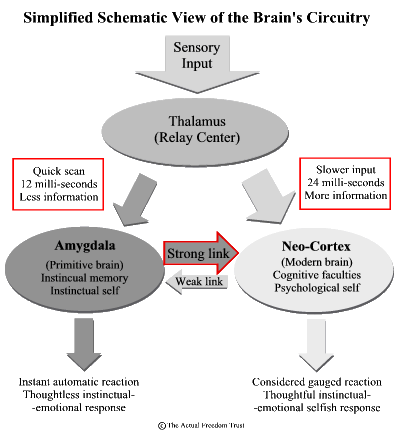
So, my choice and use of words was a bit sloppy. But I would emphasise that this is only my own experience and I would not want to discourage anyone else’s investigations. We are still investigating and discovering and ‘it ain’t over till the fat lady sings.’ I may well be wrong in the sense I make of things but I see the core instincts as no different to the psychological feelings in the neo-cortex, and the ending of them was neither by expressing nor repressing, ‘going into’ or avoiding. The other point I would make is that I can’t find anywhere that I have written the words ‘door with fear written on it’. The ‘door’ has Actual Freedom written on it and fear will be the initial emotion experienced in passing through the door, but fear is a side issue to the stepping through. Personally, my focus is on ‘how am I experiencing this moment of being alive?’ and my intent is focussed on the memory of my initial substantial peak experience or PCE – the other side of the door – if you like, my destiny. Again, just to make sure, this is only how I see it at the moment – nothing set in concrete – no wisdom or the like. It’s just that this method is what has got me to where I am now, and I figure I’ll stick with what has worked to date. I am well aware that Richard used the fear to turn it into thrill and away he went. Maybe I’m a plodder – we will see. What extra-ordinary times – the path to Actual freedom ‘live’. Sure beats sitting in a corner with your eyes closed, finding God! (...) * PETER to Alan: So, to continue our discussion about ‘the wide and wondrous path to Actual freedom’. I keep thinking of the appropriateness of Richard’s phrase as we enter this stage of looking at, and experiencing, the rudimentary animal self ‘at work’ so to speak. What an amazing thing to be able to dig so deep into one’s own psyche that one can get to the core of the programming in the brain – beyond the programming in the ‘Modern Brain’ and into the primitive brain and the genetically implanted instinctual self. No doubt, you read of the work of LeDoux in investigating the pivotal role of the Primitive Brain – the Amygdala – in inducing fear, and we have put together a schematic diagram showing the central role of the Amygdala in producing instinctually-sourced emotional responses. It is the first of the posts – it’s a bit big at the moment to send in this post but it’s worthwhile clicking it open as it forms the scientific neuro-biological basis of what it is we are doing ‘live’ at the moment. It is indeed serendipitous that LeDoux is mapping the effects of the Amygdala at this very time and that it coincides both with Richard’s experiences and writings and our discoveries as well. I do like the factual and actual – the path to freedom from the Human Condition gets wider and wider, more blatantly obvious, easier and better mapped with every passing day. If you will indulge me a bit, Alan, I want to write about the schematic diagram for a bit. LeDoux empirically investigated the pivotal role of the amygdala in producing the feeling of fear, in particular the relationship between the thalamus (relay centre), the amygdala (feelings) and the neo-cortex (modern brain/thoughts).
These investigations also substantiate the fact that no matter what degree of control is exercised by the neo-cortex in terms of morals, ethics, good intentions, etc., when ‘push comes to shove’ we revert to type – and reverting to type means animal-instinctual. This is clearly verified by the being ‘overcome’ by rage, fear or sadness and being unable to stop it. The other discovery of LeDoux
On reading this, I am reminded of the Steve Martin movie – ‘The Man with two Brains’ – if I have got the title right. Again the example of being overcome by rage, fear or sadness is a good one, for often the source of these emotional reactions is seemingly unconscious to the thinking brain – the neo-cortex. No doubt the childhood trauma therapists will use this as a justification for their work but, as we know, the problem lies not with the emotional memory but with the dominant position and influence that the instinctually-sourced emotions have in our lives. The quick, dirty and hard to control Amygdala, or primitive brain, forever condemns humans to animal behaviour. That the most significant human activity over the millennia has been – and still is – the waging of war is testament to the dominance of the primitive instinctual brain. Back to the diagram and we will see that our area of concern is the psychological self
in the neo-cortex and the instinctual self in the Amygdala. ‘How am I experiencing this moment of being alive?’ causes the
neo-cortex to focus its attention on the activities of the psychological self that has been instilled since birth. This focussing
allows us to see the over-arching role that emotions have in causing us to be malicious and sorrowful, and we find that we can
reduce their influence in our lives with sincere intent.
PETER to Alan: I have been musing yet again on the question of denial and what I wrote to you the other day –
So prolific is denial in the Human Condition that it deserves a bit more rooting around to find the real source of it. As you well know, the most prevalent self-defence mechanism evident in any correspondence we have had about the Human Condition, is one of breathtaking denial. This is the dominant response to any attempted slightly in-depth discussion or exchange, be it with Richard, Vineeto or myself. This denial is what moved me off my bum to dig in to Paul Lowe’s book, and further investigate the denial that is enshrined in the teachings of Eastern religion and philosophy. A useful exercise in itself, and great fun to do, but the response to such uncovering of the lies, trickery and deceptions of the spiritual path is inevitably one of even more denial. ‘So what’, ‘it’s got nothing to do with me’, ‘I’m not on the spiritual path’, ‘My Guru tells the Truth’, ‘it’s about the feeling around the Gurus not the facts’ are typical responses. There have been countless times when I have said to someone what a relief it is to have abandoned the spiritual world and the spiritual person I have been talking to say they agree and nod their head. Two recent examples was a woman who had just arrived in town after being in the Himalayas meditating for 3 years, the other who had just produced a magazine attacking the members of his sect for not being loyal to his spiritual master. And yet both denied they were spiritual in any way! Whenever religions are exposed for the puerile nonsense they are it’s always someone else’s religion, or the person is not part of a religion, or they simply slink away. This denial is so common a response that I now regard it as par for the course. Ah, here comes the denial phase and anyone initially interested disappears over the hill with their tails between their legs. Richard has found a few hard-nosed spiritual teachers and spiritual intellectuals – those with the most investment – who have stuck around to defend their beliefs but their defence gets sillier and sillier as time goes on and more beliefs are debunked as more facts are presented. But, of course, there is something deeper beneath this façade of denial. One of the major barriers is pride. To admit one is merely following a fashionable belief, mouthing a psittacism, senselessly following the herd, being the marionette who one was taught to be, and robotically behaving exactly how one’s peers demand, is a crushing blow, particularly to the proudly humble spiritual devotee. The other factor that operates to reinforce denial, as you have noted, is the desperate need to belong to the group and the spiritual believers form a very large, safe and increasingly popular group in humanity. So I see pride and fear operating and these were certainly issues that I had to tackle in acknowledging the failure of the spiritual path to deliver anything remotely resembling freedom, peace and happiness. Digging a little deeper is to get to the core of one’s being and to come across one’s essential nature – the instinctual self. Richard uses the phrase ‘lost, lonely, frightened and very, very cunning’ to describe the psychological and psychic entity that ‘I’ am. Lost, lonely and frightened are qualities that many will admit to, and it is indeed the tacit acknowledgement of this that brings many people to the spiritual path in the first place. These qualities also provide the fuel for many to give the spiritual path 100% effort. The very, very cunning quality of the self ensures that many people will gleefully and gullibly accept the spiritual teachings, deny the existence of the physical world, deny that they are a mortal flesh and blood, believe in their own immortality and fully indulge in the fantasy delusion that they are indeed God-on-earth. This is an act of utter selfishness, cunningly disguised as a noble sacrifice to a ‘higher cause’, yet exposed for the fraud it is when the few who succeed become Gods-on-earth, Saints, Masters, revered teachers and the like – to be feted, worshipped, adored, flattered and fawned by one’s fellow human beings. The very, very cunning nature of the self is evident in the real world as hypocrisy,
corruption, deceit, lies and denial. In spite of the constant pleas and extolling to obey society’s moral and ethical standards,
human beings, when push comes to shove, inevitably revert to natural behaviour. Natural behaviour is instinctual behaviour –
genetically programmed to ensure the survival of the species. The human species has been endowed with a self-survival program that
almost inevitably over-rides the consideration of the survival of the group. Each human is instilled with a distinct individual
self which is embellished by the ability to think and reflect into a substantive entity, an identity of psychological and psychic
substance – ‘who’ we think and feel we are. It is obvious over time bargains and deals were done between groups of humans,
be they biological family groups and/or tribal groups, and these eventually became formalized into particular sets of moral and
ethical rules. These rules, instilled to ensure the group’s survival, became paramount over the genetically encoded, essentially
individually selfish, survival program. This explanation of the human instinctual program accounts for the ongoing failure of
human beings to live together in anything remotely resembling peace and harmony. An understanding of the instinctual passions in
action also reveals the spiritual search for self-discovery and self-realization as nothing other than an instinctually-driven
attempt at self-aggrandizement and a lust for personal psychic power over others. * PETER to Alan: I have just started to write on another mailing list and a whiff
of atavistic fear arose at daring to question the sacred. Interestingly, this fear only arises with the doing of it, by sticking
my neck out, yet again. I realized that the action of challenging the sacred ceiling is something I do in order to investigate
this fear at its roots – no action, no investigation, no change. Many people think of investigation as a passive mental exercise
whereas in fact it is an active doing. So, I will take a deep breath and my next post after this will take me off on another
fascinating journey of discovery.
RESPONDENT: Finally, what I find is a common theme in my journey with actualism so far is that there are all these issues that keep popping up that immediately generate a good deal of fear – then it seems I come up with an intellectual solution or compromise – then later the same issue comes back to bug me again. I must admit this is a real pain. What am I doing wrong? I wonder if I’m allowing emotional analysis to dominate over any sort of ‘apperception?’ PETER: The idea of change, or of tackling something new, usually generates a good deal of fear. From this feeling of fear can come doubt, reluctance, inertia, stuckness and so on, but the same feeling can also generate a sense of adventure, thrill, curiosity, fascination, determination and so on. Several years ago, I experienced the same range of feelings when I gave up drawing with pen on paper on a drawing board and changed to CAD (computer aided drafting). At first I just wanted to muddle along in the old style that I had been taught in my youth, but then one day I realized I might still be drawing for a good many years to come and that, unless I changed to CAD, I would eventually end up a Neanderthal architect. After that came the resistance to starting something new, then came the trials and tribulations of having to throw out all I had learnt in the past about drawing and starting all over again. After a few weeks I found I had to actually get rid of my drawing board so that I fully committed myself to one thing only – learning a whole new way of drawing. With hindsight, I had to undertake exactly the same process when I stopped being a Neanderthal spiritualist and wanted to become an actualist – the initial resistance, a period of trial and tribulation, the necessity to cut all ties with the past, and finally throwing myself in the deep end and getting on with it. Needless to say the effort, in both cases, has been worth it – but I do acknowledge that the process of change is, in itself, always a challenge. RESPONDENT: Most of the time, when I ask these questions – I am stuck with ‘I don’t know’ as the answer – and it doesn’t seem that I can do much better than that. But the major challenge seems to me right now the fact that ‘I’ want to be free – so the questioning is intense – yet the desire to be free causes a good deal of pain through uncertainty. PETER: Whilst the process of change is, in itself, always a challenge … the hardest part of all is making the decision to fully commit yourself to the process. RESPONDENT: I have to wonder sometimes whether U.G. Krishnamurti is right by saying that the desire to be free is what causes misery? Is there an easier way? PETER: Well, if you are into Eastern mysticism and you want a delusionary state of spiritual freedom, there’s always the U.G. Krishnamurti way. From what I have read of U.G., his bottom line is a nihilistic acceptance of the inevitability of human suffering and misery on earth – a view rooted in the spiritual dogma that it is impossible to change human nature. All spiritual teachers preach the doctrine of acceptance for the basic reason that the idea of men and women taking it upon themselves to become free of malice and sorrow is anathema to all religious and spiritual belief that there is an omnipresent and omnipotent God or Presence, by whatever name, who is really running the show. The priests and gurus wield the admonition of ‘acceptance’ like an axe in order to cut people down to size, to keep them humble and in their place – on their knees. However, if you sincerely desire to become happy and harmless in the world as-it-is
with people as-they-are – and you are not happy and harmless now – then you need to stop accepting your lot in life because it
is obvious that there is work to be done and changes to be made.
PETER: Just a comment on something you wrote to Vineeto –
It seems as though you are, yet again, missing the real significance of the role that instinctual fear plays within the human condition. You have quoted from something I wrote –
and have also quoted from something Richard wrote to you on another mailing list –
What is common to both these statements is the word ‘root’ which can be taken to mean at the bottom of or underlying – the root of plant is a useful working analogy. Given that the passion of fear is ‘at root’ it is therefore at the bottom of or underlying something else that is more apparent and obvious. What is apparent and obvious to all at the surface is what is commonly known as the human condition and the predominant features of the human condition are malice and sorrow. I made this point quite clearly in the Introduction –
What should be unambiguous from this is that while fear is the basic, underlying, root passion – to use the full range of descriptive words used in the conversation thus far – it is not the predominant, as in up front, most obvious, most noticeable nor most potent. As such the wording I used when I wrote ‘fear is the most potent and obvious emotion that lies at the root of the Human Condition’ could be misleading and, as such, I will alter it. When I wrote what I did about fear, I assumed that anyone reading would be interested in the altruistic pursuit of eliminating malice and sorrow from their everyday lives rather than the selfish pursuit of fearlessness. I had no idea at the time the extent to which spiritualists were prepared to deny their own feelings of malice and sorrow in order to hang on to their feelings of superiority and righteousness. But then again, there is no substitute for being outside the spiritual world – as in a pure consciousness experience – to really see the game plan. I do like it when any anomalies and inaccuracies in my writing come to the surface on this list. I shall amend what I wrote in order to make the distinction more clear. One of the purposes of this mailing list is as a forum to discuss the human condition that we all find ourselves unwittingly trapped in. What we seek to do is discern what are the facts as opposed to what is merely belief, myth, opinion, psittacism, legend and fairy tale. As such these discussions and investigations on this list are not at all about who is
right and who is wrong because we then only fall into the trap that besets all human interactions – what passes for discussion
and communication between humans is but a battle of stubborn wills, differing opinions, varying morals, opposing values, contrary
attitudes, begrudging compromises, temporary truces, and so on. However for those interested in setting aside their ‘outer
layers’ of social conditioning there is a literal goldmine of facts available in the bowels of the Actual Freedom Trust website. Peter’s Text ©The
Actual Freedom Trust: 1997-. All Rights Reserved.
Disclaimer |