|
Selected Correspondence Peter Ego
RESPONDENT: Now ... it may appear that I am just building up my ego with all of this ... and it is possible ... I don’t know. PETER: Whenever ‘I’ started to claim the glory – i.e. whenever I started to feel I was the Saviour of Mankind – I found that it was good to remember that the ability to think and reflect, to be aware, and to be aware of that awareness is, at core, a function of what I am – this flesh and blood body. By doing so, I avoided the spiritual path trap of feigning a ‘self’-effacing humility whilst sprouting ‘self’-aggrandizing nonsense. Another approach I found useful was to regard the process of becoming happy and harmless as one of actively freeing the intelligence inherent in the physical brain in this physical body from the mind-numbing constraints of the socially-instilled moral and ethical programming and the debilitating effects of its genetically-encoded archaic-instinctual operating system. In other words, I gave credit where the credit is due.
JONATHAN: I would like to ask a question that is a bit off topic. I have read on the AF site that most if not all people experience themselves as having an ego rather than being an ego. Why? PETER: The process of socialization that very child inevitably undergoes means that all children are taught to suppress, deny or subjugate their ‘dark side’ hence the seeds of dissociation are sowed early on in life. JONATHAN: So it is the idea that we can control our feelings or must control our feelings that makes us feel as if we ‘have feelings’? PETER: It’s not an ‘idea’ that we have, it’s a very real way of coping with our dark instinctual side that is ingrained in each and every human being for very practical reason – to make each child a fit member of the family, tribe or society it is born into. Given this scenario it is quite natural that human beings associate with having ‘good’ feelings (being good) and dissociate from having ‘bad’ feelings (not being bad). This is why developing an objective awareness of the full range and depths of one’s own feelings and passions in action is initially extremely difficult – it is an unnatural process that runs counter to all of one’s social conditioning, not to mention one’s ‘self’-centred instincts. * JONATHAN: Is it the ego that is experiencing it self as having an ego? In other words is the watcher (not to use a spiritual term I just can’t think of better way to put) the ego or is the watcher consciousness that has an ego layered over it? PETER: Have you ever done any meditation? The reason I ask is that if you have you might well be able to answer the question yourself from your own experience. JONATHAN: I have never done any serious meditating no, but in the little I did I always got confused about what the hell was going on. Hehehe. From what you are saying I gather that the ‘watcher’ is not consciousness, and that it disappears as the instinctual identity in an actual freedom. So when I feel like I am watching myself act, it is really myself that is watching myself? I am taking baby steps. PETER: If I read you right, you have come across the common conundrum that many people have when mulling over actualism – how can ‘I’ become aware of ‘I’, or how can ‘I’ change ‘I’ or how can ‘I’ eliminate ‘I’? Personally, I didn’t get too hung up about such questions. Maybe because I am a practical, down-to-earth person, I figured that if I wanted to change then it was up to me, if I wanted to be free it was up to me and if I wanted to become aware of ‘me’ and how ‘I’ operate then I have a brain whose function is not only to be aware of things but also to make sense of things. In short, spiritualists regard thinking as the root of all evil and hence they abandon clear thinking and common sense in favour of refined feelings and imaginary scenarios. In contrast, actualists acknowledge the fact that the instinctual passions are the root of all human malice and sorrow and in doing so they are then free to engage clear thinking and common sense in order to come to their senses. * PETER: Put briefly, the idea of meditation is to cut off from sensate experiencing and to stop thinking (as in become the watcher) and allow imagination and affectation to take over … and lo and behold … a new very-grand ethereal-like alter-identity emerges. Personally, I don’t favour using the terms ego and soul as they are terms that have
such historical baggage that their meaning has become so confused as to be often meaningless – in those cultures yet to be
afflicted by Eastern Mysticism, someone who felt themselves to be God-on-earth would be regarded as the ultimate ego-maniac.
RESPONDENT: So far, note that this process is a-personal, and a not-too-bad approach to satisfying curiosity. PETER: Scientists, being human beings, can do nothing in an a-personal manner, but if the process they follow produces verifiable down-to-earth results with leads to things that work, or criteria that can be applied to produce results that work in similar situations, it can reliably be said that the theory then becomes fact. As for curiosity, if it isn’t a down-to-earth curiosity, then curiosity very quickly turns into a flight of fantasy – naught but impassioned imagination. A bit from my journal is relevant –
RESPONDENT: When scientist’s egos get involved and they become defensive of ‘their’ theories, the waters are muddied and extricating real truth becomes much more difficult. PETER: Contrary to spiritual belief, t’is not the obstinacy of the ego that is
the bane of humanity, t’is the tenacity of the soul. You may have observed that many scientists are very wary of treading on the
toes of spiritualists lest they be seen as ‘soul’-less.
RESPONDENT to No 14: (...) Now I understand the whole thing about PCE. Osho created situations in which we could get PCEs and hence have a bench mark to work with. While Richard is asking us to remember a PCE, defined with a description, to take it as a bench mark. PETER: (...) Well, as the man says – the whole process is a deep insight into the mind, nothing else. In other words, it all happens in the mind i.e. it is a passionate imagination. Now how you can equate this description of a glimpse of the ‘sky’ with Richard’s descriptions of the direct sensate ‘self’-less experience of the actual world is beyond me. To make the point very clear, let’s look at another quote from Rajneesh describing his Enlightenment experience –
Doesn’t really sound like a man who is flesh and blood body only. In fact, it sounds as though he is experiencing a state where He has his head in the clouds and is no longer associated with his flesh and blood body – an imaginary state of ‘leaving the cycle of karma’ and being Immortal. Does it not also make you wonder how this man claims to be ‘herenow’ when he says: ‘Since that night I have never been in the body. I am hovering around it.’ This is not a description of someone who is a flesh and blood body only but a description of someone who has completely and utterly identified with his Spirit, Soul, Atman, Buddha Nature or whatever other name one calls the psychic entity that dwells within the physical body. This is a description of a man suffering from a mental state of delusion – an Altered State of Consciousness, whereby he ‘thinks’ and ‘feels’ he is God, immortal and divine. Let’s dig a little deeper and see the extent of his delusion. Again a quote from the man himself –
Cute Hey. With a leap of imagination he is no longer responsible for his actions even to the point of killing. He becomes quite literally ‘above’ the mundane, the ordinary, the laws, the earthly, the sensate. One leaves the wheel of suffering, or earthly existence and transcends. This ‘lofty perch’ of the God-man has relevance in the Sannyas world as to his denial of any wrong doing in Rajneeshpuram – not that the American law courts believed him. No. 14 will recognize the dis-association of Rajneesh from any of his actions as identical to the position taken by Zen warriors in the ritual slaughter of 300,000 Chinese at Nanking – enthusiastically supported by the Buddhist Masters. In case you are confused about the word ‘transcend’, Mr Oxford’s definition is –
Indeed Mr. Rajneesh has transcended the ego – he has clearly become an ego-maniac in that he thinks and feels himself to be God. An ego transcended gives full reign to the soul – the ‘feelings’ – and delusion is the obvious result. Another quote from the Master of deceit –
Interesting first part that clearly points to the emphasis on ‘good’ feelings as opposed to ‘bad’ feelings. I think many people think we make up a story about Eastern mysticism and the dross it is but here it is unambiguously stated. He further introduces a bit of ‘wisdom about black magic that again relates to good and evil spirits or ‘energy’ to use the more modern terminology for spirits. Of course Mr. Rajneesh represents white magic personified. This drivel could not be further from Actual Freedom and the PCE – it is, as we continually state, 180 degrees in the opposite direction. I’ll take the opportunity to flog a dead horse a bit more with another quote that is relevant to discussions that we had about instincts and their pernicious grip on Humanity. Remember that this is from a man peddling an Ancient tradition which was in complete ignorance of modern genetics, neuro-biology and behavioural studies. He says:
Anger is beautiful, hey? Tell that to the woman being raped, the man being killed, the child being abused. Rajneesh would ‘use’ anger in active meditations and groups as a way of getting people emoting in order to ride on the energy into a state of hormonal-charged bliss, exactly as people do when engaging in dangerous sports or how the psychopathic killer gets his kicks. To call this transforming anger into love is nonsense – it is nothing more than stirred up hormones. It would all be a joke really except that people kill out of anger and Rajneesh’s famed Dynamic Meditation is nothing more than a hormonal stir-up for a hit of bliss afterwards. As for ‘anger transformed becomes compassion’, this sleight of mind can only happen if one ‘feels’ spiritually superior to the other. Then one has divine anger as Rajneesh did on several occasions when he could not control his rage in public. Displays of ‘divine anger’ (compassion?) have also been well documented in many other God-men. Further on in the discourse comes the ‘big hook’ for his Sannyasins – the chance to not be identified, to ‘let-go’ and everything will be okay –
With a promise like that from the Master it is no wonder Sannyasins are seduced into
and trapped in the spiritual world. Sounds not a fig like Actual Freedom to me – not a skerrick like a PCE.
PETER: The issue of worthy or unworthy seems to me to be a bit of a side issue. The main question is what do you want to do with your life? RESPONDENT: I think what I want to do with my life is only apparent from one moment to the next and that seems to be constantly changing but it seems to do with being curious, seriously curious about the workings of self. I had actually decided to end this ego self 10 years or so ago but because it was self trying to end self without a ‘relentless inquiring attention’ there was bound to be failure. Now with the aid of ‘How am I question...’ more of the moments are caught rather than the usual see one moment then skip a few moments and get lost in self intellectualization again. Curiosity I think, needs to be given complete leeway. PETER: I was trained as an architect but on graduating found working in an office to be too removed from the building site where the business of building buildings actually happened. Consequently I became an architect-builder-carpenter as my interest was more in the practical implementing of a idea. When I came across Richard I had spent 17 years on the spiritual path attempting to end the ‘ego-self’ but was ready to abandon the effort. I had begun to have some Altered State of Consciousness experiences but the suspicions and doubts I had of the Master-disciple business, the God-men’s lifestyle, how they were with their women, etc., meant that Enlightenment was losing its attraction. I was also becoming more and more aware of the fact that Eastern Spirituality is nothing more than Eastern Religion. I soon came to see that there were two identities preventing me being happy and harmless – the ‘normal Peter’ who was father, man, architect, etc. and the ‘spiritual Peter’ – the believer, searcher, superior one, etc. So I set about dismantling both these ‘I’s by actively challenging the beliefs, feelings, emotions and instincts that gave substance to both the psychological and psychic entity that was ‘me’. What I increasingly discovered was that the brain of this flesh and blood body has an inherent ability to be aware of itself, an ability of apperception. When I ask ‘What am I thinking?’ or ‘What am I feeling?’ or ‘How am I experiencing this moment of being alive?’ it is this apperceptive awareness that can provide the answer. It was enormously difficult and bewildering sometimes at the start but as fact replaced belief, clarity replaced confusion and pure intent replaced ‘open-ness’ and listlessness, ‘what’ I am – not ‘who’ I am – gradually emerged and became apparent. At first, the whole exercise can feel like a weird ‘self trying to dismantle self’’ exercise, but soon one realises that it is fact dismantling belief, apperceptive awareness dismantling self that is happening. So for me, in hindsight, it was apperceptive awareness – the ability of the brain to be aware of itself – that does the job, dismantles and demolishes both the normal and spiritual, both the psychological and psychic entity. When one has a realization about a belief and ‘sees’ the facts there is an actualisation that can occur which is not of ‘my’ doing. In the face of the blinding and glaringly obvious fact, sensible down-to-earth action can ensue. In the spiritual realm, one merely ‘realises’ and takes on board a new belief such as ‘I am really God after-all!’ or ‘I am Immortal – thank God!’ – and non-sensical action inevitably occurs. Many people who have read a bit of the Actual Freedom writings think that the dismantling of spiritual beliefs is some sort of side issue, or a sort of ‘put down’ as is common in the spiritual world between various teachers and Gurus. This is to miss the essential iconoclastic nature of Actual Freedom. To live in the spiritual world ie. to have spiritual beliefs is to be twice removed from the actual world. The spiritual world is an imaginary world that the spirits dwell in. The psychic entity or soul within the flesh and blood body is a ‘spirit’ ie. non-actual and metaphysical. The self as soul ‘dwells’ in the spiritual world while the self as ego ‘dwells’ in the normal world. To be an actual flesh and blood human being is to be without ego or soul – then one
can find a personal peace in the actual world, free of the Human Condition. * RESPONDENT: I agree that some of these emotions have their attractiveness but if that is weighed up against all the times one missed out on opportunities because of the negative effects of certain emotions then a strong argument can be made for sacrificing the ones that are found to be somehow enjoyable. It is amazing how this human trap can be desirable, even after great suffering. Or is it that the trap is accepted because the possibility of freedom requires opening a big heavy door and that is too much effort. PETER: Well, up until now only one person has done it, and he did it via Enlightenment. To give up the power, glory and blissful feelings of being Divine and Immortal is indeed a big heavy door and it is extremely doubtful if any of the present lot will repeat the effort. They have ‘feet of clay’ as Richard puts it. But by utilizing the method Richard has devised – to eliminate one’s social identity, who you ‘think’ you are, the ‘ego’ if you like, and then eliminate one’s instinctual self, who you ‘feel’ you are, the ‘soul’ if you like – when you finally get to the door it’s a ‘step through’ job only. Is it that you are worried about the end of the journey before you even begin?
RESPONDENT: Your best has lead you to where you now are has it not, Peter? PETER: No. If it had been up to ‘me’, I would be still striving to become rich and famous ... or Divine and Glorious. RESPONDENT: Who, (or what), was ‘it’ up to in the final analysis if not a ‘you’ Peter doing your best, (in whatever moment you found yourself)?
The last piece of writing on the ‘actual I’ is Richard’s, who lives what he says as an ongoing experience. What ‘I’ had when I met Richard was a firm memory of this third I – what I am as an actuality – experienced in a PCE that I described in my Journal. From this experience it was obvious that these other imposter ‘I’s had to leave the stage and the first one to tackle was the spiritual ‘I’, for that was my latest identity and the one that initially stood in the way of my freedom. Spiritual teaching has it that there are only two ‘I’s – normal and spiritual.
Hence the spiritual teachers use questions such as ‘who is thinking?’, ‘who is feeling angry?’, etc., which are aimed at
conditioning the hapless victim to immediately dissociate from their wrong thoughts and bad feelings and revert back to being a
superior transcendental spiritual identity. The Advaita gurus, in particular, seem to be fond of using this ruse as a standard
ploy.
RESPONDENT: Here are some quotes from a book ‘Living Zen’ by Robert Linssen published in 1958 Grove Press. (...) The author uses the term ‘I-process’ to highlight the illusory character of identity, seemingly unchanging but borne of process. PETER: It’s pertinent to point out that ancient Eastern spirituality teaches that the illusionary identity (‘I’ as ego only) is borne exclusively of the process of conditioning … whereas actualism establishes by observation and experimentation that the social/ instinctual identity (both ‘I’ as ego and ‘me’ as soul) is borne of the genetically-encoded instinctual passions. To summarize these differences –
A world of difference. * PETER: It’s pertinent to point out that ancient Eastern spirituality teaches that the illusionary identity (‘I’ as ego only) is borne exclusively of the process of conditioning … whereas actualism establishes by observation and experimentation that the social/ instinctual identity (both ‘I’ as ego and ‘me’ as soul) is borne of the genetically-encoded instinctual passions. RESPONDENT: Big deal about nothing – instinctual passions are still conditioning. Evolutionary conditioning, in fact. There are others who say much the same thing. Read writings by David Bohm, for example. PETER: A quote will reveal what David Bohm saw as being the root cause of human malice and sorrow –
And another quote reveals the apparent source of this conviction –
I cannot find anywhere that David Bohm has mentioned the words ‘evolutionary conditioning’ or anything like these words let alone where he indicates that the instinctual passions are the root cause of human malice and sorrow – all I could find made it patently clear that he lays the blame for the ills of humankind on thinking and not feelings. Given that you have made the claim, perhaps you could provide the evidence that any of
the spiritual teachings mention ‘evolutionary conditioning’ … or did you just coin the term on the fly, as it were?
PETER: You referred to Thomas Metzinger’s philosophy as a possible explanation of your ‘interesting experience’ and how and why it was different from a PCE and I was simply fleshing out the differences. If you re-read the quote you posted, you will see that you have misunderstood what he is saying. RESPONDENT: I’ve done so, and I do not think I have misinterpreted it. PETER: I’m not saying you misinterpreted it, merely misunderstood it. RESPONDENT: I think it is you who has misunderstood it. Let’s see if we can iron this out. * PETER: Metzinger makes it quite clear that the subjective experience of ‘being someone’ is one’s normal state and he contrast this normal state with an altered state of being, as in ‘being no-one’
RESPONDENT: In the section I quoted, he does nothing of the sort. He is saying that selves are subjective illusions that do not exist in actuality. PETER: Okay. I cut the quote you posted for brevity but here is what followed on from the above –
As you can see, in the quote you posted, Metzinger clearly goes on to say that the subjective experience of ‘being someone’ is experienced ‘simply as ourselves living in the world right now’, in other words as I said ‘being someone’ is one’s normal state. Is this not your everyday experience? Do you not normally experience yourself as ‘being someone’? RESPONDENT: Yes, the subjective experience of being someone is the normal state. So far so good. PETER: And the reason this is good to understand is because many people latch on to the philosophical view that the self is an illusion and then set off in search of their authentic ‘non-illusional self’. * PETER: ... and he contrast this normal subjective state of ‘being someone’ with a paranormal objective state of ‘being no-one’ –
In reflecting on this conversation, it occurred to me that another way of describing altered states of consciousness would be to describe them as altered state of being. RESPONDENT: No he does nothing of the sort. He’s not talking about ‘being no-one’ as an alternative to ‘being someone’. He’s just pointing out that the ‘self’ is an illusion. He’s not prescribing a way to become free of it. I’ve read other reviews of his book (though not the book itself), and they all support my interpretation, not yours. (One example is the article I referenced in ‘Neo-Virtualism Revisited’). He’s offering a conceptual model of the virtual self, explaining how the illusion comes to be formed, and how it comes to be experienced as real. He’s saying that it does not exist in actuality, but he’s saying nothing whatsoever about how to become free of it. PETER: Okay. Would you agree that Metzinger’s philosophical take is that we are ‘being no-one’ because ‘what we think of as ‘the ‘self’ is a representation generated by the brain’? Thus he maintains, from a philosophical viewpoint, that we are ‘being no-one’ because the self is a psychological illusion, whereas as you have confirmed that the subjective experience of ‘being someone’ is one’s normal state. Would you agree that these are two different experiences of consciousness, one philosophical and the other is one’s everyday experienced reality? If Metzinger is not saying how to become free of the illusionary self, his philosophy is certainly in accord with the notion that the illusion of the ego is root of the ‘normal’ human consciousness, a notion that is derived from ancient Eastern spirituality. * PETER: As you can see, in the quote you posted, Metzinger clearly goes on to say that the subjective experience of ‘being someone’ is experienced ‘simply as ourselves living in the world right now’, in other words as I said ‘being someone’ is one’s normal state. Is this not your everyday experience? Do you not normally experience yourself as ‘being someone’? RESPONDENT: Yes. Now you tell me: where is he suggesting or prescribing an experiential alternative to the experience of ‘being someone’? Where is this ‘altered state of being’ he’s allegedly proposing? I argue that his book, based on the reviews I’ve read, does nothing of the sort. It is theoretical, intellectual critique of the ‘self’. This again strikes me as a tendency of yours: to see spiritualism lurking everywhere, not just hiding behind the scenes, but right there for all to see, provided we don’t ... uhhh ... misunderstand it. PETER: I take it that you don’t normally go around experiencing yourself as ‘being no-one’ – you normally go around experiencing yourself as ‘being someone’. Should you go about your daily business thinking of yourself as ‘being no-one’, you would not be experiencing yourself as you would normally experience yourself. I would call that two different states of being, one real and one dissociated … and I say that because that is my own experience when I followed the ‘ego-is-an-illusion’ path. * RESPONDENT: He is saying nothing whatever about an experience of self-lessness, or an altered state of self. Where? PETER: Where – in the quote directly above. Why do you think he uses the term ‘being no-one’ in contrast to the term ‘being someone’ if he is not talking about an altered state of being – as in experiencing oneself as an other-than-normal being? RESPONDENT: Why? Because the experience of ‘being someone’ is an illusion that has real consequences. PETER: And from the review I have posted it is apparent that Mr. Metzinger takes
this observation a step further in that he says ‘Not even being no-one protects us from misfortune,
harm, and sorrow’ – which is the reason I commented on Mr. Metzinger in the first place.
RESPONDENT: What is the relationship between ego and willpower? PETER: The instinctual ‘self’ every human being is born with is pre-programmed with a set of defence and propagation instincts, namely fear, aggression, nurture and desire, which form a primary and automatic impulse and in most cases deep-seated emotions override the supposed free will of ‘who’ we think and feel we are. In spiritual practice one surrenders one’s will to a higher force, placing one’s life in gloried service to God – thus ‘it is not my will but Thy will’. For someone like Ramesh Balsekar this means that if he kills another human being it is perfectly okay ... for it is ‘God’s will’. By surrendering their will to God many people literally get away with murder. Surrendering one’s will to God is a cop-out that instantly allows one off-the-hook from even acknowledging that one has instinctual passions – let alone begin investigating them, let alone consider eliminating them. RESPONDENT: Between willpower and pride? PETER: Any entity, either normal or spiritual, is instinctually and socially imbued with both willpower and pride. On the spiritual path one is encouraged to surrender one’s will to God and to cultivate one’s humility. There are none so proud than those who have humbly surrendered their will to God for they stand on the side of Good, Truth, Right and the Almighty, by whatever name. RESPONDENT: Is developing one’s willpower an ego trip or a valid spiritual practice (or is there no contradiction at all)? PETER: Those who achieve Enlightenment do so by stubborn will for it is no easy thing to subjugate or transcend one’s ego, or personal self, and develop a new dissociative God-realized identity, or impersonal Self. It involves denying the existence of evil in oneself in order to become only the Good, who then gets to feel pure and perfect – and above it all. RESPONDENT: Is willpower derived from ego? I would say yes. In my opinion, once one attains liberation one’s actions are spontaneously derived from / are part of the Divine Will. There is no struggle or need for willpower. Again, in my experience, willpower is essential in overpowering the negative impulses of the ego. PETER: One has to desire to be God or God-realized with all one’s will. When I had a few major Satoris or Altered States of Consciousness, I knew I was on the way to being a Guru or God-man and it was only by having seen them close up, in action, on and off stage, that I started to question the very nature of Altered State of Consciousness experiences. What I found was that these experiences were not at all unique, they were culturally biased, they were affective only, and while they took me away from the ‘real’ world, they took me even further away from the actual world. The ‘real’ world is a nightmare, the equivalent of wearing grey coloured glasses. The spiritual world is a fantasy dream, the equivalent of wearing rose-coloured glasses. When one dares to take off both glasses, the actual world – the amazing physical infinite universe we live in – becomes startlingly apparent as having always been here. It was only ‘I’ who stood in the way, or ‘me’ who claimed it as mine in affective/ spiritual experiences. RESPONDENT: In what way may caring about other people be ego-transcending or ego-supporting affair (or is there no contradiction at all)? PETER: A psychological and psychic entity, the ‘self’, is imbued with tender and savage passions and is taught to be fixated by morals of good and bad and ethics of right and wrong and therefore all acts of caring, no matter how well-meaning, will ultimately be ‘self’-centred and selfish. RESPONDENT: Sacrificing for others probably does little to erase the ego. Think of the mother who sets aside her own needs for those of her child. PETER: Again two aspects operate – one’s social identity of morals, ethics and beliefs and the instinctual drives. Many parental acts of sacrifice for their children are accompanied by a feeling of resentment that often bubble to the surface in times of stress, or in later life when one has done one’s social and instinctual duty. There is, however, a predisposition towards altruism in human beings that is at the core of many of these acts of sacrifice. It is this propensity that one can tap into if one wants to make the only sensible sacrifice possible in order to facilitate peace on earth – self’-sacrifice or ‘self’-immolation, as opposed to the religious/spiritual senseless and selfish action of killing their own bodies or the bodies of other spirits. RESPONDENT: Any ‘good’ act can be ego-supporting and not necessarily ego-transcending. Living for others is an outcome of liberation, not necessarily a route to it. PETER: All of the successful Gurus demand a lot from others rather than give to others. They demand love, loyalty, surrender and devotion. I used to think they gave a lot until I realized that without their followers giving continuously they would be mere mortals like the rest of us. It takes enormous courage to question the tender passions and the Good, for we have been taught by our peers to believe that without these facets of ourselves we would run amok or become evil. But for those daring enough this very investigation is the key to the door that keeps us trapped within the human condition of malice and sorrow and the duality of Good and Evil. RESPONDENT: What is that specific element in different kinds of spiritual practice that destroys ego? Keeps it under control? Makes it stronger and more insidious? Makes it our enemy? Makes it our friend on the spiritual path? Or does our Sadhana simply not change anything about ego having other priorities instead? PETER: Spiritual jargon being as slippery, poetic and illusory as it is, I find the whole argument about ego a bit of a furphy. It is clear that a spiritual person who becomes God-realized or God-intoxicated, or whatever other name is used, has suffered a shift of identity. This can be described as the transcendence of the ego and the ascendance of the soul, but it is all so shrouded in mystique and confusion it is all much clearer if one calls a spade a spade, and calls it a change of identity. It is time to practice an active question all of one’s emotional identity, all of the
feelings that are preventing one from being both happy and harmless.
RESPONDENT: My own experience has been that being watchful for ego, in the form of self-centredness, has liberated me to act more in accordance with what I see as being right. PETER: In the Eastern Religions the mind is seen as ‘the problem’, and a puerile belief-system and associated torturous practices have evolved over centuries, deliberately aimed at stifling and eradicating sensible thought, such that imagination and impassioned feelings are given absolute free reign. A common theme in all ashrams, temples and Sanghas is that, as a devotee, you are admonished to ‘leave your mind at the door, surrender your will, and trust your feelings’. This stifling of the mind has left much of the East wallowing in poverty, ignorance, repression, suppression, corruption, superstition, fatalism, subjugation, acceptance, servitude, despotism, and theocratic rule. That these Ancient traditions and wisdoms are still practiced is witness only to the desperation of those seeking freedom, peace and happiness and obviously has nothing to do with the sagacity or success of the belief-system. In the Buddhist tradition, there have been, at the very least, 1 billion followers over the centuries, and Ken Wilber estimates that no more than one thousand have achieved Enlightenment – the Altered State of Consciousness that masquerades as freedom. This is a success rate of 0.0001% – and the failed rest dutifully believe that they get recycled to suffer earthly existence again and again until they eventually manage to achieve freedom from the cycle of birth and death – the wheel of misery. ‘There is always next lifetime’ is a common refrain. What a depressive and oppressive mindless belief-system. RESPONDENT: In fact I have seen with my own eyes that I can be very destructive when I allow myself to be carried by the unending desires of the ego. PETER: May I suggest that what you are experiencing are your own feelings and emotions arising from your instinctual passions and not, as is commonly believed in spiritual circles, ‘the unending desires of the ego’. ‘Wrong’ thinking doesn’t cause war, murder, despair and suicide – normal flesh and blood human beings endowed with genetically-encoded instinctual passions do. There is now a chance for those who want ‘to live in such away that we couldn’t possibly be making a more positive contribution to the world’ to actually do so, but the price to pay is beyond what is considered natural– ‘self’-immolation. I do know it is extraordinary to consider that everyone has got it 180 degrees wrong but it does explain why, after thousands of years of well-meaning effort by billions of people, there is still not anything remotely resembling peace and harmony between human beings on the planet. When one realizes that the suffering human beings inflict on each other, and the deep
despair and hopelessness many feel, can now be eradicated, and not simply accepted as unchangeable or as an essential part of some
perverse Divine plan, then one is personally challenged to actually do something about it.
PETER: Yes, I did note with interest your post on the subject of ego. Given that my interest is peace on earth and I like to reply in detail I can’t comment on your post on the list so I will take the opportunity to do so here.
You say you can’t hate but you obviously can still blame other human beings for as you said at the start of this post – ‘I had, and still have, all the feelings about the way this world is ran by our governments’. These feelings usually range from being upset, miffed, impatient, perhaps even angry or swing back the other way to feeling pity for them, sad, despairing, hopelessness and perhaps even depressed. If you ‘can’t hate’ which of these other feelings do you ‘still have’? When you say ‘you no longer see any part of this wonder-full creation as being separate from your own being’, do you include the human beings who are in the governments that run this world and do you include all the wars, murders, rapes, tortures, domestic violence, despair and suicide in this wonder-full creation that is not ‘separate from your own being’?
An interesting point of view. What Krishnamurti had to say was so ‘very important for people to hear’ that it was okay to deliberately conceal a long standing affair with his friend’s wife and engage in subsequent long and bitter legal battles against his friend in order to suppress any knowledge of it becoming public. Sort of a ‘don’t look at the finger, look at the moon’ argument or ‘I’m only a poor humble messenger but my message is pure gold.’ Do you not take a stand, presume a position, make a judgement on Krishnamurti by refusing to pass a judgement yourself and leaving it to others?
Well, that’s a bit of a come down for the exalted and much prized state of Enlightenment. This seems to none other than the ‘we are all enlightened, we only have to realize it’ psittacism that is floating around the spiritual world. So now, I assume your teaching is simplified even further to – if everyone sees ‘the fact of our being one with all life’ and ‘just lives (their) life not harming any one or any thing’ then there will be peace on earth. As for, ‘you may also see where I am coming from’ – where I see you coming
from is a position of back-peddling and I would only encourage you to keep doing it all the way totally out of the spiritual
world. Most people think there are only two worlds – the real world or the spiritual world, but if one dares to step out of all
illusion there is an actual physical-only world of purity and perfection and the evidence of this is the pure consciousness
experience. It far exceeds Enlightenment for all the capricious feelings and unfulfilled promises of purity and perfection of the
spiritual world are experienced as an actuality in a ‘self’-less state – a perfection and purity that is rock-solid,
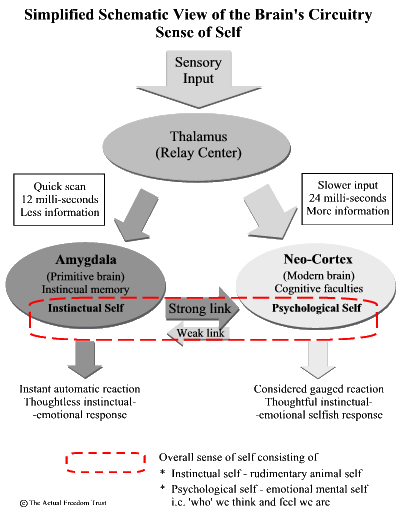
sensately experienced, touchable, visible, tasteable, smellable, audible, ever-present, each moment again. * RESPONDENT: Do any of you kind folks know of anyone writing about the ego that understand that the main problem is the physical need for security was carried over into the subjective illusion of ego? If so please let me know. I am very interested in this whole process and so far I don’t see where the psychologists are seeing it. PETER: I see you are starting to toy with the idea that there may be some physical basis for the illusion of the ego. As a radical proposition – which may well be too radical to get posted – I offer the following writing – All humans are instilled with an instinctual animal ‘self’ that is the very core of the self-survival program. Although this instinctual survival program is genetically-encoded in animals so as to ensure the survival of the species and not the individual, in humans the survival program is also ‘self’-centred. Our instinctual-rudimentary ‘self’ is both palpable and potent due to the surge of chemicals arising from the primitive brain (feelings). This ‘self’ is our instinctual ‘being’ at our very animal core – instinctual, thoughtless and emotional. Further, this primitive ‘self’ is made more complex in human beings by our ability to think and reflect and, as such, we have a more elaborated ‘self’ consisting of ‘who’ we think ourselves to be as well as ‘who’ we feel ourselves to be. ‘Who’ we think and feel ourselves to be is both a psychological ‘self’ and an instinctual ‘self’ – both mental and emotional – manifest as a discordant and alien identity that appears to be located as a thinker in the head and as a feeler in the heart and gut. Given that the instinctual animal ‘self’ in humans has morphed into a sophisticated and cunning psychological and psychic identity that appears to live within the flesh and blood body, it is obvious that the instinctual animal passions can only be eradicated by eliminating both the psychological ‘self’ and the instinctual ‘self’. The elimination of one’s ‘self’ needs to be total – both ‘who’ you think
you are as a social identity and ‘who’ blind nature has programmed you to instinctively feel you are … in spiritual terms,
both the ‘ego’ and the ‘soul’. The good news is that with the extinction of who you think and feel you are what you
are will emerge – a flesh and blood human being, free of malice and sorrow and free of any metaphysical delusions whatsoever.
RESPONDENT: You also say that if a person says he is god he has ego. I do not agree. PETER: How Big can an ego get that calls oneself God? Maybe Supreme God is bigger than God ... or God of Gods? When I was a kid they locked people up in asylums if they went off ranting that they were God, or the Saviour returned. I remember a couple of them used to be on Hyde Park corner in London with signs saying ‘The End Is Nigh’, and ‘follow me and ye shall be redeemed,’ and I regarded them at the time as having a bit of a screw loose. RESPONDENT: A person may be ego-less and yet have discovered his own godliness (or god nature) within him or her and is sharing it. You have to be very aware to see if the person is speaking with an ego or not. PETER: Yes, if only we know what the ego is – in my experience it is used in the East as expressing the fact that some-one still has a personal self and has not yet realised his or her Divine sense of self, or that they are God, or at One with God. RESPONDENT: How can you judge if a person is free of ego? Are you really free of ego? I very much doubt it... PETER: Yes, from your point of view I am not free of ego, unless I call myself God, Enlightened, That, at One, etc ... What I am (in a pure consciousness experience) is this physical body only, there is no psychological and psychic entity inside, no ‘I’ – the little man inside my head who was controlling things. There is also no ‘me’ as a psychic entity, no feeling ‘me’, no soul or spirit, that will live on after I, this body, dies. That is why I say that everyone has got it 180 degrees wrong. So much confusion exists in Eastern teaching about the ‘ego’, and generally it is put out as an admonishment to surrender your ego to God (or the Master). And once you have surrendered your will to anyone, or anything, you are really stuffed ...! Good to chat ... good subjects to get out in the open – ‘on the table’, so to speak. But, one can get into torturous semantics with all this stuff about ego and soul, while
simply setting your aim in life to become happy and harmless cuts right through the lot.
RESPONDENT: Peter wrote: – so much words that I can only ... pay you respect because: Your Ego is 100 tons weight and you have very, very strong neck in order to carry this monster. Almost alone against all that people on the list for about how much time – 3 weeks? Even if I actually don’t agree with you in many points I still pay you respect ... PETER: Respect is a fickle thing. As with the guy I mentioned above, he paid a sort of respect in saying I was talking wisdom, but then would be saying something different about me to others. The way I look at the issue is similar to the way I look at a building. I have been a builder, and when I see a building that is built well, I admire the way it is built because I can see the care, consideration and effort that has gone into it. It is an admiration of the quality of human achievement. When I met Richard, I admired what a fellow human being had achieved in ridding himself of malice and sorrow. What an extra-ordinary achievement to have found a solution such that it is now a realistic expectation that one day there will be an end to war, murder, torture, abuse, famine, repression, religion, spiritual-ism, suicide, depression and sadness. Not only to have discovered a way to be free of the Human Condition, but also to have worked out a simple method, whereby anyone can do it themselves, and to be able to effectively convey it to others with the written word, wherever they are on the planet. A bit from my journal might give you another view point –
RESPONDENT: ... or maybe your endless arguing with people on the list is helping you to ripe your Ego, to make it perfect ... PETER: What I see is, that someone who swans around being at one with God or God-realised with worshipping disciples is on the Grandest of all Ego Trips. And we let them get away with it because we are instinctually driven to follow the herd, to want to make someone else a leader so we can meekly follow. It’s such a poor excuse not to look at what anyone is saying to do the old ‘your just ego-tripping’ thing. In this country we call it the tall-poppy syndrome – any one who sticks their head above the crowd gets it cut off. That’s why I like the times we live in – the Net allows a conversation like this
for the first time in human history – where one is able, with reasonable safety, to challenge the Wisdom of the past. I did sit
down for a long while to contemplate the safety of doing what I am doing but I also figure that who I am talking to may be riled,
but only aggressive with words. I remember a childhood rhyme that went ‘sticks and stones may break my bones but names will
never hurt me’.
RESPONDENT: PETER-LOVE, ‘I’m sitting ... I am saying... I mused... I first came across... my reactions. I am looking... When I first met ... I was full ... I felt that... I naturally assumed... I had... I leapt... I realised... something far more radical – the total annihilation of the ‘self’. I remember... dawned on me... I was in for – the end of ‘me’. I thought,... The end of ‘me’! ... But I had... free myself... I had determined... as I stood... my son. I had decided ... I propositioned... I do appreciate... all I am saying... my experience... I wrote in my journal of my battle... I still found myself defending... I, and everyone... I had been reading... I found ... I found... I used... to make... to me... I was able to... I realized... I had met... I was obviously... tom! I reached... I thought I was going... I only had to... I lived... here I was... I remember...to me... I mind... I thought... I saw... I was thinking... I was... I ruled ... I somehow knew ... my head... my belief... drove me on – I was... in me...I realized... I no longer...I knew I could not... on me... help me... I could... my own intelligence... I have got it right... I knew... I have been such a fool! ... I recognized... bound me... given me... I then realized... I came to realize... I would be a greater fool... I often saw... on myself... I realized... my life... I was after... I started... in me... I got further... I began... I had begun... my role... I would see myself... It seemed to me... I also had... to myself... in my desire... to me in my situation... I would try... I saw that... I had no power... I would not want... I tried to... this path is anathema to the ‘self’... in myself... in me... I be seduced... I had reached... I had glimpsed... my life... In my experience... I was becoming... I was busy arriving...’ Obviously this path has not made the slightest dent in this ego. PETER: Just thought I would do both of your posts tonight... Have you ever tried to write a personal story about yourself without the first person pronoun I? It is very difficult. If I used the word coconut instead of I, it comes out looking pretty weird – coconut sitting.., coconut is saying..., coconut mused... Royalty use the term ‘we’ as in ‘We hereby declare ...’ to denote that they are above the ordinary and speak as kings/queens. Religious leaders declare they have found the Truth, or Love and then go on to talk about it thus avoiding the use of the personal pronoun. Of, course it is then God, Truth speaking and not them, they are but ‘humble messengers’. What a load of rot! Now, that is what I call Ego-maniacal! And yet when a flesh and blood human tells his story... So all encompassing is the belief in God, be it Eastern or Western versions, that anyone who challenges the belief is said to be egotistical, yet someone who calls himself God is seen to be free of ego!! It will take a while, but it will be so good when we are free of these nonsensical concepts and beliefs ... So, I will continue to refer to myself, this flesh and blood body free of any
psychological and psychic entity, as I. * PETER: Have you ever tried to write a personal story about yourself without the first person pronoun I? RESPONDENT: Yes. PETER: What do you call yourself then? RESPONDENT: No 11, this one, this writer... PETER: Well I must admit you (sorry the writer) have thrown me (oops ... a
personal pronoun) into a quandary. In the interests of keeping us on the same level in that the writer (meaning you) doesn’t
think that I am being superior or egotistical, I will adopt your terminology. By the way, does the writer (meaning you ... suppose
we call you writer 1 for clarity) adopt the terminology ‘the speaker’ when the writer 1 is speaking to others. Krishnamurti
used this terminology while lecturing.
PETER: To get rid of the ‘ego’ only, is to let the feelings and passions run rampant, such that one will readily and willingly kill for ‘love’ of country, God or leader and one will readily sacrifice or surrender one’s life for country, God or leader. RESPONDENT: You would have to drop your ego to know that you are incorrect here. It is only ego that kills, ego being the identification to something other than what one is. Nobody identifies with what one is, simply a human being. They identify with football teams, etc. PETER: Oh, boy. Now you are saying that no-one identifies with what they are –
simply a human being. But you are claiming a higher level of consciousness – doesn’t sound like ‘simply a human being’ to
me. And Rajneesh proclaimed himself a God-man, hardly your ‘simple human being’. Your twisting and turning and distortion of
facts and words in order to fit your scenario is quite astounding. Are you trying to ‘clip on’ a bit of Actual Freedom on to
your philosophical and spiritual views perchance? A few have already tried with ego-deflating results. Freedom from the Human Condition – Happy and Harmless Peter’s Text ©The
Actual Freedom Trust: 1997-. All Rights Reserved.
Disclaimer |