|

Vineeto’s Correspondence to the Actual
Freedom List

|
Topics covered
Doubt * readiness to die, German traits, war * net-holidays
* new correspondence* no need for a partner to become free * ego / soul, ‘I’, flesh-and-blood body, library topics * something
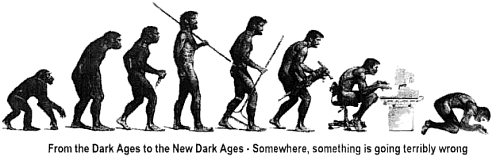
going terribly wrong * NDA language / straight talk * Tumour -Like
Mass Can Make You Want To Laugh * ‘self’ in action, pushing negative and grasping positive
feelings, emotions in pairs, PCE / ASC, chemical reactions in amygdala, senses, Buddhist ‘neti-neti’, dealing with
emotions in spiritualism/actualism
|
12.8.1998
Hi everybody,
I thought something write-worthy would happen when I would go back to my old
job for holiday-replacement! Now I have had three days of enjoyable time there in the ‘lion’s den’, the place of
spiritual conviction and where everybody feels connected with and responsible for everybody else. I enjoy working with
figures and numbers, the facts of a company’s incomes and outgoings. I enjoy the play of daily interactions with
people whom I have nothing to do with anymore on an emotional basis.
But today, something has slightly changed. Irritation happens once or twice a
day. I lay awake at night for hours thinking nothing in particular but enough to stay awake. Then an old friend of
commune-times, whom I wanted to send a book, rang in the early morning hours. And suddenly, doubt became quite obvious,
churning my guts, turning my stomach, running up and down the walls of my brain:
What if they – which means ‘humanity’, but particularly all the people
that I have known in the past 10 years – are right and I am wrong. Now, examining what that means I found: what if
emotions never quite totally disappear, are not 100% eliminable, and I will stay in this state of, being happy most of
the time, but can never quite rely on it?! Looks a serious threat, doesn’t it? What if it only happened to Richard as
a freak of nature or a consequence of his being enlightened, but I will only be able to eliminate 95% of my self and
then always live with the possibility that doubt, fear or all the other emotions and instincts can come back with
revenge? Those doubts remind me of the concept about enlightenment where I had learned you have to leave at least 50%
chance to the Grace of Existence and wait – and in most cases nothing happens! Of course, this doubt is fed by seeing
all those people around me, believing, trusting, hoping and continuing their suffering. Obviously I got again trapped in
this spiritual concept.
Reading back I can see ‘I’ have to die, ‘me’ has to die, only then
those doubts will never return, nor will any other of the emotions. As long as I want to enjoy the good times, there
will also be the quivers of worry and doubt, irritation, bitchiness and sorrow. Now that insight sets fear in motion, of
course, but I know I have found the bottom line.
I’ll see how long it will last!

26.8.1998
To be free one must be determined to die.
From the side of the Human Condition that is how it looks like, and it is
scary. From the side of actual freedom or in a pure consciousness experience however, it is simply a drama played out,
the final drama with all the ‘parts’ of the ‘self’ acting out their particular bits. What started a few days ago
as an ordinary flu with its usual symptoms in throat, nose and chest brought up my fear of old age and death, which I
experienced as a fierce tension in the solar-plexus with nausea, pain and upsets. Looked very real this way.
This morning I watched an English film about Nazis, called ‘The Night of
the Generals’, different characters of leading officers in Germany and France during the last year of the war. The
murder trial still went on 20 years later. Many of the particular German traits and beliefs I could recognise and
identify in me, the generals just had them a bit exaggerated. And the ‘good’ guys did as much harm as the ‘bad’
guys. Being right, loyal, obedient, their heroism, viciousness and the lust for power, believing in good and bad and
authority as such – just not having it quite defined as to which is right and which is wrong ... And then, of course,
the universal sorrow about all the terror of war...
All this has to die, irrevocably.
And seen from the side of the actual world, I have always been here, done
what I have done, the Human Condition is just a passionate phantom, in the process of being dismantled, diminished and
eliminated, while ‘I’ am trying to stage the dramatic stories. It is an incredible fascinating time to experience
this happening!

17.11.1998
The following is an actual question given on a University of Washington
chemistry mid-term:
‘Is Hell exothermic (gives off heat) or endothermic
(absorbs heat)? Support your answer with a proof.’
Most of the students wrote proofs of their beliefs using Boyle’s Law (gas
cools off when it expands and heats up when it is compressed) or some variant.
One student, however, wrote the following:
First, we need to know how the mass of Hell is changing in time. So, we need
to know the rate that souls are moving into Hell and the rate they are leaving. I think that we can safely assume that
once a soul gets to Hell, it will not leave. Therefore, no souls are leaving. As for how many souls are entering Hell,
let’s look at the different religions that exist in the world today. Some of these religions state that if you are not
a member of their religion, you will go to Hell. Since there are more than one of these religions and since people do
not belong to more than one religion, we can project that all people and all souls go to Hell. With birth and death
rates as they are, we can expect the number of souls in Hell to increase exponentially. Now, we look at the rate of
change of the volume in Hell because Boyle’s Law states that in order for the temperature and pressure in Hell to stay
the same, the volume of Hell has to expand as souls are added. This gives two possibilities:
- If Hell is expanding at a slower rate than the rate at which souls enter Hell, then the temperature and pressure in
Hell will increase until all Hell breaks loose.
- Of course, if Hell is expanding at a rate faster than the increase of souls in Hell, then the temperature and
pressure will drop until Hell freezes over.
So which is it? If we accept the postulate given to me
by Ms. Therese Banyan during my Freshman year ‘that it will be a cold night in Hell before I sleep with you,’ and
take into account that fact that I still have not succeeded in having sexual relations with her, then: (2) cannot be
true, and thus I am sure that Hell is exothermic.
The student got the only A.

3.12.1998
Hi everybody,
Om.Com [our server] seems to have some trouble with their
telephone company. They might switch to another company and say it may take them 10 days to do so. So if you don’t
hear from all of us who are connected through Om.Com, that’s why.

9.12.1998
Hi everybody,
there is some new, freshly update correspondence on our
web-site: Correspondence
Peter and Correspondence Vineeto.

4.1.1999
Respondent A:
Hi,
Good to hear from you. You have asked:
‘I forgot to say ... and what about someone like
me who does not have a partner, where do I fit in in being free?
BTW... Happy New Year ... it’s nice to hear from you again ...’
Actual Freedom has nothing to do with having a partner or not. Just Peter and
me have described our experiences on the path to freedom as we did it, in a partnership. But you might have noticed the
conversation on the list, Alan or No 3 are exploring freedom by themselves and for themselves. It may look different or
even more difficult in the beginning, but everyone has to discover it for themselves anyway. Don’t let yourself be
stopped by not having a partner.
Peter did not make me free nor did I do anything for him. It was very helpful
to talk to others about what is happening and ‘how am I experiencing this moment of being alive’ – and that’s
what we have the mailing-list for. We all look like fools when we learn something new, so that consideration is not
really worth to stand in the road, although I know from my own experience that pride can be such a stumbling block,
again and again.
When you start with the question ‘How am I experiencing this moment of
being alive’ you will find different kinds of reasons, emotions, moods that keep you from ‘feeling good’.
Richard has described the method really well in his article
‘This moment of being alive’.
And then you start off exploring into your psyche, finding out about your
hopes, expectations, complaints, assumptions how things should be, ideals and whatever else.
Once I got the knack I had actually good fun exploring. I found that instead
of having feelings about a useless hope or dream I could decide to actively abandon that dream, cut it out of my psyche
and come back here, into this moment with its magnificent sounds, colours, tastes and interaction. Each time it was like
an operation, but the ‘losses’ made me happier and happier, because what I lost was actually the very cause for the
present misery or anguish.
Yes, it is true, in many issues I checked myself out with Peter, but anyone
or anything can trigger an emotion, a resentment and there I went, investigating again into the cause of my emotion.
Even the weather can be a good ‘thermometer’: do I get pissed off when it rains? Do I wait for sun to make me happy?
Do I blame the weather for not wanting to be here? It does not matter where you start and it is only you who can make
you free, a great arrangement, isn’t it!
So let me know how you are going...

18.2.1999
Respondent No. B:
So you found us on the web? and joined the mailing list – welcome.
Fascinating writings I discovered while browsing the
web one boring night at school. I’ve been a student of Course in Miracles, but had a lot of suspicions about this
‘ego-bashing’ that comprises the bulk of the text. Also wasn’t too keen on the idea that Jesus was the channelled
author ... and didn’t care. But of all my investigations, you are the first to suggest that even the soul itself is
not so benign as we’ve come to believe.
Yes, the first, and according to Richard’s extensive investigations the
only bunch of people to say so. Hence our description of ‘A New, Non-spiritual, Down-to-earth Freedom’. Richard has
been the first who was not contented with his enlightenment but who, in 11 years of thorough investigation, came to see
through the delusion that enlightenment actually is.
Once I was able to look past my objections and see the radicalness of this
new approach, it made eminent sense to me that not only the ego, but also the soul, our feelings, instincts and
imagination are part of the ‘self’ that is responsible for all the malice and sorrow both in me and in the world.
But you will discover that when you have time to read a bit into Richard’s web-site.
But it is still a bit tricky to hear you referring
to ‘I’ even after all this ‘self’ annihilation you’ve been through. Maybe our language simply cannot convey
the essence of what you are really saying...but I sure ‘sense’ the legitimacy of it.
Richard: ‘There is a generally accepted convention
around the world that, when referring to the psychological or psychic entity within the body, small quotes are used. To
wit: ‘I’, ‘me’, ‘my’. When wishing to refer to this flesh and blood body bereft of this entity, it is
convenient to revert to the first person pronoun: I, my, me ... or even more impersonally ... one.’ Richard, List B, No 12
And in another conversation:
Respondent: Yes there are many subtle misconceptions
concerning the concept of ‘me’, one of them is that we can get away with all the problems by calling ourselves a
‘flesh and blood body’.
Richard: ‘No, not at all. One can not ‘get away
with all the problems by calling ourselves a ‘flesh and blood body’. This physical universe, being perfect and
pristine, has so arranged itself that nobody can get away with anything. If one is at all dishonest – as in
intellectually unscrupulous – about ferreting out anything detrimental to one’s salubrity, that aspect of one’s
personality that one has conveniently overlooked has the charming habit of sneaking up behind one and tapping one firmly
behind the knees. If one is at all desirous of living a blameless and carefree life, one can not fudge a single issue.
Thus, to merely call oneself a ‘flesh and blood body’ achieves nothing
– unless one is so stupefied as to be so easily fooled by one’s own mendacity. Only when both the ego and the soul
are extinct is this appellation veritable ... and the results of doing so are deliciously lived out in one’s daily
life.’ Richard, List B, No 20
Peter has explained it quite well in our glossary. There are three
‘I’s’, the normal I, the spiritual I and the actual I. So even when you eliminate the normal and the spiritual I
or ‘self’, there is still this flesh and blood body that one needs to refer to. I is the shortest and most common
way to name it.
Looking forward to hearing from you.

30.5.1999
Hi everybody,
What do you think about the latest scientific discovery...?

7.6.1999
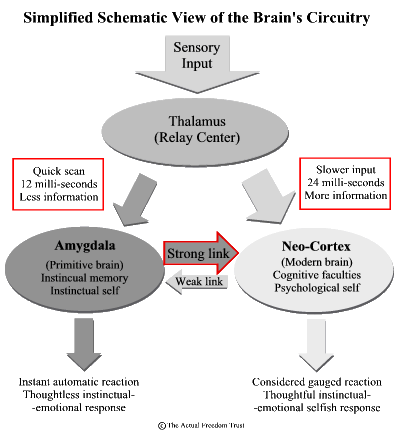
Diagram based on the research work of Professor LeDoux (http://www.cns.nyu.edu/home/ledoux/),
referred to in Peter’s and Vineeto’s posts.

28.7.1999
Hi Everybody,
I am happy to say that our mailing list is back working again, so all the
stacked up writings from everyone can go on line...
I went cruising on the internet and found in one of the spiritual periodicals
such an amusing counselling session on chat-line that I thought it would be worth translating the non-sense into
straight English. The non-sense of the conversation becomes much more obvious when one removes the New-Dark-Age cover of
decorative language. These sessions are actually offered for money and will therefore be considered even more valuable
than if they were distributed free for just compassion’s sake.
*
Here you go – have fun ... ... I recognized a lot of my own way of talking, way back then.
|
NDA Language
|
Straight Talk
|
|
A: If you have something specific you would like to share or ask, (Q), we can begin there. Otherwise, I can
start with a question, myself. Which would you prefer?
|
Good day, what shall we talk about?
|
|
Q: I would prefer you to lead...
|
You start
|
|
A: Fine. I usually start by simply asking: what is it that you are seeking or looking for?...What is it that
you feel may be missing from your life?
|
How are you?
|
|
Q: There isn’t any ongoing quest now. There are momentary dissatisfactions, but
they, too, pass.
|
Don’t know, really
|
|
A:: Good... Then, the question simply is: why are you here, in this chat space, with me now?
|
Then for goodness sake, what are you doing here wasting my time.
|
|
Q: I wanted to interact with you. I didn’t really have an agenda. I apologize if I
didn’t make that clear in my request.
|
Sorry, I just wanted to talk to somebody
|
|
A: No, that’s fine, (Q)! You did make it clear. I’m just following through to
confirm. A lot can happen between the initial request for a chat session, and the time that we actually meet online.
Is there any particular point of focus or attention that is of special interest to you, or that
you’d care to explore? I’m very willing to ‘interact’ and explore with you ... Perhaps it would be good for you
to set a course for us, since I do not have a specific agenda, either?!
|
OK, OK.
And what you want to talk about? I don’t care what we talk about.
|
|
Q: You just clarified something for me: it should be obvious that ‘something,’ a
question or want [desire] could come up during any moment.
|
Just got it. I’ve got to make something up.
|
|
A: Yes, it could. Sometimes it does; sometimes it doesn’t... And, in those moments when it seems that
‘nothing’ is coming up, there is just Witnessing... Witnessing and contentment – a larger sense of Satisfaction...
|
Why not? Could be a pleasant thing to do. Make it a bit spiritual.
|
|
Q: I did want to mention that the your web magazine has served as a ‘reminder’
(as many things can be) of the present...
|
You are great.
|
|
A: I’m glad if it has served that function for you. That’s my goal and intention... It seems to me that
the most we can ever really do is provide these reminders for one another, from time to time...
|
Ain’t I.
|
|
Q: My most recent ‘quest’ involved seeking such reminders...as though they could
not exist in my ordinary experience.
|
I am so bored, anything would do.
|
|
A: (smiling): Yes, as though your ordinary experience was not *the* most significant reminder of all!
|
I have great wisdom. You too.
|
|
Q: I can see that now, sometimes... Your work has helped me.
|
Can’t you help me?
|
|
A: ‘Helped’ you in what way?
|
Help you?
|
|
Q: ‘Reminded’ me; not ‘helped’ in the sense of adding new knowledge.
|
You are different than others. It’s nice because it doesn’t make any sense.
|
|
A: Good! As I see it, this reminding is the most valuable and satisfying thing we could ever do. Nothing else
seems to me to be as important. (And, I might add, you are quite right: this certainly is *not* about the acquisition of
‘new’ knowledge.)
|
I don’t know anything but that is the idea.
|
|
Q: In my experience, if a teacher consents to ‘publish’ a general method for
everyone’s use, it only serves to provide an excuse for me to keep channelling my energy into becoming something
else...
|
When somebody tells me what to do, I will do anything not to be me, here.
|
|
A: Yes, exactly! In this context, how do you see and experience this work? Is it any different?
|
And what do I have to do with it?
|
|
Q: You seem to refuse to provide a general method...
|
You don’t know what you are talking about.
|
|
A: Yes, indeed! You got it!
|
Yep.
|
|
Q: (You are...)...always/only pointing to the here and now.
|
You mean, I am now what I should be? It’s ok to be second-rate?
|
|
A: Yes. I’m so pleased you See this! Our immediate experience of Reality really *is* sufficient. THIS,
exactly as it is showing up within this moment, is all the ‘teaching’ we could ever want or need.
|
It won’t get any better than this.
|
|
Q: One thing that has changed for me after encountering your work: there are more
times when I experience the effortlessness of awareness.
|
You help me to resign.
|
|
A: I am so glad. Thank you for sharing this gift. It is precious, indeed, and I want to acknowledge this
shared Recognition...
|
What an heroic thing to do.
|
|
Q: I don’t blame other teachers for encouraging effort indirectly...
|
All other gurus are making me work, but they are just stupid.
|
|
A: Neither do I...
|
I am the best.
|
|
Q: It was always my own seeking that demanded some path.
|
I used to want to improve my life, but now I give up.
|
|
A: Fascinating insight, ‘Q’! You see how accommodating the world can be? It often gives us *exactly* what
we want and are looking for. Not always, but often...
|
You always get what you want. Well, not always...
|
|
Q: It’s so much easier than I ever believed.
|
That new belief is easier.
|
|
A: Yes! The delightful simplicity of This is far more amazing and marvellous than I
had ever imagined... One of my favourite reminders is from a Tibetan Buddhist teacher who points out that there are 4
reasons we do not Recognize and directly experience this ‘One Taste’ as it is showing up in the present moment:
- The first is that it is so close, so immediate.
- The second, that it is so profound.
- The third, that it is so (delightfully) simple.
- Fourth, that it is so excellent...
‘The Four Faults,’ pp.117-118, The Dharma, Kalu Rinpoche, State
University of New York Press 1986
|
This is how it is because this is how it has always been and this is how it will always be.
This is Ancient Wisdom...
Great Wisdom, indeed.
|
|
Q: Yes. Thank you for passing along this reminder.
|
Yeah, I keep forgetting.
|
|
A: I am curious now: can you point to any events and/or experiences in your life that have helped to stimulate
and deepen your own Recognition?
|
Tell me a story!
|
|
Q: I can recall moments of a feeling of union...and deep reverence for beauty...
Reading the poetry of Persian mystic, Rumi, has often been an occasion for That.
|
I have deep feelings, like beauty, like the great Rumi had.
|
|
A: Yes, his work is also a gift. In some of my earliest recollections, as a child, I (like you) associated
This with experiences of beauty... and with hearing music...
|
I like music since a long time, I am like you.
|
|
Q: Yes. Music, beautiful friends and places.
|
Yeah, good time.
|
|
A: Yes... and, then there eventually comes a place and time in our lives when there is *nothing* that is not a
reminder of This...
|
You can think of it all the time. Makes you happy.
|
|
Q: Thank you.
|
Thanks
|
|
A: Thank you, ‘Q’. I feel honoured to have shared this time with you, and I have enjoyed the gentle
spaciousness of your presence. (We do not need to close yet; please feel free to remain here a while longer...)
|
Time’s up. You can take your time to finish.
|
|
Q: That is one thing that attracted me to an interaction with you...the openness.
|
I don’t want to stop yet.
|
|
A: (smiling): Didn’t you mention this in your initial correspondence with me?
|
You are repeating yourself.
|
|
Q: Yes. It was the strongest impression, more so even than clarity...(not to say that
clarity was absent, or that the two aren’t intertwined.)
|
You are really great.
|
|
A: (smiling): Yes... I am so intrigued that you’ve felt and sensed this openness because it is, for me, one
of the hallmarks of this Recognition. How does this ‘openness’ show up for you in and through what you have
‘seen’ of me so far?
|
Ain’t I, tell me more.
|
|
Q: I’m not sure. It’s an intuitive thing, drawn overall from all the personal
writings, and your selection of wisdom sayings – from the whole picture of what I’m able to know from a website and
writings. I get a feeling that nothing is rejected from your experience...
|
Can’t. It’s a deep feeling. But you have great wisdom.
|
|
A: Absolutely. In the end, how can anything be rejected? Whatever is here and now
*must* be part of, and included within, whatever is ultimately Real – no matter how much the personality may rail
against and reject it. In the end, Reality, God or Truth, whatever you call it, must be large enough to include All That
Is...
In this, I love the words of Byron Katie. She says she is simply a ‘lover of Reality, ... a
lover of what is.’
|
Yep. Everything is wonderful and, in the end, God is almighty and Bob is your uncle.
Byron Katie says so too.
|
|
Q: Beautiful... 2 lines from Rumi:
‘The clear bead at the centre changes everything.
There are no edges to my loving now.’
|
I like love, infinite love, just like Rumi did.
|
|
A: (smiling, again): Ah, yes. The edges *are* all gone! Thank you, ‘Q’, for sharing this exquisite
expression of Insight...
|
We are both in cuckoo-land, good not to be alone... Bye.
|

1.3.2000
Hi Everybody,
Some interesting article I found in the news today. This
‘laughing-disease’ may be infectious and could very well be caught over the internet by reading, particularly by
applying and experimenting with iconoclastic and heretical new non-spiritual methods... I wonder what scientists would
find in my brain...
Tumour-Like Mass Can Make You Want To Laugh
ST. PAUL, MN
A small tumour-like mass known as a hypothalamic
hamartoma can cause patients to feel the desire to laugh, according to a case report in the February 22 issue of
Neurology, the scientific journal of the American Academy of Neurology. The urge to laugh is not always followed by
laughter.
The report tells of three patients with small non-cancerous hamartomas
located on the brain’s hypothalamus, causing mild epileptic seizures and the unusual pressure-to-laugh feeling. The
patients had recurring giggling bouts at a young age that remained into adulthood. Medication was able to stop the
seizures, but did not stop the urge to laugh. The suppressed laughing bouts could occur up to 10 or 15 times a day for
patients, causing some embarrassing situations. One woman described the feeling ‘like a tickling inside my head.’
Due to a rise in her voice occurring with the urge to laugh, she gave up singing. Another man gauged the surrounding
social situation to judge whether laughter was appropriate or not. He would bite his lip to suppress his laughter or let
the urge develop into laughter similar to his normal laugh. His normal laughter caused tearing and reddening of the face
whereas the pressure-to-laugh occurrences did not.
‘Many patients find the feeling pleasant,’ said neurologist and case
report author Samuel Berkovic, MD, from the Austin and Repatriation Medical Center in Victoria, Australia.
‘However, they are aware that sometimes a seizure may follow and this is
frightening. It results in patients torn between the enjoyment of the symptom and the fear of what could happen after
it.’ Berkovic says it’s important to recognize this often undetected symptom as a clue to the presence of a
hamartoma and seek treatment from a neurologist.
‘How laughter occurs is not completely understood,’ said Berkovic.
‘Laughter involves a complex relationship between the thought processes and emotional aspects of the brain as well as
the physical control of the muscles in the chest and voice box. We know the hypothalamus, a tiny structure deep in the
brain that is involved in things like thirst, temperature control and appetite along with emotions, is very important to
the generation of laughter.’ These three patients had normal brain development and intelligence, unlike other cases
involving hypothalamic hamartomas and laughing seizures, where problems with mental ability, multiple seizures and
behavioural problems developed.
‘The difference in the symptoms of these three patients and more severe
hamartoma cases is the smaller size of the hamartomas,’ said Berkovic. ‘Our patients are on the mild end of the
spectrum.’ Copyright © 2000 Science Daily

5.5.2000
Hi Everybody,
There has been such good writing lately in both Peter’s and Richard’s
latest correspondence with paragraph upon paragraph of accurate descriptions of what actualism and Actual Freedom are
all about. As the self-appointed librarian I wish there were adequate ‘exhibition rooms’ in order to not have those
words disappear in the vastness of the website.
Yesterday I found in Richard’s latest correspondence a description of the
self in action that I found so excellent and brilliant in its accuracy and preciseness that, in view of our latest
discussions about emotions on the list, I will post it here.
Respondent: There is, for me, something very similar
in both positive and negative feelings. What am I trying to say? I think there is a central figure that in one case
(positive feelings – like being in love) is grasping and in the other (negative feelings – being angry, repulsed) is
pushing away. There is a centre to all this feeling that tries to maintain itself by what – by nurturing itself by
grasping for things, or defending itself by pushing things away? Is this the primitive self structure you are talking
about?
Richard: Yes.
Richard, General Correspondence, No 9
‘Pushing away’ and ‘grasping’ – these are indeed the two opposite
actions that I observe as ‘me’, the ‘self’ in action, depending on the emotion that is arising at the time. And
in this very description of the ‘primitive self structure’ there also lies the solution for catching the bugger and
moving closer towards self-immolation. To stop pushing away bad, fearful, angry and sorrowful feelings and to stop
grasping the good, loving and blissful feelings leaves ‘me’ with nothing to hang my hat on – an absolute
fascinating experience when put into practice. There is a quality of suspense when I not let feelings take me on a ride,
be they ‘good’ or ‘bad’, a thrill of doing the unfamiliar, an aliveness that is experienced just before popping
through into the actual world in a PCE.
The other fascinating observation was that refusing to go along with any
emotion in one direction – ie fear – the temptation then appears to draw me into the opposite direction – ie
feeling on cloud nine. Considering that instinctual passions and chemical reactions in the brain go hand in hand the
pairing of emotions makes sense because to counteract a strong fear the amygdala will pump a strong dose of chemicals
producing ecstatic feeling in order to overcome the fear to ensure one’s survival. In order to permanently get rid of
the bad feelings, at the same time I will have to examine and get rid of the accompanying good feeling as well.
Peter said it well in his recent letter to mailing list B:
2. What made you realize that the PCE was of this
world and not from ‘above’?
The major reason was that I had experienced both a PCE
and a Satori, and both of equal length. The only similarity between them is that they are both experienced as
‘other’ worldly – i.e. outside of one’s ‘normal’ experiencing of normally grim reality.
The Satori experience is of another world where ‘I’ feel love, oneness,
wholeness, spaceless and timeless. The experience is ‘of the heart’, a feeling-only experience where normal ‘I’
is replaced with a new grander version who is at-one-with the universe. This experience is termed an altered state of
consciousness whereby ‘my’ consciousness or perception is altered from fearful mortal to fearless immortal. All of
this merely goes on in the head but is felt in the heart due to the increased chemical flows triggered by the primitive
brain. Many altered states of consciousness experiences happen during a dark night of the soul when thoughts of
hopelessness, depression, futility and even suicide are running. The very desperate near death thoughts can induce a
near death experience that triggers a chemical flow to the body and brain that produces euphoric feelings. These
feelings are usually accompanied by imaginary visions of a religious nature, dependant solely upon the person’s
culture or current inclination. Thus it is that Christians can ‘hear’, ‘see’ or ‘feel’ the Lord or the white
light leading to Heaven while Eastern religious followers feel Oneness, Wholeness, Godliness, God intoxicated or
whatever. The tell-tale clue of an altered state of consciousness experience is that the ‘new perception’ is always
cultural or religious specific and it is always accompanied by powerful emotions triggered by chemical flows from the
instinctual primitive brain.
A pure consciousness experience, on the other hand, has neither an imaginary
(cerebral) nor an affective (emotional) component. <snip>
3. Is the PCE neurological, biological,
psychological ... or what would you say?
Given that a PCE, or peak experience as it sometimes
referred to, can often be induced by drugs or traumatic experiences that alter the brain’s chemical balance it would
indicate that the onset of a PCE is neuro-biological phenomena. This is confirmed by the fact that modern
neuro-biological research by Joseph LeDoux and others are beginning to trace emotions such as fear to the automatic
reaction of the primitive brain. The amygdala in particular is being identified as the source that activates a flow of
chemicals in the body as an automatic fight or flight response in the face of danger. This instinctual chemical flow
reaches the neo-cortex or modern cognitive brain a split second later and is interpreted by the alien entity as
psychological and/or psychic fear. In the PCE, it would seem that this pathway from the ancient instinctual brain to the
modern cognitive brain no longer functions, i.e. it is temporarily blocked. The modern brain, thus freed from its
instinctual ‘self’-centred passion-producing companion, the primitive brain (amygdala), is able to operate freely
with a pure consciousness.
The physical senses – the stalks of the brain – are similarly freed of
the ever-fearful guard duty that is imposed on the modern brain by the instinctual primitive brain. This freedom from
chemical assault results in a startling sensate-only experience of the actual world that is best described as sensuous
delight. It is as though colours are far more vibrant, sounds far louder, tastes more flavoursome, touch more sensual,
smells more fragrant and everything is experienced as vibrant and not merely passive.
In the PCE, the experience of ‘self’-lessness, the lack of any
instinctual passion, the clarity of thought and reflection and the heightened physical senses all accord with the
neo-cortex being freed from the insidious influence of the animal instinctual reptilian brain. How this happens
physically in a PCE is, to my knowledge, yet to be mapped by empirical science but there is clear evidence that a
permanent disconnection has been deliberately induced by at least one person and is being deliberately induced by a
handful of others.
This is, of course, a clinical scientific description only and the process
cannot be separated from its psychological and psychic ramifications and, as such, the term ‘self’-immolation is a
more evocatively accurate term to describe this process. Peter, List
B, No 10
Contemplating further I realized that to stop pushing away and stop grasping
might at first look similar to the Buddhist practice of ‘neti-neti’, ‘neither this nor that’. The approach of
Buddhists and all other meditators is to remove the self from the source of trouble which at the same time removes one
from the experience of the sensuousness of being alive. Spiritualism moves away from sensate and affective feelings in
order to not be here while an actualist questions and eliminates affective feelings because they prevent me from being
here, being the senses-only experiencing the delight of being alive in this actual perfect abundant magical world.
But Buddhists are exercising a technique to remove themselves, to
dis-identify and finally to dissociate from either this or that feeling, implying that there is a true self, which they
want to keep, that can remove itself from this or that feeling or thought. In actualism the emotion is experienced by
neither repressing nor expressing, neither pushing nor grasping and thus one is able to examine it in reflective
contemplation so as to explore the very nature of this emotion. One does not remove the self from the emotion but
whittles away at the self which is the very program producing the emotion in the first place. This process, if
undertaken diligently and persistently, will inevitably lead to self-immolation.
Actual Freedom lies 180 degrees in the opposite direction to all religious
practice and belief.
Actualism Homepage
Freedom from the
Human Condition – Happy and Harmless
Vineeto’s Text © The Actual Freedom
Trust
|