|
Selected Correspondence Peter Self-Awareness
RESPONDENT: I want to comment on the following subject that I think is of big value due to my personal experience. When I was 30 years about, I began so have attacks of tachycardia. Palpitations in a big rate. That was due to the fact that my diaphragm, was by nature a little bit higher in position and that, when the stomach was not empty was pressing the heart and it was beginning to have palpitations, not always but in certain positions, when I was bended for example. That fact gave me one insecurity and due to the fact that 33 years ago Corfu was not so well organised with ambulances etc made the situation even worse. So I began to be afraid to be alone, and not only to go out alone. This was not a classic agoraphobia case, because agoraphobia is a Greek word, which means phobos of agora. Phobos=fear and agora=the market place which used to be an open place. So fear of open places. Because I was afraid in general if somebody was not with me, they call it agoraphobia because they did not found any better word. Last summer though, it came one insight to me. I said to my self, since my heart is fine and nothing physical is wrong with it, then must everything be due to the mind. I realised that due to the fact that this palpitations condition did not happened in the last 20 years, was just a conditioned reflex, one habit formed. So I became aware that actually I was afraid of the fear. Fear of the fear. By being afraid that I might become afraid that was agoraphobia itself. I saw that being afraid that agoraphobia might take place, already this was agoraphobia, itself. I said to my self, I must stay with the fear. Am I different from the fear that I try to control? So I took the car and I went for a round. As it was expected, due to the momentum, the fear began, but I did not try to phone for help or otherwise to interfere with it. It subside, completely, was like a miracle taking place. Not only that, but the sense of fear was begging to give its place to a joy. I stopped the pill, and after two, three more times the fear was just a memory. I tried to make him come but more I was trying to make him come more impossible that was. Since then I am free. My first reaction after that was that I become angry, because I did not think for that solution much earlier and not to loose so many years. This is the story, and I think can be applied to any kind of phobia. Now the thing that I cannot understand, is what had that to do with Vineeto’s answer. On the contrary what I am reporting now, must make her think better what I was trying in other emails to explain her about staying with the fact. And doing nothing about it, other wise somebody cannot see the fact is not in contact with the fact if avoids it. This way helped me also with other fearful thoughts that happen to everybody of us I guess. I don’t move, I stay with it and it fades. PETER: I am pleased to hear that you have eliminated the fear of going out alone – to be free of a fear that had plagued you for so long must be palpably liberating. What twigged me to write was that I appreciated that you explained the course of action involved in getting yourself free of this particular feeling of fear. You were very clear that the feeling you were feeling was fear and had no trouble in labelling it as such, even to the extent of understanding that it was not a ‘classic agoraphobia’. You obviously experienced the physical symptoms of the fear when it kicked in and you had the insight that what you were afraid of was the feeling of fear itself and that this ‘fear of fear’ was making your life miserable and causing you to be unhappy and that it was high time you did something practical about trying to eliminate it. This insight then led you to take action, get into the car alone and to experience exactly what this feeling of fear was made of. What you evidently discovered was that the feeling was only a feeling and that, in fact, nothing terrible happened to you. You then checked it out practically several more times and found yet again that nothing terrible happened to you – thereby confirming that what you had been afraid of for all those years was nothing more than a feeling. The very act of daring to do something practical to test out whether your fear was a fact, or whether it was a just a feeling, led to you becoming palpably and tangibly free of this particular fear. I can relate to your experience because I have used this process of being aware of a feeling, being attentive of its debilitating effects in that it prevents me from enjoying this moment, or equally importantly, that ‘me’ having this feeling is impinging on someone else’s potential enjoyment of this moment, and then – most importantly – wanting to be free of it. Because of my intent to become as happy and as harmless as possible, the necessary and appropriate action I needed to take to become be free of the particular debilitating feeling gradually became obvious to me and sincerity then compelled me to take that action. This is not passive awareness nor is it right thinking – this is taking intent-ful action for the benefit not only of this body but also for other bodies. By your own report, taking appropriate action does work – and, in my experience, making the effort to develop an on-going active attentiveness one can become incrementally free not only of fear, but of aggression as well and one can also become incrementally free of the more grievous aspects of nurture and desire in exactly the same manner – which then leaves one more free to be able crank up the felicitous feelings such as delight, friendliness, consideration, wonder, amazement, joie de vivre and so on. It’s no wonder you felt joy at being free of this feeling of fear – any freedom gained by one’s
own actions is a wonderful freedom, and more especially so because you come to experientially realize that your own freedom is in your hands and
your hands alone.
RESPONDENT: By asking, ‘how am I experiencing this moment of being alive?’... I have ‘gone into’ the feelings of sorrow without blocking, or distracting, myself from their horror. I have felt over-whelming pangs of sorrow, too. Spontaneously, on one occasion, eleven years ago, I saw that there was no purpose to it all. I have experientially grasped the emotion of both sickness and death to find that it was a toothless tiger. I have realised that life itself must end someday ... along with all the hope, love and nurturing, (as well as fear and anger) ... but the grip of sorrow is almost gone from my life now. <Snip> I did not seek it out to ‘go into’ sorrow to wallow in it ... but when it came to me I refused to hide any longer and I faced it down until it lost its grip and ‘it’ eventually weakened and before long it withered and died. The rewards are incentive enough to continue, (not to wallow in, run from or fight sorrow), but to embrace and examine, ‘that which came my way’ and to live an automatically peaceful/ joyful/ sensible life one delightful moment at a time. No 13 to Gary 8.12.2001PETER: What interests me particularly is your description that when sorrow came to you that you ‘faced it down until it lost its grip and ‘it’ eventually weakened and before long it withered and died.’ Your description is markedly at odds with my own experience of investigating and becoming progressively free both of my social imprinting as well as the feelings, emotions and passions that give substance and validity to ‘me’. In the process of actualism I was often aware of and involved in investigating a number of intertwined issues and therefore it was often difficult to separate out one particular emotion, track the course of its demise as well as be aware of how the process in fact worked. I was often too busy separating out and making sense of my social programming – looking at my moral stance and ethical values that stood in the way of me clearly seeing and experiencing the emotion in its raw and basic state to have an overview. Because I was busy doing it as it were, I was much more fascinated that the process worked rather than in how it worked. Often I would be startled to discover that what had been a major worry or a pervasive and debilitating emotion had disappeared out of my daily life and all I had done was investigate it, root around in it, make sense of it, understand how it operated, look at it from all angles in order to get to the bottom of it. I did, however, eventually come to realize that the very process of focussing my full attention on the feeling or emotion, investigating it as it was happening in all its aspects and then thinking about it afterwards in order to make sense of the experience was exactly what weakened its grip. As Richard describes it – if I remember rightly – you shine the bright light of awareness on the issue, problem, debilitating feeling or consuming emotion and it will eventually wither in the light of awareness. The work you have to do, and it is indeed work, is to be willing to bring it out of the cupboard and be stubborn enough to stick with it until it is resolved. Speaking personally, I would not describe this process as ‘facing it down’ – it being the particular feeling or emotion – because that to me implies keeping the lid on it or forcing it further down or away from one’s awareness. It may be your choice of words but your description fits with what I did in my spiritual years. I, exactly like everybody else, was taught to separate my feelings out into two piles – the good ones that earned ‘me’ kudos and brownie points and the bad ones that got ‘me’ into trouble and that ‘I’ then felt ashamed of. Thus ‘I’ was forever on the lookout, forever on guard, just in case my dark side showed through. And invariably, every now and again, it would despite my best efforts and good intentions and these bleed-throughs were what finally twigged me to begin to really investigate my dark side as well as its opposite number, my ‘good’ side. There’s another experience I had that might shed some more light on the issue of attentiveness and awareness. It relates to an event that happened about 5 years before I met Richard and became immersed in actualism. At this time I was following the spiritual principle of ‘self’-ishly sorting my feelings into good and bad, right and wrong, desirable and undesirable rather than going any deeper into investigating how ‘I’ ticked. I had a consuming experience of grief after my son died that served to put my spiritual smugness on the sidelines for a while. I wrote about it in my journal and I’ll just include a snippet for reference –
In hindsight, and it is only hindsight for at the time I was following no method at all, I simply became aware one day that the grief had gone – that the feeling had left me. All I had done was allow it to run its course without judgement, without indulgence, without suppressing it or repressing it. What I did was a lot of experiencing of, and thinking about, grief and one of the most striking aspects I clearly remember was how much this emotion was a part of my identity. When the emotion finally left me I was no longer a grieving father with all that being that identity involved. It was literally as if a part of ‘me’ had disappeared along with the associated reoccurring emotional memory. This is why I can’t relate to the description of facing the emotion nor embracing the emotion, which is another description you used. It wasn’t as though a stronger ‘I’ faced the emotion down or a loving or wise ‘me’ embraced the emotion but more like the grief went away by itself and took a bit of ‘me’ with it. In hindsight I would describe my experience with grief more as sitting with it, or walking with it in my case, feeling the feeling, thinking about it in all its aspects and checking out ‘my’ investment in hanging on to it, suppressing it, rejecting it or whatever. It was as though I had a good look inside the feeling and I do mean a good look. I sometimes plumbed the depths into despair and dread, I went up all the side alleys looking at all the related feelings such as guilt, self-pity, resentment, altruism, and the like. It took about four years in total until, as if by magic, one day I found I could no longer even dredge up the feeling of grief and until Peter, the grieving father – that particular aspect of my emotional identity – finally disappeared along with the feeling. It is clear to me now that the most vital aspect of finally ridding myself of grief was my becoming aware of what I described in my journal as my ‘personal investment in continuing my grief’. What I experienced was that the feeling formed an integral part of ‘my’ identity, so much so that there was most often no distinction between the two. When I was in the throes of grief, ‘I’ was grief and grief was ‘me’, so consuming was the feeling. Eventually it became apparent that if the feeling of grief was to go, then that part of ‘me’ would have to go – and I willingly acquiesced to that happening. Just to make this perfectly clear – at this point, only at the end of a long and exhaustive period of experiencing and investigation, ‘I’ willingly agreed to this part of ‘me’ disappearing. ‘I’ did not actively do anything to finally bring an end to this part of ‘me’ – ‘I’ simply agreed to its demise. This particular event sticks out in my mind as typifying the actualism method even though it predated my becoming an actualist by some years. It stands out particularly only because it was a one-off solitary event and not part of the kaleidoscope of investigations that typified my early years of actualism. However, all of my actualism investigations have followed the very same pattern and all of them invariably end up with the same result ... provided I have been persistent enough, and thorough enough, in my investigations. It is important to discern and make clear the differences between the traditional spiritual practices
of selective awareness, which is designed to be shallow and superficial, and the down-to-earth, all-inclusive, attentiveness that is the actualism
method. Only by understanding the full extent of the difference between the two is it possible to go beyond the moral and ethical restrictions of
spiritual belief and indoctrination and be able to dive deeper into the instinctual passions that are the root cause of malice and sorrow.
RESPONDENT: I am not a committed actualist in the sense that I am not asking the question ‘How am I experiencing this moment of being alive’, 100% of my waking time. Yes PCE is what I am interested in. I don’t have any such experience but recently I have come very close to having ones. PETER: I find it difficult to understand how you feel that you have come very close to something you have never experienced or never remembered having experienced. RESPONDENT: It is based on the description of others. In other words, I see closeness in what I experience and the description given by others. PETER: And only you can be your own judge of that, which is as it should be. RESPONDENT: To elaborate further, for example, at certain times it makes more sense to me what other might be meaning by 360-degree awareness. PETER: For me this 360-degrees awareness that results from actualism has two salient aspects. The first is that in the process of actualism a heightened 360-degree sensate awareness increasingly emerges as a sensual enjoyment of this physical paradisiacal planet and this happens serendipitously as malice, sorrow and resentment disappears from one’s life. As this happens one only needs to be wary of being seduced by feelings of beauty, awe, gratitude and narcissism that give rise to delusions of Grandeur. The second aspect is of equal importance and that is a 360-degree awareness that becomes inclusive of and considerate of one’s fellow human beings as opposed to the normal ‘self’-centred awareness that is instinctually exclusive and is the basis of feelings of greed, suspicion, fear, blame and animosity. As this happens one only needs to be wary of being seduced by feelings of love, compassion, saviourhood, and narcissism that give rise to the fantasy of Oneness. However none of what I describe comes without effort. It takes compulsive effort and obsessive
enthusiasm to eliminate all of the social and instinctual programming that conspires to prevent a bare 360-degrees awareness from being possible.
It’s a tough business to abandon all one holds dear and start to stand on one’s own two feet.
RESPONDENT: You are right, I have not read too much about things
related to actual freedom. I read quite a bit of Richard’s web site when I got on this list in December but then I stopped reading it. I enjoyed
PETER: Ah, I see you have found at least something that is of interest. In fact, Richard has the best descriptions of attentiveness and awareness I have ever seen. The spiritual ‘Masters’ were always so secretive and so vague in describing their experiences and deliberately so. It is very apparent that the only danger in applying Richard’s method is that one could become
Enlightened. It is such an instinctually driven act of narcissism that it takes an awareness that far exceeds the normal spiritual
‘half-baked’ efforts to avoid the entrapment. I wrote my journal largely as an expose of the fakery and fraudulence of the Master-disciple
business and the blatant abuse of psychic and psychological power by the supposed God-men. The facts of following Masters as opposed to the dearly
held beliefs. Richard’s Journal is an insider’s view as he was Enlightened for 11 years before finally freeing himself of the delusionary
state. * RESPONDENT: At one point, you wrote:
As far as I am concerned, that is the only path. I learned it from Osho via dynamic, you learned it from Richard. We can call it spiritual or non-spiritual, actualists’s or non-actualists’s. Only thing I learned from Osho is: I have to look into myself and I am on my own. Now what came out of writing to you. I saw violence in me, raw violence of the kind I have never seen before. I also observed my tendency to be cruel (malice ????). I noticed need-for-love is still working in me. I also saw lots of other things. PETER: It would seem that ‘what came out of writing to me’ is that you have been diving a bit deeper than you have before even with dynamic meditation. It is my experience that many people become quite upset to the point of feeling violent when presented with facts. It is the facts that cause the offence, not who writes of them or how they are presented, for to acknowledge a fact rather than uphold a belief is anathema to one’s very ‘self’. After all, people are willing to kill others or sacrifice themselves for their dearly-held beliefs, such are the deep-seated passions that are unleashed. This is the very reason for all the religious wars, persecutions and bloodshed. To become aware of these raw passions is to do a bit of deep sea diving into one’s own psyche – to be aware of the Human Condition in action, the beliefs, feelings and instinctual passions. This awareness involves neither repressing, nor expressing as in dynamic meditation. To merely indulge in a bit of artificial emoting such as therapy groups, active meditations, etc. is not to be aware of the role that the feelings of malice and sorrow play in ordinary life. As for ‘we can call it spiritual or non-spiritual’ – just because you choose to call different things the same doesn’t make them the same. They may appear to you to be the same, or you may want them to be the same, but they clearly are not. ‘Non’ means ‘a negation, a prohibition’ – as per Oxford dictionary. It is astounding to think that there is now the possibility of eliminating malice and sorrow to the point that one is incapable of being offended – of having no-thing to defend – no beliefs, no ideals, no principles, no rights to fight for, no ‘me’ who could take offence. And of a happiness that is not dependant on others or on being in an Altered State of Consciousness – a genuine happiness in the world as-it-is with people as-they-are. It is so very good to start exploring feelings and emotions – both the ‘good’ and the ‘bad’ – for the secret to being actually free of malice and sorrow lies in this very exploration – and to investigate the spiritual world is to investigate the ‘good’ in the arbitrary package of ‘good’ and ‘bad’. The trick is to understand that your feelings and emotions are part and parcel of the Human Condition and thus not a personal fault, failure, stigma or evil, but something everybody is programmed with by blind nature and society’s imprint. This is an investigation few are prepared to make for many see that if they dare to question the spiritual they will simply end up back in the ‘real’ world that they are trying to avoid or escape from. Some see that to question the spiritual beliefs is to go towards the devil or evil while others see it as ending up in a sort of robotic state of non-feeling. What belies these fears is the PCE where the purity, perfection and benevolence of the actual world becomes magically apparent as having been here all the time... if only ‘I’ wasn’t in the way. Actual Freedom offers a tried and tested method to eliminate the ‘I’ – both ego and soul – such that what is actual, genuine, unique, pure and perfect can become evidenced and evident. In these early pioneering days, it seems it is for the desperate and daring. Well, I tried to be a
touch less iconoclastic but it never works. It’s impossible for me to pretend that God exists, that there is an after-life or that the God-men
sell anything else but snake oil. Once you know it is all a fairy story, it all disappears like a puff of smoke ...
PETER: The issue of worthy or unworthy seems to me to be a bit of a side issue. The main question is what do you want to do with your life? RESPONDENT: I think what I want to do with my life is only apparent from one moment to the next and that seems to be constantly changing but it seems to do with being curious, seriously curious about the workings of self. I had actually decided to end this ego self 10 years or so ago but because it was self trying to end self without a ‘relentless inquiring attention’ there was bound to be failure. Now with the aid of ‘How am I question...’ more of the moments are caught rather than the usual see one moment then skip a few moments and get lost in self intellectualization again. Curiosity I think, needs to be given complete leeway. PETER: I was trained as an architect but on graduating found working in an office to be too removed from the building site where the business of building buildings actually happened. Consequently I became an architect-builder-carpenter as my interest was more in the practical implementing of a idea. When I came across Richard I had spent 17 years on the spiritual path attempting to end the ‘ego-self’ but was ready to abandon the effort. I had begun to have some Altered State of Consciousness experiences but the suspicions and doubts I had of the Master-disciple business, the God-men’s lifestyle, how they were with their women, etc., meant that Enlightenment was losing its attraction. I was also becoming more and more aware of the fact that Eastern Spirituality is nothing more than Eastern Religion. I soon came to see that there were two identities preventing me being happy and harmless – the ‘normal Peter’ who was father, man, architect, etc. and the ‘spiritual Peter’ – the believer, searcher, superior one, etc. So I set about dismantling both these ‘I’s by actively challenging the beliefs, feelings, emotions and instincts that gave substance to both the psychological and psychic entity that was ‘me’. What I increasingly discovered was that the brain of this flesh and blood body has an inherent ability to be aware of itself, an ability of apperception. When I ask ‘What am I thinking?’ or ‘What am I feeling?’ or ‘How am I experiencing this moment of being alive?’ it is this apperceptive awareness that can provide the answer. It was enormously difficult and bewildering sometimes at the start but as fact replaced belief, clarity replaced confusion and sincere intent replaced ‘open-ness’ and listlessness, ‘what’ I am – not ‘who’ I am – gradually emerged and became apparent. At first, the whole exercise can feel like a weird ‘self trying to dismantle self’’ exercise, but soon one realises that it is fact dismantling belief, apperceptive awareness dismantling self that is happening. So for me, in hindsight, it was apperceptive awareness – the ability of the brain to be aware of itself – that does the job, dismantles and demolishes both the normal and spiritual, both the psychological and psychic entity. When one has a realization about a belief and ‘sees’ the facts there is an actualisation that can occur which is not of ‘my’ doing. In the face of the blinding and glaringly obvious fact, sensible down-to-earth action can ensue. In the spiritual realm, one merely ‘realises’ and takes on board a new belief such as ‘I am really God after-all!’ or ‘I am Immortal – thank God!’ – and non-sensical action inevitably occurs. Many people who have read a bit of the Actual Freedom writings think that the dismantling of spiritual beliefs is some sort of side issue, or a sort of ‘put down’ as is common in the spiritual world between various teachers and Gurus. This is to miss the essential iconoclastic nature of Actual Freedom. To live in the spiritual world ie. to have spiritual beliefs is to be twice removed from the actual world. The spiritual world is an imaginary world that the spirits dwell in. The psychic entity or soul within the flesh and blood body is a ‘spirit’ ie. non-actual and metaphysical. The self as soul ‘dwells’ in the spiritual world while the self as ego ‘dwells’ in the normal world. To be an actual flesh and blood human being is to be without ego or soul – then one can find a personal peace in the actual world, free of the Human Condition. * PETER: If you want to be happy and harmless then nobody does it but you. RESPONDENT: It seems to me that this inquiry is done by the self without regard for the self almost like jumping off a cliff. It is amazing how after having gathered enough information about the woes of self, the self then in its own pathetic way attempts to dismantle itself. I think though this is the point where attention plays an important role. I am finding this curiosity-lead attention to be most liberating. PETER: We are attempting to develop a consistent ‘story’ and terminology in describing the
path to Actual Freedom not as a philosophy or another ‘ism’, but to attempt to clearly communicate our experiences to each other – to swap
stories and experiences on the basis of a commonly understood language. As such the ‘curiosity-lead attention’ may well be what I was
describing above as the combination of sincere intent and apperceptive awareness. If your curiosity includes an investigation of the myths and
beliefs of Ancient Wisdom – the foundation of the spiritual world – then a sensible, sensate experiencing will become more and more apparent.
One finds oneself engaged in the thrilling business of actively dismantling one’s own psychological and psychic entity – doing what every one
warns you not to do, or says is impossible to do. * RESPONDENT: Just some thoughts – How is it possible for all the bad stuff to go, those bad emotions etc., how can they go for good? PETER: I assume from your posts that you have had a good grounding in the awareness-watching business, which is a reasonable starting point. You also seem interested in the possibility of getting rid of at least some of the emotions i.e. the bad ones. One of the problems usually with the traditional awareness approach is that one can spread oneself a bit thin on the ground and not zero in on a particular issue. It makes good sense to pick one issue out of the bundle of feelings and emotions that assail one every day. Anger is an excellent starting point as it is an easily recognised and strongly felt emotion. The next trick is to pick a situation that causes you to be angry. It could be when driving your car, an excellent time for self-observation. The aim would then be not to get angry with other drivers, pedestrians, traffic jams, slow drivers, red lights, etc. To be aware of when anger arises, with the aim of not letting anger ruin your happiness while driving the car. For me, I particularly remember someone at work who could raise my heckles and ruin my happiness for hours afterwards. I made it my mission for a few weeks not to let him get at me. Not to get angry, not to let anyone get me angry. Not to let the bugger get me down! It wasn’t him personally – it could have been anyone or any situation. And anger itself went. I suggest giving it a go in an actual situation, give it a try. RESPONDENT: What removes them? PETER: You, there is no one else who is as vitally interested in your happiness as you ... and
there is no God to do it. * RESPONDENT: So what do you do with the other feelings that arise? Do you mean you don’t attempt to go into them and find out more? PETER: I find that I can best concentrate on, and contemplate upon only one thing at a time. I
can drive a car while thinking or talking but as far as tasks requiring my full attention and awareness – I do one at a time. So for me at the
start, rather than try to spread myself thin by trying to being aware of hundreds of feelings, reactions, doubts, thoughts, emotions I zeroed in
on one to study in detail. I always found that there was one particular pertinent issue at any one time that was spoiling my happiness. It was
usually the issue that I was avoiding, that bought up most fear, or dominated my thoughts most. This was then the one to ‘tackle’, the one to
dig in to, talk over, focus on, contemplate upon, etc., but it was usually obvious.
RESPONDENT: Indeed there are the occasional pop up thoughts of fear, but that is not my main problem. Mine is one of ‘trying’, the effort of thought rather than the effort to be aware. This though is an intermittent fault only, with the help of the Question. PETER: The effort of thought rather than the effort to be aware has got me stumped a bit... RESPONDENT: What I meant is that I was thinking about whatever presented itself and not giving it complete attention. PETER: Thinking has had a very bad press in the spiritual world – ‘You are not the mind’, ‘leave your mind at the door’, ‘no-mind’, etc. are all phrases that attest to the spiritual belief that thinking is the problem, while not only letting feelings off scot-free but piously giving full reign to the supposed ‘good’ set. This misinterpretation of the human dilemma is based on the ancient ignorance of the genetically implanted instinctual passions and their subsequent effect on human behaviour. The revered ancients firmly believed that violence, masochism, torture, rape, etc. were the result of being possessed by evil spirits, and you can fully understand this if you have ever felt rage well up from somewhere deep inside you. ‘Something overcame me’, ‘It wasn’t me’ are common expressions used for this experience. For the less spectacular feelings such as sadness, melancholy, irritation and annoyance the ancients pegged thought as the problem – hence the Buddhists’ emphasis on ‘right thought’ and the meditative practices aimed at stopping thought. Given that it is 1999, our knowledge and understanding, not to mention our physical circumstances, have so dramatically altered that we now can clearly see that these archaic beliefs about the workings of human biology, neurology, genetics and behaviour have no basis in facts. We now know why the spiritual ‘solutions’ didn’t work and why they can never work. The belief in God is an obvious fairy-tale but the belief in Good feelings will be a tough one for many to shake. It appears that good feelings – love, compassion, etc. and the accompanying morality of good and bad, and the ethics of right and wrong, are all that stop humanity from running amok. Indeed, they do a reasonable job – despite the fact that this has been the bloodiest century so far in human history, a substantial number of people have been spared the horrendous experiences of total warfare, me included. It is only from this reasonably comfortable and secure position that we are now able to tackle becoming free of the Human Condition in its entirety. So, given the failure of God, the failure of ‘transcendence’ and the failure of morals and ethics, we now have discovered a method to eliminate the problem rather than merely seek solutions to the problem. The problem is that our instinctually based emotions contaminate thought and produce in us feelings of malice and sorrow, and, when ‘push comes to shove’, our moral and ethical safeguards rapidly break down to reveal the appalling dread, horror and violence of war and genocide. Given our autonomous human make-up – flesh and blood body, able to think and reflect – the only resources we have available to ‘clean ourselves up’ is our ability to think and reflect. Contemplative thought is the tool for the job – to make sense of the Human Condition and to become aware of how it is operating in oneself. As one gets the knack, this contemplative thought gradually becomes less contaminated, less churning, less confused and apperception can then occur. Apperception is when the mind becomes aware of itself as distinct from ‘I’ being aware of ‘my’ thoughts. Apperception is a Pure Consciousness Experience – a bare awareness. It is as though one has 360 degree vision or, as Alan said the other day, as though hearing and the other senses are amplified. The brain, freed of the pariah-like ‘self’, is capable of startling clarity in these times, and much can be gleaned from these experiences. The trick is to try and remember these ‘gleanings’ so one can take them back into ‘normal’ life, as it were. It can be difficult at the start as one has no emotional memory of a PCE, but I would often write things down, jot notes, look at how I was in ‘normal’, see what action was appropriate to take, see what the issue was, think it through. It’s enormous fun, although sometimes a bit overwhelming in the beginning and I often felt quite split, as though I was two people. Looking back, these experiences often eventuated from setting aside time for contemplation and I would use Richard’s Journal as a catalyst, a kick start, to get the old brain working after all those years of spiritual drifting and day-dreaming. The brain really ‘likes’ to think, just as the legs like to walk or run. Thinking is its job, its function, and a brain freed of feelings and emotions is an amazing thing to behold. I’ve written more on this subject in the Intelligence chapter in my journal, if you are interested. The other part of our ‘normal’ perception are feelings and the trick here is to aim for the felicitous feelings – care, consideration, patience, well-wishing, etc. while tackling the more pernicious ones that prevents one from being happy and harmless. Again the PCE will give invaluable insight as one checks exactly which feelings operate – and what is actual – when our perception is freed of an emotional ‘self’. When back to ‘normal’ again, you are then able to use whatever feelings are running to your advantage, to achieve your goal – passion became fuel for the fire to become free, stubbornness a refusal to give in, power the ambition to be one of the ‘few’, compassion the possibility to actually do something, rather than just feel sad for those fellow humans who suffer horrendously. So, think away, think away ... as in contemplation ... opposed to meditation. (It’s that 180 degrees bit again). * RESPONDENT: Often when faced with raw emotion I have no idea what to do other than ride the tide. PETER: I was browsing the local bookshop yesterday and came across a book by the author of ‘The Primal Scream’, whose name I have forgotten. I think it was one of the influential books of the ‘express your feelings – don’t repress them’ movement that gathered momentum in the 60’s. That Guru (whose name I won’t mention) adopted this philosophy into his active feeling-expressing meditations and America particularly seems to have taken the philosophy on as a national characteristic. ‘To wear one’s heart on one’s sleeve’, Sharing’, ‘Getting it out’, ‘Childhood Traumas’, ‘Re-birthing’, ‘Past-Life Therapy’, ‘Being Sensitive’ etc. – they all point to expressing one’s feelings as a noble pursuit. Not only the current ones but regularly digging into the re-cycling bin for a re-play of past ‘hurts’ if you’re are a bit weak and lack-lustre in the feeling department. This re-living, re-playing, emphasising, stirring up, inventing, re-inventing, empathising, sympathising, getting sympathy and ‘letting go’ simply keeps the whole lot in existence and sometimes can even give a bit of post-adrenalin ‘feel-good’. At best, it can only result in a re-arranging of the furniture on the Titanic. Recent reports from America are that the therapy boom, largely based on expressing one’s emotions, is dwindling – many have spent decades (and thousands of dollars) for zilch results. No need to say anything about repressing emotions – the failures are well documented and obvious. This third way is to neither repress nor express. From experience I would say that exactly this doing nothing to dispel, avoid, deny, escape from, repress or express creates a tension and ‘self’-awareness that is the very situation that causes ‘something’ to change. And then that change is not of ‘your’ doing – it happens at a level deeper than your normal consciousness. No need for esoterics – it is a change in the brain’s software programming – the brain becoming free of the pernicious effects of the social identity and instinctual self. This was very well illustrated by Alan’s recent post about lust disappearing – in hindsight he noticed the feeling had gone! No ‘doing’ that Alan could point to, no specific event – but gone never the less. Again, a bit of experience from myself and others who are treading this path – besides occasional feelings of confusion, bewilderment, split-personalities, etc. there are often some physical effects such as headaches, bodily tensions and the likes that can occur, but these are ‘par for the course’ for such a radical procedure as re-wiring one’s brain. For me, I just figured that whatever went on, I would wake up the next morning and make breakfast again. Whatever went on in head and heart was okay by me because it meant I was incrementally becoming free of malice and sorrow. * PETER: This is, after all, a practical method to become free of the Human Condition – it is not a philosophy. RESPONDENT: And thank goodness not godness for that. PETER: Well said.
PETER: No need to say anything about repressing emotions – the failures are well documented and obvious. This third way is to neither repress nor express. From experience I would say that exactly this doing nothing to dispel, avoid, deny, escape from, repress or express creates a tension and ‘self’-awareness that is the very situation that causes ‘something’ to change. And then that change is not of ‘your’ doing – it happens at a level deeper than your normal consciousness. No need for esoterics – it is a change in the brain’s software programming – the brain becoming free of the pernicious effects of the social identity and instinctual self. This was very well illustrated by Alan’s recent post about lust disappearing – in hindsight he noticed the feeling had gone! No ‘doing’ that Alan could point to, no specific event – but gone never the less. RESPONDENT: Yes, this has been called by some mind-fullness or being watchful. PETER: I take it that you are referring to those who follow the teachings of Mr. Buddha, or have you in mind another mystical teaching? If so, then they are not referring to what I am referring to. Any similarity is merely superficial as spiritual seekers practice such a shallow form of awareness that they merely skate on the surface, so to speak. The avowed aim of their awareness is to find their ‘real’ self, ‘true’ self, original face, divine soul or whatever other name the deluded watcher assumes. And, of course, the watcher makes the ‘grand discovery’ that it is both divine and immortal! RESPONDENT: The impulse is there but the mind decides to take a new course not responding using the software of an old habitual response. PETER: A mind practicing meditation always seems to take the same course – love, bliss, oneness, timeless, formless, spaceless, oceanic, heart-opening, ... divine, immortal, ... Home ...at last! Imagination, given full reign, leads to delusion. It is well documented in psychiatry but the spiritual form is deemed too sacred to touch – who wants to rock the boat, just in case there is a God. Most of the ‘psychs’ are busy meditating anyway. RESPONDENT: It is the process of looking with interest, introspection. PETER: Yes, for most meditations I’ve done and from others’ descriptions it’s a bit like looking in a shop window and you say, look at that thought – it’s not me, I’m ‘over here’ watching and waiting for the bliss to kick in. RESPONDENT: Since ‘the watcher’ is also a complex self-sustaining thought, sometimes it becomes transparent to this introspection and leaves the drivers’ seat. PETER: The watcher sometimes ‘leaves the drivers seat’ for something much Bigger and Grander – the truly sought-after state when one ‘becomes’ the bliss, when there is no watcher, when the watcher and bliss merge into One ... love, bliss, oneness, timeless, formless, spaceless, oceanic, heart-opening, ... divine, immortal, ... Home ...at last! Imagination, given full reign, leads to delusion. If one follows the directions and methods of the Eastern Teachers, the path is well mapped and leads to Enlightenment. Using Richard’s method one can easily become Enlightenment but one would have to turn a ‘blind eye’ to the horrendous consequences of the Master-Disciple business. If you are willing and able to do that, pursue the spiritual path and become ‘the watcher’, by all means. I always like being conscious of doing what is happening – one is then in the only place one can be
– here; and when your here it can only be now. It’s the very cutting edge ... to be in the Actual World.
PETER: Just a comment on your post to No 12 entitled ‘achieving enlightenment’. RESPONDENT: Some 27 years ago I had that enlightening experience, the light, the tunnel the warmth of the glow and that everlasting sense of peacefulness. We look for the words, but the words only take us away from that which is. You ask, ‘can we bring the experience to earth?’ I believe I have found a way over these last 25 years or so to bring the experience to the playing field of everyday life. What I have found is that the ego is more of an illusion. You must ask what is the background of thought? The average individual thinks approximately 70,000 thoughts a day. Each thought is one complete cycle. Yet each thought cycle is connected to then next. PETER: Unfettered awareness and attentiveness will reveal that one’s thinking is continually affected by one’s animal instinctual passions and this is what creates feelings – a feeling is an emotional-backed thought. When something is said or observed one always has a feeling reaction, which could be a moral or ethical judgement as in good, bad, right or wrong, or it could be an automatic reaction arising from the instinctual passions resulting in feelings of fear, aggression, nurture or desire. Thus one’s thinking is never a complete cycle but rather a continual staccato that appears to be a continual thought neurosis but, if accurately observed, is found to be a continual turbulence of feelings and emotions. Thinking firstly needs to be freed of superstition and impassioned feelings for intelligence to begin to operate, such that thinking can complete its straightforward simple process of awareness, investigation, evaluation, decision and implementation. (...) * RESPONDENT: What really is enlightenment? Occurs when thought sees its relationship to that which is attentive. Thought can never be attentive because thought is a product of the past. We live in the present. We look, we listen, taste and touch in the present. PETER: Your attentiveness must be very selective and solely focused upon what you choose to feel while ignoring or denying what you regard as wrong or undesirable. The new identity that arises from this selective attentiveness is a good-feeling-only identity and must be constantly on guard lest he or she allows any bad thoughts/feelings to intrude to impede or obstruct the good thoughts/ feelings. This is why spiritual people have traditionally retreated from the world of people, things and events in order to live more completely in their own inner feeling world of their own creation. What they have done is put rose coloured glasses on top of their grey coloured glasses and as such are totally oblivious to the sensual delights and pleasures of the actual world. It takes great courage to dare to let one’s guard down completely and take off both sets of illusionary glasses. RESPONDENT: If you stop and think about it you can logically come to the realization that there really is no thinker at all. PETER: Okay. By the same logic, could you come to the realization that the feeler is equally
illusionary? It would require a degree of awareness that was beyond the limits of selective spiritual attentiveness. One would have to broaden and
deepen one’s awareness by unconditionally, and honestly, asking the question ‘How am I experiencing this moment of being alive?’ What is
preventing me from being happy now or why am I not harmless now? Why am I feeling pissed off, angry, bored, sad, blissed out, etc. What incident,
event or words triggered this feeling in me? You would have to become vitally interested in eliminating malice and sorrow from your life and
becoming ‘self’-less rather than selfishly seeking Self-aggrandizement in the ranks of the mythical Chosen Ones. One would have to abandon the
search for immortality for one’s soul and actively pursue ‘self’-immolation.
RESPONDENT: Next I would like to describe a few experiences I’ve had and maybe get some feedback from you.
PETER: It is useful when having any experiences to use your awareness to check inside, as it
were. Is there a ‘me’ or an ‘I’ inside this flesh and blood body? If so, what am ‘I’ feeling and then try to put a name to the
feelings. The only value in having any experience is what you learn from it so that you can use to dismantle what is preventing you from being
happy and harmless in the world as-it-is, with people as-they-are. What I found useful was have a notebook handy so I could jot down what was
happening in order that I didn’t forget or misinterpret later when I was back to normal again.
RESPONDENT: In those three years, for me, thinking was everything I could do. It was as if I was standing in the middle of a landscape, the Land of Thinking. I could only see land as far as my eye could reach. By thinking about thinking, I started to see that the Land of Thinking has clear borders. That land suddenly became a small island in the middle of an endless sea. This happened one week ago. The experience is extremely frightening and at the same time, it fills me with bliss that I have never experienced before. I went beyond the island that I knew, and discovered that I could still see everything very clear, better than clear, much much better than clear. I spend hours and hours looking from this endless unimaginable sea of clarity. PETER: The experience you describe could well have been what is known as a pure consciousness experience (PCE). Everybody has had a PCE sometime in their life where, for a brief period, one magically finds oneself in a ‘self’-less state of sensate-only experiencing and the perfection and purity of the actual world – the fairy-tale like physical universe – becomes stunningly apparent. The PCE offers a glimpse or window out from the ‘real’ world everyone is born into (and therefore assumes to be all there is), and one suddenly finds oneself in the unimaginable, magical, fairytale-like actual world. The PCE is a sensuous, sensate-only ‘self’-less experience of the perfection and purity of the actual universe. There is no ‘self’ as an interpreter, censor or spoiler. All is directly evidenced by the physical senses to be pure, perfect, delightful. One’s intelligence is freed of any emotions and affective feelings – thinking becomes benign, clear and concise – free of malice and sorrow. The already-existing innate purity and perfection that becomes stunningly apparent in this ‘self’-less state instantly renders redundant the need for any morals, ethics or any kind of ‘self’-control. With awareness and intelligence operating totally freed from the Human Condition of malice and sorrow, ‘I’ can then be clearly seen for what ‘I’ am – an alien psychological and psychic entity dwelling within this flesh and blood body. This physical universe is seen to be already perfect and it is obvious that it is only what goes on in human heads and hearts – the dis-ease called the Human Condition, manifest in each of us as a separate, personal ‘self’ – that is the cause of the appalling human malice and sorrow. What has always been avoided up until now is the fact that the affective instinctual passions are the root cause of human malice and sorrow – the loves and loyalties, impulses and urges, ideals and beliefs that human beings are willing and eager to fight and kill for, or to suffer and die for. One’s own ‘self’-inflicted problems lie in the feelings and emotions that arise from the animal instinctual passions – and the PCE experientially confirms this fact. The ‘self’-less state of the PCE is, however, commonly distorted or tainted by cultural or religious teachings into what is known as a Satori or Samadhi in Eastern religions, or an epiphany or revelation in Western religions. A pure consciousness experience is thus perverted into an altered state of consciousness as the ‘self’ claims the PCE as its very own. In pantheistic Eastern Religions one has a glimpse of being God personified, as an Awakened One or an Enlightened Being, whereas in monotheistic Western religions one has a glimpse of being in the presence of God, as a messenger, prophet or Son of God. All this misinterpretation and misappropriation of the pure consciousness experience is fuelled by ancient belief and wisdom and the passionate instinctual narcissism of the ‘self’. The chance to feel that one is a God-on-Earth is the seductive, seemingly irresistible lure that fuels Eastern religious belief. A pure consciousness experience, if untainted by spiritual belief, is a different kettle of fish. It
points to a different dimension and a different possibility for those who are less gullible and more aware than spiritual believers.
PETER: I am definitely wrong with you but there are, and will be, others who welcome a sincere and ‘open’ discussion even if it steps over that sacred and holy barrier of daring to question the Teachings themselves. RESPONDENT: What teachings are you talking about? Osho never gave any teachings, at least none that I am attached to. PETER: There seems to be a common use of this phrase ‘attached to’ in spiritual circles that is indicative of the creation of a ‘watcher’ – another identity who watches and is not ‘attached to’ what is actually observed with the senses, what is actually written, said or felt. Hence one is not concerned with, interested in, or effected by what is actually happening – one remains merely watching and observing. Many take it to the point whereby, when they feel sad or angry (sorrow and malice) they are not ‘attached to’ it or merely watch it. This they then wrongly interpret as ‘being aware’. Merely to remain a dis-embodied, uninterested and unattached ‘watcher’ is to cop-out of the act of being an aware, senate, reflective flesh and blood human -fully involved in the act of living. For me the awareness sparked by continuously asking myself, each moment again, the question ‘How am I experiencing this moment of being alive?’ left no room or possibility of remaining a dis-embodied and unattached watcher. I became vitally interested, then fascinated, then obsessed with any thoughts, feelings and actions
that prevented my happiness in this, the only moment that I can experience. This, of course, assumes that ones intent is to be happy in this
moment – a rash assumption I know.
PETER to No 30: I know you addressed this to Vineeto, but since I was mentioned, I feel like replying. <SNIP> RESPONDENT: If you identify with the watcher, as Vineeto points out, then you are deceived. You are caught in the trick of the mind that splits itself... one part is you watching the other part. But both are your mind! Only when you get this insight, that the watcher is a thought, can you let it all go. Then, there is a real watcher, a witnessing that isn’t thought, only pure awareness. PETER: I see, we now have a ‘real watcher’ while others claim their ‘watcher’ isn’t a ‘watcher’ but a ‘witness’. ‘Who’s watching the watchkeeper’s watcher while the watchkeeper’s watcher watches his watch?’ To be a watcher, or a witness, is to watch oneself living life. Why remain a watcher – why not live life? such as there is no difference between you doing it and it happening. Why withdraw into an inner world when this physical universe is such a magical event, all happening this very moment. A simple walk on the beach reveals an ocean ebbing and flowing with the tide and rippling with waves. A sky of such a delicious blue and an unfathomable infinite depth. A sun of such intense penetrating warmth that it surprises me every time. Air that I often seem to be ‘swimming’ in, breezes that ripple the hair on my skin. Air that is sometimes laden with moisture, other times lively and fresh. And it is drawn into the lungs and you don’t know where the air stops and the lungs begin Or the smells on the air,... nature’s bouquets. The potency of the frangipani, the incisiveness of eucalypt, the smell of the ocean. Senses on stalks ... Alive. Or the delight of sitting in my chair, typing these words – two fingered with thumb on the space-bar – giving a ‘twang’ every now again. There was another one ... or four... The soft lighting, the sound of the TV in the background and of crickets outside ... Oh dear. I’ve been off on one of my raves again... Just a thought I had about watching.
PETER: To be a watcher, or a witness, is to watch oneself living life. RESPONDENT: No 12 here: This is where you go wrong! Witness is a transcendental state, no self, no identification to a self, no self to watch, and no thought. To me, it is from ‘knowing’ this space, that my experience of living life is momentary. PETER: It’s all a bit like the Pope and Galileo. If you insist on having a conversation on the basis of you’re right and I’m wrong we will get no-where really quickly. So now, what you are proposing is that your watcher, who was really the witnesser, and who became the Real watcher, is now the transcendental, non-identified, un-watchable, no-thought, of one-mind, space – with a male and a female side to it. Why do you keep insisting that the entity that ‘feels’ – who you ‘feel’ yourself to be – should stay in existence? It just means that you are going to be forever on a see-saw of emotions – sorrow, depression, sadness, boredom, excitement, frantic, blissful. Up again and down again, keeping the lid on, aiming to be good, aiming to get out of it by any way possible – alcohol, drugs, meditation, Realization. Why not get rid of the churning emotions and instinctual urges and enjoy an actual personal peace 24 hours a day for the rest of your life – free of the feelings of sorrow and malice. It takes a bit of effort at the start to get rid of them but their elimination is permanent. I remember clearly thinking at one stage, near the end of the journey, what a relief it was not to keep up an identity any longer, trying to be good, trying to fit in. It was all an effort and so tiring, so exhausting. To be free of malice and sorrow I am free to be here as me, this flesh and blood body – no longer racked by churning thoughts and emotions. For me back two years ago the two major things that stood in the road of my freedom were the feelings of fear and pride. I just figured it was silly to let such paltry feelings run my life. I wanted to be free of them, for ‘my’ feelings were ruining my life – spoiling my happiness and causing me to inflict them on other equally inflicted people around me. RESPONDENT: To quote Osho on this point:
PETER: Ah! I see you still want to compare what I am talking about with what the mystics say. The mystics all talk of an ethereal mystical world, the inner world of feeling peace and feeling God. They knew something was wrong with us human beings, but their solution was to attain an altered state of consciousness (ASC) such that the identity shifts from being a mortal, lost, lonely frightened and very, very cunning ‘self’ to become the ‘Self’ – Realizing that it is God and Immortal. The ASC only got rid of half the problem, the ego, and the soul is free to run amok such that they believe they are God and that they are immortal. It would all be okay except others believe them, and proceed to worship them as Gods ... and yet another Religion is born. What I am talking of is the actual world, where flesh and blood mortal human beings live, here, now, on
this planet. What I am offering is information about a down-to-earth freedom from self-centred neurosis and churning feelings and instinctual
drives. Not some flight of fantasy – there are no spirits in the actual world, they all dwell in the spiritual world.
PETER: You seem to be having some fun with all this, I certainly am. I always wanted to be able to discuss these matters in my spirit-ual years, to get down to the bare bones of things. To be able to question absolutely everything and anything, the lot, without fear of getting my head ripped off, being sent to Coventry, or told I was being ‘negative’. And to be able to look at things without the typical straight-jacket of ... ‘right or wrong’, ... ‘good or bad’. By the way, is this new format of writing okay? I would welcome some feedback. It is easier for us, but is it clear your end? So, to get back to where we left off – The great thing about asking yourself ‘how am I experiencing this moment of being alive?’ is that it works. Which is why I write about it with such aplomb, which others merely see as arrogance. RESPONDENT: Yes, I do the same. Make my distance’, follow my perceptions, express my self, learn. all I know is what I know at the moment, and when I follow it I see it change. Sometimes that is scary, sometimes not, but it’s never stagnate, unless I don’t express. PETER: The query I would have with this is – ‘make my distance’. In many spiritual paths
we are advised to ‘be the watcher’, to become an ‘observer’ of one’s actions and thoughts. This ‘watcher’ then is merely
‘watching’, unconcerned about ‘changing’ the feelings, emotions and thoughts that go on – with their resulting ‘ripples’ with
others, or lack of peace and harmony in you.
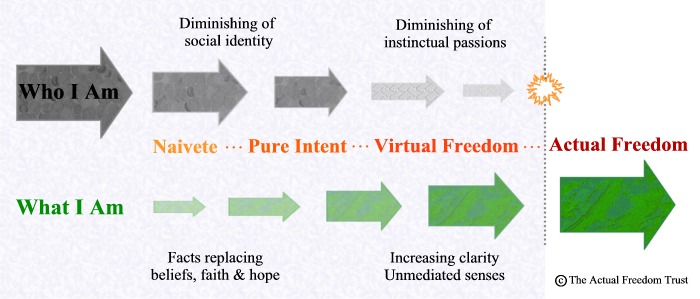
PAUL LOWE: All we have is this moment – unconditionally. <Snip> Life is about expanding our consciousness and maturing through experience. There is no particular direction to this, because each of us is totally different, unique. PETER: ‘Unconditionally’ means to accept the Human Condition as-it-is – in other words, that human beings are meant to suffer and fight for it is part of the overall game plan of ‘the source’. To unconditionally accept the Human Condition as-it-is, is to deny the possibility that flesh-and-blood human beings can ever be free of malice and sorrow. ‘It is the way it is because that’s the way it is and that’s the way it’s always been, so that’s the way it always will be’ – sad indictment of human existence on this paradisiacal planet. As for ‘there is no particular direction’ to this ‘expanding our consciousness’, the direction has been well mapped for thousands of years and nothing different or unique has resulted. A God-man is a God-man, a religion is a religion, and the fights and feuds that go on between them are legendary and on-going. Nothing different, nothing unique, more of the same ... and nothing changed. PAUL LOWE: Ask yourself ‘What am I doing and what am I doing it for?’ This is not the esoteric, ‘Who am I?’ It is a more practical, ‘Who am I in this moment. What is life about for me right now?’ PETER: The difference between the esoteric ‘Who am I?’ and the more practical ‘Who am I in this moment?’ totally escapes me. An Actualist asks the question ‘What am I?’ in order to find a practical, down-to-earth answer. Asking the spiritual question ‘Who am I?’ has always, and can only, lead to one answer – ‘I am God’. Asking the question ‘Who am I in this moment’ leads to such inanities as ‘I am watching my ‘self’ be angry but it is not me being angry – it is only anger happening’. One begins to create a second entity – a ‘me’ who watches an ‘I’ being angry and who then begins to disassociate and disconnect from the bad or negative feelings, emotions and passions. An Actualist remains firmly rooted in the facts that there are only two things in operation in this moment of being alive. There is the actual, physical flesh and blood body me – what I am – inside of which dwells a parasitical entity – the ‘me’ who I think and feel I am. By asking the question ‘How am I experiencing this moment of being alive?’ one has the opportunity to discover and investigate, and incrementally eliminate, the alien entity who is causing me, the flesh and blood body, to feel sad, feel lonely, act violently, be cunning, be malicious, say something spiteful, feel resentful, etc. etc. These feelings, emotions and passions are real in that they are ruining my happiness and causing me to be harmful to my fellow human beings. It’s a simple business, nothing complicated. There is a ‘what’ I am and there is a ‘who’ I am. No need to get your pronouns in a twist and no sense in
continuing on with the spiritual deviousness of creating a third ‘I’ as the watcher. There is a cute little
* PAUL LOWE: Somewhere inside ourselves we are all looking to let go, to finish with the unpleasant past. Then we can start again. Right now, you can start your life anew. PETER: The spiritual Gurus preach that human anger, violence and aggression are the result of the inevitable conditioning of one’s pure soul since birth, that anger, violence and aggression are an unchangeable part of the ‘design of this dimension’, and that one can transcend these bad feelings simply by letting them go. Put even more bluntly – ‘acceptance and the expansion produce the good feelings.’ Good feelings can then be expanded into Grand feelings and Grand feelings can expand into ... ‘Oh God, I am feeling Good’ then ‘Oh good, I am feeling God’, and for the chosen few – ‘Oh God, I am God ... oh .. Very Good!’ Of course, this is the world of institutionalized insanity – the spiritual world – and, as such, it’s so easy to poke fun of. It would all be a joke except for the fact of the appalling human suffering and misery that is enshrined and perpetuated by the God-men and their followers. Up until now the only escape from the real world has been into a world of fantasy – the spiritual world. There is, however, a third world, this actual world of purity and perfection that is inaccessible to the alien entity that dwells within the human flesh and blood body – ‘who’ you think and feel you are. The usurper, the impostor, the spoiler, the fake, the sham, the phoney, the charlatan, the fraud. So, to recap a little on what is being revealed in this review:
An Actualist is careful and accurate in the use and meaning of words. For the spiritualist the misuse and disregard of words and avoiding sensible communication is necessary in order to get away with what they do. An Actualist does not play this game for one would then only be fooling oneself – a sad state of affairs indeed. The wide and wondrous path to Actual Freedom is a search for what is genuine, sensible, down-to-earth, authentic, unadulterated, factual, verifiable and actual and, as such, involves the systematic observation, investigation and elimination of all that is false. Which is why self-immolation is the inevitable result. Good, Hey Freedom from the Human Condition – Happy and Harmless Peter’s Text ©The Actual Freedom
Trust: 1997-. All Rights Reserved.
Disclaimer |